
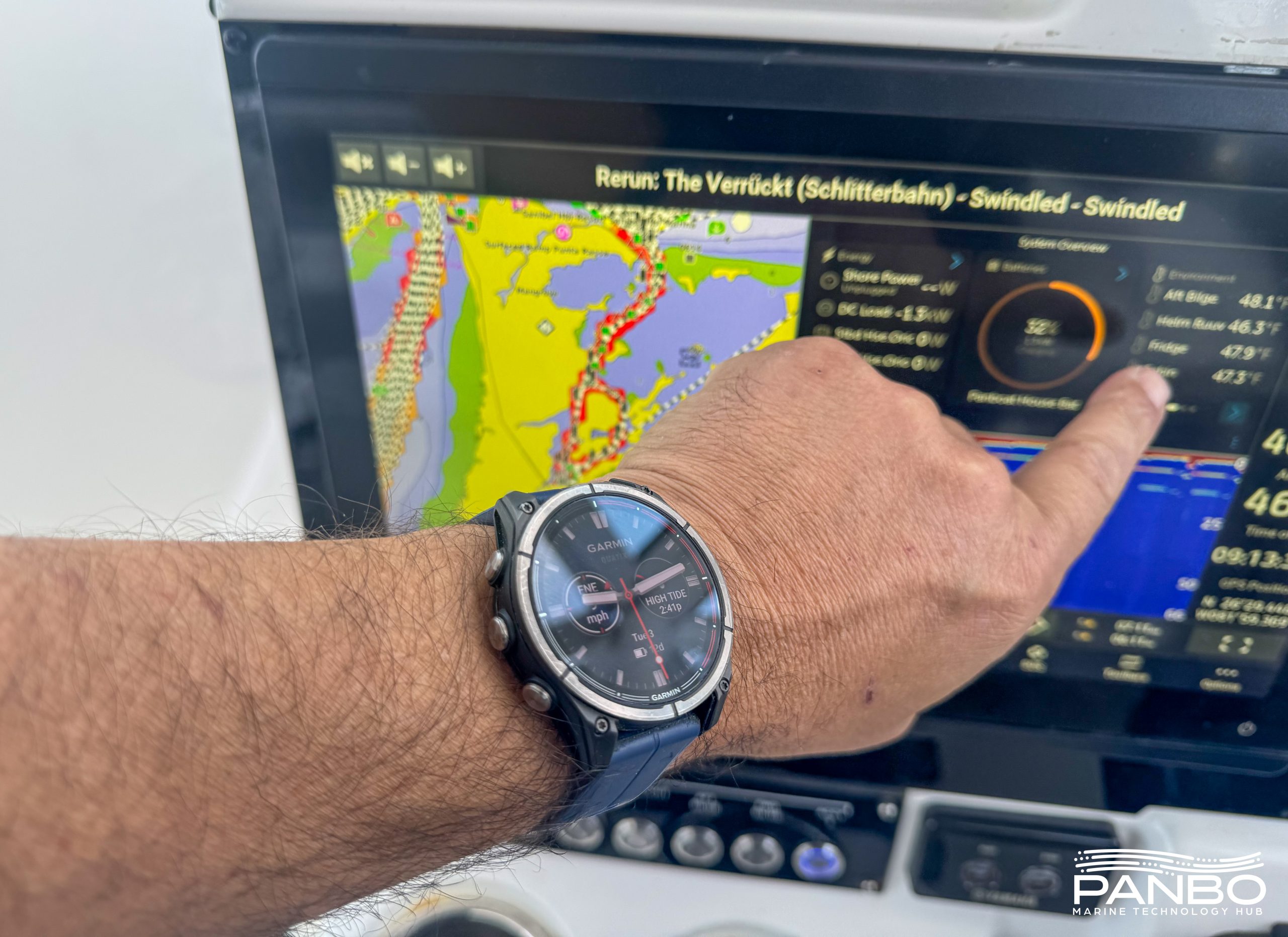
I would have posted earlier today, except that fooling with this Garmin 376C vividly reminded me (above, and bigger here) that the spell of dry, sunny weather was about to end. So I spent some hours winterizing the fleet, all the while watching the clouds thicken up from below and above. I could also see an animation of all that rain moving across New York state, plus the lightning strikes, the frontal lines, pressure gradients, wind predictions, buoy reports, etc. etc. It is phenomenal how well you can see all this info on the 376’s little screen. The display itself is exceptionally bright and detailed, and Garmin has also done a good job at letting you view the weather data mixed together or one element at a time. And, get this, I was also listening to XM radio (below). I’ve been trying the 376C intermittently over the last month or so, and am very, very impressed. It really makes sense in terms of carrying your XM weather and audio subscriptions with you on land or sea. The only con I can think of is that BlueCharts have gotten pretty expensive relative to the competition, but maybe that will change.
The Garmin 276C was one of my 5 Sail magazine “editor’s picks” for innovative, important marine electronics introduced last year. I’m working on my 2005 picks right now, and the 376C is definitely a contender. If you have suggestions for other hardware or software that should be on the list, please let me know.
I’ve been trying this Navman M300, the marine model in a new line of small GPS “Sport Tools” designed to strap to your arm while you windsurf, skate, ski, run, or walk. It delivers speed, heading, distance covered, lap times, etc., but not position or “go to” guidance. And it will not interface to a PC for data collection or waypoint passing. Both interface and tightly defined purpose are KISS (keep it simple, stupid) ideas, largely I’m guessing to differentiate the Tools from the various Garmin Foretrex and Forerunner models that dominate this niche. There are only two buttons and about six choices for the text screen (which is small but readable in all daylight conditions). The firmware for some models seems to have especially valuable features—like the way the ski model leaves the lift segments out of your speed averages and distances—but personally this marine model doesn’t excite me (learning how Richard Stephens uses his Foretrex did, but that’s me). I’m also dubious that “reliably water resistant” is good enough for wind surfers; I know that when I used to do it I’d spend a good deal of the time thrashing about while submerged up to my chin! Then again I would like to know how blindingly fast I was going when I had it together. By the way, the 19 knots max speed above was on my bike, going down a steep hill. I need to exercise more.
Update, 9/2: My doubts abut the windsurfing model may be off base. I’ve now learned that they were used successfully for the Maui Speed Challenge (yes, Navman was a sponsor, but these are the top guys and wouldn’t tolerate a product that didn’t work well).
Given that it’s notoriously hard to photograph a video screen, this is a fair image (bigger here) of what I was seeing yesterday in about 20’ of water using Splashcam’s Deep Blue camera. Plus I should note that Camden Harbor is a bit murky due to the river that dumps into it (and maybe some other dumping, like aboard visiting yachts). I could actually see that lobster trap somewhat better than the photo shows, and when I aimed straight down (with the camera surfaced, via a simple adjustment strap) starfish, shells and annoyed crabs were very sharp and colorful...and fun to see for the first time since I gave up diving. It was also simple as pie to hook Deep Blue to the Raymarine E120, which can handle 4 cameras. As you can see, you can even name the video inputs (as I’ve done with an interesting aft facing camera I’ll write about soon). Plus there are a lot of picture adjustments behind that “presentation” soft key. But dangling electronics in salt water is hard service. Deep Blue seems very well thought out and built, but the double O rings on one of its lights apparently failed in 50’, and the innards don’t look very happy today. In fact, it’s hard to blame on Splashcam as the design uses Pelican MityLite xenon flashlights rated to 250’, which seems like a smart idea (and Pelican offers a “forever” replacement policy). Another camera I took out didn’t work at all, but that’s another story.
This Friday’s gizmo is the big kahuna of all the portable power packs that can typically jump start a car (or boat), run 12v gadgets, inflate a tire, and more. Xantrex’s top-of-the-line 400R also includes a 400 watt inverter, an emergency light, and an AM/FM radio with alarm! Inside is a replaceable 20 amp hour AGM battery which seems to have guts (and contributes to a total unit weight of nearly 30 pounds). In my experience, the 400R powered quite a bit of reciprocal sanding, and then smartly alarmed and eventually cut out when the battery went too low, or if I bore down too hard. That’s a digital watt meter showing in the picture (bigger here); when the inverter is turned off, it can show percentage of charge. This thing is obviously designed for emergency backup during hurricanes and the like, but I found it darn useful around my little back field boat yard, and it might have a place on some cruising boats. It’s fairly well made, certainly better than other jump start packs I’ve had. Xantrex’s page on the 400R is here, and a fellow named Jack has written a lengthy and careful review here (he’s right that it takes a long time to recharge, but I thought the radio performed OK, at least a low volume).
I’m a little concerned that readers who ordered the nifty Bridgenorth Bailer I touted a couple of weeks ago may not have gotten prompt service from the site listed. It turns out that boathookbailer.com is actually a U.S. distributer (there’s good news in this: the deal does include free shipping in the U.S.). At any rate, if you have any problems, here’s the Canadian manufacturer’s site, bridgenorthbailer.com, which is still somewhat under construction but has solid e-mail and toll free phone info, plus more dope on the product (including the compelling photo illustration above).
Big power outage here earlier this morning…coffee bean grinder no grind, DSL modem no blink…I’m definitely off my stride. I’m declaring this an OFI Friday, and will soon be off to fool with the fleet. If you’re stuck inside somewhere, you might want to picture yourself strolling down a dock with this Flintstone tablet PC in hand (for full effect, include the GSM whip antenna not screwed onto this prototype). I saw it displayed at a show once, and the developer’s site is still up, but I’ve never seen one in the field. In my fantasy, the case is carbon black and the boat I’m strolling toward is the Wally 118. Oh yeah.
Friday bonus gizmo: you can lock the two part handle open to get a sturdy 5’ boat hook, or you can apply some pump action and suck the last drop out a bilge or dinghy. The fluid stays in the handle until you pump again, so the thing can also be used as a ‘manual’ power washer, or a wicked squirt gun. Or to test the CFR/NEMA rating on your electronics (there, topic maintained). It works like a champ and is so darn well made that I’m worried the inventor isn’t asking enough money for it. He sells them for $44 at Bridgenorth Bailer with free shipping (maybe only in Canada, the site isn’t clear). Have a good weekend!
Rugged waterproof build, 3 levels of LED light going all the way from “holy cow” bright to 28 hours on 3 AAAs dim, this Friday’s gadget is the best boat headlamp I’ve had my mitts on. Plus the accessory red gizmo adds backup or can protect your night vision. The $39 EOS and $10 Pilot are also good examples of the amazingly detailed product reviews some outdoor folks are putting on the Web, like here, here, and here. So I shall say no more. Have a great weekend.
Navagear found a solid state bilge pump switch that can discriminate between fuel/oil and water, so presumably you will not pump the bad stuff overboard. I’m just a wee bit skeptical about how well this works in the real world. What if there is just a little oil swirling around your bilge; might the switch shut down when you didn’t really want it to? A while back I tested SensaSwitch (above), another solid state “float” switch that I liked a lot. It does not claim to “discriminate” against hydrocarbons but one reader wrote in claiming that oil films made it stick on or off, which of course is what no-moving-part switches are supposed to avoid (my test didn’t include oil!). The company tried to investigate the claim but the guy said he’d thrown the switch away, and his email went dead, so this report is very much hearsay. Does anyone out there have either SensaSwitch or Water Smart Switch installed in their boat?
Eli, proprietor of the often stimulating EliBoat, knows Maine waters and yesterday wondered “if the new charting programs will ever find a way to plot 6 trillion lobster pots.” His number is only a slight exaggeration; the pot buoys and their warps really are a navigation problem. Eli jests but I do hear talk of AIS transponders replacing RACON buoys at harbor entrances and maybe someday the tiny RFID radios supposedly coming to everything in Walmart will warn a boater of a dead on buoy about to tangle his prop. But in the meantime a sharp blade can do what electronics can’t. I tried this Hook Knife from Sailors Solutions last summer and it is wickedly effective.