Damn! An AT&T 3G smart phone that can use the world's largest commercial satellite for voice and data if you roam beyond cell range, no oddball second phone number, no dorky antenna? The big bird is up, the Genus phone is at the FCC, and the whole deal seems on track to be real in early 2010. But will it be a big deal for boaters? That may depend on what system developer TerreStar means by "offshore coastal waters"...
I consider this fairly big news. Not only does the GX2100 combine full featured Class D VHF with a true dual AIS receiver in one box with a fairly big screen, and include most all of the nice added features the pairing can support, but it does it all for $400 MAP (minimum advertised price). That's a lot of features per gear dollar, and I'm going to list most of them because they're not online elsewhere yet:
I previewed this on my Ft. Lauderdale Twitter feed (did that thing work for anyone?), and I remain enthusiastic. HUG stands for Hybrid Universal Guardian, which is quite a mouthful, but then again this puppy can do a lot for a boater...
One of the most interesting meetings I had in Fort Lauderdale was with Patrick Shay, who fairly recently took the reins of Iridium's data division (after much related experience at Motorola and Sirius, and a lot of boating). His message was clear: Iridium has realized that data is important, in fact the fastest growing part of its business, and wants to see its SBD modems "disappear into as many marine devices as possible!" Coming soon is a new version of the 9601 modem above, which will be smaller and cheaper but still able to transmit a 340 byte message from anywhere on the globe in less than 60 seconds with very high reliability. It can also quickly receive a 270 byte burst from anywhere via the Iridium ground stations, and it's that two-way nature that suggests so many interesting possibilities...
Visions of Johanna is now on the coast of Ecuador, the vast Pacific beckoning. As discussed recently, Gram Schweikert has set the sloop up to test and compare the new compact satellite voice/Internet systems from Iridium and KVH/Inmarsat. Above he's geek goofing with the KVH IP Phone and a Uniden waterproof portable which
can access four lines -- Skype, cell, Inmarsat FB150, and Iridium OpenPort. But he's sure been doing his homework. What follows is the longest Panbo entry ever, in which the good Gram details the hardware, the installation, the costs, first impressions of performance, and plans for future testing...
Anyone with an interest in cutting edge satellite communications should get excited about this photo. You're seeing the 62' sloop Visions of Johanna (VOJ) almost all set to compare Iridium OpenPort and KVH Inmarsat FB150 systems in real blue water conditions. When Bill Strassberg and Gram Schweikert began finalizing plans for The Big Trip from Maine to New Zealand and back, they wanted a voice and Internet system more reliable than the Globalstar set up they've used for years, and more powerful than the Iridium handset service I brought along on our Bermuda to Maine passage. They decided to purchase the OpenPort system themselves, but knowing how able and fair Gram is as an electronics tester, I helped introduce him to KVH, who kindly loaned VOJ the TracPhone 150 above. Gram just finished the FB install in Panama, where they're about to transit the canal, and he plans to write up a series of short- and long-term tests as they cruise the Pacific. You'll read all about the project here and hopefully in longer articles for Yachting and Cruising World. In fact, here's Gram setting the scene:
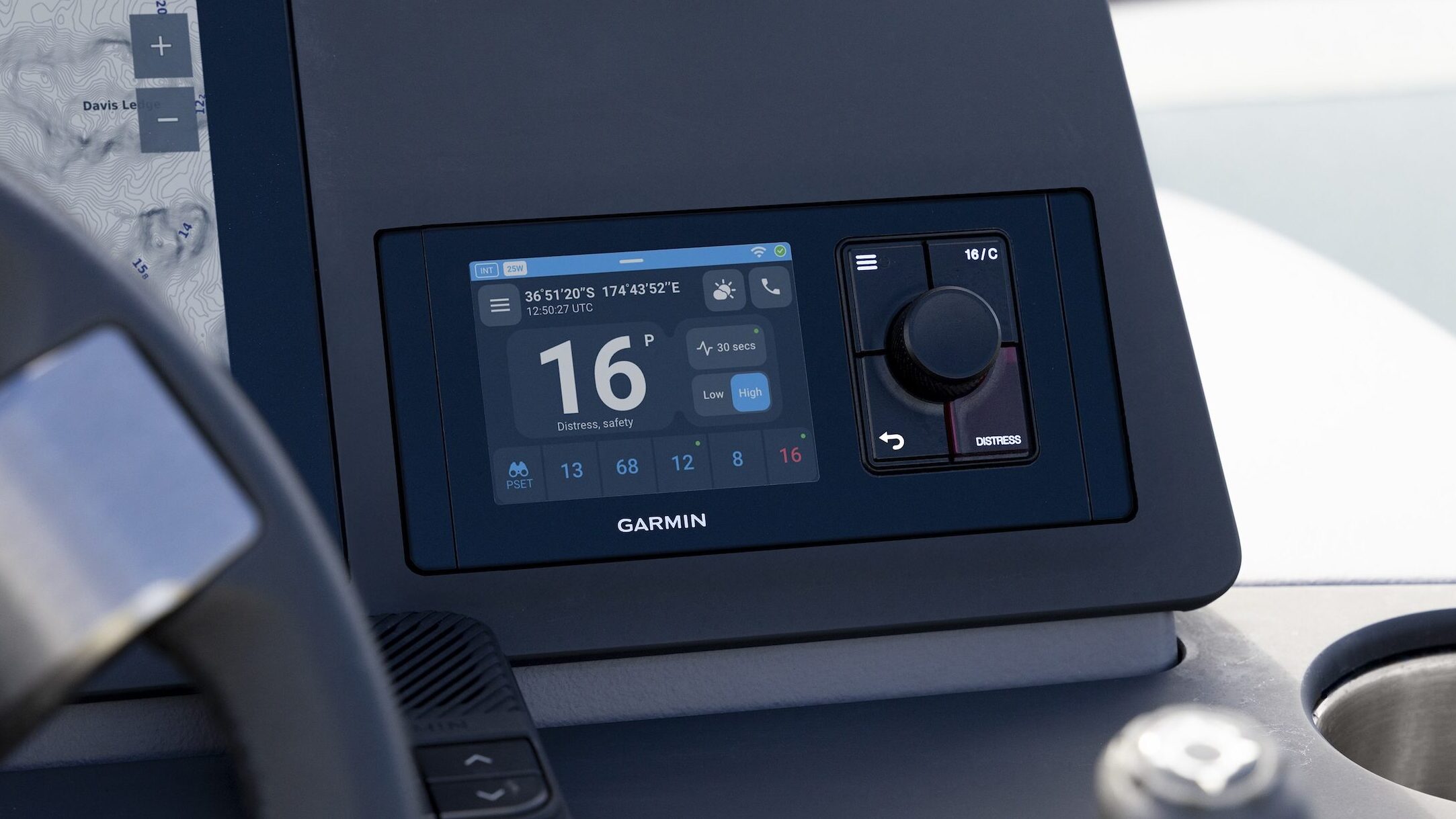
It took a while, but the premium Garmin VHF 200 is now a reality, and it's a corker. I installed a sample on Gizmo yesterday and spent a fair bit of the day listening to it and trying out DSC features. As Bill Lentz noted in a recent comment, the 200 is a snap to hook up using NMEA 2000, instantly getting GPS off the backbone and delivering DSC call info to any device that knows what to do with it (unfortunately few so far). It also seems to have a sensitive receiver and a nice way of pausing enough in scan mode that you'll often hear both sides of a conversation. But he didn't get into how well the soft key scan (and other) menus work...
Here's Bill Boudreau of Cobra Electronics showing off the two new floating 6 watt handheld VHFs the company announced earlier this week. The higher end model, the MR HH475, includes the Rewind-Say-Again audio recording feature I liked a lot in the original HH425 and the fixed F80. Plus this handset can also double as a Bluetooth handset for your cell phone, much like Cobra's dedicated MR F300 Bluetooth speaker mic. It doesn't have some of the mic's features, like a built-in address book, but it does have the PTT/VOX choice and the noise cancellation that tested so well in my lab. But what if someone hails you on VHF while you're chatting on your phone?
Garmin announced a slew of new products yesterday, the most innovative of which is probably the black box VHF 300 AIS. I think that this is not only the first combination VHF radio and AIS receiver (aside from the mod Icom UK apparently came up with), but also the first AIS receiver with NMEA 2000 output. While there are a couple of issues with N2K AIS target messages right now, I'm confidant they'll be fixed soon, and this will become the way to go. For instance, a Garmin plotter should
easily be able to "direct dial" AIS targets, buddies included, using
N2K. But that's not all to like about this radio...
So now that I have a real yacht, and hope to take her foreign one day, it seemed proper to get an official FCC Ship Station License. And better sooner than later since it includes an official FCC MMSI number, and the FCC will not let anyone transfer MMSI numbers already gotten (very easily) from BoatUS or SeaTow, etc. (despite endless petitions by various boating and safety organizations. And VHF/SSB/AIS devices can not have their MMSI changed without considerable trouble. Plus, getting an official FCC MMSI (with a zero at the end) means I can create a legitimate Group MMSI number, and experiment with that interesting but woefully under used DSC feature. So off I went to the official FCC ship licensing site (above), and into the pits of web form hell...