Interesting that an intrepid Boston Globe reporter figured out that AIS transponders might have prevented two Boston ferries from hitting each other in thick fog yesterday morning. This is the sort of thing that promotes public awareness of a valuable safety technology, and perhaps will encourage the FCC, USCG, etc. to move expeditiously on approving Class B and mandating its use on such vessels (or argue that Class A is worth the cost). On the other hand, operator error can not be ignored. Heck, these two boats both work for the MBTA. Wouldn’t you think that they’d know where each other was and be in VHF contact? Not that we all aren’t capable of mistakes. I’ve often thought that running ferries must be a particularly hard gig as the tendency to get lax must be major. (Thanks for the head’s up to Doran, who can, on a good day, float you over bustling Boston Harbor.)
Big thanks to John G. for a head’s up about the MAIB’s recent report called “Performance Investigation of Marine Radar Reflectors on the Market.” The full PDF is available on this page, along with a typically MAIB meticulous report on the tragic sinking that prompted it. Three sailors died after the big ferry Pride of Balboa apparently ran down the 26' yacht Ouzo early one morning near the Isle of Wight. At any rate, the graph above plots the average Radar Cross Sections of most available reflectors. You won't like those results once you understand them. The testers concluded that only the Sea-Me active reflector delivers a strong enough radar return to even meet the ISO 8729 standard, and some perform so poorly that they aren't worth carrying because they'll only give skippers a false sense of security! None of this real news; in fact I discussed similar findings here almost two years ago. But it's a good idea to be reminded that even good passive radar reflectors have limited abilities. Plus I was surprised that the MAIB didn't mention Class B AIS in their recommendations about collision avoidance. Did I miss something?
That’s the Coast Guard cutter Liberty off loading some 130 (of 250) passengers from Empress of the North after she supposedly hit Hanus Rock in Alaska’s Icy Strait at 2am this morning. I’m certainly not qualified to blame others for nav mistakes, but apparently this vessel has quite a history of groundings, and Hanus Rock looks like it’s well marked and has lots of room around it. (If I have the right spot; I haven’t seen a map of the accident yet, but did find this Hanus Reef at the south end of Icy Strait.) It will be interesting to see the accident report.
PS 5/15: Soundings just put up a Web “Channel” covering multiple USCG rescue operations off North Carolina last week.
This weekend a Panbo reader emailed me thusly: “How about an in-depth look at the electronics and friggin' AIS on that cruise ship that grounded then sank???” Well, I wish I could find the details of what electronic aids were available on that now sunken bridge, but I have little doubt about the accident’s cause. Incompetence trumps electronics every time! While I generally sympathize with a skipper who screws up—one result of my own numerous navigation errors—there are indications that this was an accident about to happen. One is that the Captain blamed strong currents for the grounding. As if set and drift shouldn’t have been toward the very top of his worry list, a critical factor to be on aware of, using electronics or older means. Then read down the same article to see how Sea Diamond’s operating company already had two serious accidents in the last year. Incompetence often flows from the top. At any rate, the news reports about this tragic sinking will surely get more detailed. For instance, I can’t yet find a map of just where it happened, so I looked up Santorini, Greece, in Google Earth. While there are numerous interesting POI entries about the island, no user has yet geo-located the wreck. But I wouldn’t be surprised to see that soon, GE being the global community map it’s become (more on that later).
In Maine speak, that low pressure system which blasted through here last night was a “corker”, leaving at least 10” of snow which has a gluey consistency unfriendly to snow blowers and plows. Panbo world headquarters is still digging out! Now, of possibly greater interest, that screen above is from a new and quite nicely done weather program called UGRIB. It lets you download and display forecasts for any section of earth as generated by NOAA’s “global numerical weather prediction model.” And it’s all for free, thanks to the folks at GRIB.US. You only get wind, pressure, and precipitation—and, of course, you can find far richer weather data on the Web—but one beauty of GRIB files is their compactness if your data pipe is limited…like, say, a sat phone out in the ocean. GRIB numerical data can also be animated, as UGRIB does, and used by routing programs. Meanwhile, back here in Maine, a 40’ scallop boat sank Tuesday night as it tried to return home ahead of this storm. The crew is fine, apparently because they were well equipped with EPIRBs, survival suits, etc. The Luke & Jodi even had some sort of transponder such that the owner could track it from home, though that let to some confusion. At any rate, the crew did everything right according to the Coast Guard, except perhaps deciding to supply the liferaft with a case of beer and bottle of vodka “to keep them occupied while they waited to be rescued.” That led to problems (and more detail here).
That’s a 35’ Viking, ironically named “Lit Up”, as it became “the world's largest flare gun” off Mayport, Florida, on Feb. 10. All six crew survived just fine, thanks to good planning and gear. Doug Ritter, of the always valuable Equipped.org site, first made me aware of this accident, and the picture comes from a thorough article at Jacksonville.com.
There’s no question that some boaters out there, even pros, are misusing electronics, which is why we have terms like “radar assisted collisions” and more recently “computer assisted groundings” spoken only half in jest. Now the January issue of Seaworthy magazine identifies a whole category of marine accidents they’re calling Electronically Aided Collisions or EACs. Seaworthy, aka “The BoatU.S. Marine Insurance and Damage Avoidance Report” is a terrific publication, I think. Using the vast boots-on-the-ground research conducted by BoatU.S. adjusters, the editors present the real hazards of our past time in a calm, useful manner. They have a sense of humor too, for instance titling a sidebar on a mast accident “It’s not the falling that hurts, it’s the stopping,” and including this quote in the EAC feature:
“My wife used to refer to the boat’s nav system as my $10,000 video game. After I bent both props and rudders on some rocks while I was showing her how the system worked, she started calling it my $20,000 video game.”
I think of this painting—one of an ancient series hanging in the Venice, Italy, Maritime Museum (and bigger here)—as a how-to for sailors caught out in a storm: Put out all your anchors, jettison heavy objects (like cannons), pray to your personal savior, and hope for the best! Here in Maine we’re trying not to get upset about the freakish fact that the ground hasn’t frozen yet (and I’m thankful that we live some 180’ above sea level). But I trust that whatever happens is all in God’s plan, and I wish you all a very fine Christmas, or Chrismakka as we call it in our home, or however you honor this grand turning of the seasons.
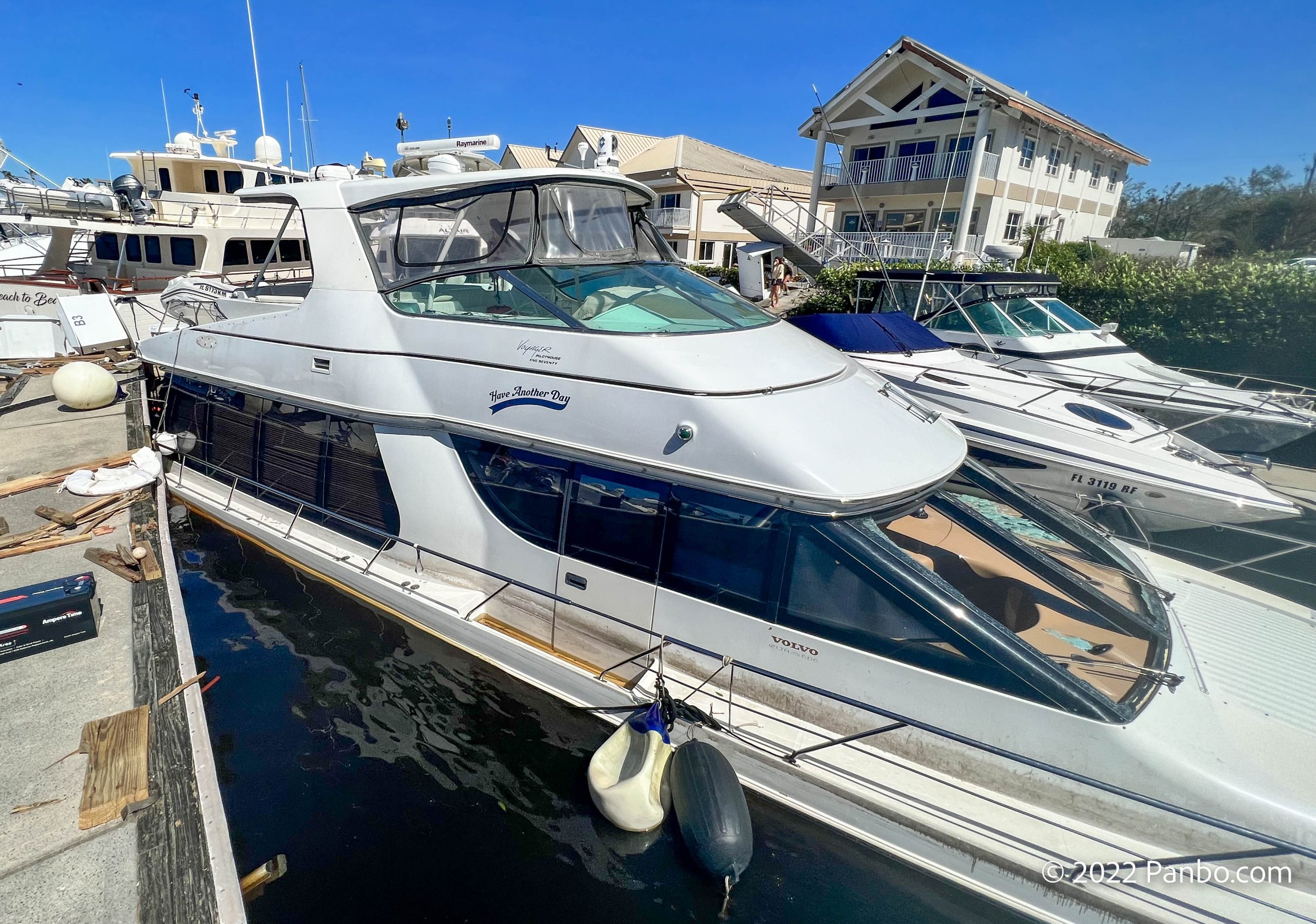
I spent the winter of 1972 living in New Orleans and working on oil field supply boats, acquiring a huge fondness for the former (not so much the latter). But I haven’t been back until this week, and naturally was very curious about how well this wonderful city is recovering from Hurricane Katrina. Well, of course it depends a lot on who you talk to, and where you aim your camera. The shot above, bigger here, shows some wrecks still lingering in the same Lake Ponchartrain marina we saw in before-and-after satellite shots back in 2005. Even right there on the spot it’s hard to imagine the ferocious weather conditions that could break off one boat’s keel on a dock, impale another with a piling. But you can see that the nifty boathouse/apartments in the background are getting rebuilt, and a turn in either direction would show many new or fully refurbished boats and docks. The “we will survive” spirit particularly showed at the Southern Yacht Club—going full steam in temporary buildings under a resurrected flag mast, brand new club house and facilities in the works.
And the Big Easy is still very much a paradise of spirited music and food. Even an oyster po’boy from the Convention Center commissary was a total treat. The French Quarter’s Bourbon Street may have gotten more touristy and debauched in the years I’ve been away, but there’s a certain evolved brilliance there. It’s closed to traffic now, and dozens of clubs compete for your attention with various entertainments, drink deals, etc. However, there are no cover charges or waiting lines; you’re free to wander in and out of most any of them, even nursing a large take-out beer, like it’s all one huge club. Laissez les bon temps roulez, and go enjoy New Orleans when you can.
Big trouble in the Southern Ocean, but the electronics work
Nov 24, 2006
While doing 18 knots 1,000 miles south of Cape Town yesterday, Alex Thomson’s Hugo Boss experienced canting keel failure, nearly capsizing. At the crack of dawn this morning another racer, Mike Golding, pulled off a remarkable single-handed rescue, then hours later, lost his own mast! Despite all this, both skippers seem to be in regular sattellite phone contact. The story is unfolding here.
A Panbo reader (thanks, Mark!) alerted me to yesterday’s collision on the Mississippi, in which the 712’ Greek freighter Zagora, coming down river with a load of soy beans, apparently T-boned the anchored 737’ Panamanian freighter Torm Anholt. Mark wrote, “It is amazing that yet again two ships of this size are able to hit each other. And to think one of them was anchored. How is it that small vessels are not plowed under more frequently? Looking forward to class B AIS transponders.” I’m looking forward to Class B too, but we should all be very careful not to over estimate its value. Interestingly, another Panbo reader (thanks, Kurt!) linked me to a page of presentations given at the recent AIS/06 conference. There’s a lot of interesting material there, which I’ve only skipped through, but of particular note is the first day presentation by Dr. Andy Norris. One of his conclusions is that “Class B users must not assume that their AIS signal will be visible on any ship.” More on Dr. Norris’s work to come. And some day the National Transportation Safety Board will issue a report on the Zagora/Torm Anholt collision. NTSB reports don’t seem quite as detailed as the MAIB work I’ve referenced before, but it will be interesting to see what happened on the big River yesterday afternoon.
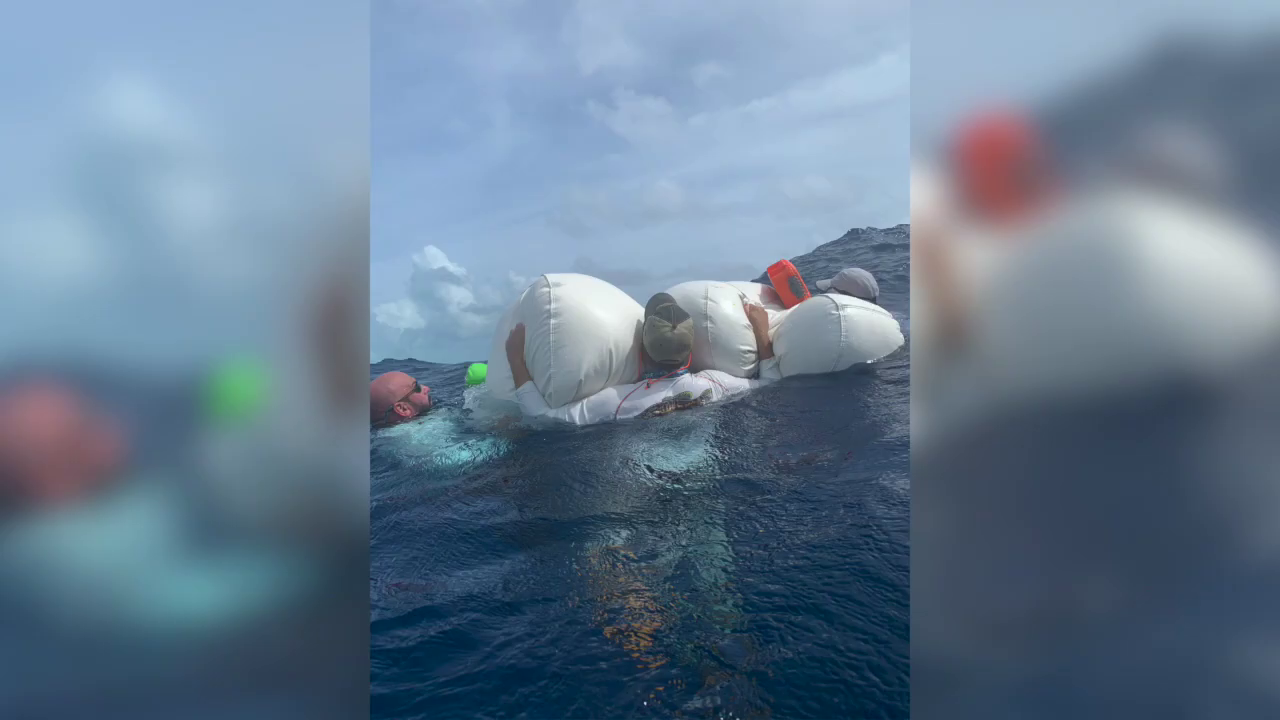
Whereas we seem to have reached consensus that Iridium does not suffice as an EPIRB, it seems appropriate to post this intimate photo of a man apparently in love with his EPIRB. No wonder. At 7:30am on 7/25/06, Captain Nick Barran’s 40’ racing sloop was holed by a whale 415 miles north of Hawaii. He and his crew had about an hour to gather their stuff, inflate their life raft, and watch Mureadrittas XL vanish into the deep Pacific. They took pictures, too, and most sites published dramatic images of decks awash and a hand about to slice the raft’s tether. Me, I like the shot of Barran, probably very shook, laying back in the raft next to his faithful ACR RapidFix. The thing, and the whole COSPAS-SARSAT system, worked like a charm and this well equipped crew was aboard the container vessel Maersk Darwin before the sun set. ACR lays out the story here, and also has a pretty compelling advertising campaign here, but no PR person was there aboard the container ship prompting Barran to pose holding his EPIRB. I wonder when he let it out of his reach? By the way, there was also a satellite phone aboard Mureadrittas XL.
OK, it’s not exactly glamorous to drive a cargo ship full of used cars out through Germany’s Keil Canal and than across the Baltic to Lithuania, but it was this unfortunate skipper’s first command. That’s why he couldn’t rest well during the already stressful 6-on/6–off watch schedule (only two deck officers!), and possibly why he let the lookout—who was also the cook and about to be relieved the next day—go below to clean the galley for the next guy. Result? The captain fell asleep so solidly that Lerrix went a full hour past a turning mark before it went aground, even though VTS (vessel traffic service) operators were trying to warn him by radio. Yes, readers, I’ve been dipping once again into the rich archives of the U.K.”s MAIB (Marine Accident Investigation Bureau), and finding yet more dope that should make you very cautious about big ships. An interesting aspect of this particular case, detailed here, is how minimal the ship’s electronics were, though up to Brit code, and how funky the skipper’s own setup:
“Lerrix’s bridge equipment met the criteria required for the flag state {U.K.} Safety Equipment Certificate. Although compliant, the navigation equipment fit was basic, consisting of 3cm and 10cm radars, neither with an ARPA facility, an echo sounder with a paper plot, and stand alone AIS and GPS sets. During the investigation, it was noted that the master carried his own laptop computer from ship to ship, complete with a hand-held GPS. Loaded onto the laptop was a pirated programme of Transas electronic charting, which he had downloaded from the internet in 1999. The hand-held GPS, which the master had secured to the bridge console, provided the positional information for the laptop’s electronic chart (Figure 6). Examination of the programme showed that it had not been updated since 1999, and the charts on the system were based upon 1999 data. The downloaded software did not provide any of the optional operator functions, such as warnings and alarms.”
I have a great deal of respect for professional seaman, but, like the rest of us, they do screw up. Unlike the rest of us, they are driving very massive vessels. In April 2005, for instance, the container ship Lykes Voyager, en route to Vancouver at 19.5 knots had a fender bender in a foggy Taiwan Strait with another container ship, the Washington Senator, which was Hong Kong bound at 17 knots. “No one was hurt but both ships were damaged and a number of containers were lost overboard.” Imagine the sound! As usual the MAIB (the UK’s Marine Accident Investigation Branch) has produced an amazingly detailed report on just what happened, available in several PDfs. Noteworthy items as drawn from the report by Digital Ship:
* “Using the VHF radio, the master of the Washington Senator had agreed to a starboard to starboard passing arrangement with another vessel that he mistakenly thought to be the Lykes Voyager - he was, in fact, conversing with another unidentified vessel.”
* “The use of the radio as the primary method of communication for a distress call after the collision was also ineffective according to the investigation, as there was no response from any other vessels or from the search and rescue (SAR) authorities.” (They used 16, not DSC!)
* “Even though both ships in this case were fitted with AIS equipment it was not utilised for identification - if it had been the Washington Senator could have easily identified which ship it was speaking with, and the incident could have been avoided.” (Both had only MKDs to track AIS targets, which—in other words—were not integrated onto their radar or chart displays.)
We need to think about realities like these even as we get excited about Class B transponders. And thank our lucky stars that we weren’t in a small boat trying to avoid these behemoths that foggy morning off Taiwan.
Good gracious, that’s IDEC’s engine lying in the rocks beneath her destroyed hull. It must have been hairy for Francis Joyon to wake from deep sleep and get off this boat in the pitch dark. Sea & See has amazing pictures of IDEC both just before her record transatlantic passage, and just after the post-finish-line accident. I don’t fully understand how Joyon’s off course alarm works—“I was using the autopilot, and I think it must have taken her off course, as happened once or twice during the record - but I wasn't going fast enough this time to be warned of the change”—but what an extraordinary shame (and ‘nuts’ to the few cynics who think he did it for insurance!).
I’ve gotten fascinated by side scanning sonar, largely because products are coming to market that are inexpensive and easy enough to interest sport fishermen and amateur Captain Cooks. I’ll have entries on those soon, but first let’s look at what can currently be done with commercial grade side scanning, usually done with a towfish. Above is the wreck of the 291’ SS Portland, which sank off Cape Cod with great loss of life during a blizzard on Nov. 26, 1898. The image, which is not a photo, was collected with a Klein 3000 towfish (below). In the larger version, fish are obvious near the bow, which, incidentally, is actually attached to the rest of the boat (the black area is typical side scan distortion created when the gear moves along the track shown as a line). Bigger images and a fascinating description of the Portland disaster are here, and lots more scans in Klein’s gallery section.
Above is the yacht Merrimac supposedly just days after fetching up on Sable Island’s notorious “swallowing sands” in 1999. The dramatic pictures (another here) started kicking around on the Web years ago, and I first saw them referenced in a snippy e-mail bemoaning the dangers of marine electronics. “A popular theory is that the autopilot was driven by the GPS and sailed a great-circle route, which took the Merrimac to more northerly latitude than intended.” I thought it was hokum at the time and wrote, “The implication seems to be that the operator of the boat was somehow gulled by his or her gizmos. I don’t think so. If the story is true that the crew hadn’t been checking their location on a chart, then the level of incompetence was profound. And traditional navigation can be done incompetently too (believe me, I know).” Now the current issue of BoatUS’s valuable publication Seaworthy (the “Marine Insurance and Damage Avoidance Report”) tells of a witness to the grounding who says the skipper had in fact plotted his Atlantic crossing on a paper chart and was right on course; the problem was that he used a hurricane plotting sheet that omitted Sable Island! In other words, what you see is the result of traditional navigation done badly.
By the way, I went looking for the obscure site where the pictures—even a graphic of the bogus great circle theory—used to live, and it’s long gone. BUT the amazing WaybackMachine has nine versions of the page as it evolved between 1/2002 and 10/2003. What a phenomenal resource.
U.S. Navy Submarine Captain Kevin Mooney takes full responsibility for crashing the San Francisco into a practically uncharted undersea mount in the Pacific last January. Yesterday the New York Times published a detailed story about the accident, particularly the drama of trying to treat and evacuate mortally injured Petty Officer Joey Ashley. Then CBS 60 Minutes did a “Who’s to blame” piece, which I happened to see. The interviewer drew out how Mooney was using a classified, best-available Navy chart and steering a route sent from headquarters, but still the Captain—who seemed like an very decent man—insisted that he should have been going slower, should have checked other charts (where there were just hints of the mountain). Most of all, he said, “I should have been more skeptical about the chart data.”
Those are words to remember, especially as there’s a growing disconnect between our super precise electronic navigation and the precision of the underlying chart data. It’s a phenomenon I wrote about here.
Me matey Charlie Doane just returned from skippering a New England to Caribbean delivery that included its rightful share of electronics drama. One night, sailing to windward and heeled down hard, he heard the “instruments down!” call from the cockpit. His first reaction — after yelling back “cope!” — was to nose around the power supply system, a whiff of sizzling circuitry leading the way. Low and behold, down in a low locker was a 24v-12v step-down transformer immersed in a puddle of saltwater that had apparently been collecting from a slight deck/hull joint leak that was getting a prolonged dunking. Electronics breakdowns, and other problems, tend to make deliveries challenging, and it’s telling that this was a seasoned 48’ Swan, the Mercedes of production boats. She’s been in service eight years, but apparently the little leak and the low gizmo had never interacted before. Another interesting aspect to this tale is that Charlie's crew were clients of Offshore Passage Opportunities, delivering the boat to learn offshore seamanship by doing. Not only did they sail on to Bermuda without instruments, but there helped Charlie locate a functional stepper installed elsewhere on the boat and swap it out. There were more invaluable lessons, including some fuel management theater, and I'm hoping Charlie will write up the whole trip for Sail.
Yes, those two guys in a Santana 22 were damned surprised to find themselves surfing a big wave under San Francisco’s Golden Gate bridge, and no doubt the real surfer in the water was surprised to see them. What happened next is unforgettable, as are the series of photos (this included) taken by Wayne Lambright and generously served on his site (specific picture link here). Sail’s Kimball Livingston has also done a terrific writeup of the incident, including after words from the two crew, who were shaken up but not seriously injured.
Apparently Lambright’s site has almost been overpowered by umpteen Web surfers wanting to see his photos since the April 2 incident, so please be patient and also support his real work if possible. And, yes, this entry is off topic, but interesting, right?
The evidence is piling up, so to speak. Last night I spoke with a friend anchored off Key West who said he and his very able 53’ trawler were delayed there by heavy seas. Now I’m listening to a guy on CNN describing how his cruise ship honeymoon in the Bahamas got messed up (the on deck Jacuzzis got washed away, amongst other problems), and the damage done to another ship off Georgia is all over the news. “When the wave passed -- some estimates have it higher than 60 feet -- two windows on decks nine and 10 of the 15-story ship were blown out, 62 cabins sustained water damage and four people were treated for cuts and bruises aboard the ship.”
I went over to NOAA’s Ocean Prediction Center to see what happened (above), and discovered that the site now has a nice “looping” function for reviewing forecast and analysis graphics.