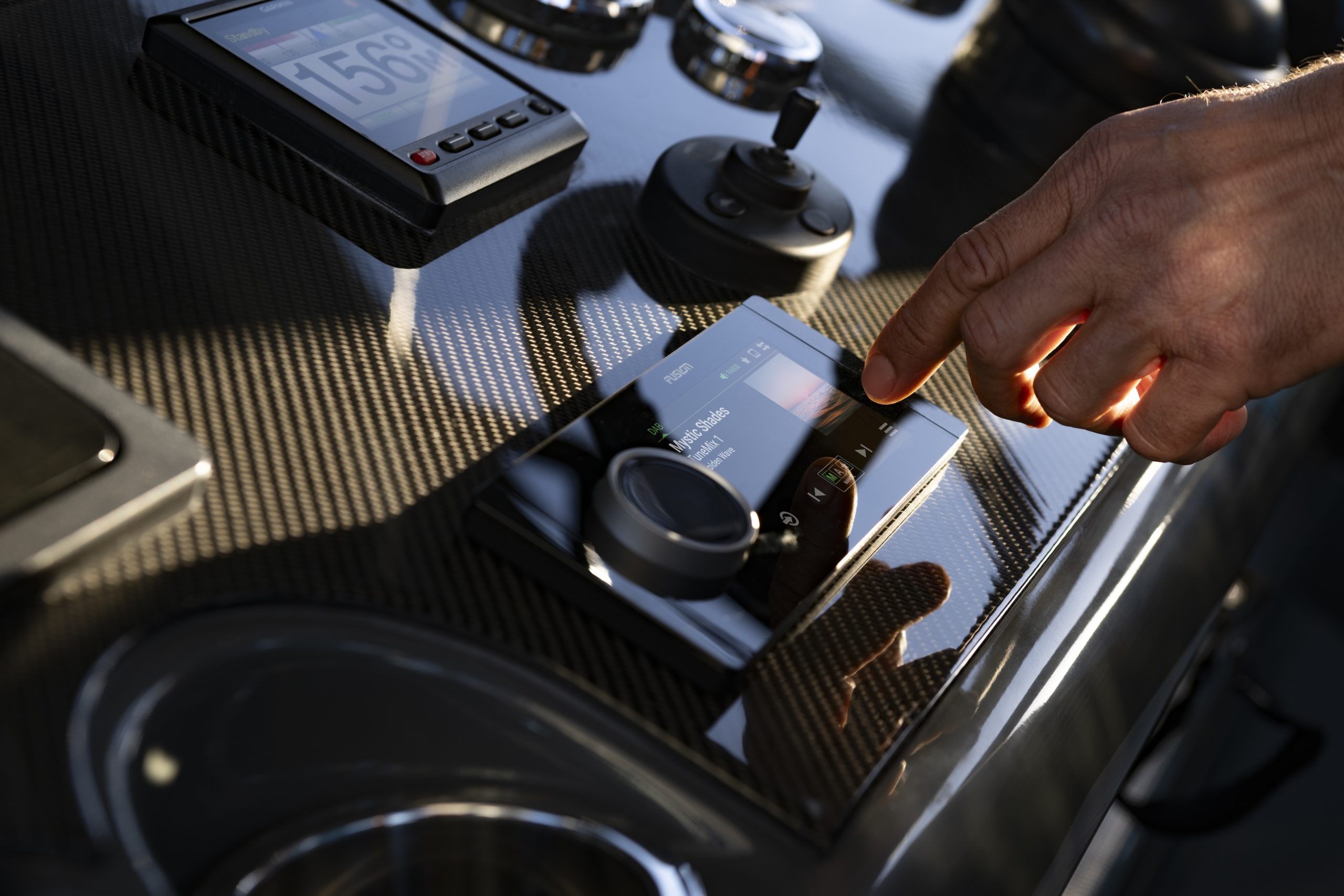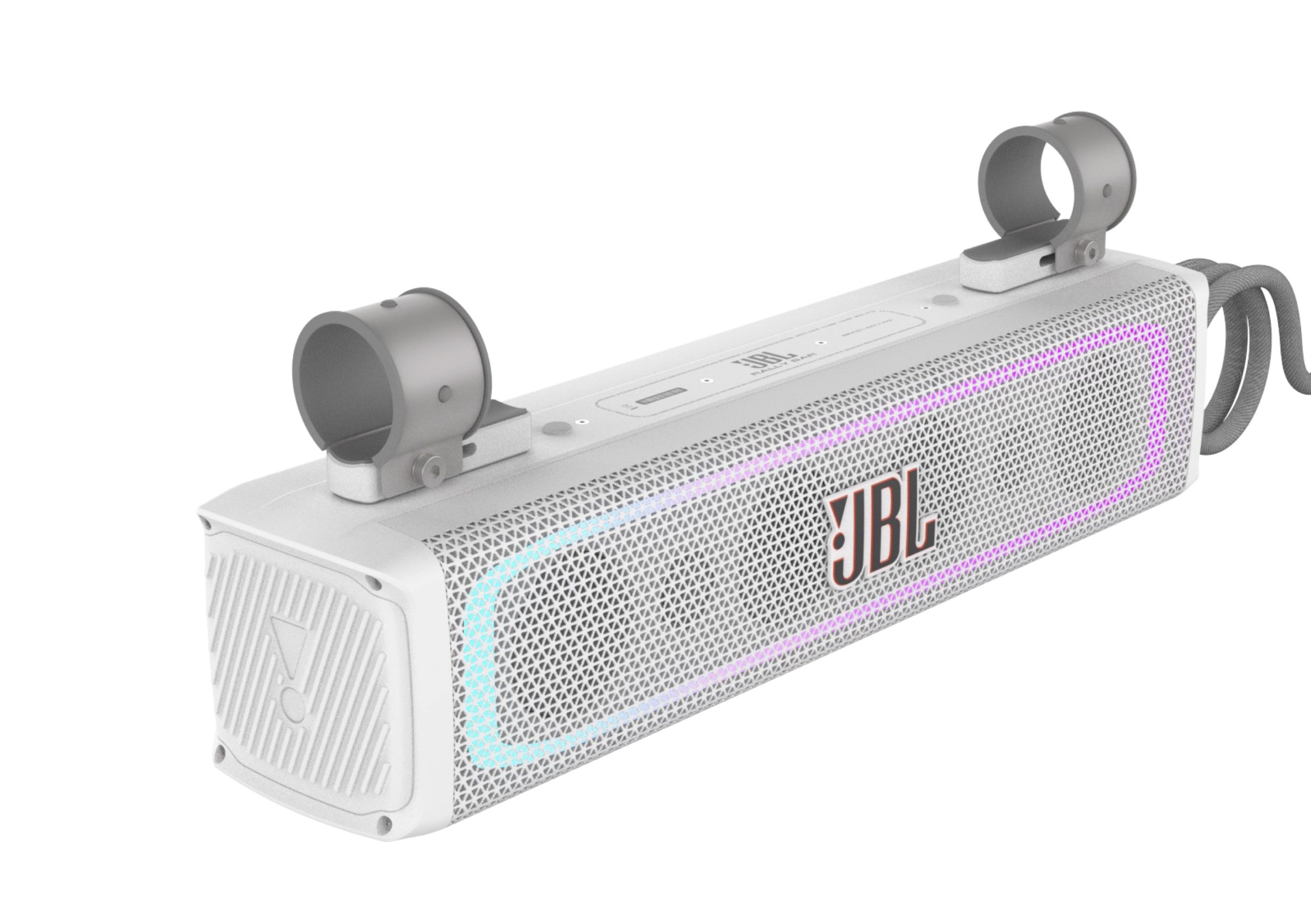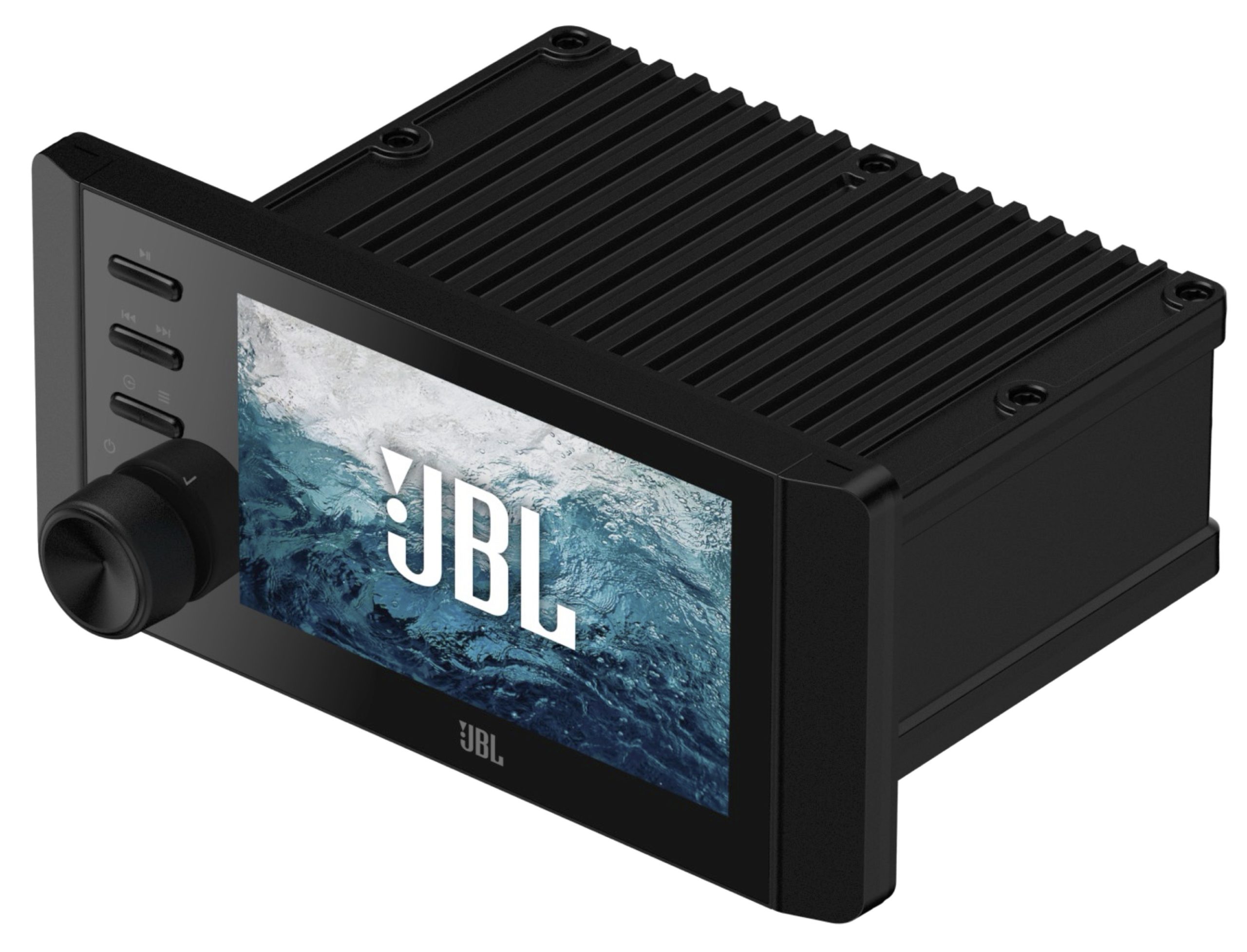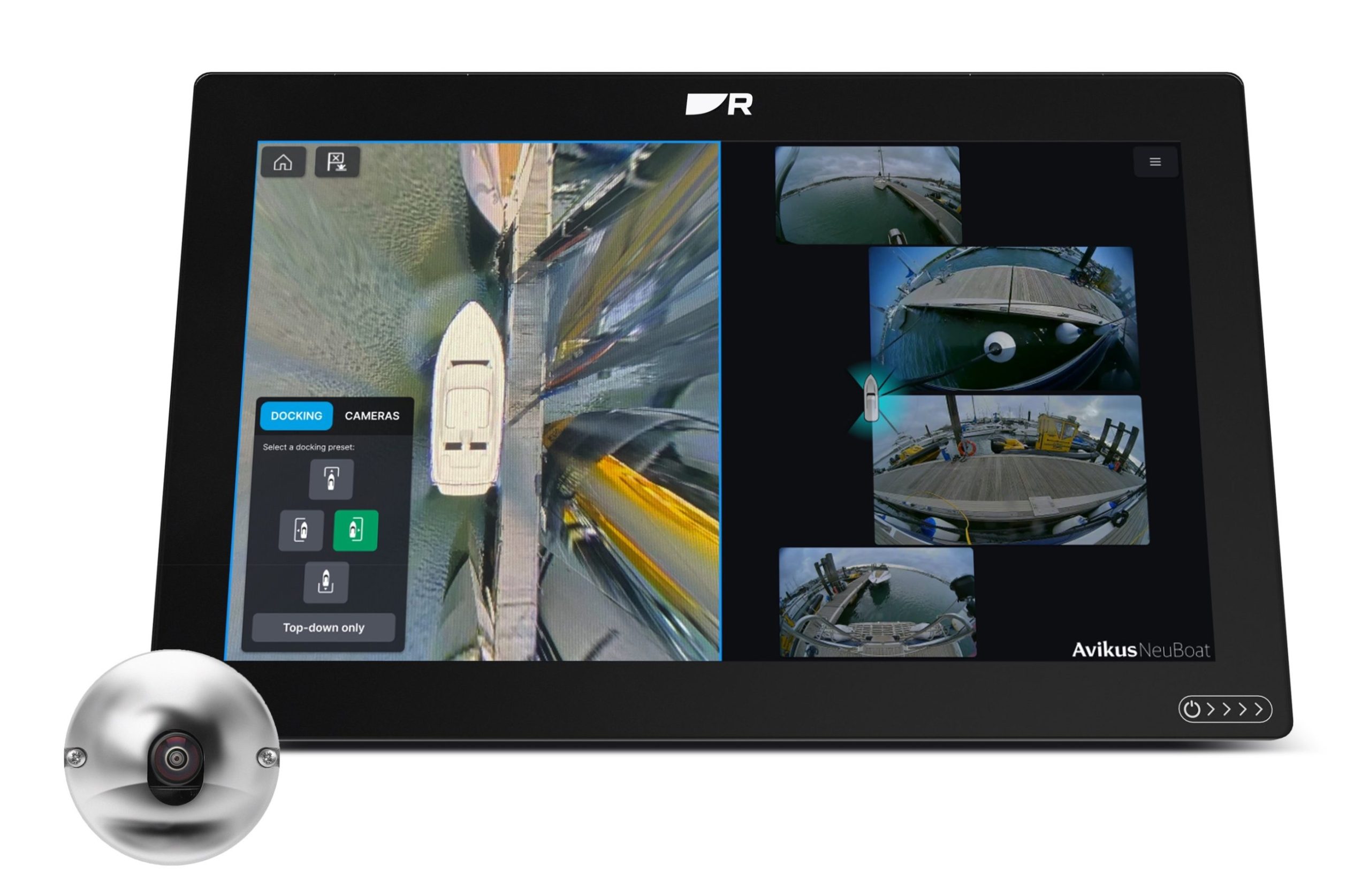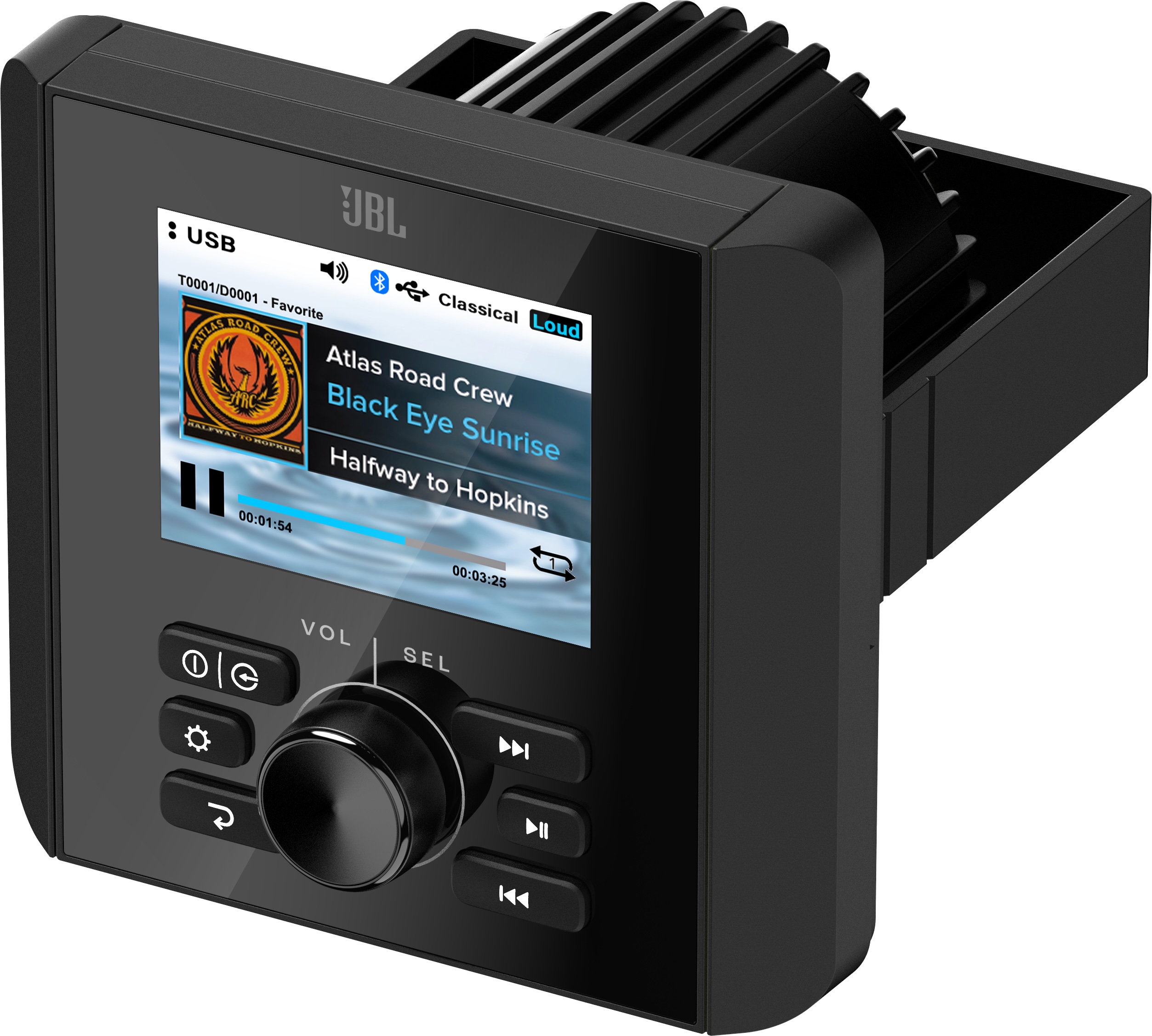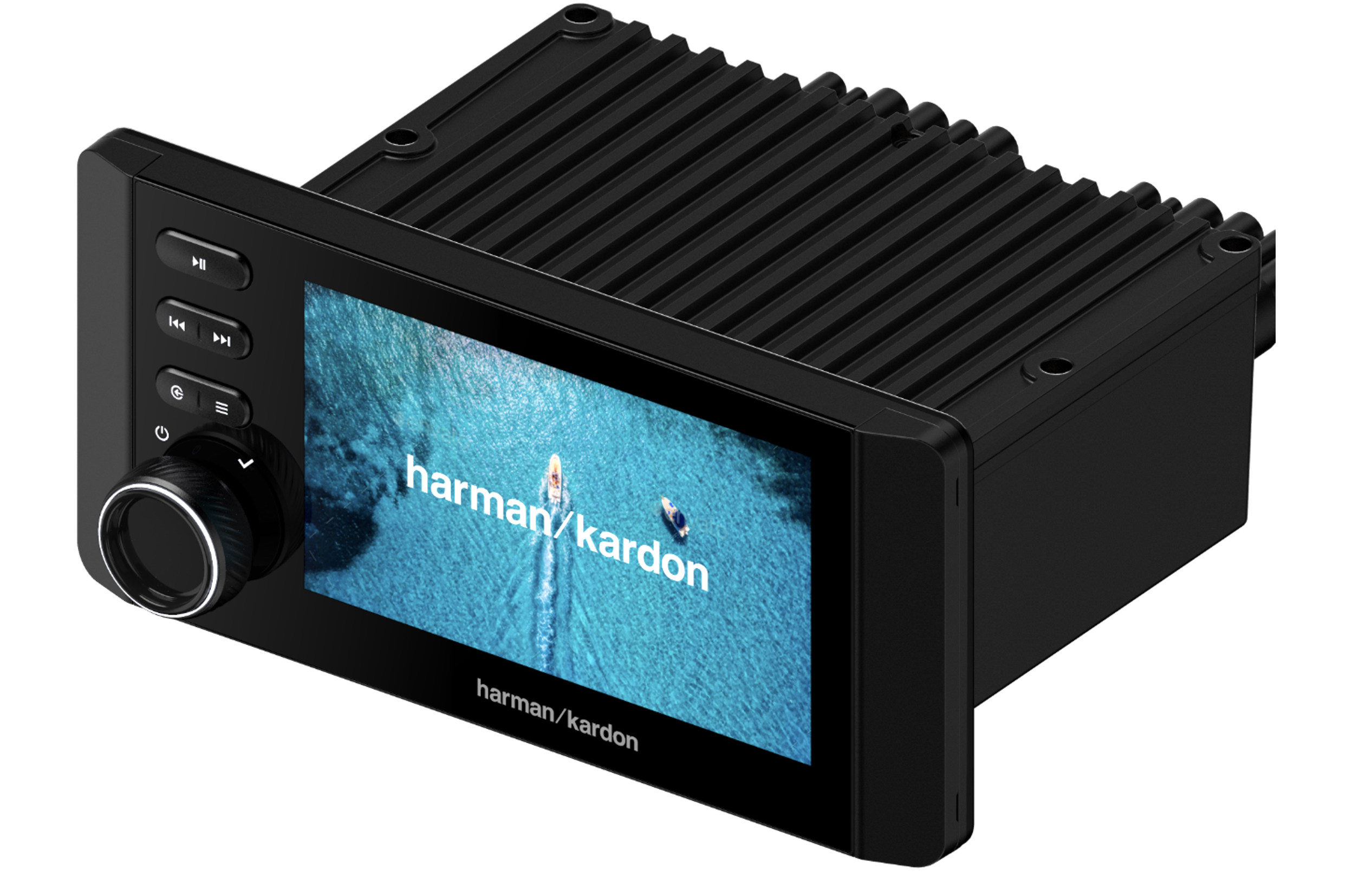

The July issue of Power & Motoryacht is now online, including my write-up of the new Fusion Marine Stereo, which pretty much summarizes earlier Panbo entries on this innovative system. But recently I got to see the shipping version of the MS-IP500 in the flesh, thanks to a visit by Todd Crocker, above. For many years Todd exercised his marine product creativity and high energy at Standard Horizon, then at Uniden (and is still justifiably proud of its snazzy color 625c fixed VHF), but now he’s a Fusion partner and manager of the U.S. division. He delivered a persuasive demo at my kitchen table!
We interrupt Panbo’s regular NMEA 2000 programming for some video side experiments. Seen above is what you get if you plug a DVD player into a Garmin 5212’s RCA “video in” port. I don’t think I’ve ever seen a multifunction display that could show video completely full screen (correction: with the exception of Standard Horizon, which can purportedly go to every edge when fed the right aspect ratio). But neither have I seen one that used quite as little of the available screen as this Garmin is doing; on the other hand, the 5212's’s video image is really sharp and rich, there are lots of controls (as shown), and if you put it into a quarter screen window it does fill its whole width.
Given yesterday’s Fusion stereo discussion, how about another new iPod-friendly marine system, from Alpine. This time we’ve got a lot of online detail on units like this iDA-X100M. But I’ll note that it is HD Radio “ready” though honestly I’m not really up on what means yet (and I’m out in LD boonies).
I’ve been keeping an eye out for the new Fusion marine stereo systems since the prototypesimpressed me at METS. Well, they’re not only official as of yesterday’s announcement, but at least the MS-IP500 model above, and bigger here, is already available at West Marine, which apparently has a U.S. exclusive. And the details sound even better than what I heard in Amsterdam.
The neat thing about putting satellite TV on your boat is that if you already have the service at home, most companies will let you put it on the boat for just the monthly cost of another receiver. The problem, though, is that the stabilized antennas start around $3,000 and even the small 14” ones can spoil a handsome boat’s profile. Enter the VuQube, which King Controls was showing at the Fort Lauderdale and NMEA shows.
It’s still in prototype, “but close to done”, and close enough that I’m sure this entirely new Fusion marine stereo design is going to make some boaters very happy. Particularly those of the iPod orientation. This stereo doesn’t just work with the iPod’s stereo jack; as you can see below it has a complete iPod dock tucked away behind the faceplate, where your precious player will be safe from spray and bumps. Should you want a model with a CD player in this spot, then a separate weatherproof iPod dock will be an option.
Thanks to Richard’s sleuthy comments to the earlier G Series entry, here are some low res images of various G Series system components beyond the monitors. They’re snitched from an online price list (PDF) put up by French Raymarine distributer SD Marine. The text is in French, and not detailed, but I gather that the “Processeur” GPM400 above has a hard disk pre-loaded with Navionics Platinum charts for one large region—you choose U.S., Europe, or ROW (rest of world)—and Gold charts for the others. It also has dual DVI monitor outputs (1280x1024 pixel), two NMEA 0183 i/o ports, a SeaTalkNG/N2K port, and a 100mb SeaTalkHS/Ethernet port.
If a 14.5” stabilized dish can look, and work, fine on my 25’ Ralph, most anyone who wants satellite TV on board can have it. But there are a lot more choices since I tested KVH’s great little TracVision M3 in 2006. In the August PMY, I detailed SeaTel’s Coastal 14 and King Control’s Sea-King 9815–RJ, and how KVH had met this competition by rejiggering the original M3 into the M3st, M3dx, and M2 models. The battle was rejoined last weekend when King introduced the Sea-King 1500-HD.
I’m working on an article about universal remotes, the bane of many yachts (and households). Specifically I’m testing a Logitech Harmony 890, and so far am finding it an amazing solution to just about every problem I’ve had with previous “universals” (lots). If you’re not familiar with the Harmony design, they all have USB ports which you use along with dedicated software and Harmony’s Web site to program the thing for all the devices you want to operate. You can teach it individual commands, but Logitech has thousands of devices already databased, including my particular TV, surround sound system, DVD player, VCR, and Media Center laptop. I’ve checked and know they also have the dedicated receiver in the KVH M3 system. What else should I look for in the lists?
At METS, the DAME awards electronics category was deservedly won by KVH’s M3 satellite TV system, a product that impressed me big time when tested last summer. But the little M3 now has a competitor worth noting, the King Control Sea-King 15” Saltwater Dish at right. It’s the same size, claims the same tracking abilities, but, unlike the M3, can receive HD and local DirectTV, even work with other service providers. It also has dual LNBs making it easier to feed two TVs, and it’s significantly less expensive. On the other hand, the M3 comes complete with a 12v combined controller/receiver (you provide the receiver in a Sea-King system), and a Panbo reader reported today that a KVH tech assured him that they’re working on a retrofitable HD/local M3 upgrade. Game on!
By the way, KVH did a great job blogging METS, which I got a particular kick out of as it was a certain KVH exec who—years ago, at a big Miami trade party, in almost classic “plastics!” fashion—advised me that blogging might be a great way to capitalize on my marine electronics obsession. I’m grateful for his encouragement (I think). Here’s wishing everyone here in the States a fine and peaceful Thanksgiving holiday.
Here’s a novel idea seen at METS: a marinized, 9–28v digital projector (front or back) meant to show multifunction nav data in the cockpit or—just swing it around—a big screen movie in the salon. The potential simplicity, not to mention lack of wires and weight, is intriguing, but I’m sure I’m not the only one wondering if any projector can overcome direct sunlight. (Plus, you know the kids are going to make wolf & bunny shadows on your plotter). My sense was that Optea has not yet put the XLMulti into full production, possibly awaiting investors or partners. Your move!
Geez, anyone know where the “Big Belly Reduction” Tool is in PhotoShop? Also, what’s the drill when your full res photo reveals a half-naked Florida boat guy? At any rate, here’s another FLIBS product intro, this one splendidly orchestrated by Raymarine’s well oiled marketing machine. Simultaneous to this “VIP preview” event in a nicely shaded and catered boat shed, Raymarine “insiders” got the news via HTML e-mail (you can be an insider too). In fact, there’s no need for me to repeat the awesome specs on the new 17” and 19”, nine-input monitors, nor mention the spectacular prices. But I will point out how neatly they can work with an E-Series VGA Out port (pictured) or a PC running RayTech 6.0, though apparently you can’t do both with the same cool dedicated keyboard. They look similar but one is SeaTalk2 and the other is USB. And I’ll add that a trustworthy Raymarine Product Manager told me that he’s seen these puppies in direct sunlight head-to-head with the competition and with an E-120, and “they rock”.
I’m still thinking, and writing a PMY column, about my TracVision M3 experience. I called Chris Watson, KVH’s Communications Manager, yesterday and wasn’t surprised to learn that the company has two full time technical writers on staff. They’re good too! I just can not imagine a better written or illustrated installation guide (full install image here), not to mention the hole drilling template, list of items shipped (w/photos), receiver user guide, etc. A nearly foolproof installation. In fact, KVH even supplies several extra of the various small fasteners that a fool like me is apt to flick overboard! Now I’m not sure how many owners will actually install a $5,000 system like this, though it is an almost-guaranteed satisfying experience. But KVH’s attention to detail could also make it quicker, and hence less expensive, for a pro to install, plus it speaks so well of the company’s style. More evidence is an M3 white paper (available from the M3 product page) that details all the technical innovations required to get a 14.5” dish antenna to perform as well as an 18” one, as shown in the test result graph below. It also lists all the testing this thing went through, which Watson says has resulted in near zero repair issues. So what’s wrong with the M3? Well, it only does DirectTV and it will not do High Definition (HD), plus of course you can find stabilized 18” dishes that cost less, especially if you go to a really unknown brand like the SeaSharp SeaVision that was aboard Shanghai Baby. Which I was looking forward to trying…except it was DOI (dead on install). Even if it had worked fine, as the first eight purportedly have, I’d still question the savings. Especially as I’ve seen other small sat TV companies show up at a boat show or two and then vanish. Of course there are several much less expensive, much lower performance, boat TV options (which I’ll discuss later), or the very simple NO-TV choice Andrea and I are tending toward. While I can easily picture cruising without TV (as always), I would like a fast Internet connection. For ‘work’ you know, though I might sometimes enjoy watching, say, Crooks & Liars clips, or YouTube nonsense. Which makes me wonder if a product like KVH’s own TracNet 100, previewed here last winter, and now fully detailed and shipping, will end up competing with TracVision?
Continuing on the subject of testing KVH’s M3 TV system, pictured above (and bigger here) is the nifty little 12v Direct TV receiver and RF remote that are included. The 3 LEDs along the top left of the receiver tell you most everything you need to know about voltage status, antenna activity, and overall system happiness. In the background you can make out the single coax cable that both powers the antenna and brings back the signal. And then there’s that Navman 8120 multifunction display (MFD) I’ve been testing recently. Pretty cool that you can watch TV on a 12” plotter/sounder/(radar soon) that seems to be selling for around $2,200 on the street.
But the video quality did seem to vary noticeably and in price order, with the Garmin 3210 below (and bigger here) in the middle, and the E-120 pictured last week—which has a video coprocessor—at the top. Hence my cute You Get What You Pay For title. Incidently, none of these MFDs seem able to use their full screens for any sort of video display. But, of course, if you did have a KVH M3 aboard, watching it at the helm would be very much secondary to using it with a nice flat screen TV or two (which I just don’t happen to have on Ralph).
It doesn’t even look as silly as I thought it would (bigger here
) on my 25’ Ralph (still for sale, people!). The KVH M3 Satellite TV dome is some svelte at less than 18” high and 16” in diameter, supposedly the world’s smallest fully stabilized antenna system. But, think about it, it takes more than small size to succeed on a smaller boat; staying locked onto, say, a DirectTV satellite (the only service so far supported) is harder when a boat’s motion is quicker. Yet I did donuts in Ralph, even got sideways in a wake that snap rolled me so badly I almost fell down… and the M3 retained lock. It was also incredibly easy to install. I’ll have more on this impressive (if somewhat pricey) unit soon, but for now will close with an image of how the M3 output looks on the E-120. It’s bigger here, but do note that a still picture of video never does it complete justice. This was very sharp, saturated, and smooth moving TV.
Looking at the animated version of this graphic too long may make you ill, but it does nicely illustrate the very different schemes that Sirius and XM chose in their efforts to blanket North America in audio and data, including, of course, our recent obsession…live marine weather. Both schemes seem to work fine around the U.S., especially on boats with their naturally wide open sky views, but how far offshore, north, and south can you receive Sirius or XM? A lot of cruisers would like to know, but the company Web sites seem vague on the subject. For one thing, I don’t think they themselves are positive about their footprint edges, and don’t want to over promise. Another issue is that XM and Sirius may broadcast into countries where they are not licensed to, and where someone thinks they should be. You may recall a long period when Canadians could only subscribe to satellite radio using U.S. addresses, even though most could get it fine. XM and Sirius were not bragging about their Canadian coverage then! Both Audio services are now licensed in Canada but, head’s up, Sirius Weather isn’t yet. Which brings us to some legalese in the Raymarine Sirius literature suggesting that your expensive weather receiver might not work if you go outside U.S. territorial waters. Not true; I checked! And judging from the unofficial footprint map kicking around the Internet (right, and slightly bigger here), Sirius will deliver fine service in Canada, out past Bermuda, down to around Antigua, across to maybe the Canal, and actually further into Alaska than shown (so I’ve heard). I understand that XM is similar except that it doesn’t reach as far south, which seems confirmed by the unofficial XM footprint map below, created by WxWorx, the company that’s developed a PC hardware/software system for XM Weather. They’d like to hear more reports from XM users on the edge, and I’d like to hear from anyone who knows more about how far either service reaches. Thanks.
PS, 7/28: We’ve been kindly sent links to a good collection of footprint maps and to a related forum discussion in which one poster describes getting XM in the Azores using a dinky home antenna (though it was before some changes in XM’s satellites).
What really gets me is that when you click on a movie, it starts instantly where you want it to…no fooling with a disk, no previews, no FBI warning. That’s luxurious. Of course it’s cool as hell to have your entire DVD collection organized by cover art, actors, genre, etc. Pick one of those films above and all the other covers will dance around for a moment, then show you the movies most like your pick. The brawn behind all this is the Kaleidescape Entertainment Server with twelve 400 meg hard drives able to hold, and back up, 660 full res DVDs (or 6,000 CDs, and you can chain on more servers as needed). The brains is a reader that hooks via Internet to Kaleidescape’s master database of cover art, categories, and the bookmarks that start the movie just so. Ethernet sends the goods to as many as 25 players around the boat. These babies are becoming quite popular on megayachts. Perfect accessory: a huge Crestron touch screen remote. The whole deal, preferably enjoyed on a sky lounge off the Italian Riviera, almost makes a guy want to be filthy rich.
The music screen above is from a Lowrance iWay automobile mapping system. It has a touchscreen and a 20 gig hard drive—partitioned so that 10 gigs are for onboard maps, 10 for tunes. PC Magazine made the iWay its Editor’s Choice in a May roundup review that included units from Garmin, Magellan, and Navman. I just came across it and was reminded of how Darrell Lowrance enthused about touch screens for multifunction marine displays during a press conference at the Miami Boat Show last winter. Lowrance’s best 2005 plotter/fishfinders are already similar to the iWay series in many aspects, like the hard drive; will they get touchscreens and MP3 players next year? There’s a ferocious competition going on to be a dominant player in the car plotter market, which has got to explode at some point. What are the manufacturers learning and developing that might migrate to boats?
I hesitate to report RUMORS, but given that strong caveat, these seem worth a “head’s up”: supposedly Lowrance’s NMEA 2000 GPS sensors have trouble with radar transmissions, and supposedly its NauticPath marine charts don’t properly show obstructions that are awash between high and low tide. Mind you, these are only rumors and, even if true, may have been fixed already or are about to be.
I tried plugging a regular household DVD player into two video capable plotters last week, and the results were quite viewable, confirming the value of helm stereos that can also play video discs. That’s a Standard Horizon CP1000 10” above and a Raymarine E120 12” below. Both have some control over picture brightness, contrast, and color saturation, though the E’s is easier to find and use. The E also has a choice of aspect ratios, but I still couldn’t get the picture to fill the full width of the screen. And yes, that is the actor from Friends who now mocks his acting career on the TV show Joey. This particular job, Lost in Space, must have been inspirational. I have no idea why the DVD is lying around my house.
I’ve already noodled on my theory that the proliferation of video capable plotters will stimulate more and more boaters toward helm stereos that can also play DVDs. Well, here’s a new one from Jensen that would fit the bill even installed in a place that sometimes takes spray. The MDV6115 has a dual gasketed CD door and conformal coated circuit boards, and its LCD is supposedly sunlight readable. Besides AM & FM, the 200 watt stereo plays VHF weather stations. Besides regular CDs, the deck will play MP3 CDs, and of course DVDs. You can even select the PAL region, meaning it should work with DVDs rented in any country you travel to. It comes with both wired and wireless remotes, all for a suggested retail of $500. The Jensen site doesn’t have info on this model yet, but an interesting online store called Rock the Boat Audio does, though not in their marine video section (we’re all just getting used to this video thing).
I’ve been lucky to experience many kinds of boating over the years, but, man, I’ve missed a lot too. For instance, I know zip about the high end ski boats which might sport this Infinity 6000M system, made by Prospec and an entry in the MAATS Innovation contest. The watertight speakers can blast a 100 watts of music out to the skiers in the boat’s wake, but the driver can cut in with his mic as needed. This wouldn’t go over well on some quiet Maine lakes, and no one skiis on the cold salt water here, but imagine the big lake scenes in the really hot parts of the country. In fact, check out this New York Times piece on Party Cove, Lake of the Ozarks, Missouri, where 3,000 boats often “gather for weekends of sun-drenched, alcohol-fueled, sometimes X-rated revelry”. Yike. Google “Party Cove videos” for a peek at what the Times only hints at. Party Cove is definitely not On Golden Pond (which, by the way, is a wonderful play my wife opens in tonight at a local community theater…much more my speed, and maybe yours).
It strikes me that with so many multifunction displays able to show video pretty darn well, a lot of boaters will be looking to upgrade their 12v helm stereo so it can play DVDs. Sound track on the stereo, picture on the bright display. Quarter screen underway in open waters, full screen on the hook. Why not, especially when you’ve already spent the big bucks on the MFD (an acronym I’m not quite comfortable with yet, but “plotter” doesn’t really cut it anymore). At any rate, there’s a lot of activity in “mobile video” because of the screens also appearing in cars, and yesterday I stumbled on this $125 add-on DVD/MP3/CDRW deck which even has a built-in TV tuner. It’s a Boss 3800T and I don’t know much more about it. There is, of course, some good dope on car video (and marine stereo) over at Crutchfield, which I’m exploring. No one’s talking about “marine mobile video” yet, but I’m sure someone out there is trying it, and I’d like hear from them.
I visited the HISWA boatshow in IJmuiden, The Netherlands, yesterday. Can't really say I saw anyting exciting, but the one thing I noticed was a very strong trend towards in-boat entertainment. Even in small boats I saw LCD-screens popping-up everywhere, lots of (somehow all) Clarion speakers installed and marinized stereo equipment. In a couple of weeks I will be at the Monaco Yacht Show and should be able to experience some real state of the art equipment over there...
Putting Oceanics' Waterproof MP3 Player To The Test
Sep 1, 2004
Jerry Hall, Guinness world record holder for longest underwater submergence with scuba gear, will this time try to stay underwater for 94 hours and 9 minutes in Watauga Lake. He's got all sorts of underwater electronics with him, allowing him to read and play chess. And this time he will also have the opportunity to listen to music since Oceanic is one of his sponsors. And I've written about their H20 Audio product-line before.
"For this dive, I will have the use of powerful underwater speakers and an underwater MP3 player," said Hall. "I can't describe what it's like to be able to listen to music underwater. That alone is going to make a tremendous difference."
"To get the commercial-free ear candy, you need a Sirius receiver and antenna. I opted for the Clarion DSH920S Tuner ($160) and the 1 1/3"-by-3 1/2" Shakespeare Galaxy SRA-30 antenna ($140). The final piece of the Clarion/Sirius system was a pair of 6.5" Clarion CM1622 marine coaxial speakers ($160/each). Then there's a $13-per-month subscription fee — a promotional $500 lifetime fee ends August 31—and a one-time activation fee of $15 ($5 online). Is it worth the price? Silly question. While testing the watertight, sealed-circuit XMD3 with an LCD display, I discovered the Sirius programming to be so diverse and comprehensive that for the first month I didn’t touch the CD player or AM/FM radio.(Sirius at Amazon.com)
I've seen through-hull underwater lights before, and from the same supplier (Underwater Lights USA & E-Fish TV) there is now a through-hull underwater video solution. Streaming right to your LCD screen in de salon so you don't have to dive in order to enjoy great marine life...
"This $1,835 waterproof camera from Underwater Lights USA can be set up for any zoom angle from 35 to 70 degrees and can send broadcast-quality, 470-line-resolution output to any number of monitors (in NTSC or PAL formats). Three and three quarters inches long with a diameter of 13'4", it fits in any of the company’s underwater light housings for steel, aluminum, or fiberglass hulls and thus is serviceable from inside the yacht."
There's no denying that satellite radio has made its entry into boating. This week's Ocean Navigator Marine Elecronics & Communications newsletter is proof of that. Chris Parker is discussing the different options you have, especially highlighting the Brix portable receiver. He's looking at a way to be able to receive the signal as far as in the Caribbean.
"I used to recommend purchasing the Sirius or XM device that was designed to interface with your brand of stereo. But audio equipment manufacturers identified a new market for this technology. Several equipment manufacturers now produce boom-box-type units for under $200 with a detachable satellite radio receiver. This allows you to take your satellite radio with you anywhere you go. You can play the self-contained unit, or play its output on your car, boat, home or office stereo."
Some nice new rugged LCD displays from Trident, up to 21.3", allowing you some great 'views' in the cockpit...
"All three panels have viewing angles of 170 degrees in both axes, with a virtually symmetrical viewing cone. This means that colour shift and colour inconsistencies when viewing the display from extreme angles are almost eliminated. This is essential for mapping and other applications where colours are used to show vital information. This symmetry of viewing angle also means the panels can be used in portrait orientation as well as landscape - something which conventional panels aren't suitable for. This is the result of ID-Tech's Post-Spacer construction, which also yields very high colour consistency."
I already saw it in my logfiles, but looking at the press-coverage on waterproof MP3 players, I must conclude there is definitely a trend here. Oceanic's DV-X has been mentioned on this website before, and now CNETAsia highlights it as well.
"Take the plunge with the Oceanic DV-X, an accessory that lets you use your MP3 player on a diving or snorkeling trip. The kit provides waterproof housing for any iRiver 300-series player and earphones made specifically for underwater listening, so you can hear your favorite tunes or take an audio-guided tour of wreck sites or sea life."
Since so many of you are looking for waterproof MP3 players on this website, I thought it would be better to post the news about this new (cheap) product. It is a "four AA batteries power built-in stereo speakers inside a water-proof casing that even comes with a hanger so you can hook it on your shower curtain rod or nozzle, turning almost any portable audio player into a waterproof shower stereo." I'm sure you can use it in a rainy cockpit as well...
"Boom Boom Multi-Box is water-resistant and is perfect for a trip to the beach, by the pool, on a camping trip, at a party, or even to use in the shower (hanger included); it has quality built-in speakers so you can play it loud and enjoy the sound, while hanging with friends!"
Lots of PR talk here, but Delphi announced today the introduction of the Delphi XM SKYFi Marine Kit. Satellite radio, either from XM or Sirius, is becoming very popular in the boating world looking at all the products (or marinized versions...) that have been entering the market recently.
"For splash proof protection, the Delphi XM SKYFi Marine Kit features a UV- treated cradle cover, which helps users see the display while helping protect their SKYFi receiver. A wireless FM adaptor with a conformal-coated circuit board, allows users to experience more than 120 XM channels of revolutionary programming including news, sports, traffic, weather and 68 commercial-free music stations through their boats' existing FM radio."
So if you've bought the iPAL for listening to some sweet tunes on deck, you might also consider a nice waterproof case for your iPod. Oh, and underwater headphones are coming as well...
"The oPod is an iPod-size version of the water-resistant, dust- , crush- and shockproof cases the military uses to protect hand-held computers. And unlike some water-resistant boxes for the iPod, it gives users access to all of the device's controls except the hold switch."
Satellite radio at sea is nothing new, but here's an overview of some of the things to keep in mind when switching from more traditional sources of entertainment....
"Owners of older boats that are not equipped with satellite radios have two choices available to them, says Smith. The existing radio can be replaced with a new one, or it can be augmented with a satellite radio receiver that connects and plays through the existing system. Many of the latter, referred to as plug-and-play adapters, fit into a permanently mounted docking station and send their output to the existing radio by plug-in wiring or by an internal wireless FM transmitter."
I have been looking for easy ways to get the music from my MP3 player into the cockpit of my 21ft boat that I use to travel the Amsterdam canals. Here's a good, and weather-resistant, solution called Tivoli PAL or iPAL.
"The tiny PAL has an amazing rich and deep sound. You plug an iPod in, turn up the volume, and it uses its internal rechargeable battery to play your musical playlists longer than your iPod battery will last (I can get 8 hours on the PAL in one charge). Clear, marvelous sound from a small, rugged box that has survived rain and being dropped into a pool. That doesn't usually happen because it is carefully designed with handy finger grips and a grippy covering. It comes with an adapter for running on AC."
If you are into wakeboarding and you'd like to have some music behind the boat, check out Infinity's new 6100M Wakeboard Tower Audio System.
"The 6000M loudspeaker pair attaches to your boat’s wakeboard tower with swiveling, one-size-fits-all, cast-aluminum brackets. The 2100M Marine Amplifier delivers 150 watts per channel of distortion-free output and even includes a talk-back microphone, so that you can communicate with the boarder from the boat. With prices starting at $1,099.95, the system doesn’t come cheap, but it will add a unique element to your watersports experience."
Motor Boating Magazine takes a look at one of the ships participating in the Nordhavn Atlantic Rally, a high-seas adventure from Ft. Lauderdale, Fla., to Gibraltar. There's a lot of electronics stuff on board this ship... Here are some of the highlights:
-“It’s the autopilot that’s the most important thing,” he says. And for autopilots, Kinney selected two Furuno NavPilot 500s and added a SC 60 GPS satellite compass."
-"The first display supports Furuno’s 1953C chartplotter with a powerful 12-kW radar for 72-mile range and 1.2-degree horizontal beam width for accurate target separation."
-"The second chartplotter, an 1833C, uses a smaller radar with dome antenna that will pump out 4-kW of power for a range of about 36 miles"
-"Called NT-Link, this is a little sister to C-MAP’s rugged commercial product, only it’s coupled with the NT recreational cartography. One notable feature of NT-Link is its ability to handle online chart updates."
-"But the real heart of the navigation package is Furuno’s NavNet system, which allows for multiple sensor displays on three different display screens—the two 10.4" monitors in the pilothouse and an additional 7" remote display on the bridge."
There are so many ways to have entertainment on board, in the cockpit, the cabins or the saloon. But most of the time sound is a 'good enough' thing. Well, some manufacturers are trying to change that.
"Poly-Planar’s new 10" MS250 subwoofer is designed to do just that, teamed up with a separate water-resistant marine audio amplifier that will crank up the required response from the lower registers."
GadgetMadness reports on Oceanic's waterproof MP3 players. I wrote about them a while ago.
"Oceanic Worldwide has a new line of MP3 players that are waterproof to 200 feet (66m). The H20Audio series looks like an iRiver iFP-300 series unit in a water- and pressure-proof housing, packaged with funky little earbuds that clip on the strap of your mask." (Waterproof at Amazon.com)
Besides some new satellite communications systems, Simrad also introduced three new satellite TV receivers and antennas. The TV45, TV46 and the TV60. With improved tracking capability, they will hopefully provide you with a clear and steady picture, even on rough seas...
"The TV45 is for slow-moving boats cruising in strong signal waters. The TV46 features faster follow-up tracking with either single or twin Low Noise Block (LNB) converters. Both the 45 and 46 work with minimum signal strengths (50 dbW EIRP), while the TV60 is designed for reception in weak signal areas (48 dbW) using a quad LNB option."
I've highlighted some more entertaining diving gear in the past, but Gizmodo now has a really good one... The Aqua FM Swim Snorkel Radio from Aquanaut.
"Even better, the Aqua FM snorkel uses no earphones, and instead uses bone conduction to pass the audio signal through your teeth right into your dome. And if you want to test the range of FM underwater, feel free; the radio snorkel is waterproof to 33 feet."
Lots of 'boat entertainment' related news this week. In this month's Boating World Gearlocker you can find the new SeaWorthy SEA2211B/W mid-tweeter highlighted. And what about this waterproof wireless TV from Casio found over at eHomeUpgrade...?
"You might find it enjoyable to lose yourself in the music, but never should it be the music that gets lost. The SeaWorthy SEA2211B/W mid-tweeter is mountable in two 18-inch gauge cutouts, which makes certain that sound is emitted at prime listening levels. Measuring 2-3/4 inches, this 30-watt speaker is ideal for V-berths, cuddy cabins and bows, and conveniently complements any system."
"The Casio XFER XF-1000 can operate for 3hours on a battery charge. This new Casio TV features a 10" screen with 640x480dots. The tuner unit can receive terrestrial TV and also has connectors for receivers or dvd players. The video signal is transmitted over the 2.4Ghz band with DS-SS (Direct Sequence Spread Spectrum/ direct spread). The reach is about 30m. Because the Casio XFER XF-1000 and the Remote are water-proof, users can take it with them to the bath tube or on a float in the pool."
Someone on Yahoo Group's World-Cruising mailing-list asked whether it is really necessary to have a 'marine grade' car stereo. Here are some of the replies to that question.
S/V Aquarius says: "we have a 40 footer that we cruise 24/7. Bought a Pioneer car stereo (XM ready) from Crutchfield with no external or added amp (draws too much power). Have ADS bookshelf speakers (great sound) that have been on board 15 years and still going strong...five years on another boat before that."
David B adds to that: "the real problem is with speakers. It's worth getting some marinized speakers (if you're putting speakers in the cockpit)....and to install them so you can screw in a deckplate or cover when the spray starts to fly, not to mention getting pooped or something. Speaker holes are very big and can let in a lot of water!"
And, again, Mike from S/V Aquarius sums it up: "in my estimation, marine stereos for cruisers are either overkill or a marketing triumph over technology!"
Oh, and Bryan Genez makes a comment that I have seen many times before: "FWIW, I installed a new stereo last year because I wanted satellite radio capability. I've since subscribed to Sirius, and am delighted. Almost completely eliminates the need for CDs."
Although intended for use in the shower, I'm sure you'll have fun with it while sailing as well...
"These portable speakers by JVC are safe to take with you in the shower. So load it up with your favorite karaoke tunes (on MiniDisk) and sing away as you soap. It comes in three pastel colors and will be available in Japan on June 1st. Also comes with a pocket-sized remote controller."
May be not as submersive as the two MP3 players I wrote about last week, but since many of you surely will have an iPod, this is the way to make sure you can use it while on (or accidentally in) the water.
"Despite the separation anxiety it might cause, you really DON'T have to take your iPod with you everywhere. Though if the pain is really too much to face, there's a new waterproof hard shell case called the Lilipod that'll supposedly keep your iPod safe no matter where you go or what you do, and even float if you drop it into the water while you're parasailing or whatever it is people do these days."
Engadget reports on the not particularly cheap, but very convenient MP3 player for listening to music on boats. Never mind the weather, or the water for that matter, since the device is submersive as well.
"The Oceanic DV-64 can be submerged to depth of 200 meters, but getting your MP3 while undersea will cost you, this baby retails for $399, or as much as a 20GB iPod."
Engadget's Peter Rojas found an even better submersive MP3 player, both in terms of cost and memory...
"That MP3 player for scuba divers we mentioned yesterday isn’t your only option for getting your MP3 on while underwater. There’s also the SWIMMAN, a waterproof player that has twice as much memory as the Oceanic DV-64 (i.e. 128MB vs 64MB) and costs $150 less."
An LCD display with built-in PC, without being able to see it. Great for space restricted environments like a saloon or cabin. Guess it won't be long before we see a rugged version of this one.
"TrustedReviews gets a glimpse of Elonex's prototype 32-inch LCD Media Center PC at the Ideal Home Show in London. The Elonex Media Center, which has the depth of a typical flat-screen TV, features a full-sized motherboard, 3.5-inch hard drive, integrated Wi-Fi and Ethernet, and two built-in side speakers. The device can also be wall mounted for optimal Feng Shui living space and placement."
I was reading an old article in Boating Magazine which had a quote that I could relate to... "It's the end of an idyllic day. Your engine is burbling through the no-wake zone, water's chuckling against the hull. The sunset is molten gold. It's perfection, and yet.... you can't place it, but something is missing. A something to make this moment last forever. You know, like a scene from a movie. I'll tell you what's missing, a soundtrack." At the same time I received a press release on a new pair of marine speakers from JBL, JBL MS920, so I thought I'd better post about it.
"The MS920 can handle up to 300 watts and has a frequency response of 50Hz to 21kHz, which allows loud, clear sound to be produced across a broad range of frequencies. The alignment of the 1-3/8" balanced-dome tweeter directly over the polypropylene woofer adds to the exceptional sound quality. The water- and UV-resistant speaker has a cutout diameter of 6" x 8- 13/16" with a mounting depth of 3-1/8". It is available in white, and the included stainless steel mounting hardware allows for personal or dealer installation."
Nowadays wireless LCD TVs still have a few disadvantages, but on a boat they could provide more flexibility when it comes to entertainment. Plug all your video sources (DVD, STB, aerial) in the base station, and use your wireless display everywhere. Its range of 50ft should be perfect for on board viewing, wether on deck or in a cabin. Let's just hope battery live will improve rapidly.
"When the signal is solid, the picture is terrific, with a wide viewing angle, high contrast and defined images characteristic of Sharp's outstanding approach to LCD (viewing on the sun deck at high noon isn't recommended, though). The issue is whether cable-free living and potentially dicey performance is worth twice the price of a wired 15-inch LCD TV."
Arriva's Wrap-Radio looks a bit weird, but I guess it's a better, and more waterproof, solution than the CapRadio I wrote about before.
"No exposed wires increase durability. Flexibility allows for abusive use and storage without adverse damage. Best of all, the weave design fits any size head comfortably and securely. The "WRAP-RADIO" will NOT fall off. The design accommodates different "ear buds" and color specifications per your requirements. The headset can even be waterproof and is designed for use with a Cassette, CD or MP3 player when used with the stereo cord."
If real offshore sailing is not your thing, than satellite radio should be a consideration for on-board entertainment. Prospec has introduced a new Sirius-ready radio.
"Extending the range of its receivers, Prospec Electronics will be offering Sirius-ready JBL radios to OEMs for the 2005 model year. Boaters won't believe their ears as crystal clear, commercial-free streaming satellite radio pours out of the speakers wherever the tide takes them. Sirius, headquartered in New York, offers over 100 streams of digital quality radio transmitted across the continental US from three high-tech satellites. Along with offering a full spectrum of music genres, users can also listen to popular news, entertainment and sports channels."
Definitely not the most inspiring gadget I have ever seen, but at a price of $20 I'm sure there are people that will see this 'very mobile radio' device and conclude that this is exactly what they were looking for....
"Smaller than the size of your palm, the CapRadio fits on the back of your cap, on your shoulder or on the collar of your shirt. The reception is about the same as any Walkman - obviously don't take it for lengthy offshore trips - but at the dock or floating around the bay you should be fine. When you walk, it doesn't jostle, and the tight-fit clip keeps it nice and snug up against your hat."
The BBC is running a story on the advances of in-car entertainment. It's not difficult to see how all of this can be applied to yachts as well. Especially the smaller, multi-cabin, boats will benefit from the economies of scale that are being realized in the automotive industry. It's not difficult, nor very expensive (Amazon), to create a personalized entertainment set-up in every cabin. And in the cockpit or saloon as well for that matter. In case you don't feel like any roof-mounted displays, why not use Sony's new wireless Air Board (LF-X1) which is for sale as of last Friday.
One other nice feature that is discussed by the BBC article is voice-control over all these entertainment devices. Again, the development in the automotive sector will create a precedent for yachting. Voice-control can not only be applied to entertainment, but to navigation as well, even more since PC technology is making a strong entry into the maritime environment.
"We're also building in 20GB hard drives Now you can take your home movies, and potentially other DVDS, record them onto a disc, record them onto a unit and keep them in the car. Now you don't actually have to bring in the DVD or the discs."
"A lot of it is voice-controlled and voice-interactive as well, the navigation systems, for example. But voice technology is far from perfect, and a screen can also be a life-saver. A rear view mirror can be connected to a video camera on the back bumper, or simply show an image of the backseat, obviously of potential use for baby monitoring."
The BBC reports on the increasing demand for satellite radio in the US. At least Sirius is also planning to offer four video channels that can be received in the same way as the radio signal. More and more boaters are also using either Sirius or XM, although coverage is limited if you're really going offshore (+200 miles).
"We believe we'll be able to put four channels of video into the back seat, so you don't have to schlep your videos or DVDs and set up some gizmo for your kids to enjoy that long ride."
Cruising the world but can't get away from what's happening at home? If you have a printer on board and a good internet connection, you can enjoy your favorite newspaper on deck in the morning sun wherever you are.
"NewspaperDirect has proprietary technology and compatible print stations that allow the recipient to receive on-demand newspaper service, which offers same-day delivery of complete, 11X17 print editions of more than 185 domestic and international newspapers directly to a luxury yacht."
To have music all over the boat might not appeal to everyone on board at the same time. Therefore a product has been developed that will make it easier to have a personalized audio experience.
"To enjoy a stereo's full sound in different areas of the boat, additional speakers are normally used. Poly-Planar's new ME-50 Expansion Amplifier is designed for the boater who wants to relax on the back deck and turn up the music-all without waking a sleeping crew member or distracting the captain at the helm."
Would you like to have on-board access to your complete DVD and CD collection without losing any valuable space for CD-racks, etc? Molino Media Mogul is a good example of a device that could help you do that.
"Ever wish you could store full, uncompressed copies of all your Music CDs, Movie DVDs, Home Videos, and Digital Photo in one place? Now you can. Molino Networks, a California based company, has just launched their iteration of a true digital media server named the Molino Media Mogul. An A/V receiver sized device that can store and playback up to 50 DVDs, 500 CDs, 10,000s of digital photos or hundreds of hours of home movies, which are available for instantaneous playback through a connected TV, A/V receiver, or home-theater system via an easy-to-use graphical menu system."
Some highlights from several recent boatshows include:
-NMEA 2000 is making real headway
-C-Map is adding 1,000 ultra-high-detail—down to slip numbers and restrooms—marina maps to its chart cards
-Digital Antenna now has a repeater intended to improve cellular reception on your boat without making you plug in
"Overall I sensed creative intensity as the big companies work to offer boaters (and builders) bow-to-stern electronics solutions while adopting better common protocols for those who like to mix and match, and while making way for increasing PC technology. Yet ther's still room for new companies with good ideas. All of which is good for us boaters."