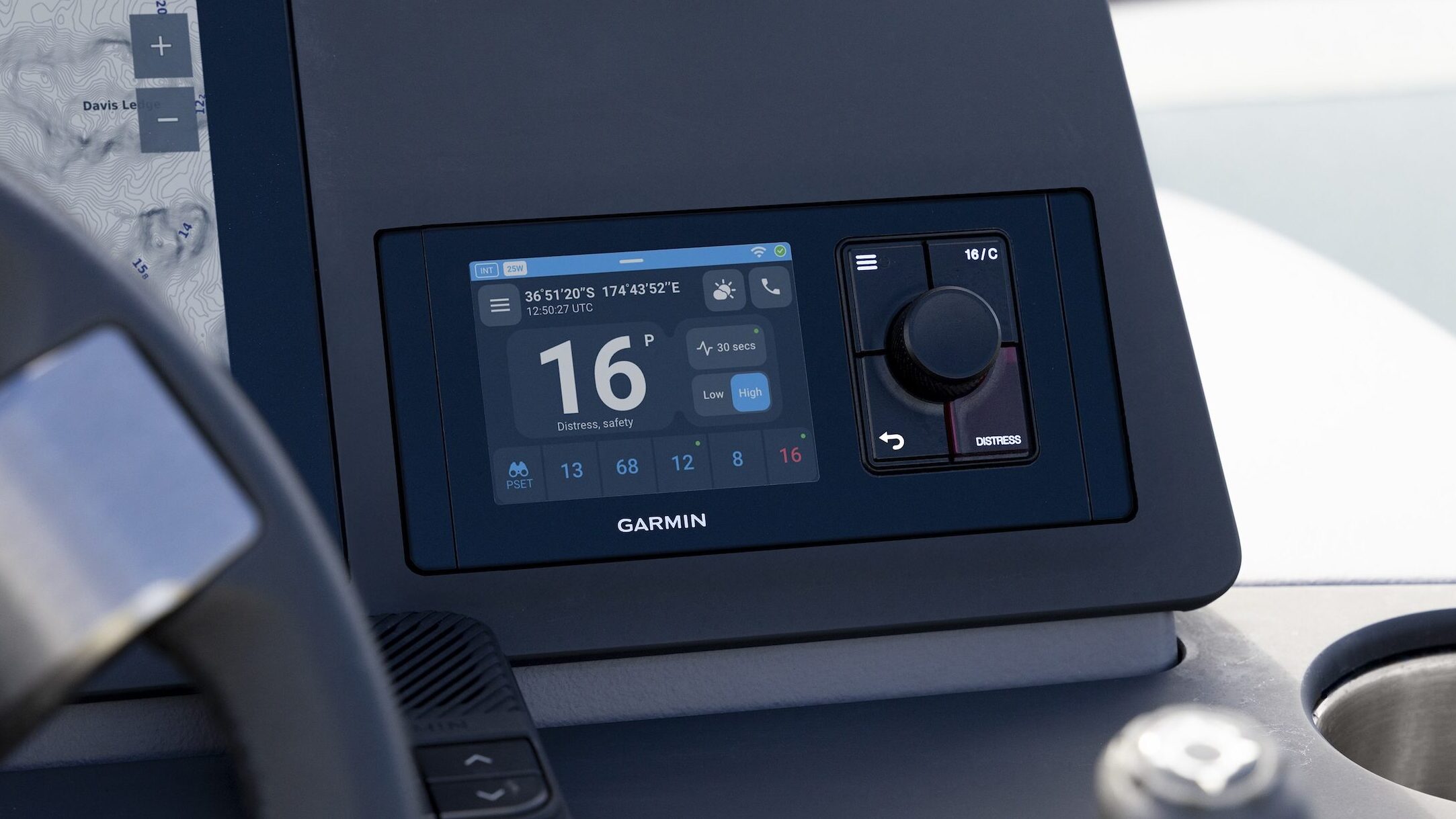

An interesting new product I didn't see at the Miami Boat Show is this NaviCom RT650 MOB. The company site is mostly in French, but MyBoatsGear.com links to a catalog PDF in English, and Foxtrot Marine has the most detail I can find. This DSC VHF seems to have an integrated AIS receiver much like the Standard Horizon GX2100, plus optional wireless handsets like the Uniden Whams, plus integrated MOB fobs that seem to work a lot like Raymarine LifeTags (with more here). The latter can apparently even trigger a DSC alert, and, in fact, all the parts make a lot of sense together, at least for some boats. Has anyone out there tried an RT650, or know why the company hasn't come to the USA?
Iridium OpenPort vs KVH FB150 testing #3, VOJ in the Pacific
Mar 1, 2010
Talk about a blue marble! Visions of Johanna is now half way from the Galapagos to Easter Island, and very far from home. But Gram Schweikert was able to call my Google Voice mail number from VOJ yesterday, and the recording sounds decent, as you can hear below. He's going to keep trying the two satcoms system across the Pacific, but he's already completed the main testing, as you'll read after the break, and the news is pretty much all good...
From Dan Corcoran in Valencia, SP: Because of the great speeds of the two sailboats, this America's cup will be held further from shore and on a longer race course than those of recent memory, causing tremendous challenges communicating on the race course. Even the judges are unsure that they will be able to communicate successfully in boats equipped like the one pictured above with retractable towers for VHF communications and satellite dishes.
The smaller, cheaper Iridium short-burst data (SBD) modem I heard about at Fort Lauderdale is now official and, wow, doesn't it look able to "disappear into as many marine devices as possible!" It even has GPS input/output ports so that it and the modem can easily share a dual-mode antenna. Hardware and service costs aren't specified but Iridium is claiming that the 9602 will have "the highest value in the industry." I, for one, can't wait to see devices like the Spot Messenger that are global and bi-directional, not to mention what the MFD and marine security/tracking developers might do with the 9602. And I'm glad for Iridium that it's got this and OpenPort going on, because it sure looks like Inmarsat is finally about to attack its dominance in the portable satellite phone department...
The tidal wave of interesting iPhone boating apps rolls on! The screen at left above (click for bigger) shows a beta version of Memory Map's upcoming charting app and I can tell you that it already handles NOAA raster charts and topo maps with speed and smoothness I didn't think possible on plain 3G hardware. At middle is the brand new Ships Ahoy!, a $3 AR (augmented reality) relative to Ship Finder and the other AIS viewers that lets you just point an iPhone 3Gs (you need the compass) toward a vessel or two to get their names and details (if the area is covered by a network receiver). And finally there's Navionics' neat new Ski:US, which admittedly has nothing to do with boats but does speak to this big marine company's big commitment to mobile apps. It happens to have my local Camden Snow Bowl among the so-far-limited ski area coverage, and it works great. In that screen shot I'm playing back the tracks (in yellow) I cut right after last week's big snow dump, in particular the --- MPH moment I lost board control in a huge drift. All these possibilities, and lord knows what else, will expand if Apple introduces a 4.0 version of the iPhone operating system this afternoon. But of course the bigger questions swirl around the Apple tablet, or whatever they decide to call it...
The gadget and GPS blogs are all over this combination of DeLorme handheld GPS and Spot messenger, which will apparently get official when the CES opens tomorrow. With good reason, too, because a user will be able to key a free-form text message into that new PN-60w and get it delivered from a lot of places where cell phones are useless. I didn't think a Spot could handle custom messages from the point of origin, and it sure makes me wonder what we don't know yet about the fixed marine model...
These 3-foot, 3dB VHF whips look very smart for sailboat mast head installs, especially the Windex-style apparent wind direction indicator built into the $190 Galaxy 5440 model. Both it and the $160 5445 model come with 65 feet of RG-58 coax cable and an "exclusive solderless connector system" that enables easy removal of the whip, and also looks easier to fish up a mast than the standard PL-259 connector at the other end. Press release here.
Following last week's introduction of the very interesting GX2100 & 2000 VHF/rxAIS fixed units, Standard Horizon is today announcing significant updates to its high end handhelds. I was already a big fan of the HX850S with its built-in GPS and full DSC features, but now the new HX851 takes care of my main original complaint -- lack of navigation features for small boat and back up use -- and adds a couple of cool twists...
Damn! An AT&T 3G smart phone that can use the world's largest commercial satellite for voice and data if you roam beyond cell range, no oddball second phone number, no dorky antenna? The big bird is up, the Genus phone is at the FCC, and the whole deal seems on track to be real in early 2010. But will it be a big deal for boaters? That may depend on what system developer TerreStar means by "offshore coastal waters"...
Standard Horizon GX2100, AISrx/VHF combo for most any boat?
Nov 24, 2009
I consider this fairly big news. Not only does the GX2100 combine full featured Class D VHF with a true dual AIS receiver in one box with a fairly big screen, and include most all of the nice added features the pairing can support, but it does it all for $400 MAP (minimum advertised price). That's a lot of features per gear dollar, and I'm going to list most of them because they're not online elsewhere yet:
I previewed this on my Ft. Lauderdale Twitter feed (did that thing work for anyone?), and I remain enthusiastic. HUG stands for Hybrid Universal Guardian, which is quite a mouthful, but then again this puppy can do a lot for a boater...
One of the most interesting meetings I had in Fort Lauderdale was with Patrick Shay, who fairly recently took the reins of Iridium's data division (after much related experience at Motorola and Sirius, and a lot of boating). His message was clear: Iridium has realized that data is important, in fact the fastest growing part of its business, and wants to see its SBD modems "disappear into as many marine devices as possible!" Coming soon is a new version of the 9601 modem above, which will be smaller and cheaper but still able to transmit a 340 byte message from anywhere on the globe in less than 60 seconds with very high reliability. It can also quickly receive a 270 byte burst from anywhere via the Iridium ground stations, and it's that two-way nature that suggests so many interesting possibilities...
Visions of Johanna is now on the coast of Ecuador, the vast Pacific beckoning. As discussed recently, Gram Schweikert has set the sloop up to test and compare the new compact satellite voice/Internet systems from Iridium and KVH/Inmarsat. Above he's geek goofing with the KVH IP Phone and a Uniden waterproof portable which
can access four lines -- Skype, cell, Inmarsat FB150, and Iridium OpenPort. But he's sure been doing his homework. What follows is the longest Panbo entry ever, in which the good Gram details the hardware, the installation, the costs, first impressions of performance, and plans for future testing...
Anyone with an interest in cutting edge satellite communications should get excited about this photo. You're seeing the 62' sloop Visions of Johanna (VOJ) almost all set to compare Iridium OpenPort and KVH Inmarsat FB150 systems in real blue water conditions. When Bill Strassberg and Gram Schweikert began finalizing plans for The Big Trip from Maine to New Zealand and back, they wanted a voice and Internet system more reliable than the Globalstar set up they've used for years, and more powerful than the Iridium handset service I brought along on our Bermuda to Maine passage. They decided to purchase the OpenPort system themselves, but knowing how able and fair Gram is as an electronics tester, I helped introduce him to KVH, who kindly loaned VOJ the TracPhone 150 above. Gram just finished the FB install in Panama, where they're about to transit the canal, and he plans to write up a series of short- and long-term tests as they cruise the Pacific. You'll read all about the project here and hopefully in longer articles for Yachting and Cruising World. In fact, here's Gram setting the scene:
It took a while, but the premium Garmin VHF 200 is now a reality, and it's a corker. I installed a sample on Gizmo yesterday and spent a fair bit of the day listening to it and trying out DSC features. As Bill Lentz noted in a recent comment, the 200 is a snap to hook up using NMEA 2000, instantly getting GPS off the backbone and delivering DSC call info to any device that knows what to do with it (unfortunately few so far). It also seems to have a sensitive receiver and a nice way of pausing enough in scan mode that you'll often hear both sides of a conversation. But he didn't get into how well the soft key scan (and other) menus work...
Cobra MR HH475: floats, rewinds, burps, & does bluetooth cell
Jul 18, 2009
Here's Bill Boudreau of Cobra Electronics showing off the two new floating 6 watt handheld VHFs the company announced earlier this week. The higher end model, the MR HH475, includes the Rewind-Say-Again audio recording feature I liked a lot in the original HH425 and the fixed F80. Plus this handset can also double as a Bluetooth handset for your cell phone, much like Cobra's dedicated MR F300 Bluetooth speaker mic. It doesn't have some of the mic's features, like a built-in address book, but it does have the PTT/VOX choice and the noise cancellation that tested so well in my lab. But what if someone hails you on VHF while you're chatting on your phone?
Garmin announced a slew of new products yesterday, the most innovative of which is probably the black box VHF 300 AIS. I think that this is not only the first combination VHF radio and AIS receiver (aside from the mod Icom UK apparently came up with), but also the first AIS receiver with NMEA 2000 output. While there are a couple of issues with N2K AIS target messages right now, I'm confidant they'll be fixed soon, and this will become the way to go. For instance, a Garmin plotter should
easily be able to "direct dial" AIS targets, buddies included, using
N2K. But that's not all to like about this radio...
So now that I have a real yacht, and hope to take her foreign one day, it seemed proper to get an official FCC Ship Station License. And better sooner than later since it includes an official FCC MMSI number, and the FCC will not let anyone transfer MMSI numbers already gotten (very easily) from BoatUS or SeaTow, etc. (despite endless petitions by various boating and safety organizations. And VHF/SSB/AIS devices can not have their MMSI changed without considerable trouble. Plus, getting an official FCC MMSI (with a zero at the end) means I can create a legitimate Group MMSI number, and experiment with that interesting but woefully under used DSC feature. So off I went to the official FCC ship licensing site (above), and into the pits of web form hell...
Some of us got confused last week when Inmarsat introduced its tiny but fast Fleet Broadband 150 Internet & voice service in Miami. While Inmarsat boasted about "sub $5,000" terminal hardware, KVH said it couldn't price its TracPhone 150 yet, and a source told me he'd seen a Sailor price list that put its FB150 hardware at over $5,000 wholesale. What we missed was the $4,995 retail FB150 terminal that's coming from new-to-retail Addvalue Communications. Fortunately, Ronald Hiemann -- who sometimes comments here as "Seajet" (his company) or as "Bremer Speck" (his boat) -- was able to fill me in on the Wideye Skipper 150. His story begins thusly: "Once upon a time, there was a sailor who wanted Internet access at sea on his sailboat..."
I'm in a gang now, sort of, and I like it. Above is my Yachting magazine colleague Jason Wood calling me via FB150 sat phone from the Inmarsat demo boat on Biscayne Bay Monday, photographed by colleague John Brownlee, editor of Salt Water Sportsman. Yesterday I talked and texted via the loaner Iridium 9555 handset with two other members of the gang, SWS electronics guy Glen Law and Sport Fishing electronics gal Chris Woodward. We are testing electronics together, or at least comparing notes, and that's good...
These are big times in the small world of global satellite communications for medium size boats! Yesterday Inmarsat demoed Fleet Broadband 150 hardware and service in Miami (my people were there, and even called me via FB150, full report soon) and today Iridium issued a press release boasting about the extensive sea trials its OpenPort system has endured, and how it's now shipping (actual FB150 hardware, like KVH's TracPhone FB150, won't ship until sometime "this summer"). Meanwhile, yours truly was using the new Iridium 9555 handset to text himself (above) and call his patient spouse from Camden Harbor...
Thanks to Sandy Daugherty over on the Forums, I now know that JRC has introduced a VHF radio series that can easily make direct DSC calls to AIS targets. They are most definitely big ship radios (see diagram below), and they do AIS calling in a way I hadn't anticipated, but still...
So Global Satellite USA has announced an interesting Iridium PBX box, but it won't roll out until June and will cost $4,200 (with an outside antenna and 20 meters of cable). I got a demo of the new Iridium 9555 handset at the Miami show, and while it's certainly less clunky than the old 9505, a fixed installation of some sort still makes sense for most boats, I think. At sea, you want to make calls down below, a dedicated antenna works better anyway, and you'll very likely have a data cable connected between phone and PC. At least for e-mail, as Iridium only connects to the Internet at 2,400 bps, before compression (which Global Satellite doesn't mention)...
You may remember my enthusiasm for GrandCentral, a free online voice mail, PBX, and one-#-for-life scheme with fantastic potential for cruising boaters (as well as mere mortals). In that March, 2007, entry I even hoped for/predicted the startup's purchase by Google, which happened almost immediately. It remained functional, but very quiet, all these months. (I never did use it as a real contact number, because I like the Maine numbers I have, but did use its slick call recording abilities for tasks like testing the Cobra noise cancelling cell mic.) Well, finally GrandCentral has emerged as Google Voice, with several added features like voice-to-text, conferencing, and Skype-style cheap foreign calls (only from whatever U.S. phone you're near). Let's test the voice-to-text; if you click on that widget above, you can call my number for free; you'll hear a voice message I custom recorded to go with the widget, and the message you leave will be converted to text and sent to me via e-mail or text message (along with a link to your recorded message). I tried it once myself and it worked very well, but you may talk funny...
How’s about a module that can seamlessly communicate voice and data all around North America via either cellular or satellite radios, includes WiFi and GPS too, and can fit in a small handset or into a multifunction marine display? That’s what SkyTerra has in development, and apparently the company (formerly known as MSV) also has the first FCC license for such a sat/cell hybrid service, and hopes to soon launch two of the most powerful comms satellites ever…
I recently spoke with Standard Horizon VP Jason Kennedy, mostly about the HX850s cracked case issue which I commented on today (and which has become a Sailing Anarchy thread). But we also discussed the future of GPS/VHF handhelds, a future that’s especially rosy as the HX850s is selling well beyond Standard’s projections. When I asked what’s possible, Jason suggested that I check out the Yaesu VX-8R, a new amateur radio handheld which comes from a sister division. I did look at the brochures and manual available at that Yaesu site and, while the button labels above suggest what a complex beast this HAM set is, the obvious potential for a related marine VHF product is…wow…
I’ve started monitoring New York Harbor VHF traffic on the Standard Horizon HX850S, first tested last September, and its effective tag and scan functions are helping to sleuth out who works which channels. They’re obviously well established as many callers identify neither themselves nor the intended recipient. Using the handheld reminded me of my HX group portrait above, and bigger here. Among other things, it illustrates some features of the 470 Series (which I’ve happily used for years) that I miss in the 760 and 850: like its compactness, its more secure cradle w/ in-front status LEDs, and its squelch/volume knob instead of the two-step VOL or SQL button then up-down key routine. You can also see the fairly significant difference between the dot matrix screens on the 471 and 850 versus the segmented one on the 760. The photo may emphasize it a bit more than real life, but the segmented technology is higher contrast. On the other hand, the screen designers are really limited by those segments, especially when they try to create less visited screens like setup menus, as seen way below, and bigger here…
Tip of the beanie to Bob Taylor, who wrote from his Nordhavn 57 Istaboa to enthuse about the Cradlepoint MBR1000 router above, which can handle—even prioritize or load balance—multiple cellular, WiFi, DSL, etc. WAN (Internet) connections coming in via card, USB or Ethernet, and then deliver them to the LAN (PCs, iPod Touchs, etc. around the boat) via WiFi or Ethernet. In the photo Bob’s got an AT&T HSUPA USB Aircard, a Verizon EVDO USB Modem , and a Port Networks MWB-200 WiFi rig (which he heard about here) all connected to it and getting along fine, as he describes in his blog.
I was asked about the availability of GPS antenna splitters “to avoid clutter,” and the kindly questioner even threw in a Panbo support donation (thanks, David!). But so far I haven’t found anything that seems practical. While there are many models of GPS Networking brand splitters available, they cost a lot more than the small marine mushroom/disc antennas they would typically replace. As suggested by the label above, though, determining splitter specifications is a lesson in how much you need to know about a specific GPS antenna in order to replace it or split its feed…
It’s a bit telling that just before Cobra’s MR F300 Bluetooth cell mic won a DAME Design Award, I’d read some critical, if uninformed, posts about it on The Hull Truth. I think Europeans are way ahead of us when it comes to cellular. And I think the Cobra BT mic, which I’ve been testing for a while, is worthy of recognition. The photo above suggests how smartly counter-intuitive it is; while it’s wireless to your phone, it’s very much wired to your boat, with a hunky curly cable, a bulkhead plug, and break-out wires (out of shot) that connect to 12v power, USB for updates, and line-out for amplifying calls. No batteries to worry about, and your cell can be tucked away and charging somewhere within Class 2 Bluetooth range (about 30’). A closer look at the handset, bigger here, shows a plethora of command buttons never seen on a Bluetooth headset and a screen whose fonts are small but readable.
A sample of the intriguing but controversial Wizard antenna arrived yesterday morning and I was able to do some testing before hitting the road for Fort Lauderdale. If I had to put the results in three words they’d be: disappointing but tentative. Before the details, check out the bigger image , which goes along with a more concrete description (that came with the sample) of the marine Wizard’s purported capabilities. That RG-58 cable with a BNC connector coming out of the left side will support a 25 watt VHF radio while the two RG 174U cables on the right (one BNC and one SMA) can purportedly handle AM/FM, WiFi, GPS, Cellular, Sat phones, and UHF/VHF, all transmissions limited to 5 watts. The various added connectors and patch cables are what I had to do to hook the Wizard to VHF and Class B AIS, and the unfortunate lash up at bottom right is one of the reasons I say “tentative.”
Check out the full screen shot for a modern take on the noon position. The world’s largest NMEA 2000 network, i.e. the yacht Sandrine, is experimenting with a Spot Messenger while on passage to Fort Lauderdale. Instead of using Spot’s tracking feature, like Flash of Beauty did, Captain Jay Kimmal (below) is using Spot’s OK message to send an email/text to friends and family every three hours, and the messages are also collected on Sandrine’s share page above. The cost, of course, is trivial on a yacht like this, but Kimmal may have had to put the messenger on deck somewhere to get a consistently functional sky view. Wouldn’t it be nice for boaters if Spot II had a bracket and ports for an external antenna and power feed?
How about a 5” square “multi-band bisynchronous simultaneous reception and transmission ” antenna that doesn’t need to be mast-mounted and can handle frequencies from AM and shortwave through FM and VHF and up into cellular, GPS, sat phones, and WiFi…three radios at once?!? That’s actually just the beginning of what AMT Revolution claims possible of its “Advanced Membrane Transducers.”
Even if it was pretty predictable (I got it half right), Garmin will indeed add (“2nd Quarter, 2009”) fixed VHF radios to its ever-expanding marine line. Here’s the press release, and here’s a bigger image of the VHF 200 model above, including the GHS 10 full-function remote mic that can optionally wire to it. The second mic possibility is why you see “INTRCM” as one of the soft key choices on that 3.2” display, and it—along with the 20 watt hailer and a NMEA 2000 data interface—are about all that differentiate the $400 VHF 200 from the $250 VHF 100 seen below.
I finally got my hands on a Standard Horizon HX850S GPS/VHF, and I’m almost in love! Even if the 1.75” screen seen above, and bigger here, is not quite as bold as the first marketing images promised, I find it quite readable in any sort of light. The screens are well designed, too, offering channel labels if you want, or COG/SOG/position, and fairly intuitive access to the radio’s complete setup and DSC menus. A little time with the manual is necessary to understand some of the radio’s more obtuse capabilities and button combinations, but that’s to be expected with so much functionality built into such a small package.
So I’ve been testing two marine WiFi systems. First up is newcomer 5MileWiFi, pictured above. Its heart is in that little machined aluminum case which delivers Internet to your PC via that main USB cable, also used to get some of the power needed to run what’s claimed to be a 1,000 mW WiFi transceiver. The side mounted USB cable is just for added power and can go to your PC or any other USB power source. The $399 package also includes 25’ of LMR240 coax and a 38” high 9 dbi omni-directional marine WiFi antenna.
I can tell you with some certainty that an RSSI value of -106 usually shows as one tiny bar on my Verizon Centro phone and usually means that it can ring when called but is darn flaky in terms of actual verbal communication. It’s pretty much the standard Verizon cell status around my house and even most places right outside. What I can’t tell you is whether the Cell Ranger Stix amplifier I’m testing was on or off when I took this photo…because it seemed to have no effect on the signal whatsoever!
Big yacht IT is challenging, and thus I nearly had to tickle local marine networking ace Nik DeMaria (Blue Maple Systems) to capture his naturally grinning good nature, above and bigger here. I’ve known Nik “since he was knee high to a grasshopper,” as we say around here, but now he can make my head spin with talk of stuff like static IP addresses and Dynamic Host Configuration Protocol (DHCP)—his worries last week. You see, he and John Gass were just wrapping up the installation of a KVH V7 mini-VSAT aboard the 115’ sailing yacht Tenacious, and while they termed that chore “easy”—even pulled it off in less than a day—Nik was looking for an elegant way to manage the vessel’s multiple Internet users and sources. I think he’s still looking, and maybe some of you Panbo-reading IT types can help…
Good times: I spent most of yesterday testing electronics on Gizmo and visiting around Camden Harbor. One system I was mostly pleased with is this little wireless communications and navigation PAN (Personal Area Network), if I may apply a long name for what’s a fairly doable setup these days (bigger picture here). The Palm Centro is running ActiveCaptain Mobile and has the Region 101 raster portfolio loaded on its 1gb micro SD card. That’s a single 353 mg file containing all charts from the Canadian border to Block Island, which scale, zoom, and pan very quickly, and look good. Better than the photo(s) actually, if you put the Centro’s transflective screen in direct sunlight or use its full blast backlighting in heavy overcast conditions.
Thanks to John Forder for pointing out the intriquing Cell Ranger Stix wireless cell phone booster. It claims to use a microprocessor to analyze a cell signal coming in through its little antenna and then add 50 dB of gain (2–3 bars!) as it retransmits the signal in a six foot radius around that 12v lighter-plug-like casing, all for a $150 and nearly zero install effort. If true that would definitely be useful on many a boat, and maybe in my office where my recently acquired Verizon Centro is barely usable. In fact, using a “field test” code found at wpsantennas.com—field test numbers are more responsive, detailied, accurate than screen bars—I’ve learned that it has an RSSI of -105 (very, very poor), and an EVDO signal strength of 107 (meaning unknown, but should change with amplification).
When I was researching a PMY article about VSAT and Fleet Broadband sat comms, I asked a fairly reliable source what would happen if Inmarsat lost one of its new I-4 satellites. He rolled his eyes and said, “they’d be dead.” You see, while it only takes three of the new I-4 satellites to provide nearly global BGAN/FB service, the things are huge, and hugely expensive. Which is why getting the third and final bird into orbit was a big deal. Plus the launch has been delayed at least once due to the failure of a similar missile carrying a smaller satellite. I imagine tension was wicked high when the Proton Breeze lifted off from the Baikonur Cosmodrome in Kazakhstan last night. Can we imagine the financial stress induced watching a critical business asset—for which, by the way, there is no backup—blast into space (especially now that we know how much angst a little electronics bankruptcy can cause). Well, the I-4 F3 satellite launched fine, and thus Fleet Broadband should become global soon. Meanwhile, KVH recently announced that its mini_VSAT service is also going global. I presume that if things go right, a company can do well with satellite communications, but it does seem like a hairy business.
It’s wonderful that the marine electronics world is still small enough that a tiny company with a good idea can get somewhere. But I’m not sure that having your Icom M504 VHF modified by Marine Werke so it can output AIS audio signals is a good idea. For one thing, I believe only the included Shipplotter software can demodulate AIS audio, so a user can’t use this AIS target data with other software or plotters. Furthermore, to get AIS, you’ll have to tune the Icom to Channel 87 and I dare say that also scanning safety channels might significantly reduce AIS performance.
This looks like good news indeed (and thanks to Mike Doyle for the head’s up). That little 1.25” diameter Callpod Dragon V2 Bluetooth headset can not only do the expected with your cell phone but also communicate directly with another Dragon V2 headset up to 100 meters away. So, at least theoretically, you and your mate could be working or playing most anywhere around your boat with full duplex hands-free communication as needed, interrupted only if either of you wants to take a call from the individual cell phones in your pockets. Actually, the phone might be stowed in a safer place, perhaps even hooked to an amplifier, as Callpod claims the Dragon “typically enhances the {9 meter} performance of standard Class-2 devices by a factor of 2 to 3 times.”
On Saturday the Apple iPhone app store started offering iNavX Marine Navigation and it’s already generated eight mostly positive reviews there. The $50 program is the work of Rich Ray, who also developed GPSNavX and MacENC, and it looks similarly well done. It works with the built-in GPS of the new 3G iPhone of course, but can also be used on older iPhones using cell tower location services. Alternately you can set it up on an iPhone, or iPod Touch, to get GPS, wind info, and other data via a boat’s WiFi router and a program like MacENC (or Coastal Explorer) that can output NMEA 0183 messages to TCP/IP (Franson GPSGate should also work).
That’s a Blackberry getting dunked in pan of water, which it apparently survives just fine, thanks to a new “vacuum deposited” polymer coating process called Golden Shellback. You can see the CNET video “Waterproof your gadgets” below, Gizmodo filmed a cell taking a call while in a glass of ice water, and Tekzilla had some fun with an iPhone. But I’m a little confused; all these tech sites talk about “waterproof” but Golden Shellback itself clearly calls its technology “splash proof.” Many of us know from handheld VHF history that there can be a big difference.
Let me say right off that the delightful title above—antenna cables and connectors really are important to performance—is stolen whole from a first class essay on antenna cabling written by Jason Reilly. And the illustration is cut from another useful coax connector page by Edward Kuester. I don't want to be an expert on such matters, but anyone who fools much with VHF, GPS, AIS, TV/FM, WiFi, and cellular antennas runs into all sorts of semi-standard connectors, and often the need to transition from one to another. The links above are great for the nomenclature, intent, and limitations of the various types, but I don’t think I’ve yet found the best sources for all the bits and pieces I could use in the lab, and you might need on your boat.
There were 15 entries in the “Aftermarket Electronics, Electrical Equipment, Instrumentation, Navigation Equipment including Software” category of this year’s MAATS Innovation Awards, and not a dud in the bunch! Which is why it’s particularly noteworthy that we seven judges gave the award to Lowrance’s Broadband Sounder and an Honorable Mention to Lowrance’s LVR-880 VHF/FM radio. I’ll be writing more about both these products as I should have samples installed on Gizmo in a week or so. The photo above is from a pre-production 880 that I tried in the lab for a month or so; the NMEA 2000 DSC features weren’t yet ready for prime time, but I was quite impressed with how well it could bring in FM radio while also scanning one, two, or all VHF frequencies, muting the FM whenever squelch was broken. Congratulations, Lowrance!
Mobilarm VPIRB, interesting idea with the wrong acronym?
Jun 23, 2008
I’ve long thought that handheld VHF DSC can have real value in a MOB situation, which is one reason I’m delighted that the HX850S is shipping and a similar Lowrance model should soon follow. I also figure that we’ll soon see more Spot-like satellite messenger/GPS/-safety products, and there will be even more confusion about how they work relative to official SARSAT system with it PLBs and EPIRBs (as referenced at the end of the recent FOB entry). But I had no idea until today that Mobilarm was developing a dedicated VHF/DSC/GPS man overboard device, and apparently marketing it as an alternative to a personal EPIRB.
I’ve never met Rob Emmet, founder of Pyacht.com, but have come to think of him as quite the can-do gear guy. Apparently the ISAF (International Sailing Federation) Race Management Team thinks so too. Above, and bigger here
, is the innovative mark management system that Pyacht developed for a certain major sail racing event—with five tight courses sometimes in use simultaneously—that will take place this August in Qingdao, China (Pyacht is not supposed to use the O name promotionally, so I won’t use it either). Whereas Emmet “couldn't see the Chinese allowing us to use the 900 MHz band to stream NMEA data from the marks,” he settled on VHF DSC. Thus all those Standard Horizon HX-850S handhelds will live in special pouches on the marks, where their GPS position can be polled by those Icom IC-M604 fixed VHFs that will be installed on the committee/signal boats. Then each committee boat, plus the Principal Race Officer and the Media Center (and “Chinese Officials”) all get copies of Nobeltec VNS Max Pro so they can monitor the course layouts. Of course putting all that gear together with proper cabling, battery charging systems, etc. and getting it all approved by the ISAF and Chinese government was pretty complicated. Emmet lays out the whole story well at the Pyacht blog. Even if you don’t give a fig about racing sailboats this is an interesting example of how the new GPS/DSC handheld VHFs can be used to track tenders or whatever. Tip of the propeller beanie to Pyacht! (Which, by the way, sends out an occasional newsletter, where I learned about this project.)
What a good idea! Today Cobra is introducing its MR F300 BT Bluetooth handset, which seems carefully designed to make a cell phone work better, and live longer, on a boat. It’s a waterproof marine-style mic with noise-canceling technology on both the receive and transmit sides. It even has a Push-To-Talk (PTT) button like a VHF mic, but in this case it’s really a reverse mute button. In other words, you and your caller will hear no amplified boat noise unless you push the button (and you’ll still hear your caller even when the button is pushed). But if it’s quiet on the boat, there’s a dedicated button for hands-free speaker phone mode. In fact, the 4.5” tall mic even has soft keys able to call up a 50 number received call log and equal size phone book, and other features like 10 ring tones that can be individually assigned to regular callers {correction due to Cobra Web error, now also corrected: there’s just a choice of 10 tones, not selectable by caller}.
When Standard Horizon showed a prototype Bluetooth VHF headset last Fall, they didn’t say which radios it would work with. Now the product scheme has become clear: a new HX760S handheld that comes bundled with the wireless headset, and a BTK-2 kit that can add Bluetoth and the headset to either of its two high-end GX series fixed VHFs. And, by gosh, if you do the Google you’ll find the both the 760 and BTK-2 are actually for sale out there.
The electronics road trip was a blast, and it seemed appropriate that I drove it with three (3!) modes of satellite communications on my dash board, bigger image here.
Here’s a reversal: I tested this Matys OnBoard Iridium/GSM distress/SMS/voice/email communicator months ago, and my PMY write-up is already online. There you can see the reassuring way the unit lets you know that an alarm message has been received, quickly too, as well as the system’s substantial cost. And the Matys site is good for the seemingly endless—tracking, weather, concierge, medical, etc.—services available.
A month or so ago reader Derek Love (thanks!) wrote in about an interesting combination VHF transceiver and AIS receiver previewed by Icom UK at the London Boat Show. It got a little coverage plus there’s an Icom UK web page about it, though that page seems oddly inaccessible from the main site. I’ve tried to find out more and what I hear is that the prototype is a small board that can be added to Icom M505 and M603 radios, but preferably during manufacturing, not as after-market mod, because of the waterproofing.
This Northstar Explorer 725 VHF, along with its optional wireless handset, was one of the few entirely new electronics introductions seen at MIBS (at least if you’re a regular Panbo reader ;-). And compliments to Northstar for using real screens in these product shots, instead of pasting in dummies as is often the case. It is a bit humorous, though, that while the photographer did manage to power up the units, he clearly did not attach a GPS, which is why the fixed unit is plaintively displaying “PLEASE INPUT POSITION!” so that it can do its DSC duties properly.
Friday’s entry may not have been clear; I only meant to snipe at the New York Times (lightly), and not at Spot. In fact, Spot was one of my four picks for the electronics section of Sail’s annual Freeman K. Pittman Innovation Awards, mentioned earlier with other M.E. awards and now out in the February issue (though sadly not on line). While it is certainly not a PLB, I think Spot could be pretty useful on a boat, or ashore. But understanding well how it compares to PLBs is critical, and hence why I’m sniping at confused coverage.
I only mentioned testing this Standard Horizon CPV550 back in Nov., and that was about a fogging problem that I’m told can be readily fixed with dessicant bags. Now my short review is out in the Feb. PMY, and I’ll add a bit more detail. Neither of these photos really does the screen justice, but above, and bigger here , is the nicely iconic main menu, which also gives some sense of all the tasks this machine can address.
I’ve been looking forward to the two VHF/GPS/DSC handhelds I heard about last Fall, but was a bit surprised to find this Standard Horizon HX850S in a magazine and also available for preorders at Landfall (Standard is great at making radios, but press releases …not so much). The 850S looks very capable if maybe a bit clunky. The built-in 12 channel GPS is not only used for a full set of DSC functions but is also output, along with DSC messages, via a NMEA 0183 cable from the radio’s cradle.
The photo, bigger here , shows what a real winter we’re having on the coast of Maine, and it was taken before yesterday’s blizzard-rain-freeze event! The dashboard GPS tableau was because a motorcycle rider reported that sending a message from his SPOT may have caused his Garmin 276c to freeze up. But I drove around like this without problems (aside from getting laughed at); SPOT transmitted “OK” and “Help” messages fairly consistently, as seen earlier, and none of the plotters blinked.
Though my first SPOT test entry garnered no comments, I remain convinced that some boaters will go for this gadget/service once they fully understand what it can do for them. Actually, out on the water is where it may perform the most reliably. I’ve been trying SPOT in some tough situations and am learning that it needs a good sky view to work well. I had it out in the streets of New York City for several hours last week, and I don’t think it ever got a GPS position, and it only twice got a message off. By contrast, a little Lowrance XOG I’m testing could regularly get a fix on these same streets (which is where I last tried the AnyTrack, not midtown Manhattan but with many tall buildings). Of course SPOT does not claim to work in urban canyons, but I wonder about wilderness canyons or places with heavy, wet leaf cover. And I don’t understand why it isn’t able to indicate if it has a GPS fix, despite having four bi-color LEDs. {Correction: when you activate a SPOT function, it will indicate after a while if it does not have GPS fix, as—ahem!—explained in the manual.)
Since Sunday I’ve been testing a SPOT—the Globalstar-based “satellite messenger” first mentioned here in August—and I’m impressed. Check out the full size screen shot above, which shows me out in Muscongus Bay this morning (being shown a very cool cruising power cat, more info to come). The mapping is a little confusing because events are numbered backwards chronologically, and time is given in GMT (both quite fixable on the Web site, I think). So at #10 I activated SPOT’s “OK” function which sent a canned email/SMS, along with a Google Map link, to a list of people I’d set up on my SPOT Web page, where I can also customize the OK and Help messages. Then a few minutes later, at #9, I activated the tracking function which, as promised, sent an automatic position every ten minutes thereafter. Only position #7 is an anomaly; we weren’t over on that side of the island. At any rate, the unit is fairly easy to use, and seems to offer a lot of safety value and tracking/check-in function for the money. I do wish I’d had a chance to try it in Europe, which is supposedly under Globalstar’s not-quite-global footprint, but at least we do know that this technology works fine from Norfolk to the U.S.V.I., as discussed recently. Remember, Globalstar short messaging does not have the problems voice/email does…and, fellow yanks, here’s wishing you a fine Thanksgiving.
It’s official. Today Inmarsat flipped the switch on the marine version of BGAN, dubbed Fleet Broadband. It’s been a while coming, as noted here last March, but the good news is that the smallest dome turns out to be less than a foot tall. Thus the new KVH TracPhone FB250 is almost the same size as the company’s existing TP 252 dome (Inmarsat Mini-M), as shown above in a photo I took at the NMEA Conference back in mid-October when KVH officially introduced the products. The big difference is that the Mini-M offers “dial-up” style data service “up to 9.6 Kbps” while the FB250 offers a “standard IP” always-on connection “up to 284 Kbps”. The bad news is that this wee dome still costs about $13,000 and pay-as-you-go data is about $13.50 per MB. Now that data cost is less than the earlier Fleet series (which charged in megabits not megabytes), but it’s still wicked costly if you want to surf the Web the way most of us do at home or work.
After Tim Hasson (of TechYacht) sent a head’s up about how neatly this year’s Carib 1500 rally is being tracked, I had a look—the whole fleet seen above this morning, a couple of days out of Norfolk, VA—and agree. You can see for yourself here, either in Google Maps or Earth. The company responsible for collecting and presenting the data is Magnalox.net, while the fully automated GPS communicators on the boats are made by Axonn. The whole set up is quite a change from past rallies, as Tim notes: “In the past, I collected everybody's position via Single Sideband, then passed the info on to the web site guy for posting on the web (a rather tedious chore, you can imagine). I’ve been replaced by robots, and couldn't be more pleased.” But the funniest line, I think, goes to Rally organizer Steve Black, who was quoted thusly in a good Cruising World article about the Axonn tracker:
And apparently, it's even been "sailor-tested." Nothing is required of these self-contained transmitters, so no one needs to touch them. "That type of reliability becomes extremely important," says Black, "when you're dealing with a group of people who like to fiddle with things."
Axonn, incidently, seems to be quite involved in the SPOT Satellite Personal Tracker, discussed here in August and now actually available. Doug Ritter has done some great research on SPOT, and I think it may become quite popular with boaters. In fact, I’d be testing one right now if it weren’t for a certain PR company that seems to be having a hard time locating its elbow, if you know what I mean.
Standard Horizon plans to introduce this Bluetooth wireless VHF headset some time this winter (plus a VHF/GPS handheld). There isn’t a brochure or web link yet but these are the specs I recall: waterproof, 150 foot range, can be used either voice-activated (VOX) or push-to-talk (PTT), will sell for around $150, and will fit many S.H. radios.
I’ve long liked the concept of a handheld VHF with a built-in GPS and hence built-in DSC alarm capability (just add MMSI). I made the case here in August. So wasn’t I tickled to see this prototype kicking around the Lowrance booth at NMEA, and later to hear that Standard Horizon is also planning a combo unit. But it was very much a prototype, in fact just an empty shell, and Lowrance could not say when it will be ready. Ditto Standard Horizon. And the naysayers still report that the needed engineering is challenging.
Sorry about my acronym thing! The relatively new and unknown Alden AE-3300 is a black box wide band receiver with included PC software that lets you easily receive Weatherfax, Navtex, Telex, and even medium and high frequency DSC messages, besides listening to most any frequency between 9 KHz and 30 MHz. Hence in marine terms it’s pretty much an all in one receiver. Check the screen shot full size
. Not only did the AE-3300 automatically demodulate the Navtex messages and save them as text files when tuned to 518 KHz, you can schedule automated channel changes (as I have for Boston Fax at the bottom of the screen). I found the AE-3300 easier to use than the Icom PCR 2500 I’m also testing in terms of finding and saving interesting frequencies, but that’s in part because it has less controls that I’m unfamiliar with (but may be valuable). I also compared the radios using the same antenna and HAM signal, and they performed very similarly. What the Icom has, besides lots more frequencies, is all sorts of ways to scan them, a more sophisticated memory banking system, and a wide pool of users and accessories. There’s even alternate Bonito RadioCom control software that seems to do the marine Weatherfax, Navtex, and Telex decoding chores, plus some non marine radio wizardry I’d never hear of like SSTV.
I’m back in Maine briefly, which means I’m back to testing a couple of black box wideband radio receivers. And I mean WIDE. The Icom PCR2500 can tune in most anything from 10 kHz to 3300 MHz—less a few gaps like the cell phone bands (you have to be official to get that model). And I’ve got a pretty serious antenna strung from the peak of my house across the backyard. Some mornings I’ve heard participants in the Waterway Net at 7.268 MHz LSB, including some who seemed to be in the Chesapeake and one voice I’m pretty sure I recognized as Marti Brown, who was probably transmitting from her boat in Marathon, FL. But frankly I’m fairly rusty at marine single sideband use, and know zilch about amateur radio (HAM) usage. So if anyone has suggestions for interesting frequencies I might find signal on up here at 45N 67W, I’m all ears, so to speak. I’m also very interested in hearing from you boaters who are using HF transceivers or receivers now, or plan to when you head over the horizon in that dream boat. I’m about to write a column about PC-controlled receivers specifically and the use of SSB, HAM, Navtex, Weatherfax, cruising nets, etc. Thanks in advance for any and all input!
Before you get overly excited, note that so far you can only use this new satellite phone in Asia, Africa, or the Middle East. But according to the Inmarsat announcement, the service will be worldwide by the end of 2008. Like Iridium, the IsatPhone does data at a piddly 2400 bps, but that’s enough for email and file up/downloading, especially with a little help from XGate. And especially when the phone’s expected retail is “about $500” with voice calls at less than $1/minute. The data rate is 9600 when the phone is used in GSM mode; that’s Globalstar speed, but hopefully delivered more reliably by Inmarsat. There will also be a worldwide FleetPhone version of this service—with a down-below handset and external antenna—said to be “ideal” for smaller fishing vessels and yachts. “We are coming to shake up the satellite phone market,” says Inmarsat’s CEO. I think the reaction of a lot of offshore boaters will be: “Bring it on!”
As suggested yesterday, boaters who already have Globalstar phones—or are trying to decide between its lower rates and faster data versus Iridium’s greater reliability and range—want to know when Globalstar will fix the amplifier problems that have plagued duplex service over the last year or so. One bit of news is that Globalstar is now offering an online Optimum Availability Report. I can’t report first hand on its accuracy, but a bigger look at the screen above suggests that, at least around Bermuda, the non-optimal times are somewhat lengthy and thus this list might be really helpful. (A Panbo reader who is struggling with a new 1700 in the Bahamas, and who we’ll hear more from, calls it the “Gap Report” and notes that it’s frustratingly difficult to access with his…satellite phone!) But what about those four new satellites that went up in May? Globalstar recently told me this:
When I sailed from Bermuda to Maine in June, the happy electronics story was testing a Class B AIS. But there were other stories, like getting to try Iridium and Globalstar satellite phones side by side. One reason I’ve been slow with it is that neither phone seemed a real winner. In fact, that’s Vision of Johanna’s owner Bill Strassberg expressing our occasional “throw them both overboard” feelings.
If you check the bigger image, you’ll see the FM band button, a welcome first for a fixed VHF radio. But maybe better yet, I think, is the Lowrance style NMEA 2000 plug on the back.
Rusty commented that the FCC may make GPS mandatory in a DSC-equipped handheld VHF, adding that he’d “rather spend $300 on a 5 watt marine portable with GPS location rather than buy one of these FRS 'locators' {TracMe}.” I agree completely, and even see considerable safety value in a DSC handheld without GPS. If, say, my little Gizmo caught fire, I wouldn’t hesitate to hit the red button on my Standard Horizon HX470S. (Actually you have to flip off the cover, press the deep button hard, and wait three seconds, counted off on screen as shown above.)
Hot and humid in Maine, a good chance to hang in the lab with the Boatsense Solutions remote monitoring system I’ve been meaning to test further and photograph. Today I learned to program it so it will send the particular message you might want depending on the particular sensors you’ve hooked to the three auxiliary inputs. You have to get the syntax right, but once I sent the text message “#AM3Intruder!” to the monitor’s phone number, then broke the connection between the Aux #3 wire and ground, the unit called me with the “Intruder!” message above.
Game change! This morning KVH announced the TracPhone V7, a marine VSAT system capable of delivering truly broadband Internet, including telephone (VOIP), to big-budget yachts cruising much of the Americas and Europe (including transatlantic, see below). But you don’t need a mega-size platform for the V7’s dome, which is an astounding 85% smaller than what it currently takes to get this level of service (and 65% smaller than slower Inmarsat Fleet 77 domes). Hence the “mini-VSAT Broadband” name for the associated satellite service, whose costs are also said to be radically smaller than existing offerings. For instance, the per megabyte price at 512Kbps-up/1024–down is $5 versus $32 for Inmarsat’s 128/128 F77 service, and there are various bundles and monthly plans that bring it down further.
My latest PMY electronics column, “Connected Cruising”, is now online and here’s a full size version of the screen shot I used to illustrate a successful online cell phone venture using Motorola’s Phone Tools software. A PMY forum comment from Robert Stronger adds some interesting detail to this story:
6/28 I’m now ashore and able to upload this shot of Malcom Willard showing off a three-meal dolphin on a lake-like Atlantic ocean. It was taken on Tuesday, a few hundred miles south of the Gulf Stream. I didn’t manage to get the text below online until Wed. afternoon. Note that no electronics played a part in the fish’s demise:
Note to self: If I ever get to try this again---posting a Panbo entry from offshore with a sat phone---
Back to business and a big thanks to Roy Mevers, Electra’s professional skipper and a freelance offshore racing navigator, for showing me this little cutie. Who knew? Inside that box, which is maybe four inches long, is a dual channel Navtex receiver, a ferrite rod antenna, and a re-chargeable battery. It can run three days on its own and has enough internal memory for “762000 indications”, which I’m guessing means characters of Navtex weather reports, nav aid warnings, etc. Plug it into your computer via USB and the batteries charge while you can use any web browser to access the reports, and control the receiver, via an attractive master page living in the box. Apparently the instructions simply explain how to make a shortcut/favorite to the box, and thus the Wetter Infobox can work with Windows, Macs, even Linux, no software needed, or even power and antenna cables. How smart is that?
A Panbo reader (thanks, Jon!) points out that Globalstar now has a enticing four year contract featuring unlimited airtime “for calls placed from the Home Service Area of the US, Canada or Caribbean,” including long distance in North America, and free “Express Data Compression”. Of course the rub is the degrading amplifier issue discussed here in February. Globalstar’s contract page is pretty frank about possible “significant gaps in satellite availability” before they get their new satellites up (and you get the deal’s cherry-on-top, great unlimited service for 19.99/month). But a reasonable-sounding Wikipedia entry goes a bit further, suggesting a possible “total loss of service in 2008.” That’s also where I learned about the South Atlantic Anomaly, a dimple in the van Allen radiation belt that may have toasted those amps.
I’ve got to say that this VHF, also seen yesterday, is pretty darn impressive, especially for the money (under $150 from some sources). Of course I love the Rewind feature, and, unlike the handheld 425, it does work on the weather channels. But more important, really, it sounds good and scans well, and that’s compared to two pricier units I have down in the “lab”, a Uniden 625c and an Icom M504. I must say I like the bigger knobs on both those units, plus the separate squelch, but the F80 is more compact. Still it has a large display, seen above and bigger here. Note the somewhat odd Lat/Long display (and, yes, I was feeding it an odd location from the laptop), but I think that high precision means that the set has taken care of the M.821 gotcha (though I haven’t yet tested it’s ability to plot a DSC call). Note too the two soft keys, used here for fast favorite channel selection, but also useful when you move through the well thought out menu system. I don’t think any other VHF, aside from the high end Ray218, uses soft keys. I find the screen almost as readable as the Icom, but the Uniden remains my favorite, even though its screen is the smallest of the bunch (color counts!). And how about that basement lab, bigger here? Yes, friends, the test Garmin 545s may have gone missing for a couple of weeks—glitches happen—but now it’s joined by a 430s, and a GXM 31 antenna. More on those tomorrow.
Well, Mr. Guntis Ositis did get me back to testing the Cobra F80, which is a good thing, but otherwise the man has got me riled. You may have seen the comments section of an old Rescue 21 entry where we got into it, and further investigation reveals that Ositis has been spreading his so-far unverified, but dire, concerns about DSC VHF radios well beyond Panbo. This letter in the March Latitude 38 is pretty much the gentle version:
DSC SIGNALS INTERRUPT RADIO TRANSMISSIONS In my opinion, your new DSC marine radio may be a can of worms. In many DSC radios, the DSC signals will interrupt voice operation of the radio. These signals can't be heard, but if there are a lot of them, they can make the DSC radio unusable for voice communications. In cases of critical construction or ship docking, captains should not activate the DSC function of their radios.
SetSail recently put up another useful survey of what their far flung group of cruising correspondents is doing for communications. This time the theme is “Skype & WiFi”, which is no surprise, especially after my visit to the B.V.I. I regularly saw people Skyping away at the Bitter End’s pub, and many a cruiser’s first question after tieing up his or her dink was regarding the state of the resort’s free WiFi. At SetSail I was particularly intrigued with the post of Joe Boyle, who’s now in Europe with his family aboard a 51’ cat. Joe’s having pretty good luck using a Broadband Express PCMCIA card (above) along with an 8dB antenna he hauls aloft with a topping lift. He reports better coverage than boats with the WaveRV, but now he’s planning to install a 1 watt amp and 11dB antenna (purchased from I know not where). He’s also figured out how to run a Linksys modem on 12v to spread the Internet connection to all three of the boat’s computers (and a few friends in the anchorage).
6:30am at the Bitter End Yacht Club, British Virgin Islands: the picture, of course, misses salient details—like the gulls rapping as they work over some leftover conch fritters, or the gentle breeze wafting through my tiki. A lot of us have made this little corner of the vast resort into part time offices as this is where the WiFi signals are the strongest (and there’s a waitress). Unfortunately the BEYC’s own free WiFi has not been connecting to the Internet for a couple of days now. I asked about it at the front desk yesterday and a nice lady there gave me a sympathetic (perhaps pitying?) look and lilted: “Da Internet?…oh, sometimes dat works, and sometimes dat don’t.”
It’s amusing how my little neighborhood on the back side of Camden—once the home of those who manned mills powered by the Megunticook River, and hence called Millville—is now home to some weirdly modern worker bees. While I’m plugging away at Panbo World Headquarters, a good neighbor, Peter Lindquist, is around the corner scanning and cataloging an enormous collection of marine photographs taken by a character named Red Boutilier back in the 60’s and 70’s (when the mills were winding down). The collection belongs to the Penobscot Marine Museum, where it will be part of this summer’s feature exhibit: “Through the Photographer's Lens: Penobscot Bay and Beyond.” This particular shot shows a man aboard the sardine carrier Delca making a call on what I think is an early VHF (?). A typed note in the negative box states that the 78’ Delca was built in 1936 as a minesweeper, then rigged over when the Port Clyde Packing Company bought her after WWII. Then she “worked steady until she sunk on Sept. 7, 1989, 1 mile northeast of Old Cilley Ledge Bell. She was loaded with 1,418 bushels of herring when she went down {due to losing a plank}. Capt. Peter Grew {perhaps above} and mate Dennis Tupper were rescued by the crew of the F/V Diane and James.”
This sailor wouldn’t want to heel too far, or that monster mobile might slide and break his foot! I found this shot at Ericsson’s press site, where the box is identified as an MTD mobile phone from Svenska Radioaktiebolaget (or SRA, an Ericsson subsidiary), circa 1980. The technology has, um, evolved. What I was actually looking for was the new, and amazingly full-featured, Ericsson W25 fixed cellular. It can use either tri-band CDMA or quad-band GSM, including three fast data protocols, to connect most anywhere on earth to using whatever you can attach via two phone jacks, four Ethernet ports, and WiFi. It also features fax support, ac/dc flexibility, twin USB ports for “print server and/or mass storage”, and an external antenna option. I don’t know what it costs, and—according to Alan Spicer, where I found out about it—you can’t quite get one yet, but it certainly appears to fit into the supercellularistic heart-of-a-boat-network category.
That’s a Shakespeare CruiseNet Cellular Router set up at the Miami Boat Show, where it was cruising the Internet at a zingy 3Mb, and serving it up via the WiFi router at left, which is plugged into one of its four Ethernet ports. When installed on a boat those dual stubbies would be replaced by a pair of marine cell antennas, because CruiseNet’s high performance design incorporates antenna diversity technology. Another reason for its somewhat jaw dropping cost—models start around $1,600, street, without the antennas!—is the industrial-strength, full-power cell transceiver built into the box. Most of the other cellular routers that boaters are fooling with—like the Junxion Box or the Kyocera KR1, or even KVH’s TracNet 100–use a wimpier PC-card-style consumer-grade radio that you supply. CruiseNet also includes a one year subscription to the “Full-Throttle” proxy server compression service Shakespeare has set up (renewable at $50/year), and it somehow establishes a static IP address, which apparently is not easy on a cell network. The IP address means that CruiseNet and everything attached to it can be queried from other computers, which leads to all sorts of possibilities, as was illustrated by the control and monitoring test board Shakespeare had set up in its booth. This product could the heart of a very connected boat, at least until you get 20–50 miles off the U.S. coast, where Sprint and Verizon broadband always-on data service ends. I’m working on an article about connected cruising, and would love to hear how people are using WiFi, cell, sats, SSB, and/or pigeons to stay in touch, or whatever.
Well, Inmarsat’s 2004 projections on the size and timing of marine BGAN may have been a bit optimistic, but the fourth generation birds are in place and the service appears to getting more and more mobile, like this ruggedized Hughes 9201 (thanks, Russ!). “The unit supports speeds of up to 464/464 Kbps transmit/receive, has a built-in WiFi access point/router, and supports dedicated IP QoS at up to 128 Kbps. It is also software upgradeable to the high-performance Class 11 land vehicular rating, which will operate with Inmarsat's BGAN-X network expected to be commercially launched later in 2007.” I don’t yet know what BGAN-X is, but I’ve heard that this nearly global broadband service will eventually come to boats in Fleet 33 size antenna domes. Meanwhile Steve Dashew has sniffed out BGAN pricing, which seems pretty good, and is apparently experimenting with his own funky marine version using a FollowMeTV tracker (a neat product I’ve been meaning to Panbo about for some time). As I’ve said before, the Dashew family’s SetSail.com is a great resource.
I’m hesitant about using Panbo as a bug list, but, geez, I’ve been getting bombed with bug reports. So, here goes:
It seems that some or all Icom 802s, almost undoubtedly the premier SSB marine radios, have a clipping problem as noted here at Lectronic Latitude, and here at Icom itself.
A reader reports that his Raymarine E-Series Sirius Weather system messes up some NOAA buoy reports, specifically showing oddly high wind speeds. I don’t have a link to this but have seen correspondence with Raymarine which admits that it is their problem, not Sirius’s, and promises “to address it in a future E-Series software release” (which is less aggressive that the reader would like).
Another reader reports another weirdo: apparently some older Garmins stop sending valid NMEA messages at 23:59:59 GMT. Pascal and others are on the case at rec.boats.electronics. I also got some graphics from a Panbot which showed how a certain BlueChart v8 Bahamas chart was out of whack, putting the routes he’d carefully collected on a Blue Chart v6 into foul waters. They are worth an entry one day to reinforce the point that more than one navigation source is always a good idea!
Finally, the latest version of MaxSea apparently refuses to open virtual com ports created by the Bluetooth protocol stack, according to ShipModul which makes a nifty BT equipped multiplexer (I’ve been trying). Older versions of MaxSea supposedly do not have this problem.
I just finished a June PMY column about how the gauge manufacturer Faria is busting out into marine electronics. I visited their Connecticut factory in January and then saw more of their Maestro do-it-all touch screen system in Miami. I’m hot to tell you more about Maestro but am going to wait until Faria puts it up on its Web site (hint, hint). In the meantime, take a gander at the WatchDog 750. Right now it’s aimed at the commercial fishing boats mandated to report positions and catches—i.e. the Vessel Monitoring System, or VMS—but dealers are telling Faria that it’s suitable for the bluewater cruising market. No kidding! The 750 combines Iridium and GSM transceivers for “least cost” global tracking/monitoring/email. Who’d want that? Be sure to check out the demo of WatchDog’s server side abilities (though the link seems a bit flaky and may need a few tries). Then imagine a cruising version of this dual-mode comms integrated with a dedicated touch screen navigation, engine monitoring, digital switching, etc. boat PC. By the way, I think we’re going to see a number of multi mode marine comms devices like this and Syrens WiFi/cell.
We didn’t get a lot of submissions to the Ideal Marine Electronics project last week, but all are juicy. I’m particularly tickled with this diagram, sent in by an English sailor who writes his own blog with some good m.e. content. There are a few items that I still don’t understand, or may be mistakes, but if you look at the full image here, you can quickly see what gear is aboard Enterprise and how it works together. Go here to see the latest submissions, and then try to top Russ with a graphic explanation of your ideal system. Thanks!
Yesterday David Pogue of the New York Times wrote a pretty glowing review of a new Web-centered phone and voice mail management service called GrandCentral. The central idea is one single phone number for life, and the central technology seems to be some slick switching software that can, for instance, ring either or both of my physical phones instantly if, say, I want to initiate a call from my GrandCentral voice mail box (which imported a big Outlook contact list flawlessly), or decide to record a custom greeting for that test Call Me button up there. So, yeah I spent some time signing up for a free GrandCentral account and testing some of its many features, and I too am pretty blown away.
I think I had a pretty good idea yesterday, encouraging you all to submit your visions of ideal gear set-ups, but I made it much too complicated. Now you’ll see below that I’ve simplified the categories into classic “good, better, best” terms, and also started (crude) Web pages for system descriptions that come via email. These could become valuable resources not only for my writing projects, but for anyone trying to think through a nav/comms system of their own. Isn’t it interesting, for instance, that the first two submissions in the “better” category represent two quite different approaches and brand choices (both reasonable, I think)? Richard’s came with these photos of his Mac Mini install, and his “Thanks to GPSnavX for giving me the privilege to not have to run Windows for navigation!”, which makes the second time this week that he’s gotten raves here.
I’ve already described the premise below, and here are some vague notions of the three categories, plus links to some responses. Please share your ideal gear ideas via comments or email. Thanks.
Good: About a 30’ cruising sail or powerboat doing short hops along coast with the occasional overnight trips; budget/value is important. Submissions so far (3/19/07).
Better: Typically a 40’ +/- cruising powerboat capable of trips, say, up into Canada or out to the Bahamas, including occasional overnight runs; the budget is good but not over the top. Sailboats in this category would certainly include racer/cruisers used for extended coastal cruising combined with ocean racing events like the Marblehead-Halifax and Bermuda races. Submissions so far plus Dan’s sailboat (3/24/07).
Best: 50’ and better bluewater cruisers, sailboat ready for a circumnavigation including high latitude sailing, powerboat capable of ocean crossings and remote explorations; very healthy budget. Submissions so far (3/24/07), plus check out Panbo entries on Bluewater and Spirit of Zopilote.
Alrighty, then, time to quit my whining and really put Panbo to work. And I mean YOU! I have a Sail feature assignment to “design ideal navigation and communications gear set-ups” for three different size but fairly typical saltwater cruising boats, and I’m doing something similar in PMY). Obviously it’s a terrifying opportunity to piss off all the manufacturers who don’t make the lists. And it’s also impossible. There’s so much good gear out there, and so many personal variables to what’s “ideal”—simplicity vs. whiz bang, reliability vs. new new, embedded vs. computer-based, single brand vs. many, good value vs. gimme-the-best…etc. etc. But let’s give it shot; it’ll be educational. Whether you’re a pro installer, boat owner, or a dreamer, tell us what your ideal set-up would be for. The only categories we’ll go for will be “good, better, best”, sail or power, as detailed in the entry above. Please submit your ideas in the comments section, or by email for addition to the Web pages I’ll create for each category (and please tell me if I can use your name here and in magazines). Equipment chosen should be at least real enough that you can order it. Of course we’d like to hear about the thinking behind your decisions, and detailed gear lists, photos, helm mockups, and system diagrams are all very welcome. In return you’ll get the chance to share your ideas, a possible magazine credit, and my gratitude.
Yesterday loaner units of two new Cobra VHF’s—the MR F80 B and MR HH425LI VP (who makes up such names?)—showed up on my doorstep. I plan thorough tests, but first some initial reaction to the handheld, which I wrote about when a similar model was introduced in Europe. If you read that entry, you’ll see that I liked the “Rewind, Say Again” memory feature in part because I pictured using it when I missed an important bit of a long NOAA weather forecast loop. Well, guess what? The memory feature does not work when you’re on the weather frequencies! Now, in many other ways the feature is quite well done, like that count down timer shown on the screen (my replay has 13 of 20 seconds left to play), the way you can record your own transmission (though you won’t know how without the manual), and the “REW” on screen showing if you have the recorder on or off. And, by the way, 20 seconds turns out to be fairly long in terms of VHF transmissions. (And, yes, there is something a bit unbalanced about the screen lighting, more on that later.) I want to whine some more about my wrong presumption re: replaying weather forecasts. I know that at least one knowledgeable person at Cobra read that entry, but did not think to explain this particular limitation to the feature (or missed it). That’s a shame, because such corrections are a real Panbo feature. In fact, to some extent I use these entries as raw writer’s notes, and that usually works well because I get the feedback of electronics enthusiasts and the trade, I can correct mistakes nearly instantly, and all that means that what I eventually write for print publication is more accurate. In fact, I just mentioned that same weather replay bit in a piece on this radio for Sail. It happens that it’s still fixable, but in a week or so it would be headed to ink where it might have put a wrong idea into the heads of possible Cobra customers for many months to come. Plus, I know that others in the marine press use Panbo as an electronics research tool. So, head’s up, manufacturers, please, please correct mistakes made here before they go further!
I really didn’t get to fool with the new Ray218 much during Raymarine’s Miami sea trials—what with the AIS250, C-Series Sirius, and LifeTag demos—but it sure sounded good. The speaker is big and the product manager claims that specs (PDF brochure) like sensitivity and “intermodulation rejection” are the best out there. It’s also the first VHF with a soft key interface, which seems darn useful for getting at favorite channels quickly or negotiating complicated menus (the main thing many boaters get from DSC, I fear). There are three knobs, too, just the ones you need, not to mention four scan modes, 30w hailer, and NMEA in/out. The Ray218 (May shipping expected) will come with a fairly standard mic, but there will also be an optional full function RayMic that has the same soft keys, and does duplex intercom with the base station. Apparently this $569 MSRP set will be the top of a whole new VHF line to roll out eventually, and surely is an indication that Raymarine wants to go hard against the best of Icom, Standard, etc. Is it just me who’d like to see an ever higher end model with a color screen?
It can be hard enough to work on, say, a megayacht satellite antenna, imagine trying to deal with “rapidly degrading amplifiers” that are inside the satellites! That’s exactly the problem poor Globalstar faces, a situation that is badly overshadowing the nifty new handset I wrote about last week. The issue was revealed in an SEC filing, and the next day the market took it seriously enough to reduce GSAT’s value by 25%. Ow! Business Week lays out the story nicely here, but no one is predicting what I imagine some cruisers want to know…will their sat phone service crap out before Globalstar can fix the amplifiers and/or launch new birds? It seems to be the general consensus that Iridium is a better system in terms of reliability and global coverage, but I know that many boaters, particularly in the Caribbean, are content with Globalstar’s lower hardware and service costs, and faster data rate. As always your comments will be appreciated, but I must warn that all commenting may get temporarily shut down as—sigh—my server issues are not totally resolved.
PS I notice that Iridium has just announced 8 new partners who will “add value” to its data services. They are all in addition to ones I hinted at in a comment the other day, and include BriarTek, makers of the ORCA MOB system. Interesting, what?
PS 2/26: Evidence mounts that Globalstar’s performance problems are real. Money quote: “In initial testing, analysts found that more than 99 percent of calls placed through the Iridium handset were successfully connected, compared to 51.3 percent of calls from the Globalstar handset. Tests also indicate that 98.1 percent of calls on the Iridium handset and 36.2 percent of calls on the Globalstar handset were successfully connected and completed without being dropped during a three-minute period.”
Well, it turns out that my verklempt (definition) marine PC buddy didn’t have his facts right. Apparently Microsoft’s fee for driver certification is actually in the 2–3 grand range, and is waived entirely until May! Also, the new Globalstar 1700 satellite phone I mentioned is, or soon will be, Vista certified, and so will the older 1600. And this new phone looks sweet, with what looks like a number of usability improvements besides a major size reduction (though that folding antenna is still large enough to impress the swabbies). Globalstar has full coverage here, and OCENS is ready to sell you the phone, accessories, and service plans here. In fact, the phone comes with trial versions of OCENS Mail and WeatherNet, and is supposedly very easy to interface with a PC via USB: “Works with any PPP standard Internet device, including Windows, Mac OS and Linux.” And I notice that OCENS seems to have a promotion running that will get you an annual 1,800 minute voice/data plan for about 30 cents per. I dare say that other marine sat comm specialists like NavCom Digital and Marine Computer Systems will soon follow suit.
It’s just been announced that Raymarine and Remote Knowledge have inked a deal to develop a Ray branded communications product. Remote has been fairly quiet since I wrote up their initial RK3000 product back in my January, 2005, PMY column (this part below not online for reasons unknown), but—man-o-man—it’s not too hard to imagine how their CANbus/N2K and sat/cell comms technology could be married beautifully to Raymarine systems.
OK, back to work! Today we need to help the captain of a smallish ferry find the right gear so he can talk to his two deck hands “easily, wireless, hands-free and with all 3 connected and able to communicate with each other for docking, emergencies etc.” despite the fact that they work in an environment which includes “crowded decks, loud background noise in terms of voices, engine, wind etc.” Now, besides the popular Mariner 500 Headset above (too funky for commercial use methinks), I once tested a pair of these Eartec TD900s, which sound good, are full duplex and very easy to use. You can add a third set but then one becomes a sort of master, and besides they’re not waterproof and seem a dite expensive. So what other choices are out there? What do they use on megayachts? Do some VOX headsets (attached to VHF, UHF or FRS handheld radios) work well enough for a noisy boat?
Speaking of SSB, here’s a cool development, I think. Last Friday the FCC announced that it will no longer require a Morse Code test for any of their amateur radio licenses. Thus, as Dan Piltch at Marine Computer writes, “it will be easier than ever for folks to get licensed up, and start using WinLink (with their Pactor modem) for free email”. Dan put up some good dope here. I heard from lots of Panbo readers about this (thanks all!), including TechYacht’s Tim Hasson who pointed out that not all his fellow hams are pleased (as you can read here and here). The actual rule change, by the way, will take a month or more, and that classic Vibroplex Deluxe Bug above is available here should you want to do Morse just for fun.
I’m a fan of Marti Brown, author of a several how-to books about marine SSB radios. This is one of the most daunting technologies cruiser may struggle with, and Marti does a good job of clarifying just what it can do for you, and how. I’m just setting up an Icom R2500 receiver to test, and I think the book at right is going to help me listen in to some of the interesting marine nets and other resources. There’s more info at her Idi-Yacht Web site, as well as Amazon and wholesale distributor NavCom Digital. I spoke with Marti this morning and she told me about a neat project getting started in her home port of Marathon, Florida. Boot Key Harbor is full of live-aboards like her, and, despite the sunny weather, they have concerns—hurricanes, homeland security, Avian Flu breaking out in Miami and working down the Key’s single access highway, etc. So they’re setting up the “Boot Key Harbor Tropical Telegraph”, a system of phone trees and radio procedures such that all boats can be alerted of a problem. MMSI’s and DSC are a key part of the plan, and Marti says her fellow cruisers get enthused when they learn just how well DSC can work for this. The local Coast Guard apparently likes it too. The “telegraph” seems like a great idea, and another way that DSC/MMSI use might progress toward the tipping point.
Panbo reader Steve e-mailed a while back asking me to bug the VHF manufacturers to build in a replay feature. He wrote, “I cannot say how many times I have missed something on the VHF and longed for a ‘back’ 10 seconds button.” Well, I thought it was a great idea—lord knows how many times I’ve suffered through a long NOAA weather loop only to space out by the time the particular forecast or buoy stats I wanted came along. But I had nothing to do with the several VHF replay features now hitting the market. First up is a Cobra handheld that was previewed at METS (above). It has a built-in memory chip that records the last 20 seconds of whatever breaks squelch on the channel(s) you’re monitoring. You can also save recordings, make voice notes, or record a canned transmission. The U.S. version of this radio, not yet available, is also dual band, able to do GMRS with 5 watts of transmit power. I suspect that Cobra has a hot product here, and I’m hoping to test it when available. (There will also be a fixed Class D VHF with “Rewind, Say Again”.) Meanwhile, out in Everett, Washington, professional skipper Scott Sucke has developed Last Call, a VHF speaker with a memory chip inside. Straight up it will probably make your existing VHF sound better (building radios waterproof is not good for speaker performance), and it will replay/amplify the last 60 seconds of continuous transmission, save it too. Apparently the Washington State Ferry Service likes them enough to equip its whole fleet. The Last Call Web site has a demo video and contact information, but note that there’s $99 deal going on the first manufacturing batch, “while supplies last”. I hope to test Last Call too.
One factor inspiring me to get a bigger boat is an old friend who spend a few days with us recently. Bruce is older than me—which is old—but last year he sold his house and took off in his 34’ sloop down the East Coast and into the Bahamas. He had a wonderful time, and now has the boat back in the Chesapeake for some work, and plans a more leisurely trip South this fall. He kept things quite simple, no computer, but he did invest in that $100 PocketMail Composer above. In the photo he’s dialed an 800 number that came with his $15/month subscription, and then squeezed the gadget’s adjustable earphone and speaker against my handset and pushed the button that activates the acoustic modem. After a period of squeaks and squeals, he had sent and received his e-mail, as shown below. No color screen and no attachments, but the PocketMail system works economically in many parts of the world (In the Bahamas, for instance, there’s a Nassau access number, meaning Bruce could use a cheap in-country calling card at pay phones). Here’s the PocketMail Web site.
My photo is none too great, but at least at bigger size you can make out the hardware components. Port Network’s approach to marine WiFi is not a fixed high dB antenna but rather minimizing the distance between an independent, well amplified WiFi radio and its relatively small antenna. The wiring is further simplified by ‘injecting’ power into the 25’ Ethernet cable. The result: a waterproof, portable WiFi bridge that you deploy on deck when you anchor or tie up. I’ve tried it now in Boston and around Camden Harbor and can say with assurance that it locks in way more WiFi signals than my little Linksys PCMCIA card. It finds available access points automatically, too, though you can use a browser to get into its extensive software, below, and survey what APs are in sight.
The screen shot, incidently, shows how two commercial providers, Abacus Technology and Mesh-Air, have blanketed Camden Harbor with WiFi, and right now the latter is giving it away. Thank you, Mesh-Air. I could barely get two of those APs with my regular card, but I must say I’m curious how this thing would work with a 9dB antenna. On the other hand, it would quite handy as is in several hotels and other situations I’ve been in over the last year. (Here’s a PDF describing the MWB-200 in more detail, and here’s its online store blurb).
PS, 6/15, Port Networks comments:
To answer your speculation about how it would perform with a 9dB antenna: great, when it worked at all. Here's why...
Omni antennas like these are passive devices, achieving their gain by focusing the signal passing through them. They redirect signal that would go up and down, using it to push farther out to each side. (Imagine someone taking a ball of dough and squeezing it down into a pancake. The radius of the pancake is considerably larger than the radius of the ball, and that's the gain.) The tradeoff for higher gain is less coverage -- relatively little signal is being sent above and below that horizontal beam. With a very high-gain antenna, the beam is so flat that alignment becomes critical. If the antennas on either end aren't in exactly the same plane, then they won't even communicate. We chose a 5.5dB antenna to provide a balance between gain and a wider beam. A 9dB antenna would provide twice as much gain, but if the boat rolled, or the antenna wasn't at 90 degrees to the path between the two radios, etc., the signal might be lost entirely.
P.S. I should mention that the above applies primarily to omni antennas. Another way to get gain without giving up too much beamwidth is to use a directional antenna, akin to the reflector inside a flashlight. We will be introducing a second model with a directional antenna shortly. By virtue of its directionality, it will have to be aimed, and you'll therefore need to know the location of the access point to which you want to connect, but for those people who are in the situation of trying to connect a long way within their own marina, it will offer twice the gain of our current model.
Above, in a scene from my DSC testing, the Northstar NS100 has just received a position requested from another radio and the E120 has automatically picked up the message and is offering to place a waypoint and even make it a “go to”. Very cool, except that when you look at the bigger picture, you’ll notice that the position received is an overly tidy 44 13’.000N by 069 04’.000W. It’s damn hard to get yourself that geopositionally neat, and in fact I’m pretty sure this had to do with an ugly little DSC detail known as the M821 expansion. Apparently the original DSC spec had radios sending position in whole minutes, probably to save bandwidth. Later ITU recommendation M821 lets manufacturers optionally broadcast to the accuracy of the attached GPS. That means that the radios have to ask for and send the extra digits of lat and long as another message. DOH!
Actually all the radios I tried (Icom 504, Uniden 625, and Standard Horizon GX3000S, besides the Northstar) seemed to handle the extra precision fine. I suspect that the zeros above, which I didn’t notice until I looked at the pictures, were the result of the second message somehow getting lost. Still, I’m told that there are plenty of “minutes only” radios out there, so if you ever see such a neat DSC position, realize that you’re looking at the corner, bottom right in North America, of a location box that’s one minute square (which good map heads will know is always a nautical mile high but only a mile wide if you’re on the equator).
Finally, note that what you see above is all that a Raymarine E or C series will do with a DSC position, whereas the Garmin 3120 below (bigger here) and some other plotters will let you attach names to MMSI numbers and will keep lists of received calls. I asked Raymarine about this and a product manager said that while he thinks the naming/listing features are cool, he’s not sure they worth the programming resources because so few boaters are really using DSC yet. Point taken!
DSC position requests, a whole lotta beep'n going on
Jun 1, 2006
Geez, it’s been more than a month since I promised some entries about all the DSC testing I did, and I’ve only posted a sidetrack about my sloppy wiring. Well, let me say that I saw DSC work pretty impressively. It was easy to get and program in free MMSI numbers from BoatU.S. and Sea Tow. Then, once I got the annoying NMEA 0183 wiring straight, all four radios accepted position info from either the Raymarine E120 or the Garmin 3210. Inputing another radio’s MMSI, then placing an individual voice call, or sending a position, or asking for a position…all went well. And since I’d done a two way NMEA interface, both plotters, and a laptop running Nobeltec VNS 8, all automatically plotted those position asks or receives. Neat stuff.
But there were some hassles. One function I paid particular attention to was position requesting because that’s how Sea Smart’s interesting AVL tracking works. By default if someone requests your position each radio beeps you for a confirmation, which makes sense privacy wise. Each also lets you turn on an alternate automatic request respond mode (if you can figure where to go in the menu system). But they all still beep, and most still want an acknowledging key punch before they stop beeping! I guess the idea is that you’d want to know if someone got your position, but in the case of AVL this could become quite a beeping pain in the rear. Only the Standard Horizon GX 3000S above had a total silence option (though buried in an entirely different menu). Overall, DSC is fairly complicated to use, and pushes the limited radio interfaces to the wall. Methinks that’s partially why so few people have gotten into it, though I’d guess the main reason is that old communications gotcha — it takes two to tango. But once you and some buddies get your DSC squared away, look what it can do on, say, a Uniden 625 (here, and bigger here, showing not only your own heading but a bearing and distance to your MMSI buddy).
Global Yacht Mobile (GYM) is a new company whose first product is a pay-as-you-call SIM card service designed to help international voyagers manage their cell phone costs. $60 gets you the card with a phone number theoretically in Liechtenstein—apparently a principality that’s friendly to global cell talkers—and $20 of calling credit. You add credit to, or “top off” in Brit talk, the GYMsim using their Web site and your credit card. GYMsim claims significant savings over international roaming and also claims to be competitive with local country SIMs without the hassle of changing cards and numbers from country to country. All rates for some 121 nations are clearly spelled out, including special GYM-to-GYM discounts (hello megayacht crews), and supposedly there are no hidden costs whatsoever. Sounds good for voyagers, or even just scribblers who get to go on exotic press junkets once in a while.
Of course you need to have an unlocked GSM phone, preferably quad band, to use a GYMsim, which is exactly what I ended up with after my phone search a couple months ago. (I got a Motorola V190, above, not the smart phone I was dreaming of, but I like it). So I’m ready to try a GYMsim, which is “in the mail”, but meanwhile I’m curious what you all think of this service, or other ways to do cellular in foreign waters without nasty surprises?
A waterproof cell phone, and the great Skype tease
May 19, 2006
It was just introduced in Japan, so it may be some time before you can get your mitts on this waterproof—30 minutes at 1 meter—Sony Ericsson SO902iWP+. But still, isn’t nice to think that such phones will one day be available? And isn’t funny that the whipper snapper author of the blog where I found out about this phone calls the waterproof feature “useless”, adding “we’ve never really seen the point of waterproof gadgets unless the manufacturers are actively targeting people who make a habit of dunking their gear in toilets.” So cute! We’ll politely not call him an idiot, but simply note that our very first cell phone died dead from just a wee splash of salt water. We like waterproof.
Meanwhile Skype, the king of free computer-to-computer VOIP telephony, is offering free calls to any landline or cell within the U.S. and Canada until the end of 2006. That’s going to please some cruisers who like to use Skype over WiFi along the coasts, as is Skype’s plan to offer a “SkypeIn” service whereby you can purchase a phone number that friends and associates can use to dial your VOIP system. Perhaps the wildest concept: Set up your boat with an amplified and marine antenna’d cellular high speed data card and unlimited service, and then use it along the coasts for e-mail, Web access, and phone calling using a cordless Skype phone like this.
Great news from Annapolis (with a tip’o’the cap to Jeffrey): today there’s a“wire cutting” ceremony to comemorate the advent of free WiFi service in the downtown area, which definitely seems to include the various marinas and even the anchorage (if you have the right gear on your boat). Will cruisers visit more often and stay longer? I wouldn‘t be at all surprised, though there is one unknown. Users of Annapolis Wireless are forced through a Web portal so that advertising can be sold to finance the free service; the ad concept is fine, I think, but I’ve had trouble in the past with the “forcing” technology, as when I once signed up for a day’s service at a Miami Starbucks and spent too much of the day on the cell with tech support trying to figure out why I was getting dropped so much while trying to send photos to a magazine. I also feel a little badly for the nice folks who rent bikes and online computers right near the docks; but maybe free WiFi will mean more bike rentals?
Shakespeare's ART-3, check your transmitting power!
Apr 26, 2006
I may be naive—I don’t have much experience with testing tools—but Shakespeare’s ART-3 impressed me. In this picture, bigger here, that VSWR reading well into the red demonstrates something I’d suspected but wasn’t positive about…the old antenna attached to the Icom 504 may look OK but it must be pretty pooched inside. VSWR, by the way, stands for “voltage standing wave ratio” though Shakespeare more reasonably terms it “antenna efficiency”. Interestingly the meter showed the Icom and other of my test radios transmitting at a mere 17 watts with this same antenna, but pumping out a full 25 watts with a VSWR of only 1.25 (a mere loss of 2% according to the table on the meter face) when well wired to a decent antenna. Antennas really make a performance difference, as does a good power supply. The $90 (retail, though I don’t see a place to buy one online) ART-3 can also generate a tone on Channel 72, thus providing a simple reception test. Note that you do need to provide your own short patch cable between the meter and radio, annoying, but it is smartly designed so that it can be used portably with an internal battery or rigged permanently with wired 12v power.
Icom's CommandMicIII, and some (juvenile) electronics humor
Apr 24, 2006
So I spent a good part of my weekend wiring four different DSC radios to two plotters and a PC, and experimenting with some of the selective voice calling, position requesting, and caller plotting functions then possible. It turned out that the NMEA 0183 interfacing was relatively easy, and the DSC stuff worked pretty well, but there were some hassles. I’ll probably write several entries on this subject this week, but let me start with some comments on Icom’s new CommandMicIII.
It’s nice! Fully pictured here
, you can see how hunky it is (my hand is average size). That means a big, fine sounding speaker. And, while those small screen fonts are quite small, they are sharp. This remote mic will do everything the radio can do, including all the DSC (there’s a distress button on the back). I particularly like the “jog dial”, which alternately controls channel, volume, squelch, menu settings and more. In fact you might say I’m a knob guy; for instance, I think the ‘rotary’ controls on NavNet and Raymarine E/C machines are very desirable features. But, wait, I’ve way outgrown the dirty mind of a 12 year old boy. That’s why I didn’t really notice this finger photo until the finger owner made noise about it, and I didn’t even notice the giggly conjunction of VHF channel 69 and the word “pleasure” (Icom’s fortuitous label for this ‘recreational’ or ‘non-commercial’ channel), until I saw the photo above. Honest.
When I had lunch in Miami with the Sea Smart folks, they showed up with a Mystic, the somewhat weird but wonderful VHF/GPS hybrid that Uniden introduced about three years ago. I tested it then and was very impressed with design, build, and performance (gave it an FKP award, too). I still am, and now you can buy one for $300, or $390 with all U.S. Charts. (But note that Magellan Blue Nav charts are getting old, and you can only load one small area at a time into the Mystic).
Think about what the Mystic would give you in combination with a Sea Smart account. Where ever you went within 5 watt VHF range of the coast stations, you’d have live operator access, phone service, web tracking, and DSC distress calling in addition to regular VHF comms and a little B&W plotter. Plus you can plot other DSC radios on a Mystic, and vice versa. The thing’s too big to swing on your belt but easy to lug from boat to boat, or across an island. I’m hoping to see a Mystic upgrade or competitor someday, plus a bunch of smaller handhelds with GPS/DSC built in, no plotting. (But I do not know of anything about to happen).
Well, so far a very small sampling of Panbites (?) is not too excited about Sea Smart. But I am. I think it may well become a “no brainer” for offshore fishermen, long distance coastal cruisers, and others, especially once it’s fully rolled out. I for one am tickled that at last there’s a service that makes good use of DSC. Especially as I’ve been in touch with the U.S.C.G. again, and the latest on Rescue 21 is discouraging. At least they've finally got a revised implementation schedule—above, and bigger here
—which is better than the situation I wrote about last year. But check it out. Full implementation of R21, once expected by 12/2006, is now set for 2011!
Now Sea Smart is not meant for distress calling, but its call center will be able to hear DSC distress calls and relay them to the Guard if needed. I like that, and think its another reason to wish the service well. But there is a contrarian view, expressed to me by a couple of you via the back channels. There have been issues with Sea Tow and other towing services over salvage claims—in fact I once wrote about such a questionable claim, and then about all the follow up letters. So cynics theorize that Sea Smart’s long range coastal VHF network will give Sea Tow franchisees a head start on possible salvage operations. My take:
* Sea Smart might make any towing service better because it will give you a more reliable way to get a call through or get help from an operator, and the operators will know exactly where you are, even if you aren’t sure.
* Sea Tow especially gets better because its dispatch center is in the room next to Sea Smart. (And the combined subscription package, $262, is going to appeal to many).
* Every boater should learn exactly what the difference is between towing and salvage.
As explained a bit yesterday, Sea Smart has taken over the infrastructure—towers, radios, and marine operator licenses—that MariTEL shut down in 2003. As shown above, from seasmartvhf.com, the service is live on the west coast of Florida, coming to the NJ/NY/CT shore soon, and supposedly the whole U.S. coast by late 2007. Like the old service, Sea Smart is primarily offering ship-to-shore phone calls, but at a flat rate that’s much simpler and more reasonable than it used to be. Range, of course, will usually outdo even the most souped up cell phone setup, and the operators can supposedly supply “information on the nearest fuel dock or restaurant…” (though I’m not clear about far the Long Island, NY, call center is able or willing to go with this sort of ‘concierge’ service).
At any rate, current Sea Tow members get unlimited calls, including U.S. long distance charges, for $144 per year, while non-members pay $204. Note that each call is limited to five minutes and the service does not support shore-to-ship calls. (Note also that the shore side of your phone conversation can be heard by anyone tuned to the channel, and, if this service takes off, calling slots could get scarce). Sea Smart had a temporary station set up at the Miami show and I tried a call to my cell. It was somehow pleasingly retro to place it with a live operator and the voice quality was quite good.
Getting the Sea Smart operator is just a matter of selecting the right local channel (the possibilities are: 24–28 or 84–86) and holding down the transmit button for 5 seconds, listening for an automated confirmation message, and then holding the button for another 5 seconds. DSC is not actually needed to connect with the operator, but Sea Smart requires that you have an MMSI along with a DSC radio attached to a GPS. That means that once the operator gets your MMSI he or she can poll your radio for a position. Sea Smart seems to have two reasons to push DSC. One is that when help is needed the call center can then very easily give good position information to the adjoining Sea Tow dispatch center. Another is that DSC polling lets Sea Smart include Automatic Vessel Location (AVL) as part of the service. The screen shot below, and bigger here, shows you how, say, your family might check on your fishing trip.
I have even more noodling on this subject but I’m really curious what you all are thinking. Might you sign up for Sea Smart when it goes live in your area?
Researching Sea Smart is getting me nostalgic. Back in the 70’s—when I was running a daysailer, delivering yachts, dragging scallops…out on the water a lot— Camden Marine was a tiny independent company with an antenna on a local ‘mountain’, a license to operate 2 “public correspondence” VHF channels, and a few staff who took turns handling the calls from one’s home. Back then, way before cell phones, they had a nice business patching through calls from summer cruisers, lobstermen, etc. They also had such good range that they sometimes relayed distress calls to the Coast Guard. The operators were easily the best known voices on the Bay, and it was a comfort to know that they were almost always listening. (Plus you could hear both sides of any phone call, and listening in was a popular anchorage entertainment.)
You may know the rest of the story. Cell phones really hurt the business, but then an ambitious company called MariTEL bought up almost all the coastal stations (plus more spectrum from the FCC), centralized operations, and made extravagant plans to improve the technology, enabling DSC driven automated dialing, e-mail, etc. Six years ago, I was writing excitedly about MariTEL claims that it would soon be able to hear DSC calls 50–100 miles off the entire U.S. coast and its strong hints that the Coast Guard was going to contract their service in order to quickly adopt DSC distress call ears. But before some of the hype even got into print, the general telecom boom came crashing down, and MariTEL’s big plans with it. In 2003 they even shut down the regular marine operators (and I wrote about their rise and fall with some bitterness here).
Well, guess what? MariTEL still exists, at least as a spectrum and tower owning skeleton of a company, and Sea Tow is licensing its VHF assets to create a very interesting service called Sea Smart. The marine operator is back, though this time around she’s apt to have a “New Yawk” accent. More soon.
Inside a Hotbox is a cellular highspeed data card—EVDO, Edge, whatever you want. The box converts the cellular connection into a local WiFi hotspot. The company that makes it has equipped the particular model above with an M-Tec cellular amp, a high dB marine antenna, and even a VOIP phone, which sounds like quite the package. Unfortunately its Web site doesn’t really detail this setup very well, and also leaves out the daunting $4,500 price tag! The bigger picture, though, is that I’m hearing more and more about this cell-to-WiFi concept, and I like it. I even came across a Norwegian company that’s at least planning a product like this that also integrates NMEA 0183 data. That’s a real wow, because then your boat’s hotspot can both put you online and feed GPS, etc. to your charting program, AND the same data can be send out to the Internet, meaning that, “external users with appropriate software installed can follow the boat’s progress, …a very powerful tool for tracking, monitoring or fleet management.” High speed cellular data is also the foundation of the interesting KVH/Microsoft product (WiFi too) I got a glimpse of in Miami. KVH has now posted a press release, but pricing isn’t on it. I’m told that the system with an external amp and antenna will be “under $1,500” with “all-you-can-eat Internet and MSN TV service under $100/month.” Plus I think you can pop the PCMIA card and use the cell data connection off the boat, in your laptop. Given all that, and KVH customer support, the souped up Hotbox looks a little pricey.
Are you old enough to remember Superman on TV? “It’s a bird! It’s a plane! It’s Superman!!!” That’s what came up in my fuddled brain when first presented with Standard’s first-of-its-kind what-the-heck-is-that? VHF and chart plotter combo machine. If you look close, the screen above is an obvious dummy, but I saw the unit running in Miami and was impressed. That screen is a 7” wide style—hi res (800 x 480 pixels) and hi bright. The CVP fully supports C-Map Max and its interface looked quite polished up compared to the old CP series (which wasn’t bad). The radio is full Class D DSC with a 30 watt hailer/horn built in, and you can add two RAM+ or telephone style mics if desired. You can also hang a black box fishfinder on this ($1,100 MAP priced) thing, making it quite the all-in-one for, say, a center console fishing machine or a tuna tower, or a sailboat helm. The designed-in ‘handle’ on the right side might be useful in those places too. Of course all the DSC benefits of interfacing GPS/plotter and VHF come built-in, just add an MMSI to get position with distress call, plot your buddies, etc. By the way, that area of marine communications is about to get a boost as Sea Tow rolls out an interesting new marine operator service called Sea Smart. More on that in few weeks.
The Miami Boat Show is next week and the new product teasers are coming in fast and furious. How about a KVH cellular modem combined with MSN TV, which is an Internet appliance and portal meant to be used with a TV screen? Yup, it’s the old WebTV (which served my dear mom well for a while), but now in its second incarnation…faster, more able, etc. This wireless unit promises DSL speeds using EVDO cellular data and 50 to 80 Kbps using the more pervasive 1xRTT. The concept was actually announced at CES in early January, but the marine version will be detailed in Miami. It appears to be a simple product that might please a lot of boaters looking for easy Web and e-mail. And whereas the box also becomes a WiFi hotspot, it may even have geek appeal. More information, hopefully including hardware and subscription costs, after Miami.
The full name is Marine Technologies and they’re coming to market with a large portfolio of marine cellular gear. At the top of the line (nearly $1,000) are wireless amps like the above, which claim to provide a carrier-friendly gain ranging from “-40 to +20 dB, 70 dB maximum”. That’s a lot. Marine Technologies is a spin off from a big Florida marine electronics installer, and the folks involved say that their technology blows everything else (i.e. Digital Antenna and Shakespeare Marine) away. One drawback to the high performance, however, is that you have to choose your amp for either 800 MHz (Alltel, ATT, Cingular, etc.) or 1900 MHz (Verizon, Sprint, T-Mobile, etc.).
M-Tec also sells these amps in a neat package with the new and very wireless Motorola SD4500 cordless phone system. If you use a compatible Moto cell, you could step aboard your yacht and drop it into a Cell Dock where it would be charged and amplified. Your base station (above) can wirelessly connect to 3 of these docks, even pass address books, plus you can have up to 7 wireless handsets (left) around the boat using the cell lines and a regular phone line (land or satellite). I’ve written about the advantages of a “wireless wireless” boat cell system; this is wireless x 4, all from one marine source, and it looks like it will make some yachtsmen very happy. More on the M-Tec line soon.
PS 12/14: CNET just put up a pretty thorough review of the SD4500 system, as well as RCA’s Cell Docking System, which is less sophisticated but works with many more cell phone models.
Uniden announced the ES VHF series over a year ago, but the UM525 and UM625c above (bigger here) didn’t materialize until fairly recently, and the UM825 is still missing. It bothers me to have written about gear that wasn’t really available, but, wow, it’s hard not to like these radios. The color model is particularly noteworthy. Like the Navman/Northstar pilot, color seemed to really stimulate interface design creativity. The 625c does all sorts of things you’ve never seen in a VHF, but yet is very easy to use. It also sounds good. So do the accessory WHAM 4X wireless mics, which so far have met my expectations. You can wander hundreds of yards from the base while still controlling it, (as long as there’s not a serious 2.4 GHZ blocking wall in the way). You can also intercom to all or individual stations, as shown on the screen. I’ve got further plans for these and some other test radios—more DSC calling, GPS hook ups, setting up the two bases as a network, etc.—which I’ll report eventually. In the meantime Chuck Husick has published his own findings on the 525 and Whams in Yachting, but note that he got confused about the mics (these radios can support 4 Wham4X mics, not 2).
My question, having seen the vast communications closet, was, “Is there a system for least cost routing the yacht’s phone calls?” And the answer was that you just go left to right on the line buttons shown above—shore lines 1 & 2, GSM cellular, Fleet 33, Fleet 77 low and high speed. The first one with a dial tone is the cheapest way to make a call. It’s striking that on these megayachts full of screens and other extravagances, some of the most important install techniques are simple ideas like this, plus excellent labeling.
Also on the “keep it simple (sort of)” theme: this Panasonic Super Hybrid System has apparently become more or less standard on megas, making it easier for installers and crews moving from one boat to another. But the installer did have to take a week-long training in how to set it up (it will even print out bills for charter guests). Note that the cell line is an Ericsson fixed unit, further amplified by a wireless Digital amplifier that also helps out other cells being used near the bridge.
Northstar has just announced two new black box VHF radios—its first communications products ever, I think— and, by gosh, the things actually exist already. The single station NS100 is illustrated above, and there’s also a dual station model with foghorn/hailer/intercom. The radios aren’t even on Northstar’s site yet but I got the single station unit to test in yesterday’s mail. I just had a first look, and, while it is manufactured in China, the fit and finish seem exceptional. I’m told that the design and engineering are entirely Northstar’s, and I look forward to checking it out. I don’t see anything revolutionary in the spec sheet, but I’m hoping to find high performance and a good interface. (I’m also trying a Uniden 525 and two WHAMx4 wireless mics, which should make an interesting comparison. Plus, while I was away, Sitex sent up an eLoran and a black box AIS receiver. I’ve got some shop time ahead getting all this stuff running.)
I was pleased to get an automated e-mail from Boat U.S. last week reminding me to update the registration info associated with the MMSI number I got through its Web site a couple of years back. It’s really important to keep this data current as the rescue authorities will use it if you ever make a DSC distress call with your VHF (or SSB) radio. Bad info can lead to wasted rescue resources, or worse. I haven’t moved or changed phone numbers, but adding more alternate numbers was easy, as was getting the free number in the first place. If you are one of the many who have a DSC radio but still haven’t gotten an MMSI number, for goodness sake do it! While it’s true that the U.S.C.G. hasn’t fully enabled its DSC listening system yet, it’s very likely that someone will hear you if you hold down that red button. Note that if you plan to take your boat outside the U.S. you should get your MMSI from the FCC, along with the needed VHF and other radio licenses. Otherwise, your MMSI will not be added to the international database. Tim Hasson of Marine Computer Systems has some good information about that whole FCC process here.
This babe, the first of Inmarsat’s 4th generation satellite fleet, was launched in March and recently went into service over the Indian Ocean. That dish antenna is 9 meters across, the array of solar panels extend 45 meters. The flap at far left is a “sail”, able to “harness pressure exerted by particles from the Sun - the solar wind - to steer the I-4 and fine-tune its orbital position”. This bird is already improving existing Inmarsat service in its planet print, and is just about to really show its stuff in terms of high speed data. Tim Queeney at Ocean Navigator nicely lays out what this all means for actual boat communications here (not much yet, unless your ride is a megayacht).
Some 75 boats in tomorrow’s 97th running of the Mackinac race will be using a new FlagShip transponder supposedly built to very high standards. It’s quite compact (empty Bass Ale bottle for size reference only), operates on its own rechargeable battery, and will be sending location, speed and heading every hour. Once started, we’ll be able to track the race here. Interestingly, the FlagShip also “provides two-way communications”, though the press release is vague about how, and what can be done with it. Also interesting, the developer is a lady IT specialist who is a regular and successful captain in the race.
I’ve never much liked the practice of inserting insulators in a sailboat’s backstay to create an SSB antenna; I want my backstays in one piece, thank you. Thus the Gam/McKim Split Lead Single Side Band Antenna looks like a much more sensible idea. The new design (bigger drawing here) fits over the stay, is easy to install or remove, and promises better performance with less likelihood of corrosion. Plus it’s “priced to compete with conventional backstay insulators (including swaging costs)”. Nice.
PS, 7/18: Rumor has it that Sail SSB expert Gordon West tested this antenna and found that it worked as well as an insulated backstay, even when fitted over the grounded stay of a steel boat. I’ve also seen reports that it many cases (depends on wire fittings) it is actually less expensive than the traditional insulator set up. Very nice!
An on screen personality I am not, a fact I was reminded of yesterday when circumstances led me to some videos I did for PMY almost two years ago. I did try to be informative about Navionics Gold, above, even if I was terrified that the fancy camera bungee corded onto Gizmo would go overboard. Life was better with a real camera man for the shoot about DSC calling and plotting using Standard Horizon gear (still a way underutilized technology, I think). Plus there were stripers involved, which I’m pleased to hear may be headed to Maine early this year (thanks, Eli).
Nobeltec just announced an InSight Sounder option for its VNS and Admiral charting+++ programs. The company can now supply the soft– and hardware for plotting, radar, AIS, and fishfinding, including a heading sensor and even a wireless display. Nobeltec has also established a relationship with SkyMate, the easy-to-use satellite messaging and monitoring system that I’ve followed with much interest. Their respective programs can now share a PC and sensors nicely, and maybe more (not much on either company’s sites yet). Finally, Nobeltec has slashed the price of its AIS listener (was it the first to offer AIS to yachts?), and is running some new rebate programs. And we can imagine that the lads in the lab are working on more ways to expand the total package.
Yeeeeeha! The basic V-24 is a 26’, 360 Hp, 70 knot racer designed a few years ago by Ocke Mannerfelt, and said to be relatively ‘safe’ and easy to drive. Panbo reader Tom W. has a custom version sporting 650 Hp and capable of over 100k—nicely displayed at www.batboats.com. You can imagine that it gets noisy in there! He and his passenger currently use a full duplex “helmet intercom system made by PCI Race Radios that’s tied into my VHF radio with push to talk buttons in the dash for both driver and passenger.” He’d like to do away with the wires. Can anyone suggest a solution?
One problem with putting together a high power marine WiFi system is the need to use finger-thick low-loss LMR 400 coax—the shorter the better—between the high-gain antenna and the radio. The stuff is hard to run and particularly ungainly when plugged into the dinky connector on a laptop’s PCMCIA card. One solution is a WiFi “Ethernet bridge” which can be installed near the antenna and then connected to the boat’s computer or network router via a slim, no-loss Ethernet cable. GeoSat Solutions has gone the next step by designing a 12v, 250 mW bridge into a waterproof box and packaging it with a 10 dB omni-directional antenna. This is a serious ($1,395) big boat system.
It’s a little confusing but note that one of these bridges—there are inexpensive non-marine versions—can connect to a conventional WiFi router. Thus a boater can use a normal WiFi laptop on board, connecting to shore via two WiFi hops. Here’s an interesting example of such a system installed on a Greenpeace vessel.
Alrighty, then, it’s Uniden Day. While getting links for the earlier entry, I spotted this new Bluetooth cordless phone system that just might be terrific for bigger yachts. The key feature is connectivity between a Bluetooth cell phone and the base station which supports up to 10 cordless handsets. Hence you could tuck your precious cell away on the boat, safe from saltwater and preferably connected to an amp and high gain marine antenna. Bluetooth headsets are also supported, which means that some yachties may eventually look like those guys at the airports with blue LEDs blinking on their ears.
I actually think that the most important innovations in marine networking are happening over wires — Ethernet and NMEA 2000 wires — but some of the wireless happenings certainly are, er, sexy. I tested Uniden’s first WHAM wireless mic and, while it worked OK, the screen was hard to read and the overall build quality didn’t impress. Now I’ve seen a prototype of the second generation WHAM and it is a whole new animal. Not only does the screen look very readable, but it now has greater range and function. It seems possible that you’ll be able to wander anywhere on a boat, and maybe a ways down the docks, easily carrying full power (25W) VHF and intercom capabilities. I’m supposedly on the list to try a couple of WHAMs, along with the interesting UM625c (for color) fixed radio, soon.
SSB SailMail, Sat C, GSM phones using GPRS data, Iridium, marina WiFi, Internet Cafes (“Curses to French keyboards!”), online banking, malicious spyware — damn, some long range cruisers are becoming IT professionals. Yesterday, SetSail.com put up a series of “Sailor Logs” on the topic of “Staying in Touch & Paying the Bills While Cruising”. Very interesting stuff from 5 cruisers in different parts of the world. Among other things, I learned that Iridium now has $1/minute pre-paid SIM cards and — they’re popping up everywhere — Australia has a marina WiFi service.
SetSail is the work of Steve and Linda Dashew (and family), and it’s loaded with content. In fact you can get lost. Do check out the radical cruising powerboat that the Dashews will soon launch in New Zealand. Sometimes called FPB for Fast Pilot Boat, sometimes “The Unsailboat”, it is wired.
Yesterday KVH announced that ISDN (by-the-minute data) service for its big Fleet 77 Inmarsat communications systems is going from 64 to 128 kilobits per second. And hence “with KVH's exclusive Velocity™ Acceleration software, broadband data connections as fast as 500 Kbps - roughly the speed of residential DSL or cable Internet service - can be achieved, depending on network traffic and the data being transmitted.” The release says that existing F77 systems are compatible with the upgrade, and seems to imply that 128 Kbps will be charged differently than 64, though the new rates aren’t yet on KVH’s Inmarsat Airtime sheet (a PDF file here). It’s amazing how connected a deep sea vessel can be these days, but the difference between the hardware and costs involved and what’s happening on land, or near to land, remains profound. Some coastal cruisers complain about high power marina WiFi services that cost about $10 per day while Inmarsat ISDN is $7 per minute. And boats using satellite Internet have to be careful about leaving computers online or letting programs like Windows automatically download updates. A few years ago I attended (and wrote about) a communications seminar where several mega yacht captains spoke of accidental $50,000/month Inmarsat bills!
I’ve learned a lot about how boaters are using WiFi along the our coasts, and it’s darn exciting. Savvy folks are using the Internet to the max for fun, work, and even cruise planning (weather, slip reservations, etc.) using fast wireless connections, either free or from dedicated marine services, in anchorages and marinas from the Abacos to the Straits of Georgia. You won’t hear much about this in the marine press because it’s kind of a helter skelter scene with very few big players.
Yet a clear key to success is good equipment. You might find an occasional hotspot using Centrino built in WiFi and standard Windows XP WiFi software but you’ll do a whole lot better with a high power (200 mw) WiFi card or USB device connected to a high gain (6–12 db) 2.4 GHz omnidirectional antenna with low loss LMR400 coax cable and some decent WiFi software (like the free program available from Boingo). You won’t find this stuff at Staples! And so far hardly any regular marine electronics outlets have gotten into this market. Places to look for long range WiFi gear are: Broadband Express, a Pacific Northwest marine service provider (gear shown); MarineNet, a Florida marine communications outfit; and HyperLink Technologies, a commercial all-things-wireless equipment vendor (where there’s also great detail on which cards use which connectors, etc.).
I was talking to the anchorage in Key West again last night, only this time I was using the remarkable over-the-Internet phone service Skype. I just had to dig out an old computer headset/mic, download Skype’s easy software, and I was registered, tested, and ready to make calls in minutes. Now I feel like the last geek on earth to discover Skype (free PC to PC calls, modest charges to SkypeOut to actual phones)—there are 2.5 million users online as I type this!
What got my attention was learning from Jeffrey Siegel that cruisers are happily using Skype in places like the Bahamas where WiFi Internet connections are fairly common, but cell phone service expensive and/or complicated. Jeff is a terrific resource; for instance, he’s currently cruising the East Coast with high power WiFi gear and two cell phones with different services and data plans, and he’s sharing his findings with mutts like me, not to mention the denizens of the Trawlers & Trawlering E-Mail List. Jeff and Karen make their home port (below) near me in Maine and I profiled them for the first issue of Voyaging last fall. I’ve been researching marine WiFi recently and Jeff has been a big help, including my experience with real off-the-boat Skype last night. I thank him.
Last night my May PMY electronics column went up on the magazine’s Web site, one of the first up for this issue for some reason (probably random). I don’t think there’s another boating magazine on the planet that publishes so much of its content to the Web so quickly, not to mention so well. I’m one writer who really appreciates it (there are some freelancers who fear that Web publishing will lead to theft of their work, but that’s another subject).
At any rate, the column is about the U.S. Coast Guard’s new search and rescue communications system, called Rescue 21. It’s going to be extremely powerful, but has suffered recent delays, which come on top of previous delays. Naming it after a century—instead of a year like NMEA 2000, also powerful but also slow to really happen—was a good idea.
ACR sent out a press alert about the first rescue credited to its relatively new GPS equipped Personal Locator Beacon. I can’t find any other Web references to the incident, which involved a pair of divers off Bradenton, Florida, but it certainly sounds like ACR and the whole SARSAT system have something to brag about. The little beacon was set off “around 7pm”, seen by a GOES Satellite at 6:58pm, sent up a GPS fix at 7:01pm (presumably from a cold start), and a Coast Guard 41 footer had steamed 10 plus miles to the scene by 8:10pm. It wasn’t until 7:47 that the LEOSAR satellites could resolve the beacon’s location by the standard Doppler method, a delay that might have cost a life in this case. Hat’s off to ACR’s apparently speedy GPS PLB technology and to the fast SARSAT dispatch system! Here’s an article I wrote about SARSAT last year, ACR’s AquaFix site, and an early look at these units by Doug Ritter at the Equipped to Survive Foundation (which will hopefully conduct a thorough test of current PLBs soon).
Over at Ocean Navigator, SkyMate's CEO John Tandler has a few things to say on the cost of using a system like theirs.
"First, SkyMate transmits text email files much more efficiently than connection-based systems. This is because satellite phone airtime is billed in one-minute minimum increments, so for a message of less than 1,000 bytes, 98 percent of that one minute of airtime is unused. With SkyMate, the user is only charged for the amount of data actually transmitted. A user sending five separate emails per day over a Globalstar phone would use about 150 minutes of airtime per month, which in the Caribbean would cost more than $120. The same usage profile using SkyMate would cost less than $70."
Check out this article if you're thinking about Wi-Fi enabling your boat. Also have a look at HauteRoute's Distance Calculator...
"When used in conjunction with extended range base station equipment such as the HauteRoute HR-2611DX 802.11b Access Point, HR-3054DX 802.11b/g Access Point or the HR-5354DX 802.11a/b/g Access Point, and appropriate outdoor antennas, users can expect line of sight and near line of sight performance ranges measured in miles rather than feet."
Unfortunately we will have to wait for another two years before Inmarsat's BGAN service will be available (pdf) for leisure yachts. But at that time all you need is a mini-M terminal, like the one to the left, to be able to have broadband internet access wherever you are. No news about pricing however...
"Inmarsat has announced plans to offer its Broadband Global Area Network service globally, carrying around 432 kbps. The service will be able from early 2006 to the aviation sector, followed by the maritime sector around a year later. Shipboard terminals, the size of a mini-M, will be able to carry data at 380 kbps. Meanwhile, development of the Inmarsat Fleet terminals will continue and the Fleet terminals will be compatible with the I4s. Mr Johnson says that the move should make anyone considering installing a VSAT terminal "look to the right" - because they can get faster data on Fleet, the cut-off point where a VSAT is viable will change. "The terminal prices come down, the airtime comes down," says Mr Johnson."
Last week I had a post on the potential of using your phone as a chartplotter. Nokia has just released a new phone, the 5140, which comes with a digital compass. Once calibrated, it does a decent job at pointing out the right direction and users can set a specific bearing to follow. Of course it is water resistant, but it lacks Bluetooth support. Would have been nice if it could communicate with one of those Bluetooth GPS devices...
"An uber sporty rubber-and-translucent plastic shell encases the interior electronics and provides excellent protection against the elements. The phone worked fine after being dunked in water, kept in the fridge overnight and dropped repeatedly. It would appear extremely difficult to damage the inner core of this handset with water as the battery is further protected by a water-resistant cover beneath the outer shell."
While I was writing about Marlink's Fleet F33 solution, I came accross this historical fact. That's just 38 years back.... We've come a long way so to speak.
"1966 - First ship-to-shore satellite radio message sent from USS Annapolis (AMGR 1) in South China Sea to Pacific Fleet Headquarters at Pearl Harbor."
They are definitely not the first, but Marlink has a new Fleet F33 MPDS solution. Especially geared towards smaller vessels.
"Fleet F33 MPDS uses Internet Protocol (IP) technology and time-shared channels to allocate network resources, enabling cost-efficient Web access, e-mail, and “always on” remote access. This new Marlink service is ideal for a wide range of IP-based applications such as online navigational information and updates, online weather reports, and e-mails with attachments. Marlink Fleet F33 MPDS users pay only for the data packets they send and receive, making this ‘always on’ service a most cost-efficient means for online communications at sea for small boats."
I've talked about SeaWave's Integrator 3.0 least-cost routing solutions back in March. They have launched a new product, the NavSeries. It looks less complete and flexible compared to the Integrator 3.0, but I'm sure there will be a price advantage in return...
"SeaWave has announced the launch of the SeaWave NavSeries. The NavSeries is a cost effective voice and data communications system with built in satellite, cellular and GPS modems that ensure reliable and economical voice and data communications all for $3,199. The NavSeries harnesses SeaWave's proprietary Throughput Technology Software (TTS) to enhance transmission speeds and make communications a more land-like experience. The NavSeries utilizes the global satellite service of Iridium and combines it with the economical coastal coverage of cellular (GSM). As a vessel moves out of inexpensive cellular range the NavSeries will seamlessly continue data transmission over satellite. This provides piece of mind knowing that your email has reached its destination."
I was reading some industry news on Sea Tell and Globalstar, and I realized that I had never posted anything about the WaveCall 3000 which seems like a good solution for data and voice communications if you are sailing the oceans.
"It provides voice and data speeds of up to 56Kbps using data compression, with the added ability to interface with permanently installed shipboard systems. The WaveCall MCM3 uses 3 simultaneously connected channels to provide voice and data speeds of up to 144 kbps using data compression. An RJ45 Ethernet connection also makes the product easy to integrate into networks."
Since I am using the Amsterdam waterways quite often this is especially relevant (pdf) to me.... Not sure about the exact coverage area, but would be nice if Amsterdam was to become a giant 'hotzone'.
"To access the system, ships need to have computers with a standard wi-fi data access card. The system is provided by Radionet, a supplier of wi-fi "hot zone" technology, and Baas WDS (wireless data systems), a system integrator. It was installed in June 2004. The network is owned and operated by Amsterdam Port Authority. The system uses the 2.4 GHz WLAN spectrum and 802.11 wi-fi protocol. The wi-fi access points, located around the port, also communicate with the data backbone system by radio, at up to 10 Mbps; the
backbone itself can carry 34 Mbps."
Located in Portland, Maine, DiMillo's Marina at Long Wharf seems to have done everything right when it comes to letting boaters connect to the internet as easy as possible. They even took advantage of that by offering value added services over the wireless network. That way the Wi-Fi network might even pay for itself so access can be free...
"DiMillo's caters to boaters from all over the world, piloting yachts up to 250 feet in length. With the new Wi-Fi service, captains enjoy convenient dockside check-in and the entire crew can instantly converse with family and friends via email from the comfort of their cabins. Strolling along the 130 slips, it's not uncommon to find people relaxing on their boats with a cold drink while surfing the Internet."
Nice new service for when you're sailing along the Cote d'Azur. I'm sure there are many more to come since GSM/CDMA reception is no longer an issue, not even offshore...
"In France, a company called Seapass is testing an SMS reservation service with several thousand ship owners, allowing them to make their docking reservations by text message, at 5 different ports off the Côte d'Azur (Sainte-Marie-de-la-Mer, Les Embiez, Bandol, Sanary et port de Bouc.) Mobile users need only to send an SMS to a designated short code to: reserve a parking spot for their boat, request the weather report, request the sites to visit in the area, best beaches, best restaurants, historic monuments..."
I've seen a lot of similar products, but Digital Antenna's PowerMax will really help you out when in need of sending (or receiving) some SMS messages while sailing (too far) offshore....
"Lucky you, because Digital Antenna’s PowerMax cellphone signal booster takes an external wall mountable 7-inch antenna, some power adapters, 30’ coax cable, and pumps out some serious GSM/CDMA reception—up to 500% more power."
Wireless Maritime Services, a joint venture of AT&T Wireless and MTN, is offering a roaming solution for GSM subscribers while cruising in international waters. I've written about similar solutions before, if you have a large enough yacht you might even install it for private use...
"Our passengers now have the option of using their own mobile phones while at sea, whether they wish to stay reachable at their usual phone number or check for voicemails and text messages whenever they like." Wireless service is now available on the Island Escape for many passengers with GSM phones operating on the 900 MHz frequency, which is common throughout Europe. Passengers will be billed for usage by the wireless carrier to whom they subscribe, as with any other roaming service"
Can you imagine that here are still marinas out there that do not offer Wi-Fi internet access...? It won't be long before yacht owners expect to have it like they expect to have water and electricity at their slip.
"When Ed and Betty Jo Chipman, two members of the yacht club, heard the yacht club was offering Wi-Fi (through smartBridges), they immediately asked SmartWires to design a personal local area network 'on-board' their trawler. "Now with the wireless network, we can transfer files between our computers and access the Internet from anywhere on our boat or in the club. We cannot imagine going back to our old dial-up Internet connection" explained Mr. Chipman"
I guess Wi-Fi internet access is becoming a standard feature for ships like these, and so it should be. And looking at the pricing, I would prefer sending some emails instead of using their satellite phone...
"Previously, the charge for outbound satellite telephone calls from Seabourn ships was $12.50 per minute; it is now $4.95 per minute. Internet connection, which previously cost 95 cents a minute, will now be 50 cents per minute. Discounts for purchasing bulk packages of online time can further reduce the internet cost to as little as 25 cents per minute."
Motor Boating Magazine takes a look at one of the ships participating in the Nordhavn Atlantic Rally, a high-seas adventure from Ft. Lauderdale, Fla., to Gibraltar. There's a lot of electronics stuff on board this ship... Here are some of the highlights:
-“It’s the autopilot that’s the most important thing,” he says. And for autopilots, Kinney selected two Furuno NavPilot 500s and added a SC 60 GPS satellite compass."
-"The first display supports Furuno’s 1953C chartplotter with a powerful 12-kW radar for 72-mile range and 1.2-degree horizontal beam width for accurate target separation."
-"The second chartplotter, an 1833C, uses a smaller radar with dome antenna that will pump out 4-kW of power for a range of about 36 miles"
-"Called NT-Link, this is a little sister to C-MAP’s rugged commercial product, only it’s coupled with the NT recreational cartography. One notable feature of NT-Link is its ability to handle online chart updates."
-"But the real heart of the navigation package is Furuno’s NavNet system, which allows for multiple sensor displays on three different display screens—the two 10.4" monitors in the pilothouse and an additional 7" remote display on the bridge."
Having reception problems while sailing along the coast? Here's a simple and cheap solution.
"The new Freedom Antenna from ARC Wireless Solutions presents a simple way to minimize those problems. The antenna, housed in a thin piece of plastic 3 inches wide and 6 inches long, uses patented technology to boost a signal enough to add at least a couple of bars to your phone's signal-strength display."
Although I'm sure this is meant for military use, this solution from Nautronix allows you to send an SMS while underwater. Well, sort of at least....
"The mine countermeasure system will provide divers with underwater PCs that allow them to track their position using GPS or sonar technology, log the locations of objects in the water, and communicate with each other by an acoustically powered "underwater SMS" system."
Apparently Raymarine is launching a new fixed mount VHF radio and some other products. But I can't find anything about it on their website though. Or anywhere else for that matter....
"Making its show debut will be the Ray 240 E - a fixed mount radio, offering top of the range features for VHF and Digital Selective Calling, and RayTech 5 - the latest and most technically advanced version of RayTech Navigation System software that can be operated from the new fully waterproof USB navigation console keypad."
It has been a while since we last heard some news about the availability of Boeing's supposedly rule-breaking solution. Apparently they are testing it with a commercial shipping company, Teekay.
The Connexion by Boeing maritime solution - 2.5 Mbps to the vessel and 256 kbps from the vessel - is much faster than the most commonly deployed narrowband maritime communications systems available today. This capability will allow users to access the Internet and firewall-protected corporate intranets, send outgoing e-mails or open large attachments from incoming e-mails and get the news, weather or destination information.
And we have another fan of Uniden’s Mystic, a device that has been mentioned on Panbo.com before and should be a very popular GPS device looking at my website statistics... In the article a couple of other devices that help you find yourself again are reviewed, a.o. Garmin’s GPSMAP 60CS and Foretrex 101 Personal Navigator and the Suunto X9 watch.
"When boating, I usually take a GPS along but always wanted some inexpensive and integrated device that could signal for help in an emergency. Uniden’s new Mystic handheld marine radio offers terrific GPS navigation with a one-button emergency call to alert the Coast Guard to your position."
You're not allowed to communicate on 14.300 MHz frequency using your SSB radio unless you are an amateur licensee. But make sure you know how it works in case of an emergency...
"Under normal conditions, transmissions by non-amateur stations on this frequency are prohibited by international law," said Assistant Net Manager Tom Job, VE3II, who lives near Toronto and took the initial call for help. "But when an emergency occurs at sea, anyone can use the frequency for assistance." At the time, the 80-foot, steel-hulled Brandon Travis was reported two days east of Roatan, Honduras."
If you can't afford Altobridge's solution for being able to send an SMS from anywhere at sea, than may be Xantic's prepaid messaging service is right for you.
"No special software or hardware is needed to implement Xantic Prepaid Messaging and users receive a delivery notification (positive or negative) indicating the status and cost of each email or SMS sent."
If you happen to be sailing the North Carolina waters over the next 10 days, make sure you take notice... Update: Apparently Boat U.S. is concerned about the impact of this GPS service disruption.
"GPS interference testing, conducted during a military exercise by the Department of Defense, will make the signal unreliable and may affect cell phone signals from about 50 to 60 miles off the coast of Cape Hatteras as well as some waters off Florida, the U.S. Coast Guard announced Thursday."
Besides some new satellite communications systems, Simrad also introduced three new satellite TV receivers and antennas. The TV45, TV46 and the TV60. With improved tracking capability, they will hopefully provide you with a clear and steady picture, even on rough seas...
"The TV45 is for slow-moving boats cruising in strong signal waters. The TV46 features faster follow-up tracking with either single or twin Low Noise Block (LNB) converters. Both the 45 and 46 work with minimum signal strengths (50 dbW EIRP), while the TV60 is designed for reception in weak signal areas (48 dbW) using a quad LNB option."
Last week I wrote about Simrad's new offering, and now Nera's F33 is also available on smaller craft.
"The Nera F33 gives leisure craft, fishing boats and other smaller vessels access to high-class communication facilities comparable to those of large commercial ships. The new MPDS facilities vastly enhance the Nera F33 terminal's capacities, thus contributing to better communication and safer travel at sea". With the MPDS service, Nera F33 users can access the Internet, e-mail, real-time weather updates, instant messaging, as well as any online data updates."
The early adopters of marine electronics can be found in the competitive fishing scene. Here's a story on a guy who outfitted his boat to the fullest extend. Like the article says: "he'll be at the helm of a boat with a control panel that resembles the Starship Enterprise"
"An impressive array of electronics -- everything from a laptop computer and wireless monitors to color sonar, a Lowrance LCX-104C, and global positioning system technology -- covers the dashboard of Samson's 20-foot Crestliner walleye fishing machine. As technological trappings go, not even Mr. Spock or Capt. Kirk could claim bragging rights over Samson."
MegaYacht has an article (free subscription required) on Altobridge's system that allows you to use your regular cellphone onboard, anywhere at sea... I've written about their solution two months ago as well.
"The Altobridge AM (Aeronautical & Maritime) Gateway Platform will enable mobile phone users to effectively roam from their usual home mobile network onto a ship-based network in the same way that they would if using their mobile phone overseas on a foreign network. Users will be able to use their own phone, their existing service provider and personal settings, as if they were on land. Calls made at sea will be charged to their normal phone bill."
Simrad has launched two new, Inmarsat Fleet based, satellite communication systems. The MS55 would be a perfect solution for larger ships, whereas the other, Simrad's MS33, is especially useful for smaller private yachts. It provides an (MPDS) always on internet connection, so you'll never have to be offline again with your AIM, Yahoo or MSN messenger...
"The MS33 is designed especially for small and medium sized fishing vessels and motor and sailing yachts. This cost effective communications package requires a small, light antenna and features 'plug and play' below deck interfaces (PC, fax, telephone). This makes installation of the MS33 so simple that boat owners can do it themselves, saving the costs of a specialist installation engineer."
SAIL Magazine highlights some new gear, amongst which a couple of new devices from Standard Horizon.
"Standard Horizon's RAM+ Mic becomes a full-function remote station unto itself when connected to the company's new Matrix or Quantum VHF radios. The Ram+ boasts all normal functions and one-button DSC distress calling, and it has advanced DSC functions like buddy calling, position polling, and nav-data display."
New marine communications methods allow for new life styles. Here is a perfect example of that. Jonathan Selby is sailing the world over, sometimes single-handedly, but still is an active co-owner of Xaxero Marine Software.
"Today we sailed through the mind-bending Lemaire Channel that separates Booth Island from the Antarctic Peninsula. The staggering, crazy shapes of beached icebergs dominate the landscape, and the particularly nasty email I got from a disgruntled customer fades to insignificance. Working out of a briefcase is the norm for many of us, but the freedom of modern communications allows us to take this to extremes — in my case, to the limits of where cruising is possible and the Antarctic Peninsula."
An article on TeleSea, the company that provides Wi-Fi within 30 miles of the (US) coast. Still pretty expensive I must say, and it's primarily being used by commercial ships at this moment. But expect prices to drop so we can all use our Vonage subscription 30 miles offshore...
"For a one-time installation cost of $7500 and $500 per month, TeleSea installs an omnidirectional antenna and transmitter relay node onto a boat and provides Internet access via the company's wireless network along the coast. The relay node turns the boat into a floating Wi-Fi hot spot, so no additional wiring is necessary. With an additional piece of hardware, Wheat's system also has the capability to forward voice-over-IP (VoIP) phone calls onto the telephone network."
Good article by Ben Ellison on "how the mess of gadgets and wires pictured above is actually one sensible system for getting the most out of marine cellular." In this June 2004 column for Power & Motoryacht he talks about the actual performance of gear from, a.o., CellSocket, Shakespeare and Digital Antenna.
"I can tell you that Digital’s gear really works. I often saw 5- to 10-dBm improvements just by attaching my phone to the antenna, another 10 to 15 by adding the amplifier, which also seemed to flatten signal fluctuations. I was the strange guy repeatedly calling my own office answering machine from the boat (and pickup truck, as I also had a 3-dB car antenna) last season. I’d find a marginal reception area and then place separate calls with the cell alone and with the bidirectional booster attached. I could hear the difference both ways, first in my machine’s outgoing message and then when I got home on the messages I left."
Ocean Navigator has a very short, but also very positive, review of a book called 'HF Radio E-Mail for 'Idi-Yachts'', written by Marti Brown. It's a guide for setting up and using wireless e-mail through ham/marine SSB radio.
"The book offers the information simply, assumes limited knowledge on the part of the reader without being overly simplistic. Chapters include discussion of HF equipment, both ham and single-sideband radios and modem choices; rigging an HF radio in a sailboat; a discussion of various service providers and their offerings; a valuable chapter that describes how to make all your communications gear work together; and discussions on HF operation. The book’s CD-ROM includes related articles, software programs and samples of data sounds encountered in HF comms."
Two weeks ago there was a conference organized by Digital Ship, with one of the topics being on-board satellite communications. Although its main focus was on the larger shipping companies, some lessons can be learned for private yacht owners as well. You can find the report here (pdf).
"The result of the trial was that V.Ships saved 67 per cent of its communications costs on Fleet 55... ...EMS Satcom also calculated that Fleet 55 MPDS was 87 per cent cheaper than Mini-M for data communications with the same real life communications pattern, since mini-M was not designed to carry data."
"Dimitris Theodossiou, managing director of Danaos Management Consultants, created a stir by saying he could offer VSAT 64 kpbs always on for $400 a month, guaranteed 99.99 per cent availability, not including lease of the equipment, through Danaos' partnership with Broadband Maritime of New York."
My website statistics show me that for the last week, the post on Uniden's Mystic was the most read page. So here is an article by Chuck Husick on hand-held VHF radios that might be interesting to you. It has some tips and tricks on the workings of these devices and how to use them.
"As with all marine VHF transceivers, hand-helds must provide a 1 watt transmit power selection in addition to whatever higher power may be available (usually 3-6 watts). The general considerations that govern the choice of a fixed mount VHF set apply to a hand-held radio. The receiver is the most costly part of the radio and its ability to separate the signal you need to hear from interfering signals may determine the radio's worth. Transmit power is a secondary consideration. Remember, communication on the marine VHF band is essentially line of sight. Unless the radio is connected to a fixed antenna, mounted at some height above the water, the one watt low power setting will usually be all you need for clear communication. Further, unless the radio is connected to an external power source it will be drawing energy from its internal battery. Battery life is greatly extended by using the low power setting."
So when you're list of on board electronics and gadgets looks like a summary of this website, how do you make sure interference won't be spoiling the party? Well, start by reading John Payne's electronics column in DIY boat owner magazine's 2004#1 issue.
"Noise sources on a boat are often classified as radio frequency interference (RFI) or electromagnetic interference (EMI). They are major enemies of electronic systems, corrupting your GPS position fixes, degrading radio communications and causing general electronics performance problems. RFI is essentially interference and noise that is superimposed as a disturbance or voltage transient either on the electrical power supply or the data and signal lines. This is then processed along with the good data to corrupt or degrade the processed information."
Let's start with a quote from the article: "Sailors are preoccupied with weather." I guess that's a true statement, so where should we get our weather information? If you have a Practical-Sailor.com subscription, you can find out all about it right here. For those of you who don't, there is a free trial available...
"Once you step aboard the boat and drop the mooring, however, things change. Unless you have satellite television aboard, The Weather Channel is a fond memory, and (lacking an unlimited budget) high-speed Internet access is just wishful thinking."
Nice thread on how short SSB antennas operate and why. The discussion is concerning antennas that are shorter than a quarter wavelength. It's a bit technical, but you might find it helpful if you are into SSB.
"It may seem like semantics but there are a lot of people that get confused and think that when making the system resonant with a shorter antenna that the antenna is really the same as a quarter wave length antenna when there is a loading coil. It is far from that. Its radiation resistance and its feed point resistance are both much lower."
A quite funny quote from a Netstumbler forum thread shows very well that the combination of Wi-Fi and boating is still in the early adopter stage, and that 'wardriving' has its equivalent at sea....
"WARBOATING!!!! It was actually sort of tough to set this up (see photo below). The boat has a double door that snaps open, so I used the double doors to hold tight the NiteIze case flap. The case flap has a metal insert in the back and this is very strong. It held the Jornada, PC card adapter, Orinoco Gold card, yagi antenna, and wires in place for our entire four hour ocean voyage. I set the 8dbi yagi to point towards the shore. When we neared any boats I'd turn the yagi around if need be. (Or is this warshipping? Is that praying?) We received several pings from shore locations, but when we were passed by a police boat we also got a ping! Seems the sonar ping sound is perfect for being on a boat. I checked just now to see if we did indeed get a ping off the boat, it is WEP enabled for Seal Beach police. Good going guys! You're secure! (Warcopping?)"
With more and more marinas offering Wi-Fi internet access to boaters, it is very important to understand how you can get the most out of these possibilities. One issue that keeps coming back is the range within a user has access. Improving this range can be done in several (simple) ways. One of them is using 'high-powered' PCMCIA cards.
"So... given that a PCMCIA Wi-Fi card is a compromise, one way to overcome its limitations is to increase the transmitted power and receive sensitivity of the PCMCIA card. In the case of the SMC card, the transmit power is now 200 mW instead of 30 mw, and SMC claims "improved" receive sensitivity. My totally unscientific review testing tends to bear out SMC's claims."
I have posted many times on the differentapproaches and offerings for having satellite internet access anywhere at sea. Recently Boeing made a lot of headlines because of their plans to offer internet access via the same system as they are using to offer internet access in air planes. Many expected this to be a serious competitive threat to Inmarsat, a sort of incumbent in this area. Wi-Fi Networking News is comparing the different systems for offering in-flight internet access, but the analysis will probably teach us something about the future of satellite internet at sea as well.
"The 864 Kbps service from satellite giant Inmarsat delivered from its three fourth-generation I4 satellites scheduled for launch starting in late 2004 could dramatically change the future of aviation Internet access. This service is called B-GAN for Broadband Global Area Network. The service is in symmetrical 432 Kbps units with Tenzing recommending two bonded channels for 864 Kbps of bandwidth, although four channels and 1.7 Mbps are possible as well."
The Garmin Marine Network: How Not To Get Lost At Sea
Apr 16, 2004
Engadget discusses Garmin's new plug-and-play systems (GPSMAP 3010C & 3006C) that put GPS, weather, sonar, radar, and other important data at boaters’ fingertips. It also highlights Garmin's proprietary Marine Network, yet another alternative to NMEA 2000, the standard that somehow takes a long time to mature. One of the advantages of the Garmin approach is that it uses ethernet as a backbone. Since ethernet cables can be used for powering devices as well, this will make a supposedly plug and play boat network a lot less complicated in terms of wiring...
"From Garmin, a couple of new waterproof GPS handhelds designed specifically for seafarers. The GPSMAP 3010C (pictured above) has a 10.4-inch color LCD screen, while the GPSMAP 3006C has a smaller 6.4-inch screen. Both of them work with the Garmin Marine Network, Garmin's new line of peripherals that you can attach to the handhelds. The first two to be available will be the GDL 30, which connects to XM's satellite weather service and can download real-time graphical weather data (there's another version, the GDL 30A, if you want to tune into satellite radio, too), and the the GSD 20, for adding sonar. A marine radar attachment should be ready sometime next year."
Never mind VHF radios with buddy lists, there is still a lot of room for error when using VHF equipment. The latest Ocean Navigator newsletter looks at the role of VHF communications in a collision avoidance context.
"Warnings continue to surface periodically about the dangers inherent in VHF communications as used for avoidance -- most because of the uncertainty of who is talking to whom. One master commented (in discussing the explosion of electronics, etc., available to the bridge) that sometimes it’s necessary not to forget to look out the window!"
Great to see that more and more marine electronics and communications functions are being integrated. Not only on a hardware level, but definitely also on a software level. What I really like about Uniden's MYSTIC, a full VHF/GPS Mapping Marine Radio, are simple functions like having a buddy list. Product design that starts with user needs is something we don't see often enough.
"Uniden is making an emphatic comeback with its new Mystic, a strikingly original and well-executed marriage of a full-on Magellan hand-held WAAS-GPS plotter and the first portable DSC-VHF radio with advanced functions like buddy lists. The two work together, plotting the origin point of incoming DSC calls and including your position with your outgoing calls (for fun or in distress). In my testing, the submersible unit demonstrated long battery life and solid performance. It comes with U.S. street and buoy maps and supports Magellan's full-detail BlueNav charts. The Mystic, which is 13" tall and lists for $699, is not a trivial gizmo to clip on your belt, but -wow!- is it capable."
The BBC discusses a simple set up for sending and receiving email at remote locations, in this case the Solomon Islands. Key to this solution is WaveMail, software that is being used by sailors as well since it is especially developed with low bandwith situations in mind.
"The system runs on software called WaveMail, which works with the HF radios in villages. "We are using old technology but it is robust," said Mr Rausi. "This laptop is quite old but it does the work. In the end we have to look at what is affordable in villages. The People First Network is not about the technology. It is about improving the standard of living of people in rural areas. "The social side is more important than the technology.""
If your communications, networking and securtity needs are extensive you'd might consider Virtek's CommBox. It combines a router, email server, least cost route switch, and lot's of other features in one box. Altough developed with large vessel requirements in mind, increasingly private yachts will be equiped with these types of solutions as well.
"CommBox is designed not only for today's data communication requirements, but also with the future in mind. Anything that can communicate through the Internet can communicate through CommBox. CommBox supports all standard mail clients. It can run as a stand-alone e-mail server or as a mail relay server to enhance the performance of existing mail systems. CommBox utilizes dedicated black box technology for superior stability compared to software solutions. Configuration is easy as any user with privileges can control CommBox from any computer in the network with a web browser. CommBox supports all dial-up connections, MPDS and leased line."
When I was going through the log-files of this website I noticed that many people come here searching for rugged cellphones. Fortunately, Siemens unveiled the ruggedised M65 this week. Not sure if it's really rugged up to the level you would require in a marine environment, but it is a start.
"The splash, dirt and shock resistant M65 sports a 2.1in 132 x 176, 16-bit colour display, backed by a 640 x 480 digicam for video and still photography. Stills can be edited using on-board software, with special effects filters built in too. The handset supports 40-voice polyphonic ringtones, a customisable user interface, Java games - four titles are bundled with the phone - and instant messaging. The tri-band GSM/GPRS handset comes with a 750mAh lithium ion battery - enough, said Siemens, for five-and-a-half hours' talk time and 300 hours' standby time."
Boeing's VSAT Offering Suitable For Smaller Boats?
Mar 19, 2004
A detailed look (pdf) at current VSAT offerings by bdp1 Consulting, triggered by Boeing's Connexion announcement. It is very much focused on the off-shore and cruising industry, but at the end comes a very important statement for the owner of yachts that can not be characterised as megayachts...
"Part of the (Boeing) vision includes overcoming a frequently heard objection to VSAT -the size of the onboard footprint- and will be offering users an antenna that is approximately 0.6 Meters in diameter, in contrast with the more typical 2.4 M sizes."
"Boeing will be offering what it calls a “seamless global VSAT network” to the maritime industry, according to Mr. Sean Schwinn, Vice President of strategy and Business Development, one which will use the same satellites serving the international airlines. With continuous worldwide coverage, Boeing expects to be offering what it describes as “Bandwidth upon demand,” as contrasted with a fixed size of presently available VSAT links. The bottom line will be a service available to the main mass of the maritime market at price points that maritime industry users of Inmarsat are already accustomed to."
Tony Gutierrez pointed me at APRS, an Automatic Packet/Position Reporting System. ARPS is a real-time tactical digital communicatons protocol for exchanging information between a large number of stations covering a large (local) area. As a multi-user data network, it is quite different from conventional packet radio. There are many APRS applications, and I will get back to that later. First, here's what Tony uses it for:
"I dont believe I can afford satellite internet, but I was psyched to find that I could use my amateur radio licence to broadcast my position to a web page map, and to recieve and send email while at sea. The position broadcasts are tracked by a site called findu.com which allows you to use your own web page to access numerous scripts that create a map of your boat's position for your web page visitors."
The concept of marinas offering Wi-Fi internet access will by now be clear to most. Fortunately, more and more service providers are popping up, all over the world. YachtMama's YachtSpot is the latest, so check out whether you're lucky enough to be able to get your email on board very soon.
"Providing a dependable Internet connection at a marina and surrounding areas is similar to the wireless internet in your home or office. This system allows slip renters and visitors access to your private connection. Our systems are capable of extending the signal at up to 1+ miles out to sea. Users can easily check email, news, weather, stock performance, or nautical maps while mooring on their boat."
Also today, D-Link has introduced the AirPremier DWL-2700AP, the first weatherproof 802.11b/g (2.4GHz) wireless access point for use in marinas or on large yachts.
"With a die-cast watertight housing and a built-in heater, the 11-by-6-inch inch device can withstand rain, snow, sleet, humidity and even a lightning strike, the company says. It draws power through an Ethernet network cable and is compatible with the latest network management and wireless security protocols. It has a range of nearly 2,000 feet, and available antennas can extend that even further."
A company called Marine Robotic Vessels (MRV) International has developed the Ghost Guard. This brilliantly named vessel (an Unmanned Surface Vessel or USV) uses some technologies that will hopefully be available to all of us very soon. It will give 'push-button sailing' a whole different meaning...
So what's next? The boating equivalent of DARPA's Grand Challenge for autonomous ground vehicles?
"Almost any hull can be configured by MRVI as a Ghost Guard™ to function as an affordable method of mounting water-borne surveillance in all weathers and by day and night. The heart of the Ghost Guard system is MRVI's new generation software, which comprises remote command and control, navigation, route planning/re-planning, event and crisis management, full onboard diagnostics and dial-up diagnostics. COTS-sourced integrated systems, including camera and vision systems, will provide surveillance that could not be mounted in any other way. Using a launch and recovery system, Ghost Guard can be deployed, operated and recovered from vessels underway." Click here to download the Ghost Guard video (62MB, .avi).
Having cheaper, faster and easier internet access at sea is what we all want. Boeing's announcement in January that they would launch their Connexion service (satellite-powered broadband connectivity for commercial airliners) for the maritime market as well was very much welcomed. Although there still aren't any further details available with regard to launch dates, pricing, etc, here you can read an article by a Boeing employee explaining why they are making this move in the first place.
"Vessels need to stay connected, no matter where they are in the world-close to shore or in the shipping lanes across the Pacific and other oceanic regions," said Connexion by Boeing President Scott Carson. The available maritime market could include as many as 35,000 ships worldwide, he added."
Since I was discussing Bluetooth-enabled devices already, here is a round-up of different Bluetooth GPS receivers currently available. Although the review is focused on the use of these devices together with PDA's with streetmap software installed, they are compliant with NMEA standards. This means they will work with your Pocket PC navigation software as well. Just beware of the fact that they are not necessarily ready for use in a (harsh) maritime environment.
There is definitely a benefit in using this type of solution over using something like Mitac's Pocket PC with integrated GPS: "The major benefit of a Bluetooth-enabled GPS receiver is that it doesn’t have to be physically connected to the Pocket PC. That eliminates a tangle of cables that dangle in your way while you are walking or driving. In addition, Bluetooth solutions let you position the GPS receiver for optimal GPS reception, and your Pocket PC separately for the best viewing. Bluetooth can travel around corners, and through clothing and other material."
I've talked about the potential of radar and navigation capabilities on cellphones before, but in Japan it is already happening. Although currently meant for navigation in a city environment, it's a perfect example of how cellphones are becoming powerful enough to perform such functions. Combine that with the fact that both cellphones and marine instruments are becoming more and more Bluetooth-enabled, so they can communicate wirelessly, and you will realize that we don't need a dedicated navigation-PC anymore.... Just the monitor.
"Japanese firms Index and Jicoux have developed a navigation system application that runs on 3G GPS phones with digital compasses (which, at the moment, means KDDI's au service in Japan). It includes the ability to show a "radar display" of the location of nearby friends, places of interest, or bus and train stations useful in getting to your destination. There's also a B2B aspect to the service in that, as with most web-based map systems, it would be possible to pay to have your business location displayed on the radar."
I've been waiting for something like this, and I know I'm not the only one. To have easy access to a database with up-to-date and detailed marina information is a great step forward, especially when cruising in unknown areas. And it will just be a matter of time before innovative services will be offered as an add-on. I would not be surprised to see some community driven and/or open source alternatives very soon however.
"Coming soon to the site will be the ability to make slip reservations and other important arrangements right over the Internet, as well as direct to one's chart plotter. Users will also be able to store screen pictures and routes saved in the 'My Marina' section."
A company called Altobridge has a solution that will allow you to make a call, or send an SMS, with your regular cellphone (GSM or CDMA) anywhere at sea, all over the world. It requires you to have an always on internet connection, but that should be no problem if you're willing to spend $25K for using your favorite Nokia in the middle of the Pacific in the first place. Calls to and from your cellphone are charged to the to your normal 'home' account and appear on your bill like any other roaming call.
Oh, and if you're coming in range of land, remember to switch the GSM off. It might cause interference or adds to the terrestrial GSM signals, which the local operator will have probably paid large licensing fees for...
"Altobridge's basic shipboard GSM system will cost Eur 25,000; for a little bit more it can be expanded to also pick up 802.11 and Bluetooth, standard short range wireless networking protocols, and CDMA, another mobile phone system."
By the way, if you have an always on internet connection and you're not willing to spend this extra money to use your Nokia GSM, consider a Wi-Fi SIP phone.
This article in CNET is not discussing the possibilities for satellite internet access at sea, but touches upon a couple of issues that might be relevant to it. Standards and scale. If both happen this will also have a positive effect on costs and innovation with regard to satellite internet at sea.
"Last week, Hughes took one step aimed at cutting satellite broadband costs, endorsing the Internet Protocol over Satellite (IPoS) standard, which sets a common language for devices and applications to work with a satellite broadband service. The hope is to rally support among manufacturers who make PC devices such as handhelds, Wi-Fi hubs and Net phones. If manufacturers all develop products based on those standards, then broadband satellite equipment will become cheaper, the thinking goes. Thus far, Hughes has not announced any manufacturers who have endorsed its standard."
With more and more marinas offering Wi-Fi internet access, and with many other floating hotspots all over the world, it starts to make sense to use Wi-Fi as a telephone backbone. So instead of having to deal with different types of networks (GSM, CDMA, UMTS, etc), and roaming between different operators or having to purchase pre-paid calling cards, why not use the WiSIP WiFi SIP Phone to call home. Make sure folks back home have a SIP number as well (and in the near future that won't even be necessary) and you've got one thing less to worry about.
"Basically, the idea is that anywhere there is a WiFi, you should be able to call anyone you can access via SIP. Just like a cell phone. Except... for free."
"It's a bit "prototypey" but it seems to work... Although I don't have anyone to test actual calls with. It comes with a Free World Dialup number, but I don't have any friend who use SIP. I heard that they are currently working on a deal with Vonage, which will let you receive your normal phone calls on it, but I'd rather have everyone using SIP. I got a few other friends to order them so I'll let you know how it works when I have someone to call. ;-)"
Not as inspirational as the Lake Dal project in India, but nevertheless this is a very welcome gift for commercial ships and private yachts travelling through the Van Starkenborghkanaal in The Netherlands. They will now have the possibility (in Dutch) to enter a wi-fi zone and as long as they're in it, free internet access is available so that email and the latest weather reports can be downloaded.
Although sponsored by Inmarsat, this is a nice guide to help you get the most out of your internet connection while at sea. I like the fact that they are specifically mentioning the use of instant messaging software as a very efficient means of communication.
"One particular application, familiar to most land-based Internet users, that becomes economically viable through MPDS is instant messaging software, available for free from companies such as Microsoft, Yahoo and Netscape, and for business functionality from eg. Mediachase (www.mediachase.com)."
We've discussed least-cost routing and connectivity managers before, and here is another new (software) product from Fiberlink that will help you manage different types of internet connections. Besides these types of solutions, it is also very wise to understand how you can better compress data, or even prevent unnecessary data from being transmitted at all.
"With patent-pending technology called Active Transport Notification™, Extend360 scans a user’s current environment, dynamically detects the access modes available and supported by the enterprise – such as 3G, Wi-Fi, broadband and dial-up – and presents these options to the user in one, easy-to-navigate interface. Users can easily see their options and connect with all available access methods."
Gizmodo is reporting on the Grundig Yacht Boy. Not because it is such a special or unique device, it isn't, but because it can be used for things you might not have known about.
"The Grundig Yacht Boy 400PE is ostensibly a portable marine device for tuning in AM/FM and shortwave radio stations (as the 'Yacht Boy' moniker might have tipped you off to.) For those that want to explore the darker side of radio reception, however, the Yacht Boy becomes a indispensable tool for discovering and monitoring 'Numbers Stations', the shortwave radio stations that broadcast mysterious streams of five-figure number blocks throughout the night."
As long as real and flat-rate broadband satellite internet is not ubiquitous at sea, there will be a need to handle data traffic as efficient as possible. A detailed article in Digital Ship's February newsletter (pdf, p.8-13) looks at the various compression methods that are being used in order to optimize the throughput for satellite internet. There are different ways of doing it, and systems deployed by KVH, Inmarsat, Iridium, Seawave, Accelerator from Expand Networks and Globalstar are being reviewed and explained.
"Much attention is given to the compression of data, processing documents and image files so they use the minimum data possible, to reduce the ship shore communications cost. The choice is not whether to compress, but how well and how easily it can be achieved."
"While compression itself is important, preventing unwanted transmissions, repeat transmissions and making full use of available resources is perhaps even more important. Prevention coupled with superior compression remains the best approach to reducing costs."
It furthermore discusses the future of shipboard internet access as well, 'warning' Inmarsat that it will have to match its offering to that of the VSAT service providers. And, if that happens, we might be surprised about the market uptake of these services. Another development putting pressure on Inmarstat is of course the Boeing announcement that they will introduce their Connexion service to the maritime market.
"According to Worldlink, internet access onboard vessels will not happen with MPDS, but will only happen when VSAT like tariffs are available from Inmarsat. "If you consider downloading the CNN front page is 200-300 kilobytes that's about $12.0 at current going rates for MPDS," comments Asad Salameh, CEO of World-Link. "No compression or caching is going to reduce this number enough so that a crew member can relax on the internet."
Long article in Great Lakes Boating on the spread of Wi-Fi in marinas and on boats. The author makes a nice comment with regard to sailors and computers : "...and for the most part, people who are good with boats aren't necessarily good with computer science." He feels this is one of the reasons Wi-Fi isn't as widely spread as it could or should be.
"If your marina offers a Wi-Fi service, and you are not a computer nerd, I would recommend that you get a wireless network card, plug it into your computer, and see if you can see the Wi-Fi service. If you can, good. If you can't, remove the card and take it back to Best Buy and forget about the whole issue. Life is too short to hassle any further with it."
Came across SeaWave's Integrator 3.0 solution in combination with Inmarsat's Fleet 55. What I really like about this solution is that it provides 'least-cost routing' for all your voice and data traffic, depending on your location and availability of different (satellite) communication networks. Such a system can be created by anyone with enough expertise, but this one works out of the box. It does have some proprietary elements in it however, which makes the system somewhat inflexible.
"The Satcom Fleet 55 communications system automatically provides optimum performance at a minimum cost, without the need for a professional communications specialist. Those who enjoy the complicated process of managing communications may at first miss the romance of being the 'Sparks' on their yachts, but I suspect that romance will fade. After all, it's tough to beat the convenience of contacting anyone, virtually anywhere, at any time."
Good article over at Boating World explaining the configuration of a good VHF set-up by detailing the workings of the different components. Do not focus too much on the radio itself, understand the importance of the antenna and cables. Click here for an overview of good, but more expensive, antennas at Amazon.
"The basic rule of VHF communication is to buy the best antenna that you can find and install it so that it provides the maximum range and reception for your boat. Dave's friend, on the other hand, had saved some money by taking a different approach. He bought a good but inexpensive VHF that had the channels and features he needed, and then he used the savings from that purchase to add a high-performance antenna and top-grade connecting wire. The result was good range at a reasonable price. It's about the best mix you can get for your VHF needs. So before you buy your equipment, you should take a look at some antenna facts to see how to get top performance."
Today's Wall Street Journal discusses a problem many wi-fi users will recognize. Dead spots around you property where you can't get a signal. The same problem occurs at marina's offering Wi-Fi. Depending on your berth, you will or you won't get a signal. There are a couple of solutions to this problems, amongst which repeaters like this one and antennas like this one.
"But it turns out the popular Wi-Fi systems that beam the Internet throughout the home can have the same dead spots that drive cellphone users mad. "It's the wireless-network equivalent of 'Can you hear me now?' " says Doug Hagan, spokesman at Wi-Fi manufacturer Netgear. Now, computer companies are catering to this fixation with a new range of gadgets meant to stamp out those dead spots."
Technology is entering the boating world in many ways. The city of Amsterdam just announced (in Dutch) they will collect harbour/water taxes by SMS, cutting back on administration efforts and increasing ease of use. A similar system would of course be great for collecting mooring fees as well, in the same way that you can pay for your parking tickets in many European cities already.
In Ocean Navigators' eNewsletter EPIRBs (emergency position indicating radio
beacons) are explained. A very interesting read (not online yet), and a necessary one if you're thinking of buying/using one. It stresses the importance of registering your beacon for verificaton purposes. More then 90% of calls are false, and without any verification there is little hope you will be rescued.
"Let’s look at how 406 and 121 EPIRB signals are handled. A 406-MHz signal is picked up by a worldwide network of orbiting satellites generally within a couple minutes of activation. The 406 transmits the electronic serial number of your EPIRB. A GPS EPIRB adds GPS position of the unit to the transmission. Without GPS information, additional satellite passes are necessary to triangulate the location of the distress signal.
Think of it this way: The 121 says, "HELP." The 406 EPIRB says, "This is the vessel Serenity, and I need HELP." The 406 GPS EPIRB says, "This is the vessel Serenity; I’m at 40 degrees 50.223 minutes, 61 degrees 19.456 minutes, and I need HELP." Position can be determined without the GPS information, but it may take 30 minutes or so for 406 and several hours or more for 121."
Straightforward column in Yachting that discusses the different options for connecting your boat to the internet. As we know, different options are available depending on your specific requirements. Expect more developments in the near future...
"In response to year-round professional demands, more and more yachtsmen are equipping their boats with technology that enables them to cruise off the beaten path while making phone calls, exchanging e-mails and transferring files of all sizes. These communicat"ion capabilities, once enjoyed only by those aboard megayachts, are now available for midsize vessels."
Several companies are offering solutions that allow users to seamlessly roam between different types of (data and voice) networks, based on availability, but also preferences like bandwith and cost. Typically these solutions are hardware oriented (PC cards), but for offshore (30m+) use other types of connectivity (i.e. satellite) should also be included via a software solution. However, when sailing close to shore and with more and more marina's offering Wi-Fi access, these PC-cards can be a very interesting solution.
"'Seamless' to us means that the user isn't necessarily aware which wireless technology he or she is connecting by, and as he or she passes from one coverage zone to another - hotspot to GPRS, say - the system performs a smooth handover."
Altough not very different then some of the more off-shore Wi-Fi initiatives in the (at least) US, I really like this example of ubiquitous wireless internet in India. Let's see if we can make something like that happen in, let's say, the Med.
"A lake in North India famous for its tourist houseboats has become one large wireless hot spot. A Times of India report called Lake Dal in the state of Kashmir "the first Wi-Fi enabled lake in the country, and perhaps the world". Tourists flock to the picturesque lake for its rustic tranquility, but those who prefer to stay connected can now also browse the Web and check email while afloat on native houseboats, said the report."
Ocean Navigator runs a nice review of several systems currently available for accessing the internet while at sea. Although they miss important (future) players like Boeing's Connexion and Sea Tel's WaveCall, it's still worth reading. As an 'extra', the article shortly discusses another very interesting development, marina hotspots using Wi-Fi technology.
"Of course, some technically savvy boaters may engage in a new kind of trolling, sailing along close to shore while using their computers to look for existing and unencrypted hotspots through which to connect to the ’Net. We hope their navigation skills match their computer skills, however; otherwise, we may see shoals decorated with grounded boats."
When planning to sail around the world, or even just a part of it, it is important to consider different international power requirements, especially since many yachts are fully loaded with all kinds of electronics.
"More of today's cruising boats provide all the comforts of home, and with luxury comes an increased demand for AC power, or alternating current. It seems like every galley now has a microwave oven; television sets with a VCR or DVD player are common. And how about a laptop computer or electric hair dryer? Or a central air-conditioning system? In no small degree, AC power on board has become a way of life for many cruisers."
In order to make sure that you're always seen by big ships and that they see you, install an Automatic Identity System. It might help prevent collisions that occur every now and then and might have a fatal impact. Will be interesting to see how this system will integrate with other systems and what services will be developed based on that integration.
"The Automatic Identity System (AIS) is shaping up to be an important marine safety tool. It's based on a clever communications protocol that allows a nearly infinite number of nearby vessels to simultaneously exchange vital position, speed, heading, and other data over two previously unused VHF channels. Picture a super-solid ARPA radar target, only you also get the target vessel's name and whether she's just initiated a turn or speed change, and more, and vice versa. And the target is visible beyond normal radar sight."
Internet@sea developments are happening in a fast pace. Again, we have a new entrant to this market, TeleSea. Although some of these players are very much focused on US coastal waters, I expect more offerings for the European waters as well shortly.
"The world of high-end satcom has an aggressive new player. TeleSea Blue's four-foot stabilized antenna, North American coverage, and cable modem-like speed are similar to SeaTel's Wavecall 4003 system but use different satellites and a different business model."
I would be very surprised if this would take of in the maritime sector, since it is not yet even a credible offer for homes connected to normal broadband internet.
"The $600 VisiFone is primarily designed for homes and offices with unlimited broadband service, where the calls are essentially "free" but Sea Tel has teamed with Viseon to highlight the capabilities of its high-end WaveCall 4003 onboard broadband system, which can now be had with unlimited service contracts (though, of course, at considerably more than onshore rates)."
What's the best system for onboard internet, without it costing a small fortune....?
"This is becoming the $64,000 cruising question. Or the 64,000 bits per second (64 kbps) question, as that's about the minimal Web speed most of us can tolerate for work or play these days. There are several ways to get online onboard, but none has yet emerged as a real performance/value winner."
Global Search and Rescue Satellite Aided Tracking (SARSAT) is a system that can be very useful in emergency situations, however, recent integration with GPS systems might not have been such a good thing.
"In the course of researching this column, I discovered that the Coast Guard and NOAA, concerned about the low number of successful GPS-assisted SARSAT calls, did some real-world testing off Key West, Florida, last year. I've read the report, and it's disturbing. Some models seemed to deliver GPS position poorly, if at all."
Short article focusing on the different, but really available, systems that allow internet access off-shore. It elaborates on the KVH and Sea Tel offerings.
"Sea Tel just introduced WaveCall 4003, meant for quite large yachts. It uses high-frequency GEOs and an antenna engineered to fit a 48-inch dome and offers 512/128 Kbps down/up speeds, both expandable, and voice. Coverage is wide, but not global. Hardware is $35,000, and a $1,000-a-month contract includes a gigabyte of data."
The 1 billion maritime communications market will soon have a very strong new entrant. Boeing will introduce it's Connexion service, used for a.o. in flight internet access, to the maritime market. Will be very interesting to see how Inmarsat will respond to this new challenge, altough not many details are availabe. That makes it difficult to see wether it actually compares to something like Inmarsat's Fleet services, but if it is anything like the service being offered for in flight internet access, in combination with small footprint hardware, well then...
"Connexion by Boeing has successfully tested real-time data communication and a live, high-quality video teleconferencing from a private vessel in Seattle's Lake Union to its Seattle campus. The Connexion by Boeing maritime solution is expected to be approximately ten times faster than most commonly deployed communications systems available today, and significantly less expensive to use. Details on system and service pricing will be announced closer to service launch."