

Simrad RS35 & Lowrance Link-8: DSC VHF + AISrx + N2K = YES!
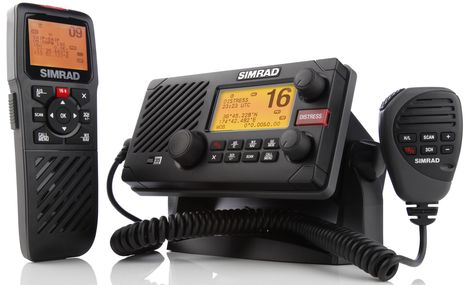
It would be interesting if the new Simrad RS35 VHF and its optional HS35 wireless mic could actually work channels 9 and 16 simultaneously, but I think that the product image above is just a Photoshop mistake. However, this radio and its Lowrance Link-8 sibling bring together a unique feature set that’s much more valuable, I think. These radios include a two-channel AIS receiver, like the very successful Standard Horizon Matrix AIS line, but they add a NMEA 2000 interface and that should add up to all sorts of plug’n’play goodness…
Consider the many boats out there that have an MFD navigation system with NMEA 2000 but no AIS and also a regular fixed VHF that’s probably not wired via NMEA 0183 to a GPS. (At least in the U.S. “probably” is the correct term according to this USCG warning.) If the boat owner replaces that radio with one of these (the same antenna and power connection should work fine) and then plugs its N2K port into the nav network, all of the following should or could be true:
- The Simrad RS35 or Lowrance Link-8 VHF will get GPS info from the nav network and therefore can place an automated DSC distress call (once the boat’s MMSI number is entered). Other DSC features like direct calling and position polling should also work well, and the VHF can be an alternate display of position, SOG, and COG info. Plus these VHFs include a MOB function.
- The radio will display and alarm AIS targets, but better yet, I think, all that AIS target data should also be available for display on whatever MFD or nav PC is on the N2K system. AIS over NMEA 2000 had some early issues but I think they are mostly history now.
- The boat will now be ready to use the new personal AIS safety beacons like the Kannad R10. I don’t know if the RS35 and Link-8 are programmed to pay real attention to the beacon messages yet (as discussed here), but I do know from other DSC radios that devices like this with relatively big speakers and amps can really get your attention if they want to! Of course the beacon messages will also go out on the N2K network.
- DSC call data should also go out on the N2K network, which should lead to a variety of standard and proprietary features. I’m not positive where the line between the two is — DSC over N2K has been rare — but I think that any well-programmed N2K chart display could plot the position and MMSI of a distress or direct call. These Navico radios also have something called Buddy Tracking which can automatically poll a friend’s DSC VHF (if he or she enables auto polling responses) and I imagine that Navico MFDs will be able to put that polling on your chart screen.
- Finally, the radios themselves should be able to place direct DSC calls to AIS targets and that feature can be neatly integrated over N2K with a plotter, as Garmin has demonstrated for years!
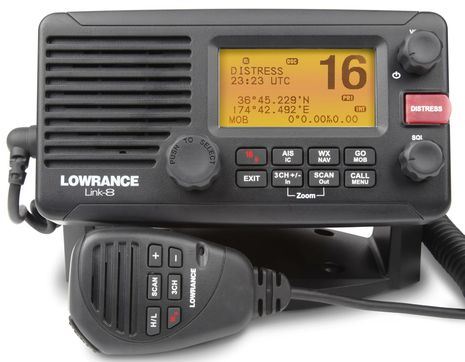
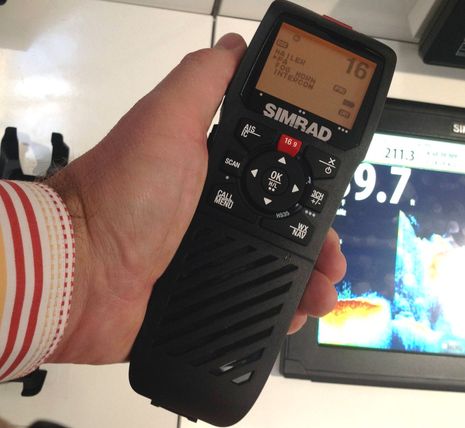
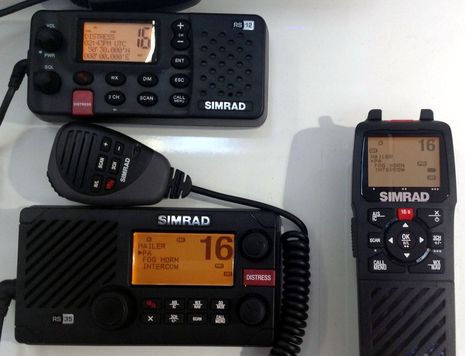
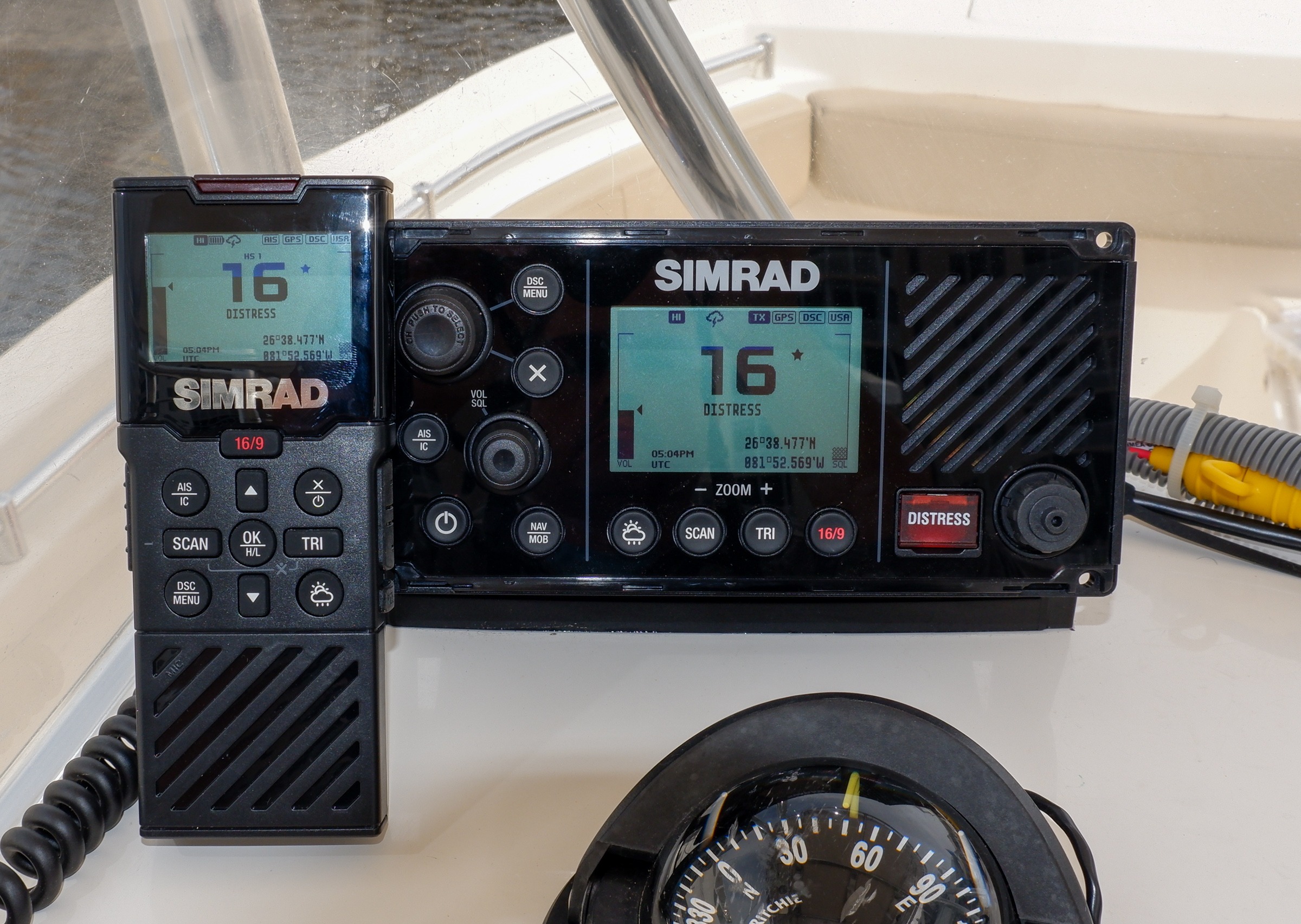
Of course the actual radio performance of the RS35 and Link-8 are important, as is the user interface. I notice that they don’t have the soft keys that I find quite useful on both the Garmin VHF200 and the SH GX2150 currently installed on Gizmo, but I’ll certainly reserve judgement. Maybe Navico makes operations easy just with hard keys and knobs. And the dual HS35 wireless mics — which come with inductive charging cradles and are purportedly capable of 100m range — certainly are interesting. Kees Verruijt reports that they are big, as his METS photos below indicate, but that may be OK, especially if the menu fonts are easier to read than those on Garmin’s wired and wireless remote mics. (I like and use the Garmin GHS 10 a lot but also wish I could turn it off or mute it from the main radio; I wonder if Simrad thought of that?)
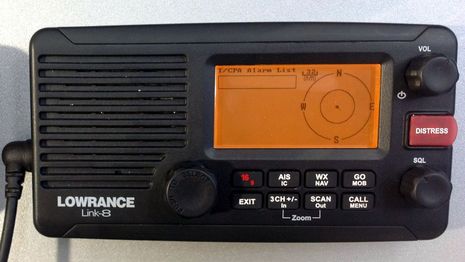
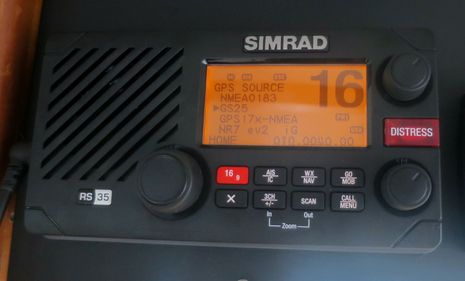
Kees also got a shot of the Link-8 in AIS mode, which I think is also possible on the wireless remote mics that can go with the RS35. No targets are shown but this looks similar to what the SH Matrix AIS and its wired Ram Mic 3 can do…
And finally here’s a Kees shot of the whole new Simrad VHF family, including the more petite RS12. It’s a more standard Class D DSC VHF except that it too has a NMEA 2000 data port, which means that a lot of those plug’n’play features listed above still apply. I don’t know why there aren’t more N2K radios available already, but I’m certainly glad to see Navico offer several new choices.



PS I think the RS35 may even be welcome on boats that already have an AIS transponder but don’t have the AIS/DSC/N2K integration features.
Also note that SimNet is not mentioned in the RS35 and RS12 specs. In my view SimNet is a perfectly good N2K-like connector and cabling systems for many boats, with some special features, but having it slowly go away will make NMEA 2000 less confusing.
Ben,
Can you please confirm that RS35 will accept a DSC call initiated from Zeus, NSE or NSS with AIS?
I know it *should* work, but from your post from December 2011 about Vesper Marine being able to do the same, I reached out to them last week and eleven months later they will only endorse a couple of Icom radios, and reiterate that it *should* work with other NMEA 183 radios.
All I am saying is yes, this *should* work, but so far appears elusive. As of last week, I decided to go IC-M604 for our refit because it will take calls initiated with the Vesper, but I would go with RS25 (and its wireless remotes) if there is confirmation that it will take calls initiated from Zeus.
+1
Happy to have 3 7 sprong simnet joiners in a row and enough simnet to mico c cables
Since my rs82 and 87 don,t get the needed positions over n2k I might move to the rs 35
@Ben “Also note that SimNet is not mentioned …. but having it slowly go away will make NMEA 2000 less confusing.”
Amen to that.
I think Garmin was the first with this kind of VHF with the option in the MFD call on radio.
https://panbo.com/archives/2009/07/garmin_vhf_300_ais_xhd_radar_more.html
Finally!!There was an earlier Lowrance with limited N2K but adapter cables were an issue.I would buy the Simrad to plug right into my N2K Simnet.
Inductive chargers seem to be a big generator of RF.
I know the Uniden ones put noise out…affecting an onboard 12v stereo.
I prefer hard wired/contacts chargers.
Sorry, Xavier, I can not “confirm that RS35 will accept a DSC call initiated from Zeus, NSE or NSS with AIS.” I’ve learned more about these radios since I wrote the entry but am still unsure about the AIS target calling, especially from an MFD.
Let’s clarify that there are two ways that a VHF radio like the RS35 and Link-8 can place direct DSC calls to AIS targets. One is right from the radio, just picking a target off the list, specifying the working channel you’d like talk with the target on, and hitting call button. That should be really easy to implement in these radios, even if it takes a software update (which can be done over N2K from Navico MFDs).
The other way, already possible over N2K with a Garmin MFD and VHF, is by selecting the AIS target off your display, picking the working channel, and sending the command to the radio. But understand that you still have to command the radio to execute the command. So there’s not all that much difference, and in either case you are saved the pain of transcribing the target’s MMSI # from one screen to another.
I should also note that many vessels, ships included, are not yet used to receiving direct DSC VHF calls and don’t know how to acknowledge them. Or they don’t have a VHF programmed with the same MMSI as their AIS transponder. However, with radios like this you still have the target’s name right on your radio for placing a regular voice call.
My experience from the handful of times when I have had the need is that reading the ship name off the AIS pop up box on my plotter and hailing them on 16 is 100% effective.
The one circumstance in which the DSC hailing would perhaps be helpful is for targets that are Class B equipped vessels that often show only an MMSI on the plotter and thus cannot be hailed by name but could in theory be hailed via DSC.
I’ve never even tried to contact via DSC a vessel not known to me, for the reason Ben notes above. However, I have found DSC to be exceptionally useful when buddy boating with other vessels that have DSC radios. It cuts a lot of hassle out of reaching your friends, and the loud alarm ensures that they hear your “hail”, even if the radio is turned down. Our Matrix also shows a “missed call” on the screen if a hail came in when you were off the boat.
I purchased a Garmin VHf300 a few months back after being assured (in writing) that it would support the direct hailing of AIS targets using the radio. (Like Standard Horizon does.) After installing the radio (and sending it back for a software upgrade so it would work with GHS20 wireless mics), I learned that this features is actually not supported. If fact, it took several emails to get to the point where they even understood what I was talking about.
It is possible to hail AIS targets using the VHF300, but it requires a Garmin chartplotter. This would be a second best solution, but only if I had a Garmin chartplotter. (I don’t.)
I mention all this as it would seem obvious that the new Navico VHFs would also support direct AIS hailing, but I wouldn’t assume anything. This may not be a big deal to many, but when sailing offshore and and crossing shipping lanes it would be very helpful to be able quickly hail AIS vessels to confirm course, etc.
Jeremy,
it was exactly this point that made me chose a SH GX2000 over a VHF300 though I would have much preferred the black box configuration.
I have used the GX2000 for the past season and am happy:
– I can select an AIS target from the GX2000 and issue a call with about 5 key presses. The list on the radio is sorted by distance (I think). Be aware that in a crowded area, this quickly becomes impractical to the point where you are no longer able to use it. I think the list is truncated at maybe 10 entries. Even if it weren’t, as you can only read a few lines and the scrolling speed is low, it would take minutes to scroll to position 70 down the list. In a crowded area, the interface via a chartplotter is the better or only way. However, I still prefer this method because it is quicker and more reliable on a bouncing boat.
– I can request a position from my SH HX851 handheld, get an automated reply and have the GX2000 output the position as 0183 DSC and DSE sentences and have a red dot appear on the chart in Coastal Explorer. The position request can be set to be sent repeatedly at a timed interval. This makes the dot in CE jump at intervals. It seems that you can’t send manual position requests more frequently than the automatic interval of a few minutes.
– The GX2000 and HX851 work together as desired even if they are programmed to the same MMSI. The GX2000 does not respond to it’s own position request and the HX851 responds to the request even though it uses the same MMSI that the HX851 itself is programmed to. I had doubts whether this would work but it does. Because of a change in legislation in Germany, this configuration is now legal.
– I can use both of the above functions also from a RAM mic in the cockpit.
– Having a hardwired cockpit station instead of a wireless is also why I am still happy with my purchase after this entries’ Simrad model was released. I have mostly Simrad gear around the boat and have ditched my RS82 dual station black box VHF for the GX2000. Sure, I would like the Simrad’s better design but not at the cost of a wireless mic.
– There is a second sepaker in the cockpit and the GX2000 allows for it’s volume to be adjusted independently from the volume on the main unit at the nav station. The cockpit speaker even works when the RAM mic is not connected. I just can’t change the volume (it uses the last volume setting).
I find it weird that the GX2000 and RAM mic cost only a fraction of the RS82 dual station installation it replaced but at the same time offers several times as much utility. I also find it weird that Simrad does not update their flagship models (RS87 and RS82) to support position output and positions request/response. Poor superyacht owners!
But be that as it may – I am happy.
another thought:
The SH GX2000 has one NMEA0183 output at 4800 bit/s and two inputs, one fixed to 38400 bit/s and one at 4800 bit/s. My 0183 AIS transponder Weatherdock easyTRX2 has a function to send the sentences of the internal GPS intermixed with the VDM-sentences on the high speed port. So ideally I would just connect the easyTRX2 and the GX2000 via the high speed ports and be done.
But not so: the GX2000 stubbornly refuses to read the GLL sentences on the high speed port and demands them on the low speed port. So, voila, there we have our rat’s nest of wires.
I think this pretty well underlines Ben’s argument for NMEA2000 with VHF radios and I hear it. Just not at the price of a wireless mic, especially if the charger creates RFI.
And what about the volume of the speaker in the wireless mic? I have been surprised several times at how enormously loud you have to turn the volume in the cockpit in order to make out the conversation when underway. I usually forget to turn down the volume after docking and have on occasion been startled to the point of almost jumping overboard by a sudden burst of traffic on the VHF.
Is a battery powered handheld device giong to provide this much audio power and if so, for how long?
And a reminder:
When you are requested on the radio, using your cokpit station, to provide your position, do you have a display at hand giving you lat&lon in numbers?
And if you are given a position on the radio, do you have a way to write it down in the cockpit? I have wax crayons that write on the gelcoat.
I keep waiting for someone to build something like the R35 with AIS transponder integrated. One box, no external spliter, fewer wires, etc.
That combo might be nice, but perhaps not possible given the tight regulations transponders are built to.
Navico supplied a PGN list for the Lowrance Link-8 and Simrad RS35 VHF/AISrx combo radiow with N2K:
127250 Vessel Heading
127258 Magnetic Variation
129025 Position, Rapid Update
129026 COG & SOG, Rapid Update
129029 GNSS Position Data
129033 Time & Date
129038 Class A position report (Rx,Tx)
129039 Class B position report (Rx,Tx)
129040 Class B extended position report (Rx, Tx)
129041 AIS Aids to Navigation (AtoN) Report
129283 Cross Track Error
129284 Navigation Data
129285 Navigation Route/WP Information
129792 DGNSS Broadcast binary message (Tx)
129793 UTC and date report (Tx)
129794 Class A static and voyage related data (rx, tx)
129795 Addressed binary message (tx)
129796 Acknowledge (tx)
129797 Binary broadcast message (tx)
129798 SAR Aircraft Position report (tx)
129799 Radio Frequency/Mode/Power
129800 UTC/Date enquiry (tx)
129801 Addressed safety msg (rx,tx)
129802 Broadcast safety msg (rx,tx)
129803 Interrogation (tx)
129804 Assignment Mode Command (tx)
129805 Data Link Management message (tx)
129807 AIS Group Assignment
129808 DSC Call Information
129809 AIS Class B “CS” Static Data Report, Part A
129810 AIS Class B “CS” Static Data Report, Part B
130074 Route and WP Service – WP List – WP Name & Position
130842 AIS and VHF Messages (Simrad Proprietary for AIS Class B ‘CS’)”
Also added this: “We are working on DSC calls to AIS targets as an on-going project and hope to offer this as a feature in both the radio and our MFD’s in future software updates.”
Ben,
Is it fair to expect a VHF/AIS Transceiver in further evolution of the trend? Do you have an inside track on anything in the works?
DJ
Sorry, haven’t heard anything about a VHF/AIS Class B in the works, and sort of doubt it’s possible given the strict build regulations.
Will the Rs35 be able to be networked together with my raymarine e 120?
Does the link-8 display AIS targets and info without programming a MMSI? The user manual says a MMSI is required for AIS to work but I do not understand why?
Has anyone tried?
My question is whether or not it is possible to use the Simrad wireless remote mics with the Link 8? To my eye, the Link 8 and the RS35 are identical products, and removing the $2 in parts is likely to be more expensive than just leaving them in the link 8 and not offering that functionality in the specs, even though it is in fact built in and functional. Any ideas about this?
I’m really trying to stick with Simrad equipment, but they’re making it difficult. I cannot believe they don’t sell a wired remote unit for this thing like Standard Horizon does.
I don’t need a wireless remote unit because I only need to use it at my helm. And, I don’t want to have yet one more thing that needs to be charged or that can go dead unexpectedly. I also don’t want to lose the bloody thing over the side. So I need a good, old-fashioned WIRED remote unit. And they don’t make one.
Furthermore, i don’t want to buy up to built-in AIS just to get the wired remote option because I already have the NAIS-400 transponder on NMEA2K.
I bought the RS12 NMEA2K VHF when I was configuring my system and it is perfect for my needs, except for the lack of a WIRED remote unit.
What is with this irrational wireless obsession? It’s bloody mental.
Think I’m gonna ditch it for the Standard Horizon GX2000.
Several points from the Simrad manuals online.
BOTH the old Navico and the new Standard PGNs for Class B Static Data are supported: 129039&129040 and 129809&129810. (RS35 and HS35 User Guide, p.73)
There is no AIS PPI on the HS35 screen (p.68) — It doesn’t say if the T/CPA Approach screen is shown on the HS35.
The mounting bracket for the HS35 includes an induction charger, so if you want a wired remote all you have to do is supply your own tether to the mic.
Peter asked if AIS targets are displayed if the MMSI has not been entered. The answer should be yes for any AIS receiver. The manual says the MMSI is required to use DSC functions, not AIS.
Simrad documentation implies that the HS35 remote doesn’t work with the RS12. If thats not the case, they dont make it clear.
Norse, thanks so much for keeping up with this stuff!
Anon, I’m not sure where you got confused but the RS12 definitely doesn’t support the HS35 wireless mics.
Ben, the simrad site has contained errors, and retail marketing often suffers sins of omission. The usefulness and applicability of the wr20 remote commander is a case in point. This site has been updated in haste (and with errors) to dispell notions that it is compatible with Simrad’s consumer radios. Subsequent research indicates that customers are underwhelmed with its performance, often wondering why it doesn’t work. I’m left wondering if they even understood that it might not be compatible with their equipment. For me, I’m just looking for a vhf radio without AIS that has a simple wired remote unit that allows full operation at the helm. This irrational exhuberence for wireless seems absurd. Standard Horizon seems the better choice.
Brian,
Simrad RS82 is still available.
You can buy mine if you like
I’m a big fan of black-box units with full-function remote mics. A quick search shows these options:
Standard Horizon Phantom PS1000,
Icom IC-M400BB,
and also these which have N2K:
Raymarine Ray260,
Garmin VHF300,
Simrad RS82.
All of these use wired remote mics.
I installed a Lowrance link-8 2 weeks ago. In the detailed AIS screen I do not see all details of the vessels. MMSI, COG, speed, position is displayed but I am missing vessels name, length, width. Is this a error on my radio or is this information not transmitted by every AIS transponder? I sail on a lake and there a only 2 vessels sending AIS information.
Did you leave the radio on for a while, Peter? In both Class A and B AIS, the info you saw is broadcast much for frequently than what’s called a vessel’s “static data” like name and dimensions.
The static data message is only sent every six minutes so it might take that long to show up, or longer if you are far enough away from the vessels that some messages don’t make it.
Please let us know if leaving the radio on solves the problem. I think you are the first Panbo commenter who is trying one of these Navico combo AIS VHF radios.
So could some one please tell me if i should purchase the RS35 OR the Link- 8, which one is the best. Cheers
Hi Scott, I’m not positive but I think that they are very similar radios but you pay a bit more for the Simrad in exchange for the ability to have remote wireless mics.
I actually have an RS35 installed in my lab, but am just beginning my tests. I can tell you that hooking it up to a Garmin GPS via NMEA 2000 was almost instantaneous plug’n’play (you do have to go into the radio’s setup menu to select the GPS source). I presume but have checked yet that N2K AIS info come out of the radio just as easily).
I’ve also observed that the radio is quite sensitive, bringing in very distant WX channels clearly. But note, as discussed above, that it can not yet place direct DSC calls to AIS targets, which should be easy and may come in a future software update (not sure how that gets implemented). It also doesn’t seem to a memory scan function like Icom, Standard Horizon, Garmin and others offer. It has a very nice tri watch scan of any 3 channels and will scan all channels, but you can’t scan, say, you 8 favorites. Unless I missed something. More to come.
PS The manuals for both radios are online and worth checking out:
http://www.lowrance.com/en-US/Products/VHF-AIS/link-8-en-us.aspx
http://www.simrad-yachting.com/en-US/Products/VHF-Radios/RS35-VHF-AIS-Radio-en-us.aspx
Radios like this can do a heck of a lot!
I have installed the RS35 (and HS35) in a system that combines Maretron and NSS/zeus MFDs. As other have observed, the instalation is pure plug and play. So far so good!
The disapoinment came after 8 hours of use when the screen on the HS35 showed off a distinct scratch (it migth even be a crack, but its hard to tell). Given the stuff was new, I handled it very gently – and it still got scratched. Simrad could certainly learn a lot about screen tecnology from the producers of modern cell phones.
I’m on my second Link 8; the first never worked using MMSI polling between to other radios. It also started playing NOAA weather while the display showed it was still on Ch 16 – the channels never changed.
I’ve given up on Lowrance from a chartplotter perspective after 2 defective HDS touch units; I am hoping for better luck with the second Link 8 but am concerned with using it with a Garmin (741xs) chart plotter. I wonder how compatible it will be?
I’m pretty sure it will take the 741xs GPS input over NMEA 2000 and would be surprised if the 741 didn’t see it’s AIS info fine. But I’m not at all sure about how well N2K DSC messages work between any mixed manufacturer combination of radio and MFD.
According to
http://www.nmea.org/content/nmea_standards/messages_pgns.asp
the *only* DSC N2K message defined as standard is “12808 – DSC Call Information” which is how a radio tells other devices (MFDs, charting software) about an incoming DSC call. The PGN number is actually 129808 – the website is wrong and has been for half a decade.
So this part could work between manufacturers – you can check the manuals for this PGN (output on the Link 8, input on the 741).
Anything beyond this, such as tapping an AIS target on the 741 to initiate a DSC call will almost certainly not work because there is no N2K standard PGN defined that any of the manufactuerers could support.
Hi Henning, It’s getting rather dated but you might be interested in the PGN field list here:
http://www.nmea.org/Assets/july%202010%20nmea2000_v1-301_app_b_pgn_field_list.pdf
PGN 129808 has a lot in it
Ben, it appears from your post of the NMEA standard for PGN 129808, that if the radio (link 8) and the MFD (740xs) both correctly conform to the NMEA 2000 standard, DSC polling and display shouldn’t be an issue. I’ll report back after I install it all together. As stated, the Link 8 did not work correctly with an HDS-9 touch, but both units proved to be defective so there is not way to tell anything with that test.
I installed a Garmin 547xs replacing a Garmin 740 on my boat. I have a mixed MFD install…. a Simrad NSS8 and a Garmin 547xs. The 547 is connected to a SH GX2100 via NMEA 0183 and the NSS8 to an ICOM 504 via NMEA 0183 Both MFD’s are connected to a Garmin N2k network and exchange data without issue.
Here are some screen displays from the Garmin 547xs.
Garmin 547 N2k Device Display
Garmin 547 GPS SkyView Display
As with the 740 the Simrad sees all the Garmin 547’s N2k devices and can use the GPS data for navigation. The only diffence is when I choose to use both the US and GLONASS GPS Systems the SkyView data does not appear on the NSS8’s SkyView Display. The NSS8 does display the 547’s positional data, accuracy numbers, and WAAS info. If I choose to only use the US GPS System then the SkyView display does show up on the NSS8.
Note: I’m using the 547’s internal GPS antenna. It works well even though my unit it flush mounted.
The Garmin lists the Simrad GS15 GPS Antenna in the N2k Device List but cannot use the data from it.
My Install
CHIRP Sonar Display
My 547 is connected to an Airmar TM150m TM transducer. The combo works well together.
Tom
Forgot to mention ….. I’ve installed one Lowrance Link 8 VHF Radio on a clients boat. The first two were defective out of the box (1st dead microphone, 2nd the radios display would not work the dreaded black screen) the 3rd one worked as advertised. Haven’t heard back from my client as to performance on the open ocean.
Thanks for the file!
Joe: I believe the “polling” part, where a radio asks another radio where it is, is handled between the radios and does not involve the MFD and any kind of N2K PGN.
The “display” part, where a radio that has received the position from another radio (as a result of polling or via an incoming call, individual, group or safety/distress), sends the information related to this call (all of the data shown in the field list) to an MFD, is covered by PGN 129808 and I agree that this should work between the Link 8 and the 741.
I remember reading here that Garmin MFDs combined with Garmin radios allow to tap a call target displayed on the chart in order to initiate a DSC call to that target – to prepare the call on the radio and avoid having to enter the MMSI by hand. The call target could be there on the chart via a previous PGN 129808 or it might even be a regular AIS target.
This particular function, I think, isn’t going to work with this combination for lack of a “prepare DSC call” PGN that would be sent by the MFD and received by the radio.
Garmin and also Simrad with the AI50 and RS82 with updated software have implemented this function using a proprietary PGN that will in all likelihood not work between manufacturers.
However, I personally see the display part, which is covered by 129808, as far more important than the convenience of not having to enter the MMSI because the dot displayed via 129808 could be my wife or child in the water carrying one of our two DSC handheld radios or it could be another boat in distress.
Also for this reason, I don’t like the position polling feature of current DSC radios called “buddy tracking” because this denies the important safety aspect.
After installing both units last night and messing with every imaginable setting on the,, I can not get the GPS coordinates to pass from the Garmin 741 to the Lowrance Link 8. The 741 sees AIS data from the Link 8, and the Link 8 sees the 741 as a GPS source, but I am unable to get the Link 8 to display the GPS data over the NMEA 2K link. I briefly attempted to do it via NMEA0183, but I’m certain my wiring connections were wrong and it didn’t work. But after seeing the defect history of the Link 8, I don’t know where to look next.
I have been hailing AIS targets with DSC MMSI using my Garmin plotters to input the data via NMEA2000 with my Garmin VHF200 radios. I have always received a return call from Class A vessels. I have only had a few Class B vessels not respond. I think it’s an easy way to hail a vessel and negotiate. I just did a call tonight to a Class A vessel 76 miles away. We are experiencing tropo ducting from NJ to North Carolina tonight.
Bill
MV; Wireless One
Mainship 40SB
Ben,
You mentioned in an earlier post that “I can tell you that hooking it up to a Garmin GPS via NMEA 2000 was almost instantaneous plug’n’play (you do have to go into the radio’s setup menu to select the GPS source).”
What Garmin model were you using? Did you do anything “special” to allow that info to pass over the NMEA 2k network from the Garmin other than choose it as a source for your GPS on the Simrad? I have done literally everything I know (to the point of changing out NMEA cables and NMEA2K tees!) to get the Link 8 to get GPS info from the Garmin 741. I finally wired it in a NMEA0183 config to get the GPS coordinates on the Link 8. IMO, however, this is defeating the reason to even buy the Link 8.
Joe, It’s a Garmin 17x and I didn’t do anything “special”…in fact, I don’t think there is anything special that can be done. So, are you positive that the Garmin 741 has its internal GPS on? On the radio, have you definitely found the Menu/Radio SetUp/GPS Source spot where you should see a choice of NMEA 0183 (default) or Garmin GPS?
I do have a Garmin 741sx en route to me now so I should be able to try the same setup this week.
Ben,
When you say internal GPS on the 741xs, I’m not exactly sure what you mean. The GPS is “on” (I’m not sure how to turn it off, other than tehmain power switch?) as I can my see my location on the chartplotter and also the coordinates (only via NMEA0183) on the Link 8. Is there something else I could have missed as far as having the GPS on?
I see and have chosen the Garmin 741xs as a GPS source in the menu of the Link 8 VHF.
I’m very interested with what you find when you receive your Garmin 741xs.
The GPS settings on the Garmin 741XS are as follows:
Skyview View of satellites acquired and S/S
GLONASS on/off
WAAS/EGNOSS on/off
Speed Filter
I’ve posted a lot information on THT in regards to some of the GPS N2k data anomalies I’ve seen between my Garmin 547 and Simrad NSS8 things I didn’t see with my Garmin 740 and Simrad NSS8.
GPS N2k Anomalies
Tom
Thanks, Tom! It looks like you and ‘kaz911’ have identified a possible issue with using Garmin’s GLONASS/GPS data beyond Garmin devices. It may also be true that the Simrad RS35 is particularly fussy about what auxillary GPS data it needs to see before using the position info. I notice now that while my test RS35 sees a Garmin 17x, it does not seem to see a Raymarine RayStar GPS on the same backbone. That’s tentative; I’ll do more testing.
My RS35 hooked to the NK2 bus sees the GPS inside a Zeus Touch T7 every time, but sees the B&G ZG50 GPS only part of the time.
Joe, I’m getting the same results. The Simrad RS35 sees the Garmin 741 as a GPS source but then can not use it, even though the 741 has a valid position (“ready for navigation”).
Sorry that I misguided you in a comment above, but this is surprising. It seems like the RS35 is darn finicky about acceptable GPS data and also that the new Garmins with Glonass may be putting out some unusual data. A Maretron WS100 GPS does work with the radio but a Raymarine Raystar only shows up as a source with no position received (like the 741). Meanwhile the 741 displaying on an old ST70 shows 10-14 satellites in use while its own screen shows 5-7 in use.
I predict software updates for both RS35 and 741, hopefully soon 😉
Ben, that is interesting. I guess I am glad to hear it is not just my radio, but now realize I am waiting on at least one software update to make this work the way it should.
I installed a Garmin 741 last night on a clients boat. It’s connected via NMEA 0183 to a SH GX2150 VHF/AIS radio. Everything is working as advertised in regards to navigation NMEA data passing between the units.
BWP-I have my Link 8 connected via NMEA 0183 to my 741xs and it also seems to be working correctly, transmitting both GPS and AIS info correctly. I have not tested DSC polling with othyer boats yet.
GS25 as well supports Glonass. As expected RS35 don’t have any problems using GS25 as gps source.
There is a thread on Raymarine support where two of us are trying to get the RS35 to recognize GPS data from e series MFDs. Same symptoms as Joe reports.
http://raymarine.ning.com/forum/topics/integrating-e125-with-simrad-rs35-ais-vhf
Glad (sort of) to see that the problem exists with other brands providing GPS data to the RS35, maybe that will help Simrad narrow it down. Though, like you say Ben, I see nothing anywhere about user applied software updates to this radio, so if a solution does come, the radio may need to be shipped back.
This was posted on TheHullTruth this morning. Sheds some light on the issus of N2k data problems.
I just recently bought a Simrad RS-35 VHF. Has some nice features I wanted, such as AIS and NM2k network interface.
You may have seen the technical service bulletin for the RS35 earlier this year, which I thought had been resolved. Looks like they either didn’t fix it yet, or discovered a different problem.
Simrad is telling me not to use the N2K features of my radio. They say they have issues and are working on a fix. They went on to say that the NMEA 0183 should function correctly. This is a email I got:
Hi Martin
Our R&D has recognized an issue in the RS35 N2K interfacing. They are working hard on a fix and hope a new software will be ready next week.
The interfacing via NMEA 0183 should work perfectly, so this could be a solution for now.
Best regards
Odin
Has anyone tested the link 8 / RS35 and DSC using NMEA0183? I’m able to get AIS info to my chartplotter from the Link 8, but I’ve been unable to successfully trade DSC positions with a friends VHF radio/chartplotter.
I’m wondering if like the old Navbus protocol, if using NMEA0183 on the link 8 and trying to trade DSC polling positions may be proprietary to Lowrance units as well.
Joe, is the problem between the radios or between one of the radios and it’s chart plotter? Would the problem still exist if only the two radios were involved, not any chart plotters? And do both radios receive their own position from their connected GPS receivers? If so, the problem is not related to NMEA0183.
If the radios exchange their positions OK and the information is not displayed on the receiving chart plotter, then it could be related to the NMEA0183 protocol but this is not very likely as the sentences involved in sending the information for an incoming DSC call to a chart plotter are standardized (sentences DSC and DSE). However, some plotters may not have support for these sentences. The Link-8 most likely outputs these NMEA0183 sentences correctly. That would make the chart plotter on the receiving end the most likely culprit.
I have a Garmin 547 connected to Stand Horizon GX 2100 VHF/AIS and ALL is well in regards to NMEA 0183 DSC/AIS. Just for test purposes I connected a Garmin VHF 200 via N2k to my 547 and it works just fine. IMO the problem is the RS35 and Link 8 radios. I’ve installed 5 Link 8’s and 1 RS35 and all have had issues with N2k and NMEA 0183 in regards to DSC and AIS. Navico has already stated via emails there are NMEA issues with these radios. Of the 5 link 8’s I’ve installed 3 were bad out of the box.
I’m beginning to believe you Tom. This series of radios from Lowrance seems to be very buch in beta mode.
So *IF* the LINK-8, RS35 and the GX2150 are all connected via their respective compatible networks (N2K or N0183) and *IF* they are all working with their MFD correctly (eg 741XS) are there any functional differences?
Can any of them initiate a DSC call from the MFD?
I did receive verbal confirmation from Lowrance that the LINK-8 does indeed support initiating output DSC calls to AIS targets.
Navico sent me a recent “Simrad RS35 VHF Radio-Shipping Hold” that also applies to the Lowrance Link 8 and reads as follows:
“Navico is working to improve aspects of the NMEA2000 networking on the RS35 VHF radio.
We have had reports from the field that RS35 is not seeing GPS position source from some other manufacturers MFD’s and GPS antennas, whilst others are working correctly. We have also had reports of some issues with GPS source list not seeing all units on a NMEA2000 network, making it difficult to select a GPS position source. We are working on updated software and will release it as soon as possible.”
They say they are very close to a fix and that radios with software 1.062 or better can be updated over NMEA 2000 from a Navico MFD.
Lee, I also double checked your “verbal confirmation from Lowrance that the LINK-8 does indeed support initiating output DSC calls to AIS targets” and think it was confusion. You can input the MMSI of an AIS target to place a direct DSC call but one-button initiation of such a call won’t be available until a future software update.
Anytime the RS35 is on, I get very brief random systemwide errors every few minutes such as:
“No controller found”
“No a/p available”
These are rather noisy (all the Tritons and Zeuses go berserk) and, as far as I can tell, very transient, because by the time I hit “OK” or “enter”, all seems to be working again.
Yesterday I was even able to produce the error by merely turning on the RS35. Yes: turn the RS35 on, wham, systemwide alarms!
There are three GPS in the network (ZG50, internal Zeus T7, and NAIS-400 with GPS data output). The RS35 often is unable to see them, or loses sight of whichever one it was last set to listen to. The RS35 is exclusively hooked via SimNet.
One more thing: the AISrx on the RS35 reports most boats’ names properly, but at the end of a minority, it appends “@” repeatedly all the way to the end of the field. So, for instance: PANBO@@@@@@@@@@@@@@@. It does this even to my own boat’s name, even though my boat’s name shows up properly on other AIS receivers.
I’ll be turning off the RS35 and using either the Icom IC-M92D or the HH36 handhelds until the software issues are fixed!
I’m also having the same problems getting the RS35 to see my GPS location from the Raymarine e7d.
There are some other annoyances which would prevent me from recommending this unit:
1) I’m seeing a bug where the unit randomly switches to the weather band from VHF. It doesn’t believe that it switched (HS35 and RS35 both show the VHF channel on their displays), but it’s playing whatever weather channel you were last on. I have to press WX twice to switch back.
2) The scan feature is useless in Canada where VHF 21 always has the weather. The scan feature on this radio scans everything, instead of using the normal implementation of allowing you to mark which channels you want to scan.
3) Sound quality on the HS35 isn’t great. It can be hard to hear, even near your ear, when sailing in high winds or in rough seas.
It sounds like some of you have had more help from their customer service. When I asked about it not working with my e7d I got very little help. They haven’t responded at all to the other issues that I’ve mentioned.
Do I really need to find a Simrad MFD for firmware updates? How does this work for boats that are primarily using Raymarine or Garmin electronics?
Alex,
My first link 8 had the same problem of switching to NOAA weather without ever changing the channel. I sent it back to Navico, and they sent me a new radio.
The new radio does not receive or (transmit as far as I can tell) radio traffic (except for NOA weather), and DSC does not work over NMEA0183 or NMEA2000 connections. I have verified the antenna by temporarily swapping in another radio that worked fine. AIS however, does work on both NMEA0183 and NMEA2000.
I understand they have a new fix that should be available soon, and am sending the radio in again for repair (or replacement). At this point, I’m tired of messing with it and just want a radio that works.
Thanks Joe.
I just got email from Navico that there is new software available. I have to find a dealer who can upgrade my radio for me. They neglected to let me know if the fix included the NOAA issue.
The RS35 update is ready, but this one has to be done by a Navico or one of its dealers (as is true of all VHF radios I know of). Here is what Mark Harnett, Navico Comms/Safety/AIS Product Manager just wrote me:
“Finally done, we delayed a week or so to improve the CPA/TCPA alarming and added more flexibility in setting these minimum values and made the defaults more sensible.
Unfortunately the radios have to come back to Navico to be upgraded, or a suitably equipped dealer. (Future upgrades possible over N2K from MFD).
We have successfully tested with other manufacturers units, including Garmin 740.
Full improvement list here;
New Software v1.112
N2K:
– Integrate update N2K library V0.3.8
– Update N2K handle for disconnect issue and position update
– Fix COG display in radio when select N2K GPS as source
– Fix N2K incorrect bearing data in NAV mode
– Change N2K navigation update interval from 2s to 1s
AIS:
– Updated CPA/TCPA default settings
– Changed CPA and TCPA range settings
– Fix CPA 1nm setting retention issue
– Display MMSI when Name not available in AIS list view
VHF:
– Update 16/9 key function only for USA version
– Update CH9 always Hi power first for USA version
– Fix Ch9 power setting issue under Wx Alert turn on
– Fix HL power setting not being retained on power cycle
– Mute speaker when PTT
– Update text display under ‘HS SETTING’ menu
– Handset subscribe UI update
The bulletin will be going out in the next 24 hours, all stock at Navico distribution centres will be upgraded.
A PC with SWUP software and a USB to SimNet converter is needed to do the update. The USB to SimNet can be Simrad ST10 or Kvaser USB to CAN bus development tool. Software versions prior to 1.062 can’t be upgraded from a MFD. Current Simrad and Lowrance MFD software don’t support upgrades from 1.062. I have upgraded both my RS35’s to 1.112, I will help a guy with his Link-8 tonight. I’m using SWUP with ST10. I bought ST10 a couple of years ago when assisting a couple of guys with AP24 pilots but with no Navico MFD’s to upgrade their autopilots.
The Norwegian Navico distributor has put up a list of dealers with SWUP update capabilities on their webpages for RS35 and Link-8 customers to see if they can get the update done by a dealer locally, or if they have to return the radio to the distributor.
http://www.pronav.no/index.php?page=download&FilArkivID=181&KatID=1
An update, at the website of the Norwegian distributor it is stated updates for 1.062 and higher can be done from MFD’s. I tested upgrading a RS35 from a HDS Gen2, and yes it works!
I was ready to try the 112 update listed above on my us version, however, my RS35 no longer shows up on my NMEA2000 network. It will be going back to Simrad tomorrow! Not a happy camper. 300 for a radio, plus overnight shipping, because I wanted it now, then find out it is backordered, now I have to send it back to Simrad, at my cost, then wait up to 14 days for them to “repair” it and send it back to me via ground… To add to that, we just had to RMA our Lowrance HDS 12 due to a huge green spot that was ” caused by the manufacturing process”… They shipped another one pretty fast, but it cost $90 bucks to ship the bad one back to them! Lowrance/Simrad/whatever else they are need to get their act together, or at least start covering return shipping if they are going to put out such junk! I would go to Garmin, but the Lowrance products are still a bit better, at least for me… If these products were for cars or airplanes there would have been a class action by now, just to cover return shipping charges!
Think I’ve made up my mind – Standard Horizon’s GX2150 for me; works on NMEA0183, but works. These units by Navico seem to be too flaky just to get N2K.
There is still no update available for US customers. Pretty bad since it looks like this has been available in Norway for weeks now.
My radio has 1.023 on it, so it looks like I will need to either send it in for service or work with a local service center.
My RS35 is version 1.062. I downloaded the sw update file from the Norwegian site and my B&G Zeus 12 does the following:
– Upon selecting the .swup file, it displays the screen that from experience I know should display all devices that are capable of accepting the upgrade, name, current version, etc. You then should be able to select the one(s) you want and execute the upgrade.
– This list is blank.
– Any Zeus polls of the network before or after the above failure do show the HS35, its instance number, its sw version, etc.
– Turning off and on the radio or the Zeus or the network causes no changes to the above behavior.
This is too bad, because yesterday we did the Florida automated radio check on channel 27 that records your voice and plays it back to you. Our Simrad HH36 handheld came in last for audio quality, our Icom IC-M92d handheld came second, and the Simrad RS35 was by far the clearest. All three at the “low” power. Of course, the RS35 benefits from having a 4 feet Shakespeare antenna atop a 70-foot mast…
The RS35 software upgrade is now up at Simrad
http://www.simrad-yachting.com/en-US/Support/Downloads/RS35-Software-v1112/
and will soon be at Lowrance for the Link-8.
But Navico asked me to repeat that no one should try to update a radio themselves unless it’s already running 1.062 software.
(Sorry, anon, I don’t know why it isn’t working for you and I’m told that the update on Simrad is the same as the one you already tried.)
Interested in any/all Link 8 updates
B&G announced its equivalent of the Simrad RS35 and HS35:
The B&G V50 and H50
In case of receipt of a DSC distress call, the Zeus show the position of the originating call. Is this a new feature or will the RS35/HS35 currently hooked to the Zeuses via N2K do the same?
In other words, are these cousins the same with a different label or are there differences?
http://www.yachtingmagazine.com/electronics/communication/2-sweet-helm-upgrades?cmpid=enews101013&spPodID=030&spMailingID=17959633&spUserID=MzQzNTcxMzgwODMS1&spJobID=233513057&spReportId=MjMzNTEzMDU3S0
I checked again on 18 Oct 2013 to see if there was an update for the N2K problem and Navico told me there is now. You have to call them and get a RMA and the right paperwork to send in with the radio. The unit has to be sent in for the fix, but at least there now is one now! Mine is on it’s way to the location somewhere in San Diego for reprogramming, so I hope to give a positive answer here in a few days.
The 1.112 update has been available since July. For those with software 1.062 or higher the update can be done from a Simrad MFD. For those with an older software RS35 will have to be returned to a dealer or to Navico for the update.
The 1.112 software can be downloaded from the link below
http://www.pronav.no/download.php?FilID=251
I’m sorry – I should’ve been more clear. The update is for the Lowrance Link-8. You’re right – the update has been available for the RS35 for several months.
Smooth Sailing
I also upgraded a Link-8 to 1.112 in July
The software is not posted at the Lowrance pages but I assume those who need it can get it from customer support.
Is this VHF worth buying ?
Are the bugs solved now ?
Update about Lowrance Link-8. In early November I was notified that there was now a fix for it. Others reported this months earlier, but now I can confirm too. They told me to box up my radio and send it in to get it reprogrammed. About a week after it was sent in, I received a NEW Link-8 radio from the repair facility. It was not my original radio – this one was new. The first thing I did was put 12v on it and verified the software/firmware load. It was the new v1.112 version. The radio works as advertised now. AIS, GPS…everything works on NMEA2K. Good radio – worth the money.
I tried to update the RS35 to the v1.112 software update via NMEA2K from a Zeus 12. The RS35 died, as in it would no longer even turn on!
Note: my RS35 _did_ have a sw version which _was_ “supported” for software upgrade (earlier versions were not supported for software upgrade and needed to be sent back).
Simrad replaced it under warranty.
The current RS35 seems to work well, but it does not yet work correctly with the HS35:
1. The HS35 loses sync to the RS35 after a while. What’s dangerous about it is that you may be given no clue about it: it all seems to work, except when you press the push-to-talk button on the HS35, no actual transmission goes out of the RS35.
2. The HS35, while scanning two priority channels, will display every few seconds as follows: 16…9…16…9… etc. But guess what happens when there is an actual transmission on either channel? It displays “0” (channel zero) for a fraction of a second before it locks on and plays sound and displays the actual channel under which there is transmission.
So you may want to get an RS35, but do not yet get an HS35 to go with it.
RS35: S/W Ver: V1.112 US, 2.4G Ver: V.1.030
HS35: VER: V1.031
I used the RS-35 and HS-35 all summer (no software updates).
Other than the NMEA2k issue, I’m satisfied with both.
RS-35:
Either I got lucky, or the VHF performance of this radio is great. Receive sensitivity is much better than the ~4 year old ‘good brand’ VHF it replaced. Transmit seems to be solid as well.
AIS info does flow to my Raymarine e7 as expected (over nmea2k cable). This part is good too and I’ve used it many times.
HS-35:
There is a learning curve with this microphone. Basic functionality works fine for me.
Battery life is better than documented, which is good as I was concerned about that. I’ve run it 16 hours straight, mostly receiving but occasionally transmitting and had plenty of battery left according to the indicator.
The only nit would be that it’s not loud enough. But I could add an aux speaker somewhere in the cockpit if that really bothered me.
All in all, I still think it’s a good package. As the boat is currently on the hard for the winter, I’m going to hold off until Feb or so before sending it back for updates to let you southern boaters continue to work out the bugs for me. 🙂
I have installed Lowrance Link-8 together with my Raymarine E7 MFD over NMEA 2000 / Seatalk NG and after upgrading the E7 to release 9.45 it works fine with displaying AIS info. Also GPS position is fed to the Link-8 VHF without issues. The installation is just finished, so I have not evaluated stability and usability at this point.
I’m having an issue where the VHF will switch to a WX station randomly. I’ll monitor Ch 16 but usually within a few minutes it will switch to a weather channel. When in Canada it was switching to Ch 8, in the US it switches to Ch 4. The kicker is that it shows it is still on ch 16. I have no clue what is happening. I reset the unit and it still is happening. Anyone have a clue about this? Am I missing a wx monitoring function that doesn’t show what channel its on??
Thanks
Nick
Hi Nick,
I haven’t done enough research to tell if it’s a feature or a bug, but I did figure out how to make it stop. Go to Menu/Radio Setup/WX Alert and turn it off.
Reading the manual (p. 32) what this alert should do is sound an alarm when NOAA (or the Canadian weather service) has some timely news like a line of thunderstorms, and then the operator can hit any key to hear the warning. I’ve seen this work nicely on Standard Horizon and other radios but now that I think about it, the feature is not right on the RS35. Hopefully it’s one of several issues they’ll take care of with the next software upgrade.
I remember my first link 8 did that. Eventually, it got worse and wouldn’t work at all, and stayed on ch 16 all the time. I sent it back.
I think it worked on the second radio but I got rid of it shortly after that.
Nick, I actually posted on this above:
I’m on my second Link 8; the first never worked using MMSI polling between to other radios. It also started playing NOAA weather while the display showed it was still on Ch 16 – the channels never changed.
I’ve given up on Lowrance from a chartplotter perspective after 2 defective HDS touch units; I am hoping for better luck with the second Link 8 but am concerned with using it with a Garmin (741xs) chart plotter. I wonder how compatible it will be?
Posted by: Joe at June 18, 2013 2:48 PM | Reply
Mine has been doing this too for the last year. I sent the old radio back to repair facility and they sent me a new radio. The new radio is doing also and more often. Hard to stay on Channel 16. Will call Simrad tomorrow to see what they want to do.
Melissa
My RS-35 Simrad is a fantastic radio. However, I can’t transmit my LL to my buddies. I receive their LL and display it on my NSE12. They cannot get my LL. They have a Garmin, Lorance, and Icon radio. They all get each others LL but not mine. Is my RS-35 capable of sending MMSI LL position to them?
I have an RS25 and am wondering if it is compatible with the HS35. Or do I have to upgrade to the RS35.
Unfortunately the RS25 is not compatible with the HS35, the RS25 does have a wireless handset called the AHK05 though.
Lowrance have posted a software update for their LINK-8 VHF DSC radio at
http://www.lowrance.com/en-US/Software-Updates/Link-8-Software/
According to the release notes, the update “adds the additional function of DSC calling from a compatible Lowrance [multi-function display].” Lowrance also says the update implements “a number of software improvements” but does not list them specifically.
Exactly which Lowrance multi-function displays will be compatible is not mentioned in the release notes. The updated version of software is designated v.2.87
Well, it only took almost 3 years to get corrected.
Actually, I’m surprised they didn’t just introduce a completely new radio.
I did not have any issues with my RS35 after updating to v1.12 in July 2013. The Link-8 update was available at the same time, I got the file from Navico and helped a Link-8 owner with the update since I have ST10 and SWUP.
For me RS35 v2.84 was about added functionality, not bug fixing.
I don’t remember specifically as it’s been almost 3 years ago, but was that upgrade file ever available for public use? Weren’t they handled/upgraded through a return process?
I think the final return of the radio (3rd radio) finally got it to work as advertised. As you seem to have a special relationship with Navico, most of us aren’t privy to your level of support, so we have to do it their way.
I went through 3 of the radios and 4 of the then-new 2nd gen chartplotters as what I can best call a beta tester. I can only imagine what I spent in shipping stuff back to them to be replaced–probably enough to buy an entirely different brand chartplotter and radio.
In short, I’ll never purchase another Navico product.
The Lowrance LINK-8 update v.2.87 mentioned above was “released” on November 19, 2015, a few weeks ago.
ARBOR–is the same version you say you received three years ago?
Hi, i have installed the mssi number….. but how do i install the Vessel Name so when people view on their chart they can see the name of the vessel?
Thank you
Aaron–in Digital Selective Calling there is no means for a DSC radio to transmit its vessel name. A DSC radio only sends its maritime mobile service identity.
In some DSC radios there is provision for a local directory which the radio operator can create. The local directory allows for association of a mnemonic with the MMSI, but usually the mnemonic length is limited to a few characters. This information is just used on the local radio and is never transmitted. It can be very useful to help the operator identify vessels by a mnemonic instead of an MMSI. Check the operating instructions of the DSC radio you have for advice for creating local directories of vessels, for how long the mnemonic can be, for how to enter one.
Also, perhaps you have become confused and are thinking of an automatic identification system transponder or AIS transponder. Those transmitters in the completely different AIS system send a great deal of information about the vessel, including the vessel name.
Aaron, Jim is absolutely correct. You want an AIS transmitter if you want other vessels to see your location and see your vessel name. Your VHF radio only receives the positions of others. It doesn’t transmit your location except when you push the emergency button for DSC.
I am still have difficulty getting GPS data from my Raymarine A78 to the RS35. I get AIS data to both of my Raymarine MFDs on the Seatalk network with the devicenet cable, but no GPS data.
I picked this unit up 6 months ago and now finally got around to installing it. It has the updated firmware, but still no GPS data. Help?
John
You need to select a78 as GPS source for RS35 in the Radio Setup menu.
Prediction,
In 5 years, there will be a handheld VHF + AIS transceiver. 🙂
DJ
If anyone is still monitoring this thread, do you happen to know if the Lowrance Link-8 radio can but updated with the .swup file via the Lowrance HDS-5 (Gen 1)? I’ve seen comments about people using a Gen 2 and higher to do the update, but haven’t seen anything yet about anyone using a Gen 1.
I have a Lowrance Link-8 VHF. I need to program into it a couple private licensed frequencies for use by Sea Rescue group. Does anyone know how this can be done?
Yes, there is a software and programming cable that can do it. Ask the nearest dealer for that. Private channels programming. here in my country we used that to brazilian navy
Sorry, Shaw, but I don’t think that regular marine VHF radios can be programmed for frequencies not already built in. To accomplish your goal I’m pretty sure that you need to program a more general UHF-VHF radio from the likes of Kenwood, Motorola, Icom etc. but hopefully one of the radio heads who reads Panbo can answer better. What frequencies do you need and where are you located?
I´m looking for the LCD assy of this radio. Simrad doesnt sale parts. The LCD is the same for simrad or lowrance. Do you know where i can find an used AS IS equipment to scrap on . I will buy it. Thanks
I have a link-8 VHF on my boat. I want to add an AIS Transponder with an separate antenna. Will my link-8 detect this transmissions and show CPA alarms? Or does it recognise that this transmission is from my MMSI and ignore it?
Did anyone ever find out if the HS35 wireless mic would work on the Link-8 or is it the Link-8 missing the wireless radio needed for it?
I think the bug in which the RS25 randomly starts monitoring the last-used WX channel (but still shows CH16 on the display) was worked around in v2.91 by turning the WX mode off, except for alerts. That’s how mine now operates: pressing the WX button does nothing, but WX Alerts are received normally. After complaining to Navico, they RMA’ed my entire radio. The new radio behaves exactly the same way – thus it must be the software.
Hi i need wiring manual or service manual of lowrance link 8 . plhelp me to get it