
AIS, a threat to our liberty?
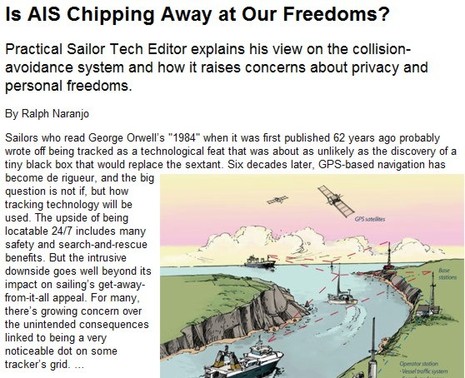
I remember a few years ago when some boaters worried about “Big Brother” style AIS surveillance while the IMO fretted about hobbyists using shore receivers to display real time coastal AIS info on the Web. But all that seemed to go away, because — I think — people realized that AIS is indeed a public information network and that there is nothing especially threatening about its use by agencies or amateurs. But today I was struck by a “fatcat1111” comment stating that “I absolutely do not want to update the Fed with my location every 30 seconds” and that he or she hadn’t felt that way until they read the Practical Sailor article above by marine safety expert Ralph Naranjo. Well, maybe I’m completely blind about “personal freedom” but I’ve read Ralph’s article a few times now, and I just don’t get it…
This is tricky, as I know Ralph as a nice man with tons of experience and valuable writing in his wake and yet I feel obliged to both paraphrase and debate him. That’s because many of you probably don’t have the Practical Sailor online access that comes with a subscription (though it’s worth considering), and the idea that not participating in AIS is somehow an expression of liberty deserves challenge, I think. So here goes. {Update: PS kindly opened up Ralph’s whole article.}
Ralph’s opening premise is that magazine writers and AIS manufacturers have not been forthcoming about the role of AIS in international security, especially regarding America’s Maritime Domain Awareness (MDA) program and its associated NAIS system, which is now monitoring some 6,000 vessels a day along our coasts. But isn’t that because the primary collision-avoidance aspect of AIS is complicated enough already? I know I’m hard pressed to keep within a reasonable magazine word count just trying to sort out the available types of AIS gear and confusion around them, as seen in my last Cruising World piece on the subject. And, frankly, if I did have room to get into NAIS it would be as a valuable search and rescue resource, something I started noticing here on Panbo back in 2008, and just mentioned again during another AIS argument.
But Ralph hears Orwellian tones in the NAIS stated goal — “Armed with a comprehensive view of our nation’s waters, decision-makers will be better positioned to respond to safety and security risks.” — and wonders if those decision-makers might include “agencies for which you need a top-secret clearance to find their phone number.” Heck yes, Ralph! After the sinking of the USS Cole and the horror of 9/11, how could the national security folks not recognize that our harbors are very vulnerable? Ideally, the USCG would like foolproof ID technology on every vessel coming into, say, New York Harbor, so that suspicious ones would stand out.
Ralph acknowledges this, and even the idea that a Class B AIS can serve as a sort of electronic passport as one cruises the coast, but then he goes on to suggest that the fact that his young grandson somehow made the TSA’s watchlist illustrates the danger of all this. Should we base decisions as important as carrying an AIS transponder on TSA mistakes? He also discusses how “Innocent cruisers who have been boarded by law enforcement often re-calibrate their assumptions about privacy and search-and-seizure laws.” Well, I didn’t actually enjoy men with guns on my boat last summer either, but I understood the concept, and I thanked them for their work.
But Ralph’s main worry seems to be that we will lose our “right” not to carry AIS transponders, and I’ll quote his whole paragraph on why you might want to exercise that “freedom” while you have it (which I suspect is what got to “fatcat1111”):
This decision is likely to be based upon the interplay between competing factors–on one hand, a perceived need for surveillance and security, and on the other, the right to freely navigate coastal waters. Scrutinizing the innocent in order to discover the guilty has gained traction without much congressional debate. It has become standard operating procedure despite constitutional conflict and challenges to prevailing views toward liberty. For many, whatever the effort, if it lessens the likelihood of another terrorist attack, it’s worth doing. Others are less willing to abdicate freedom and personal liberty. At present, a sailor has a choice in whether or not to become a blip on the AIS display.
Well, I value my “right to freely navigate coastal waters” tremendously, but I just don’t get how carrying an AIS transponder affects that. In fact, I’m super excited about exercising my navigation freedoms down the East Coast next fall, though I realize that many of my habits — gunkholing into odd places, lots of photography, and all those antennas, to name a few — could be viewed as suspicious. But isn’t it simply the reality of our times that makes driving an unknown, uninspected 37 foot boat down the East River analogous to stepping onto an airplane with a big heavy suitcase that no one looked at?
The freedom I’m worried about losing is the actual right to navigate wherever I can find enough water. A few years ago a USCG Rear Admiral addressing a Miami room full of boating writers — the Guard has not hidden the MDA program — discussed what might happen if terrorists used a boat to pull off a major attack on a U.S. port. I don’t think he was exaggerating or threatening when he said that one possiblity would be to confine boat traffic to proscribed channels wherever “soft” coastal targets exist. Heck there could instantly be millions of citizens demanding just that. Which is why I wrote a bit about the Admiral’s talk and programs he advocated like Waterway Watch.
This thinking is why I’ll happily and freely choose to use an AIS transponder when I head South. Of course, I value the safety aspect a lot, but I’ll also be pleased to be seen by NAIS, as there’s another safety aspect to that and it may help the USCG do their job. It might even mean that I’ll be subject to fewer “safety inspections”. So what am I missing? What exactly is the freedom I’ll be giving up? I’d really like to understand.





Ben, I’m slightly less sanguine than you appear to be regarding the abuse potential of AIS. I do not yet have an AIS transceiver installed on my 40′ sailboat, but I intend to get one this year, so I’m not necessarily paranoid. But other tools of less power have been abused by law enforcement personnel, including the FBI and even the USCG, over the years. There’s no reason to believe that AIS would not be similarly misused. We do live in perilous times, but much of the “security” to which we are now subjected is closer to street theater than to actual safety from attacks. Although I want to be seen by other vessels, and (even more) want to see them, and I normally don’t care who else knows where I am, I’m still skeptical about the casualness with which our government (especially since latish 2001) spies on its citizens and uses the word “terrorist” as justification for doing whatever it wants.
I spent 24 years of my life explicitly defending one’s right to say just about anything not proscribed by law. Let’s assume for a moment a person choses to function within the modern economy at some level above abstemious, bartering, non-communicative pseudonymity. If so, the stance described on AIS transponders in PS may be emotionally satisfying, but it is Quixotic at best.
The following persistently gather & send information on one’s whereabouts (generic or specific):
Cellphones (triangulation or GPS — continuous)
Smartphone Apps(with geo-tagging — continuous)
Laptops (with geo-tagging — continuous)
WIFI services (IP address and location — continuous)
Credit Card transactions (POS reporting, name, time, date… — periodic)
Commercial and Aircraft (tickets and transponders — continuous)
Cruise ships (tickets and AIS– continuous)
Railroads (tickets and GPS — continuous)
Autos equipped with emergency location features — store & forward
Taxi Cabs (called for by name + GPS loc to dispatch — continuous))
And the list goes on.
The barn door on this issue has been swinging open for decades.
If AIS helps me avoid being rundown or running someone down, if it contributes to rescue in a true emergency, the risks it offers to personal freedom are so overwhelmed by technology already deployed — the AIS debated is mooted.
PS I don’t think the USCG is interested in mandating AIS on recreational vessels, though the latest “Small Vessel Security Strategy Implementation Plan” ( http://goo.gl/dL2yx ) mentions the following goal:
“Foster research into low-cost, nonintrusive, small vessel identification systems, such as radio frequency identification (RFID) tags, adaptable miniature transponders, portable Global Positioning System (GPS) devices, or cell phone–based recognition systems.”
I also agree with Kurt Schwehr that NAIS data ought to available for many purposes, perhaps even public Web display: http://goo.gl/Vc8du
SheltieJim, what “other tools of less power have been abused…”? Surely NAIS isn’t on the level of phone tapping, is it? How do you abuse someone with tracking information?
Perhaps I’m very cynical but it took me just moments to think of ways that knowledge of a persons location could be used to make that person susceptible to improper pressure. I don’t think it’s a problem intrinsic to any organization gathering the data. The problem lies with some individuals who may have access to the data in the course of their work.
Fishwife
I think I see where you’re going, Fishwife, but isn’t that a special case? Is a person “susceptible to improper pressure” if he or she did not lie to someone else about where they are?
Ben, among those “tools of lesser power” that have been abused are ordinary land-line telephones, classroom discussions, and peaceful get-togethers of like-minded people. We have seen (and are seeing) illegal wiretaps of phones, provocateurs planted in classrooms and at meetings, and a plethora of similar abuses. “How do you abuse someone with tracking information?” Consider the possibility that I post onto a blog somewhere an opinion that offends the sensibilities of somebody in the administration or in the USCG. My MMSI is readily available to authorities, so it’s trivial to set up a watch for an AIS broadcast with my MMSI. Suddenly, my boat is “randomly selected” for “routine inspection” every few hours…and they exactly where to find my boat at all times.
Now, as I said, I’m not really paranoid, and I have never personally experienced anything like this. But I do know people, personally, who have had things like this happen to them. I will definitely install AIS onto my boat this year, but I am comforted in knowing that, if I want to, I can power it off and be a little less visible.
Christopher, I first want to thank you for your service to our country and our values. And I fully recognize that all of the factors you cited, and many more, can be and are regularly used to track people’s locations and actions. I find that mildly worrisome, government or not, but I haven’t “gone off the grid” to prevent it. Some visibility is inevitable when one lives in a modern society. But I have the option of turning my cell phone or laptop off, of working behind a NAT device, of using cash more of the time, etc. I want to keep the option of turning my AIS broadcast off as well. Not because I’m doing anything nefarious, but because I believe that I have a right to simply *be* without being watched at all times by anybody.
So long as it is optional for small vessels, after all we are not going to sink a super tanker, I see no problem with having it. But as soon as the government mandates it, then I have a problem.
The list from Christopher highlights this issue, these are all optional services/items. I can turn them off and remove the battery or CHOOSE not to get on a train or plane. But if biggov decides that I must transpond my location then I have a problem with that.
So does one of my employees right now. He claims he is in an area that does not have broadband with verizon. However, I am able to pinpoint him using http://www.marinetraffic.com/ais/# and he has lied about his situation/location. It may cost him his job. (not wanting to work is one thing, not telling me the real reason is a big problem for me)
Ben,
In your response to Fishwife you mention “lie to someone else” – but we all, to one degree or another do this, it’s called privacy. The concern really only comes into play if you have a need/want for privacy for a personal, not illegal(!) reason. As long as AIS isn’t mandated for recreational vessels I’m good. And as you’ve written, many of the Class B transcievers have a “silent” mode.
That said, I’m looking forward to adding AIS capabilities to my boat. The safety and security benefits are just too great to not do so. And, just as I can turn off my cell phone, pay cash instead of Easy-Pass (Christopher missed that one) on the highway or credit card in a store, I can go silent with AIS. It IS about choice, even if I never choose to do so.
SheltieJim
Thank you for your thank you. I haven’t a problem in the world with your approach to navigation, but…
Having flown transponder equipped aircraft since I was 17, I simply would not turn one off, unless it was on fire. The problem is this. A prudent aircraft pilot and nautical navigator must always practice “see and avoid.”
If I never see an AIS target, it’s like navigating 5 years ago, and I’ll be eyes on a swivel and watching the radar for everything. If I see an AIS target and it goes away, my mind will put it in a lower state of risk category (and so will my AIS).
If it goes away because someone switched it off, I will not be kindly disposed if they become a hazard to me as a result. Simple as that. I’m interested in managing risk and someone practicing counter-government surveillance by flipping switches off and on while maneuvering in a seaway is not my friend.
Doug, Easy Pass was in the list goes on… 🙂
As Christopher pointed out early on, the privacy implications of AIS are relatively minor compared to the many other ways we can be individually tracked. Probably the single biggest risk to the average modern user is in services like Foursquare, and ill-considered Facebook updates, in which information about where we are and what we are doing is voluntarily posted, in a convenient format, for the whole world to see. (PleaseRobMe.com, for example.) Car insurance companies’ GPS trackers, promoted as “we’ll cut your rates if your driving patterns warrant” but rapidly becoming “we’ll milk your wallet dry unless you give us a GPS track of every single place you went this year”, are also in the “more scary than useful” category.
Something like AIS, that offers a clear and measurable safety benefit, shouldn’t be a cause for concern to most of us. I’d put it in the same class as properly set up cellphone GPS (like on my LG 9200, which enables rebroadcasting of its GPS co-ordinates only when authorized with a particular key sequence: 9-1-1-Send.) Yes, there are some folks for whom AIS monitoring by the government would be a justifiable concern. Those folks will simply not install AIS, or will fit a transponder for show and leave it unplugged most of the time, or will feed it false position data.
Most of us are more or less safe from being tracked simply because we aren’t interesting enough. Now, don’t get me wrong, I am very much against any government or (especially) corporate tracking and logging of individuals’ activities, with a handful of notable exceptions (sex offenders’ ankle bracelets for example). But we need to keep risks in perspective, and frankly, our everyday activities (carrying an improperly configured phone, or using Facebook, or paying by credit card) expose us to far more dangerous and sinister tracking risks than AIS does.
Ha! PleaseRobMe is for real: http://pleaserobme.com/
Maybe I am weird about this location thing. I think of myself as a pretty private person. I’m hell on wheels when it comes to telemarketers, for instance (though they’re pretty much gone after a few years of the magic words “Do Not Call List” spoken with conviction). And I’d be outraged if my phone was tapped because of my politics or some such (though what they’d hear would be pretty boring).
But just where I am on the planet at any given moment…meh. I don’t care who knows, and I’m pretty sure that only people I care about might be interested. (Except maybe for those very long ago outlaw days of youth 😉
The USS Cole was not sunk.
9/11 cannot be used to rationalize anything the US government chooses to do any more than holocaust can be used to rationalize any stupid thing you might want to say about Germany, or that Pearl Harbor can be used to rationalize anything you might want to say about Japan.
I agree with the perspective that American’s are amazingly willing to give up their constitional rights that are the envy of so many citizens in other countries.
With regard to AIS, the FAA has probably already set the precident with aircraft transponders so I agree that the horse is out of the barn.
But if you really want something to worry about, educate yourself about cyber war (try Fatal System Error by by Joseph Menn and Cyber War by Richard Clarke). It’s happening today all around us. The US continues to build the 21st century Maginot Line (notice how useless the USS Enterprise is for fighting piracy?), and spend billions of dollars and thousands of lives chasing a few terrorists while ignoring the real threat to our security.
Privacy is very important and no gov’t has the right to do what the US is doing in the name of ‘freedom’. My concern also includes DSC.
I think Christopher hit the nail on the head. If you carry a cell phone, you’re tracked. In addition to the methods he listed, you also have face recognition software on a lot of cameras and an increasing use of LPR (License Plate Recognition) in both stationary locations and law enforcement vehicles.
AIS is the least of our problems with regard to privacy. The average boater who doesn’t venture out of the harbor may not need it, but if you’re offshore and want to avoid being run down, I think it’s invaluable.
Dan
I must be pretty dull. I don’t have any secrets, and I don’t have any embarrassing habits past the occasional burp. I don’t even know anyone with any of the above. A complete rendition of my politics is available at any time of the day, and I can’t afford household aides, with or without documents. Of course, it’s much easier to live like a Boy Scout at sixty-something than it was as a teen, but I doubt my teen-age years would have aroused much interest from counter-terrorists either.
So I’m glad someone knows where I am, by my cell phone, by traffic cameras, or by AIS. After all, Publisher’s Clearing House may need to find me, or perhaps I may, after all, need to know the best place to buy Viagra. Nobody has to hunt me down to make me write bad checks; I can do that without thinking, and I doubt anyone would pony up more than a buck and a half ransom money.
The reason I like the idea of AIS is I am still afraid of things that go bump in the night; big things or little things. I would really like the really big things to see me, if for no other reason than to know where to send the settlement check! Use my Maryland Address; mail in the Caymans is rather iffy….
So what am I missing here? Is everybody here really important, or really sinister, or hiding Coke’s secret formula in the Vee berth? Doesn’t Big Brother prefer to bag big game?
Class A ais is great. I have used it for 5 years in the pnw to keep an eye on the big ships that I need to stay away from. Class B… No thanks.
This has gotten off topic a bit, eh? What’s next, a post about our freedom not to appear on radar ?
I kind of wish they would just put RFID tags on all our boats (state registration stickers ?) if that is what it took to make the concerns with transmitting AIS position go away.
Cattledog: Interesting example of loosing personal freedom and/or possible misuse of AIS. It resonated with me briefly until I thought about it. Instead, I would argue that wireless broadband technology and/or the job caused the loss of freedom, not AIS.
Ben, I think you made great points,
– The issued died down, and its resurrection by Ralph (and PS) is unhelpful.
– “Participating in AIS is somehow an expression of liberty deserves challenge”
– “The freedom I’m worried about losing is the actual right to navigate wherever I can find enough water.”. (a familiarity with prior Panbo entries is helpful in understanding the gravity of that point)
@Dan Cororan – yes, you have valid points and one has to ask, when is too much information velocity just Too Much?
How about when a BLIND person can even see that texting messages via cell phone is alerting the chemical balance in our brain?
In which case, that would be yesterday, as a blind
17-yr old wins the prestigious Intel Science Award (and $75,000) for studing measurable withdrawal symptoms in teenagers seperated from their texting cell phones for one hour.
http://www.mytractorforum.com/showthread.php?s=ad0ccf953469aa246ed98e1a798cb54a&p=1619549#post1619549
p.s. Michelle, way to go girl!
Now I am off topic … back to great points:
– The issued died down, and its resurrection by Ralph (and PS) is unhelpful.
– “Participating in AIS is somehow an expression of liberty deserves challenge”
– “The freedom I’m worried about losing is the actual right to navigate wherever I can find enough water.”. (a familiarity with prior Panbo entries is helpful in understanding the gravity of that point)
I actually have no problems with AIS, in fact I welcome it with open arms for the increased navigational awareness it gives me. But, to play the devils advocate, I believe that some States in the USA are rather aggressive in collecting tax from visiting boats. If AIS became mandatory, how long do you think it will be before they have a system that tracks your AIS and measures your presence in their waters down to minutes 🙂
Fishwife
For what it is worth, I would argue that locations of vessels is not the same as personal location privacy. Very often the person who owns/registers a particular vessel is not on it when it is underway. I was asked by the USCG to track all USCG personnel with USCG cell phones during Deepwater Horizon. I told them I wouldn’t take the data from Good ( http://good.com/ ). That’s different than tracking assets. If AIS had a message that sent out who was on the ship, I would start to get very worried about privacy. If someone comes after you for being somewhere based on AIS, it won’t be hard to argue in a legal sense that is in no way proof that you were there… there is no mechanism in AIS to verify that an MMSI is a particular vessel. Mistakes are common… as government vessels have demonstrated.
And if you carry an AIS transmitter, then you are telling NOAA, USCG and ACOE that you use that part of the water way and it is a vote for them to spend their $ on that part of the water way.
Aahaah! Fishwife brings up the very first point that I see as a real valid liability of AIS and I don’t dount that it is soon to come. Once the gov finds a way to create a revinue stream with AIS data it will be exploited for that purpose.
For all other things though, when it comes to AIS I simply wouldn’t leave port without it. It is far too great an asset to be without. The first time that a large ship hails you BY NAME in a busy seaway instead of referring to you as that vessel bearing such and such, you will be ecstatic that you have it onboard.
@Kurt Schwehr:
I’ve been sailing for a very long time and I am more than capable of knowing what vessel I am and at what bearing and range from a hailing vessel. Its called seamanship. Sure, its more convenient to be hailed by name or be able to hail the large ship by name but its no substitute for SEAMANSHIP.
I’m unwilling to surrender my privacy for convenience.
Wait, are we talking about documented boats that try to avoid paying any state excise tax by being “visiting” boats everywhere? Or can someone be made to pay excise tax in two states for the same boat?
Would Ralph think one also would be wrong to register an EPIRB because such information will then exist on a some agency’s database?
I offer to argue another side of this discussion.
I agree with Russ’ comment about the illusion of a 21st Century Maginot Line, on which we spend billions solely trying to prevent the inevitable. However, some enlightened government people now feel it time to use MDA and related programs to redirect focus away from pure prevention, and instead develop effective programs to quickly and effectively restore infrastructure following “an event.” And it is in this regard that both AIS and DSC are critical components. Stop thinking “them” and start thinking “we.”
Most people don’t know that an estimated one million people were taken off Manhattan(“rescued?”) on 9/11 by public and civilian vessels in addition to the Coast Guard and military. Subsequent reports from these events highlight that DSC and AIS could have been utilized to better assist in the greatest rescue effort in U.S. history.
While researching for an article in U.S. Naval Institute’s Proceedings, I found many government specialists tasked with working both sides of the fence on this subject. They agree that all future National Response Teams need to develop better ways to use civilian volunteers, and AIS and DSC are important to that goal. In the case of the Cosco Busan oil spill in 2007, community wildlife groups would have been more effective at rendering assistance in oil containment and wildlife rescue if they could been managed through better communications and closer location-specific direction.
The sailing “get-away-from-it-all” attitude Ralph speaks off reflects that his experience cruising the South Pacific some 30+ years ago in his sailboat. But times have changed and it is time we help in the defense of the freedoms we enjoy.
As for the usefulness of AIS in real life, and which, to me, transcends any perception of threat to personal intrusion, I offer no better example than on a windy night approaching Terifa and the Strait of Gibraltar as part of the Nordhavn Atlantic Rally. Only one vessel in the fleet of 18 had AIS, and while other, inexperienced crews discussed a parade around the Rock the next day, the skipper of this one trawler (a European boat headed home) calmly but effectively hailed by name each of the five or six ships constantly barreling at us from all directions at 20+ knots. Every ship responded because of the AIS. He successfully negotiated our safe transit through the outlying waters and into this busy funnel, something I think dangerous and difficult otherwise for a swarm of 18 displacement powerboats. I will never go offshore again without AIS.
Excellent discussion.
If a ship needed to hail me by name, I would consider myself very stupidly to be in the wrong place.
As A Brit I may be confused about your tax regimes but I’ve had an inpression that should a boat overstay a period (three months ?) in some states there is a ‘use’ tax to pay. That’s a visiting boat I’m talking about. As a visitor, I could easily see the attraction of exploring somewhere like Florida for more than 3 months. My knowledge is anecdotal so someone please correct me if I’m wrong.
Fishwife
Bill, Ralph wrote me saying, “I believe in the value of a lively spirited debate and recognize that there are many perspectives when it comes to how much one values being tracked.” though he added that “An old Kiwi sailing friend once taught me never to get into an argument in someone else’s cockpit.” However, his point of view will heard better because Practical Sailor nicely plans to make his whole article available to all interested readers later today.
Correction due to technical problems: The open version of Ralph’s article won’t go up until tomorrow.
That’s great, Ben. Ralph certainly has a valid point, based on a career in this passion. But within the larger scheme of things, I feel that too many people don’t somehow include themselves in the bigger picture.
Great discussion, with lots of good opinions. Looking forward to tracking you down using AIS this season, and forcing you to have a beer on our new power cat.
Ben: You are right on target with your point of view. I lost a friend in the Lockerbie flight and watched the towers drop from my office in Jersey City. We all lost many freedoms in the last 20 years but this minor intrusion for the sake of safety is an easy decision. My wife and I are retiring on a trawler in 2 years and AIS is one of the first things I will install. I love technology and my wife loves to feel secure in our travels. AIS will help immensely.
In the wrong place if a ship hails you by name?
I don’t think so. This past January I was approaching the BVI from the north and it happened to be the day the cruise ships go back to Fla or wherever. There was a steady procession of them coming around the corner at Anegada Reef and heading northwest and the choice was to stay back on the sidewalk or work our way through them, talking to all the watch officers and figuring out who was going to do what.
I did read a news account of a guy who lost out in a divorce situation because his wife’s attorney subpoenaed his Easy-Pass records, but the moral of that is if you’re somewhere you don’t want someone to know about, pay cash.
Michael
I don’t cross in front of ships. Ever. So they don’t ever need to hail me. Isn’t that the correct proceedure? What do you think you guys on the big ships?
I know that Joe Bob has a boat. I know that Joe Bob’s boat has an AIS transponder on it which puts his whereabouts on the internet for me to see. I trust the USCG but do you trust me?
It isn’t that AIS doesn’t have tremendous protective value. It does. But privacy is a protection as well.
Here is another thought. I’d be happy to have an AIS transmitter on the boat if it kept our friends at Homeland Security happy when I am transiting between two Canadian ports, where drifting into the US is pretty easy (i.e. up the Niagara River). It would be simpler to let them monitor me than go into a US port to report I was in US waters for 30 seconds in case the current pushes me over the boarder. If AIS makes it easy to protect our citizens, then who the heck cares. Even USCG boats broadcast their positions for all to see. Why does one care about civil liberties here as anyone with eyes can see you – boat registrations in legible numbers already remove your privacy!
The states haven’t used AIS for excise tax records yet, but it might not be too long before they do. Supposedly Turkey is watching AIS tracks of boats going straight out and back to refuel in neighboring countries to avoid their high fuel taxes.
Whether those boaters have a “right” to do that or not, I guess would depend on your point of view
From BoatUS:
“In several recent cases, BoatUS reports tax authorities walking the docks, inspecting marina records and aggressively enforcing tax codes. “States are strapped for money, and they are increasingly looking at these visiting boats,” said BoatUS Vice President of Government Affairs Margaret Podlich. “We urge cruising boaters to be aware of potential tax liabilities when traveling, plan accordingly, and be ready with documentation in case disagreements arise with tax authorities,” she added.
“We believe boaters should pay their fair share of taxes,” Podlich continued. “However, our concern is that some boaters are being unfairly targeted for this tax levy. Some tax agencies have made it difficult to dispute the tax, even with accurate owner recordkeeping such as log entries, marina and fuel receipts or repair contracts. These documents are critical for boaters to keep, and are often the only way to fight an unjust tax bill,” said Podlich.”
http://www.boatus.com/pressroom/release.asp?id=506
“Just because you’re paranoid doesn’t mean they aren’t after you.” Joseph Heller, Catch 22
I’m installing a Garmin 600 next week. The owners want to see, and be seen. I think using all available means to avoid a collision at sea is important, and prudent (rule 7), even if insidious forces may be afoot. What’s the alternative? This is certifiably a most eclectic dialog.
If someone is concerned that “Big Brother” is watching, why not just turn the AIS off? Do you really need an AIS during the day if there is good visibility?
My AIS is receive only, and I like it that way. Maybe manufacturers of AIS transponders could include a switch to toggle between receive/transmit mode to receive only mode.
The main point to me is not whether or not YOU care if you’re being tracked, but whether or not I care if I’m being tracked. Different people have different expectations of privacy. I just personally don’t want my movements tracked, and to me that is a good enough reason not to allow it. Plus, I can see many scenarios where it might not be a good idea to have your every movement tracked. Someone has mentioned the tax implications if you should stray into another state for more than the allowed 30, 60, or 90 days, and every state’s laws are different on this. Now what if they decide to track your boat to make sure you have visited a pumpout station every few days? Or what about your insurance company making sure you haven’t strayed out of your coverage area? If this information becomes public what is to stop a thief from checking the AIS plots to make sure you are well out at sea while he ransacks your house or car? And, of course there are the pirates to think about when you are required to do this in foreign waters. Etc.
Are we missing something in all this? AIS tracks ships (and some boats) not people. Pull up the AIS display on any vessel displayed on the internet websites and you will plainly see that there is no information whatever about WHO is aboard, only data identifying the vessel, its movement, type of vessel, destination etc..
Rights of privacy belong to people, not vessels, and AIS does not compromise any of those rights. It does however protect those people from shipwreck, environmental disasters, drug smugglers, terrorists, etc., and if they choose they can add their vessel to the system and use the data flow directly. If those people are concerned about their privacy they can turn off the transmitter, or simply buy a receiver.
As a member of the Coast Guard Auxiliary I can promise you that the only two situations where we care where a PERSON is located are when they appear to be breaking one of those laws the public asked us to enforce, or when you want us to come fetch you out of trouble, which we are proud to do. AIS is of little use in SAR cases today, but when PEPIRBS and EPIRBS gain AIS capabilities it will be a godsend for pinpointing victim’s locations. When (and if) ATONS gain AIS capabilities I understand they would also serve to relay VHF distress calls, so there’s another benefit.
If there is some villainous evildoer tracking individuals for nefarious ends, I can assure you he’s not in MY Coast Guard.
Far be it for me to criticize or even comment on the levels of angst and other emotions reflected in these comments. I have my own, and I hold them dearly.
But I would suggest I have seen a level of government purpose, coordination and (nefarious?) innovation described in this thread that boggles the imagination given government performance in this domain to date.
Are there miscreants out there? Yes, on both sides of the equation. Are safety surveillance and tracking systems gong to be misused along the way? Yes.
Is it going to be done in a systematic way with private boaters, as a class, as a target? I really doubt it, we are talking mucho dinero invested for little societal income.
Are private boaters going to get snagged in the process of surveilling others? I suspect so, it’s already happened in drug interdiction.
Is boater behavior relative to taxes and other regulation going to fuel some interest in technological means to curb persistent and widespread illegal behavior? Probably. Is it persistent and widespread? That’s in the eye of the beholder.
Does any other navigator out there really need to actively know where my 11 tons of congealed petroleum is at any given time? Not really.
In managing risk, (if you discount “ignore it and it will go away”) the ends of the spectrum are satisficing — doing just enough to cover the most likely risk and at the other end, minimizing your maximum regret — doing everything one can to prevent, the perhaps least possible, but most devastating outcome.
For now, we all get to choose where along that spectrum we want to operate. I personally want to keep the focus on retaining that right to choose. The presumption of privacy is long gone.
I’m reminded of the mouse and thhe owl cartoon. That last gesture made the mouse feel good, but the owl didn’t go to bed hungry.
It happens I just paid excise taxes on three boats here in Maine and have some observations:
* They seem to be regressive. As a percentage of market value, I’m paying much, much less for my 37′ semi-custom yacht built in 2000 than for my 18′ 1958 production daysailer or my 14′ 1997 production outboard cat.
* By the same metric, market value, all the fees are fairly low compared to vehicle excise tax and trivial compared to local property taxes, which themselves are fairly reasonable in my town because there are lots of valuable seasonal homes.
* If the numbers I’m seeing are true around the country, and were better publicized, I’m not sure the general citizenry would feel fairly treated.
* If some boaters are getting away with not paying excise tax, I don’t think that’s a matter of freedom. It’s more like a matter of ripping off other taxpayers. And what’s so bad about “aggressive” tax collection, if the laws are fair? (And I still haven’t heard any details about unfair ones, just conjecture.)
Ben, there are 50 different states with 50 different sets of rules on this, and many of the rules make no allowance for what has happened to you in another state. Many states have no property or excise tax at all on boats, but they may very well insist you re-register your boat in their state, even if you are documented, once you overstay your 30, 60, or 90-day (different in each state) grace period. I believe that excise tax in Mass. is based on where you are on July 1 every year. So if you happened to rent a slip in Mass. for July you would end up being liable for Mass. excise tax too, and then if you went to SC I believe it is based on where the boat is on Jan. 1, but it is a property tax so it would be due in addition to any excise taxes you paid in another state (and it’s a really huge tax too). Now, NY doesn’t have a property or excise tax, but they are very aggressive about use or sales tax. I just went through about a year of filing reams of paperwork trying to prove that my boat had never been in NY–it doesn’t matter for how long, it had to be never for even one day, or else the tax would be due because I am a NY resident, even though I don’t keep my boat there. Have you ever tried proving you’ve never been some place? Maryland charges you their 5% irregardless of whether or not you’ve paid a use tax or sales tax in any other state–no credit for taxes paid elsewhere. And, Florida requires your boat to be state registered, whether or not your state requires it in addition to your documentation–no grace period. It goes on and on. It is very difficult to satisfy the letter of the law, and I have found that many of the supposed enforcers of these laws don’t know them accurately. So, it’s great if you never leave Maine–pay the tax–but if you travel a lot, like I do, you are subject to overlapping and varying tax laws that are very difficult to comply with.
Great; Ralph’s article is open in full at Practical Sailor: http://goo.gl/ohHEB
He thinks I may have “cherry picked” his points a bit; you decide!
PS Thanks, John (Kettlewell). What particular states do I need to worry about when I take Gizmo south next fall, leave her somewhere like South Carolina for a few months, and then come home? And can I use AIS to prove where I’m not ?-)
OK Ben, having read the article, I’d say rather than picking cherries, you pretty much offered the core thoughts sans rant.
Didn’t see anything in PS that was going to change any minds for or against.
Good technologies can be used for bad purposes by good people. Been there, seen that, ad nauseum.
We have legislative mechanisms for dealing with government excess (should that be the case here) in this country. It would be better from my perspective to put the ranting energy into the political debate than into navigational activism.
I am concerned: I think this discussion is (mostly) about mandatory AIS transmitters, right? So: how big was the boat which was used for the Cole attack? As I recall, not so very big- in fact just about the most common size- runabout. Not a boat one would take to Florida for the winter (well, maybe on a trailer).
Thee are countless thousands of boats of this size all over the U.S. Many ,many of them have not even a VHF, never mind a chartplotter. The 40 foot trawler is not the boat I would worry about, from an “event prevention” standpoint. Are we gonna mandate an AIS with all the expense and complexity it entails for every little boat out there? How many do not have any electrical system at all? Still capable of being “weaponized”, right? Does this mean small boats are now a threat to our safety- can they be allowed to operate at all?
While I think that the tax concern may have merit, I don’t think that that is what is on the mind of the USCG. If you don’t mandate AIS transmitters on EVERY vessel, there is no point, and that mandate would be untenable to the point of being bizarre.
Seems like Ralph may be on target- if you follow the logic out to the conclusion. Mandatory AIS transmission means a very significant change to the ability to go boating.
Ben, the Salty Southeast Cruisers’ Net http://www.cruisersnet.net is a good resource on the tax issue. Much has changed since 2008 in SC — different counties treat the issue differently.
Ben,
This is also a good tax info resource:
http://www.boatus.com/gov/StatetaxRegistration.asp
as is this
http://www.boatus.com/gov/state_boat.asp
But, Erik, there is no evidence (I know of) that the USCG wants to mandate AIS on every boat. I think they agree with you and many that it would be “untenable to the point of being bizarre.”
However, the Guard is on record as interested in some form of “low-cost, nonintrusive, small vessel identification system”, as I noted in an earlier comment. And I think they regard all sizes of boats as possible threats, which makes sense to me.
Now there are people who are convinced that AIS will be mandated on all of us in the USA. I invite them to post any evidence they have or to send it me via email. If I can verify it, I will write about it.
Ben, frankly I think the tax issue probably won’t be an issue if you keep moving, but you do have to watch out if you leave the boat someplace for more than 30-60 days, and/or over certain dates in the year. When I was in SC every marina turned in a list of renters as of January 1 and you were then taxed by the county tax office on the value of the craft. At the time I had an old boat valued at about $24K and the yearly tax was around $450. It is probably best to research any state and county you plan on spending more than 30 days in. Go right to the various tax office Web sites and look up the actual laws, because all of this free Internet information is worth about what you pay for it. My information may very well be out of date.
As to the AIS part of this, it might be useful to prove exactly where you were for exactly how much time, but I suspect there would emerge many Catch 22s that wouldn’t be pleasant for boaters. State laws are not written to take in the considerations of boaters who don’t live and can’t vote in the state. As a “tourist” you are looked at as a non-complaining source of revenue.
One last thought on this is that the true terrorist will just disconnect the AIS or take the chip off the boat or whatever is needed, so there will be lots of tracking of the innocent while providing only a minor inconvenience to those with bad intentions. How would you feel if every car was equipped with a transponder so that every trip could be monitored? Go too fast on the highway and you’ll get an automated speeding ticket in the mail. Park too long on the street, you’ll get an automated parking ticket. Etc. Some of us would prefer not to have big brother watching and I hope it remains our choice whether or not to participate.
I present the following data points, gleaned from a security newletter that I subscribe to that I think is reliable.
1) Verizon responded to over 8 million “law enforcement” requests to track cell phones. None of these requests needed a warrant.
2)The FBI recently lost a court case about putting a GPS tracking beacon, without a warrant, solely because he had communicated via email with someone else who was being watched for something.
3) In 77 towns in England, the most common use of the system of video surveillance cameras was to give tickets to people who put their trash containers on the curb before they were supposed to.
The problem isn’t that AIS data shouldn’t be public. The problem is that the US has no reasonable laws prohibiting misuse by the authorities.
A couple more data points hardly related to the use of AIS:
1) A big story in Maine today is a spike in gas mask sales: http://goo.gl/jo79a
2) It turns out that my new hearing aids keep track of my sonic environment, counting up the hours of “calm”, “noisy”, “noisy with speech”, and “music”. I know this for a fact as I’ve seen the data with my own eyes after it was wirelessly downloaded to a computer that supposedly belongs to my otherwise innocent seeming audiologist. What else might they be up to? http://goo.gl/bIOwO
A question for all you electronic gurus. If you are using a DSC radio properly hooked up to your GPS and with MMSI entered can’t the CG or anyone else poll your radio to see exactly who and where you are? Does the CG already do this on a regular basis over wide swaths of the coastal waters?
John, essentially no and no.
* DSC radios can be polled for position but the default setting is always set so that the operator must explicitly permit each and every position report. I’ve tried this stuff with lots of radios and found that almost all alarm you EVEN if you set them to respond to position requests automatically (which I don’t consider a feature!).
* So if the CG was doing wide spread position polling I think we’d hear about. I also don’t think it’s possible to make a position request without knowing a boat’s MMSI, so can’t picture how they’d cover “swaths” of boats they don’t already know the identity of.
Again, if anyone thinks I misunderstand the technology or that the USCG is somehow circumventing it, don’t be shy with the evidence.
As i posted on another thread. Only IMO SOLAS vessels MUST broadcast classA AIS. I can assure you Navy vessels aren’t SOLAS, don’t have to and usually don’t. Watch out for a fast aircraft carrier running you down.
Keep visual watch at all times.
It was a substantial challange to read thru this PS article. It feels like the author is tugging at my potential fears (e.g. “round in the chamber”, “boats with no deck lighting and only the bare minimum of navigation lights displayed”, e.g. typical sailboat at night could be mistaken as a threat) while painting a picture that the “USCG Acquisition Directorate” has made a big investment in a grand scheme to which he describes, that will take away our freedoms.
Out of curiousity I checked that such an organization exists. While the USCG Acquisition Directorate does have a website, it’s mission statement (a capital program to replace obsolete equipment assets) sounds mundane rather than big brother.
My limited understanding is that an effort based on AIS, rather than “being a premier project”, has been discarded until a capability much cheaper than AIS is found, proposed funded, and implimented.
Why does small craft movement need to be stored in a database? AIS is for collision avoidance, isn’t it? If so, then there is no reason to have land-based systems capture this data and upload it to the Department of Homeland Security to be stored in a database. Given that the DHS is spending real money to do just this, there must some reason for this, and it clearly isn’t collision avoidance.
Why can’t we simply enjoy the benefits of AIS without being tracked?
AIS stored data is used in accident reconstruction and incident reconstruction analysis.
fatcat1111: Because some of us use that data to try to make life better/safer for mariners. While I do enjoy the *many* sea stories that I’ve heard doing my research, they are pretty hard to statistically analyze. We use AIS data to try to figure out what is really happening in the water ways and how to support you all. When you carry an AIS transceiver on a small boat in the US, you are casting a vote to NOAA, USCG, ACOE to support small boaters. Many officials have a hard time realizing the number of small boaters out there and what their needs are. In the ~2TB of AIS data that I have, it looks like small boaters hardly exist. Combine good quality AIS data with the USCG “incident” database, MISLE, and we have the beginnings of tools to really make a different for vessels of all size. By all means jump in and start taking a look…. this is the first time in the 3000 year history of ships that we really have a chance to really know how people use the waterways.
http://vislab-ccom.unh.edu/~schwehr/ais/ais-references.html
http://vislab-ccom.unh.edu/~schwehr/papers/
http://schwehr.org/blog/attachments/2011-01/misle-with-table.png
http://schwehr.org/blog/attachments/2011-01/misle2010-1-us.png
And yes, a recruiting pitch: we are always looking for good Masters and PhD students…
Schwehr,
Gotta tell ya: Anytime some gov’t agent tells me he’s got my best interest in mind I KNOW that isn’t the case. Thanks for confirming my worst suspicions. Now I know what I need to do.
The thing is, Fatcat, that no one gets to say what AIS data is used for. It’s public and free, and anyone can do whatever they want with it (as long as they’re not breaking the law). I hope you realize that hobbyists started broadcasting AIS data on the Web, and saving it (see MarineTraffic vessel histories), even before governments started collecting it.
And the reasons — both for security and safety — why the U.S. government is listening to AIS are obvious. I wrote about them above. Listening is relatively cheap and easy, and it adds to their situational awareness.
But that doesn’t mean the feds will mandate AIS on all boats. They would like to track every boat that gets near soft targets like cruise ships but are looking for some sort of solution that is cheaper, less intrusive, and less public than AIS.
And please consider the fact that finding the government somehow villainous for listening to AIS puts you the same camp as rude fools like “bosunj”.
Have we set a new record for comments? I don’t see how something as prosaic as marine electronics could generate as much attention without invoking Liberty, Freedom, and the Anglo-Saxon-Norman-Latin-Gaulic’n’Prussian way of life!
(there wa a point there, somewhere.)
And We blamed Ralph for waving the flag!
Given the performance of the US Government in keeping track of Intelligence info and using it for “security” over the last 50 years, what do we do when we find our cruises posted in Wikileaks? Were they tracking me to the local pub in Belfast every day after working all day on the water- please don’t tell my wife…..
Kinda makes you wonder why we concentrate the “Intelligence Agencies” in and around DC when there appears to be little intelligence seen in Congress. Wait, I see it now. They are still looking.
MaineFog: Don’t wait for the US Government or wikileaks. It is legal for anyone to publish any AIS data that they receive. That data is already bouncing around lots of companies. I provided the AIS for the US Government’s Common Operational Picture (COP) during the Deepwater Horizon and there are lots of examples out there.
If some one is really paraniod about the “black helicopters” and the government watching them, they might want to consider keeping off the internet.
None of the comments I have read so far consider the misuse of AIS information for the purposes of piracy.
How long will it be before yachts are attacked at remote anchorages.
If AIS identification becomes mandatory in the future (almost a certainty), switching it off to increase safety will surely be interpreted as suspicious by authorities, until boarded.
I fully support AIS as an aid to safe navigation, but one the dark sides of the use of such technology will certainly be piracy.
I guess it will come down to who you prefer to be boarded by in the middle of the night. Armed pirates, or armed TSA types.
“If AIS identification becomes mandatory in the future (almost a certainty)…”
What leads you that assumption, Simon? And did you read through the previous comments?
I don’t mean to highjack this thread, and the following possibly needs a home of its own, but DHS has released the public version of its
http://www.dhs.gov/xlibrary/assets/dhs-uscg-small-vessel-security-strategy-report-to-public-012011.pdf
and it needs to be read front to back before you respond. It is disturbing.
I may have to change my tune.
In this DHS pdf, compare the photo of the CG boarding vessel on page 15 with the photos of a real boarding as shown in the MV Dirona blog for February 20, 2011:
http://blog.mvdirona.com/2011/02/20/CoastGuardBoarding.aspx
“five heavily-armed crew”, not to mention the boat.
While this boarding was polite and professional, it does suggest a worry that DHS can’t tell the good guys from the bad guys and is a bit paranoid itself.
Not a good combination.
I’ve read the document, looked at the blog of the boarding, and find that neither causes me undue alarm. The USCG is a Law Enforcement organization and as such it’s personnel are often armed. They are also charged with ensuring that vessels are operating safely. Boardings are part of that. To me the narrative of the incident reflected the courtesy and professionalism of our Coast Guard.
And before we start thinking we’re being singled out as boaters…
I was recently on the road and stopped at a rest area where a weigh station was operating. In CT the State Police operate these stations. So who was inspecting the trucks? Armed state police officers. Again, they struck me as courteous and professional.
Want to freak out, read about how the CBO thinks we should install tracking devices in our cars to tax us for miles driven!
http://thehill.com/blogs/floor-action/senate/151765-cbo-says-taxing-drivers-based-on-miles-driven-a-real-option-for-raising-revenues
I read the DHS document and what comes to mind are the words of Pogo, “We have met the enemy and they are us”
It is sad that the presumption of innocence no longer exists. The freedoms that so many fought for
are easily swept aside in the rush for a false security,easily circumvented by those who would do harm.
Yeah, I know Kurt. I have AIS up to watch the harbor activity in Baltimore and radio facilities in my vehicle and to use while on the water. It is the absurdity of it all as part of Operation Enduring Blunder.
We will reach a level of tracking that will be useless and unmanageable. Millions of active data points and some DHS (or other) employee has to pick the bad one with the bomb. Even data mining software will have trouble concluding that some little boat on some waterway is acting in a suspicious manner.
By the time the information makes its way thru the levels of command (it’s a secret remember and agencies don’t talk to each other) the event will have occured. There is no vessel in the harbor to respond anyway.
I suppose hiring a million watchers could help the unemployment picture.
AIS should be used for the original purpose for which it was designed. Anything more will make it as useless as the folks in DC.
There are two different questions here which are getting conflated:
1. Is AIS broadcast and display useful for mariners? I think we all agree that it is.
2. Does government recording of personally-identifying AIS data amount to a privacy incursion? This is the question we should be debating.
I do not think that we need to accept the latter in order to get the benefits of the former. For example, one can imagine a system where a new vessel ID is randomly generated every time the transceiver is turned on. This would provide for collision avoidance, traffic control, even accident reconstruction and analysis, but would not allow a DHS contractor to query a database for my MMSI.
Those two questions should be:
1. What good does it do? (intended purpose)
2. What harm does it do? (side effects)
The answers to #2 are all speculation about possibilities. Privacy is certainly lost, but that is not itself the harm. The harm comes from what others do with that broadcast or stored information. I expect the developers were not expecting this information to be rebroadcast widely or did not think it through enough. I am surprised that rebroadcasting is regarded as legal and not as intercepted private communications.
Whatever happens, AIS information is going to remain visible to the government authorities.
One compromise to protect personal privacy would be to only allow rebroadcasting of Class A AIS information. Keep Class B information private, on the reasoning that A is mostly commercial use and B is mostly personal use.
Pretty amazing graphic demonstration of cell phone trackng (thanks Christopher!):
The German translate roughly as:
“Greens politician Malte Spitz has sued the (contractor) of the telecom for six months of the tracking data they had on him. Using this data, you can follow all his movements during this time. The spatial data we have also linked to the information available freely online from the life of Deputies (Twitter, blog entries and web pages).
With the Play button start following Malte Spitz’s journey. WIth the speed control you can adjust the speed or stop at any point with the pause button. … any point in time can be controlled. Each vertical column represents a day.”
http://www.zeit.de/datenschutz/malte-spitz-vorratsdaten
And people are worried about AIS, which has been openly treated as public information by hobbyists, private data companies, and governments for years???
It is nice to think that mandatory AIS will be the end all and be all for security, but it can only be mandated for U.S. flagged vessels in U.S. waters. The USCG and other agencies cannot mandate the equipment that a foreign flagged vessel must carry. We are a Canadian-flagged vessel, so we go by the Canadian requirements even when in American waters. We can’t be told by the U.S. to get a transceiver, just like the Canadians (or any other country) can’t tell Americans what equipment they must have.
Besides, even if they made AIS mandatory, if you purchase an AIS outside of the U.S., you can plug in your own info. Do you think a drug runner or a terrorist wouldn’t figure this out and put false info on it?
This should hopefully help for safety, but I don’t give it much hope for helping U.S. National Security.
Maybe it will cut down the “stealth followings” by the USCG off the coast that scare the hell out of sailors.
For the record, we have a transceiver on our cruising sailboat.
Lynn, the USCG would have a very hard time mandating AIS on U.S. recreational vessels, and they’ve shown zero interest in doing so. Heck, they held hearings about extending the AIS mandates for commercial vessels two years ago and still haven’t come out with a ruling, which will no doubt include at least a year grace period for compliance.
What the USCG has expressed interest is little RFID tags or miniature transponders. If the idea ever comes to fruition, they’ll probably stick one on your bow when you cross the border, while we get them along with state registrations or documentation. Or maybe they’ll just be used in the vicinity of “high value” targets like those ocean liners in Miami.
In the meantime they seem to be using a combination of AIS, radar, and eyes on the ground to monitor port activities as best they can. I suspect that any cruiser with AIS and a fairly normal itinerary will cause less alarm, will suffer fewer boardings, and will generally be helping the Guard out with a difficult task. But some disagree 😉
Ben, I realize that I’m commenting on something you said about two weeks ago, but referring to one of your readers (and, I daresay, fans) as a “rude fool” is a bit over the top, isn’t it? That kind of contempt is not something I’d have expected from you. Bosunj is not the only person commenting on this thread who has expressed concerns about possible misuse of AIS data; indeed, I myself have done so. (And, to be fully honest, I like much of what bosunj has to say.) We (as Americans, boaters, and blog readers) have many varying opinions and it’s reasonable for us to be respectful to even those with whom we disagree.
SheltieJim, The act that earned Bosunj my “rude fool” reference was his characterization of Kurt Schwehr as a “gov’t agent” and a liar. Unlike “Bosunj”, Kurt uses his real name and he’s been a real resource of valuable information here on Panbo. And he’s a University of New Hampshire researcher and professor, for cripe’s sake.
It’s worth adding that I made the editorial decision to stop publishing Bonsunj’s comments — which I very rarely do — because they got even less useful to this discussion. But that did lead to a protracted email conversation in which I learned that he is a true wingnut, and if you don’t believe me, check this: http://bosunjbkk.wordpress.com/
If you poke around Panbo, I think you’ll see that I’ve been quite hand’s off when it comes to comments. But there have been a few cases where wingnuts and/or trolls have really disrupted a thread that might have otherwise beeen valuable to readers for months or even years. I’m determined to thwart that, and am working on some comment guidelines, though actually they’re pretty obvious to most people (“bosunj” excepted).
The problem is not just with AIS. Cell phones have the same problem.
http://finance.yahoo.com/news/Your-Phone-Yourself-When-is-apf-1852784235.html?x=0&sec=topStories&pos=main&asset=&ccode=
NTSB has issued it’s final report:
Collision Between U.S. Passenger Ferry M/V Block Island
and U.S. Coast Guard Cutter Morro Bay
Block Island Sound, Rhode Island
July 2, 2008
http://www.ntsb.gov/publictn/2011/MAR1101.pdf
Thank you for posting John. I was nearby on my 39 foot sailboat at the time of the accident and was curious about the cause.
The question is not how AIS information might be used by “good guys” – that’s tautological. The question is about how can AIS information be misused and abused. There are already cases where the Somali pirates have used AIS receivers to pinpoint ships at sea for attack. As for mapping people to boats, for recreational vessels, that’s trivial with a high probability of accuracy. For instance, the Maryland boat registration information is on the web. With the name of a vessel, a very modest amount of search effort produces the registering party, which is probably the owners, and for a recreational vessel, very probably at least one of them is on board. It’s a good guess that for a couple, the male owner is on board (not guaranteed, just a good guess), which makes the street address of the registered owners a likely burglary target. The fact you can see all this information on the web looking at Annapolis could easily be viewed as a significant exposure to risk which would NOT exist if AIS data were not available about that vessel.
Given the small amount of time it took for me to describe this one abuse, anyone believing that many more abuses are not there to be found are profoundly naive.
While AIS is *certainly* very useful as a navigation and situational awareness tool, it is not without costs which, from this discussion, are not entirely obvious.
There *is* a risk associated with AIS data about a vessel being available, and the risk is materially larger for a recreational vessel than a commercial vessel simply because the exploitation of the information is easier.
If they really are after you, being a diagnosed paranoid does nothing to mitigate that.
cheers,
-mo
What is your diagnosis, Mo? Cause I’m worried about you, mate. You seriously think that there are sophisticated burglars collating boat registration info with live AIS web sites? Or that said crack burglars couldn’t hack your cell phone and know where you are at all times if the AIS option wasn’t available? Or that there’s even a smidgen of a chance that AIS info, designed from the start to be public, could somehow become private?
The route to peace of mind in 2011 is to assume that good and bad guys know where you are at all times. Take due precautions, enjoy your unavoidable connectedness, and, for cripes sake, relax.
My point about the “diagnosis” is that being told you are worrying pointlessly does nothing toward mitigating a real risk.
As for assuming that everyone knows where I am all the time, that is conveniently cynical outlook which cleverly subverts the discussion. I also don’t believe
it is either true nor necessary to assume.
A criminal does not have to be very smart to simply use their web browser to find the AIS info displayed on a map and then do the lookups necessary to find the likely vulnerable properties. That is *several* orders of magnitude harder than hacking a cellphone
that is not promiscuously announcing its location. They are not remotely similar as to difficulty. A competent 12 year old could readily accomplish the former; as for the latter, probably only a small subset of this list would know how to even contemplate such an attack.
My point is that this discussion has focused primarily on “magical thinking” about the risks. Remember when nobody believed anyone would go to the trouble to write a virus or worm? I do. Or that nobody imagined the widespread availability of personal GPS jammers?
As Dan Geer would point out, security is about economic tradeoffs – risk models can usually be formulated in those terms pretty effectively so the costs of risks and countermeasures can be assessed relatively dispassionately. One can have a vigorous discussion about your favorite settings for thresholds, but at least the discussion has a concrete framework.
But critical to that is being able to assume the role of the counterparty and think as aggressively as they would assuming they are at least as smart and motivated as you are. The conditional probabilities certainly enter into the final threshold discussion, but it is a pervasive failure of security thinking to assume the the adversary is not very bright, or lives in caves, or is not very motivated.
As for the policy question that motivated this discussion, the fact that people have willingly and/or stupidly sacrificed rights they previously held dear when driven by irrational fear is not a
particularly compelling argument to continue the abrogation of what little is left of Constitutional protections.
Mike, I think it’s an extraordinary stretch to think that a public vessel tracking system violates the Constitution. Hell, it’s not even mandatory for recreational boats, and I don’t think it ever will be in the U.S. Yes, the USCG may come up with some electronic ID system, but it will be encrypted and you can fight that fight when and if the proposal ever reaches an endless ruling process.
You think you also missed my point, and that of many other commenters above, about the personal location cat being out of the bag. It doesn’t feel like cynicism to me, convenient or otherwise. It feels like realism and I’m comfortable with it.
Mike, Agreed. Most especially with your last paragraph. Good on ya.
I wouldn’t dismiss the threat of robbery or worse that easily. I boat in areas where the nearest law enforcement may be 100 miles or more away. An AIS signal can say that “here is a big boat all alone in this isolated cove.” You can even tell how big of a boat it is. It makes it much easier for our hypothetical bad guy.
It is rare, but stuff does get stolen and people do get attacked. Such incidents are not advertised by the boating press for obvious reasons.
As far safety I agree with the navigation argument but it does absolutely nothing for “homeland security.” A good zodiac can do over 40mph. We have two marinas located within a couple of thousand yards of a whole bunch of aircraft carriers, and a marina right next to a ferry landing. Do you think that AIS on a 9-knot boat makes anybody safer from terrorists?
The events of 9/11 have been used to create an entire industry that in my opinion is a worthless waste of money. AIS is good but I can see no scenario where it helps against terrorists. (So how many terrorists have we caught in those long lines at the airports, anyway?)
George, I don’t think the USCG views AIS as a great security tool either, as I wrote in the original entry. But it is one of several data streams they’ve cobbled together in an effort to protect “soft targets” after 9/11. And didn’t they have to cobble something up? Wouldn’t the country have gone nuts — and possibly forced onerous restrictions on our ability to boat where we want — if a recreational boat had bombed one of those aircraft carriers? If AIS helps the USCG sort my boat from “unknowns” I OK with that, and even think it might help me avoid unnecessary “safety checks”.
Also, I think the obvious reason that most boating magazines don’t dwell on piracy, accidents, etc. is because they are by nature “enthusiast media”, meant to serve a different purpose. Same reason they don’t dwell on bad boats, bad electronics, etc. There are exceptions like Soundings, which treats boating accidents much more like a newspaper. And there are several online sites that report on piracy like Noonsite:
http://www.noonsite.com/General/Piracy
Normally your writing is clear and lucid but your response here puzzles me. Not only did we not require recreational boats to get AIS after 9/11 or the USS Cole attack but the FCC actually prevented those who wanted it from obtaining it. (Nobody required transponders in private planes after 9/11 and yet people are still allowed to fly pretty much wherever they want to.)
Since AIS is about as secure as a “Hello, my name is…” tag, I think the argument that you are making is that although it doesn’t make us more secure it makes us feel more secure and prevents us from doing something even more intrusive, expensive, and useless. Requiring everybody to carry AIS would be a placebo.
(This is what the terrorists want to happen. A small group of about 50-100 people have managed to cause this country to discard most of its values and implode financially. It is absolutely classic.)
Suppose we require AIS and we still have an attack by a small boat. What good did the exercise do other than covering some politican’s stern? The actual effect in the unlikely scenario of such an attack will be the same whether or not we had required everybody to carry AIS. In fact the result would be worse, since the misplaced trust in the placebo would now be exposed and cause us not to trust anything done to protect us.
As an aside, I think that it is charmingly naiive to think that AIS will protect you from boardings. In my experience the USCG is more concerned with checking expired fire extinguishers and flares — a check that probably saves more lives than anything that I’d imagine they could be doing for security.
Requiring AIS on all small craft would be a loss of freedom, and since it only is useful for tracking people who are broadcasting truthful signals it isn’t the putative terrorists who are losing. It would be a very handy tool for enforcing “no wake” zones, exclusion areas around big ships, and crossing lanes.
On two occasions last week I heard VTS yelling at pleasure boats by name for improper crossing of shipping lanes in Puget Sound. I don’t know if the operator was just having a bad day or it has become standard procedure to try to enforce crossing rules. Look where we are headed…
Here is the funny thing that has happened to security post 9/11. In the old days, if a boat full of armed men started to circle the ferry the captain would have all the passengers lie on the floor while he called the authorities for help.
Nowdays nobody pays any attention to the two orange boats armed with machine guns that sometimes circle the ferry. The AIS says that they are the Coast Guard so there is nothing to worry about.
It is a good thing that there really are not that many people who want to harm us.
George, I’m beginning to wonder if you read the original entry to which all these comments refer, especially mine. Now it sounds like you’re arguing against Ralph Naranjo, sort of like I did. I do not think that USCG/DHS is going to mandate AIS on recreational boats, nor do I think that their listening to current AIS affects my liberty.
But I do think that Ralph is right that some safety checks are really security checks. Hence if my boat is a known one, seen for some time doing normal stuff, it might be less suspicious.
By the way, I agree with you that our national reaction to 9/11 could have been a lot smarter. Iraq! Demonizing Islam! But surely our government felt and had an obligation to do something?
Ben, of course our government “felt and had an obligation to do something”. I have no disagreement with that. What it actually did, though, was to start suppressing our constitutional rights to create the illusion of security. Nobody who knows what’s going on believes that the street theater that airport security became makes this country safer.
Among other things, the 19 hijackers went through metal detectors, and even set one of them off. Frisking grandma and baby Alice doesn’t accomplish anything more. And, of course, about 85% of the tests run by security agencies to attempt to get weapons, including handguns, through security are successful.
I would be far more sympathetic to the responsibility to “do something” if there were any evidence that the “something” actually increased our safety without undoing so much of what this country was established for.
Here’s a link to an interesting news report about how criminals are using social media sites like Facebook in order to plan crimes. Seems like it might not be a great idea to announce your whereabouts to the world: http://news.sky.com/home/uk-news/article/16077087
Great News! Now that LightGreed has bought themselves a high-powered GPS industry shill, we won’t have to worry about AIS exposing any seekrit information! When LightGreed deploys, you can just kiss-off ever using anything relying on GPS ever again anywhere in CONUS or its territorial waters. And while you’re at it, you can also kiss-off Inmarsat and Globalstar satphones.
Looks like the sextant salesmen will have the last laugh after all!
John (Kettlewell), I post my location often and even map it over on Panbo’s “About” page ( http://goo.gl/qERje ). I really am in Sanibel, FL, right now, quite far from home. But of course as you know, since your mom used to be a neighbor, my home is protected by a crack security team largely made up of ex-Mossad agents. There are many ways to deal with privacy or the illusion of privacy.
How much does an ex-Mossad team add to the operational cost of an AIS? The About page isn’t relevant to AIS, so why not use MarineTraffic.com as an example instead? It knows three Gizmos, and it is pretty easy to pick yours since there is a photo of it there: MMSI 367412350, last seen 2011-08-08 in Acacia National Park, Maine, heading south at 6.3 knots. Go back to my question from April — why is having this information broadcast and archived of any value to us? It is meant for the other boats in the immediate vicinity; what is the value of publicly spreading it further?
Another interesting thing about my coastal trip from Maine to South Carolina and back: Even though Gizmo is bristling with antennas and I am a curious monkey who often drives right in close to Navy docks and other spots that may be considered “soft targets” — often with a big camera in hand — I never once got stopped by the U.S. Coast Guard or any other agency.
I don’t know for sure, but I think the fact that Gizmo constantly broadcasts its identity and position via AIS is a big factor in this. I bet Gizmo has generated a big file somewhere at the Department of Homeland Security, possibly even with personal info about who I am and what I do. Thus my gunkholing habits look normal in overall context, not suspicious.
In other words, giving up my cruising anonymity — which was probably an illusion anyway — I may be more free to come and go as I please.
It’s an interesting theory that you are allowed to travel freely due to giving up some anonymity, but I wouldn’t be surprised if luck played a bigger role. Recently there have been several instances of boats traveling from Florida to Cuba without being spotted by authorities who were on the lookout for those specific vessels and had a very good idea where they originated, etc. If Big Brother can’t find vessels they are looking for, what does it say about how much tracking is going on? I think we often overestimate the capabilities of Big Brother.