Here I am trying to cover the world of marine electronics from my nest in Camden, Maine, and darned if I don't miss interesting happenings in my own neighborhood. Apparently Richard Baldwin, an experienced bluewater solo sailor who lives just up the Bay in Belfast, is the passion and brains behind an unique endeavor that's using mini sailing drones like the prototype above to teach students of all ages about oceanography, not to mention GPS and satellite communications...
After METS 2007, I wrote about how many new AIS products Comar had in the pipeline. Well, this U.K. company hasn't slowed down, and has even developed a snappy new logo and Web site. Comar's latest is this AIS-Multi, which seems like quite an able AIS listener at $399 (from U.S. distributor Milltech Marine). It features true parallel receivers, so slow Class B updates will plot as well as they can; an amplified VHF splitter, so you don't need to add another antenna; USB data output, so you can connect it to a modern PC without needing a serial converter; and, finally, the ability to multiplex in NMEA 0183 data at 4800 baud (GPS most likely), so the unit's 38,400 baud data output can be easily used with a plotter whose NMEA 0183 port was already in use (and the PC will get it, too). But...
So Gizmo's nifty, and now semi-permanently installed, PC charting system could have perished abruptly in a nasty mix of saltwater and glass. But it didn't. In fact we were tied up on our float before the slow shatter of tempered glass became evident. And it was really me, not the boat, at fault. On Memorial Day, soon after we set out for home from Pulpit Harbor on North Haven (note the link: it's great news that MyTopo has revived the old Maptech mapserver), the running port windshield wiper went overboard with a bang. It was blowing 20 knots Northwest right on our nose with short, sharp seas, and we were taking serious bow spray even at 6 knots, but none of that broke the window...
The photo isn't fair, because the shooter (me) is reflected in the Raymarine A57D's screen and the iPhone is in an Otter Box which includes a screen protector that muted its display in a way I don't notice in normal use. But there's some truth here, too; the screen on the Lowrance HDS 10 has been bright, crisp, and completely readable in all light conditions so far experienced on Li'l Gizmo's completely exposed helm, whereas the other two have sometimes been quite hard to read. Another truth is...
Ever since I realized that the free Siitech.com AIS pro web viewer can count and/or filter AIS types, I've been using it occasionally in an attempt to gauge the spread of Class B in the USA. You may recall the day last October when my Li'l Gizmo was the only Class B to show up on the whole East Coast (or at least within range of a certain mix of listening towers). And, frankly, I haven't seen many B transponders in US waters since then...until today when there were six in the general New York area, almost all underway. And, surprisingly, some were being seen well offshore, in fact way offshore...
I think that the Google news search above, and those 397 articles you can click through to, mostly indicate that the US General Accounting Office accomplished its goal: Light a fire under the collective butt of the U.S. Air Force, which has apparently been slow at deploying two billion dollars to upgrade the GPS satellite system (GAO report here). I've gotten several notes of concern about the situation, but I think boaters are about the last user group that needs to worry about it. We almost invariably use GPS in almost ideal conditions, puttering along at a relatively slow speed with a wide open sky view. And we don't care beans about altitude (except for going negative)! We were about the first to get into GPS because it was useful on the water before the full constellation of satellites was in place, and, if the system truly does break down, we may be the last. But we surely do value electronic positioning a great deal. So here's my question: If we're having trouble keeping GPS fit on a two billion dollar budget, why the heck is the government even considering saving a tenth of that by shutting down eLoran, a viable backup system?
I don't usually write about rebates and sales, but 90% off!?! Navionics not only launched version 2.0 of its Mobile app yesterday, it's slashing prices. Here's the press release, and note above how the whole Gold USA East chart portfolio dropped from $50 to $5. Apparently all the chart region prices will follow -- at least to some degree (British Columbia now $10) -- in the next few days, and stay bargain priced for "a limited time this summer." A month ago I noted how fast iPhone/Touch navigation is moving, and it hasn't slowed down...
Some of us got confused last week when Inmarsat introduced its tiny but fast Fleet Broadband 150 Internet & voice service in Miami. While Inmarsat boasted about "sub $5,000" terminal hardware, KVH said it couldn't price its TracPhone 150 yet, and a source told me he'd seen a Sailor price list that put its FB150 hardware at over $5,000 wholesale. What we missed was the $4,995 retail FB150 terminal that's coming from new-to-retail Addvalue Communications. Fortunately, Ronald Hiemann -- who sometimes comments here as "Seajet" (his company) or as "Bremer Speck" (his boat) -- was able to fill me in on the Wideye Skipper 150. His story begins thusly: "Once upon a time, there was a sailor who wanted Internet access at sea on his sailboat..."
How about these command and navigation stations? Thursday evening turned out pretty horrid for a boat launching, but Lyman Morse pulled one off with its normal panache. The Hunt-designed 54' jet express Whistler (just visible beyond the catamaran's bow) is another stunner for its power boat portfolio, especially if she zips by you at her expected 30 knot cruise. While it was neat to check out Whistler's interior at the same time many of the local craftsmen involved were showing off details to their families, I particularly enjoyed some alone time on the 60' Morrelli & Melvin sailing cat Mala Conducta, which Lyman Morse launched just last month...
I'm in a gang now, sort of, and I like it. Above is my Yachting magazine colleague Jason Wood calling me via FB150 sat phone from the Inmarsat demo boat on Biscayne Bay Monday, photographed by colleague John Brownlee, editor of Salt Water Sportsman. Yesterday I talked and texted via the loaner Iridium 9555 handset with two other members of the gang, SWS electronics guy Glen Law and Sport Fishing electronics gal Chris Woodward. We are testing electronics together, or at least comparing notes, and that's good...
These are big times in the small world of global satellite communications for medium size boats! Yesterday Inmarsat demoed Fleet Broadband 150 hardware and service in Miami (my people were there, and even called me via FB150, full report soon) and today Iridium issued a press release boasting about the extensive sea trials its OpenPort system has endured, and how it's now shipping (actual FB150 hardware, like KVH's TracPhone FB150, won't ship until sometime "this summer"). Meanwhile, yours truly was using the new Iridium 9555 handset to text himself (above) and call his patient spouse from Camden Harbor...
Lucky me, I have an amazingly bright and progressive plumber who is also a seriously addicted boater, and sometimes we barter our respective skills. Which is how I found myself tuning up and updating his old GPSMap 276C last week. I was amazed to discover that Garmin's latest update for it was just released on March 19; it's a minor update, to be sure, but this unit has been around since 2004 (when I gave it a prize). And so I planned an entry complimenting Garmin on its perfectionistic persistence...but that was before I saw the just-released 5.0 software for the networkable 4- and 5000 series. Wow...
There are numerous cable labelling devices and styles, as folks have commented about in the Gizmo schematics entry and the systems forensics saltwater pathogens entry (;-). I even have a low-end, but decent Dymo LetraTag Plus whose tape labels can be made work okay on cables. But last week I noticed, and bought, this newish Dymo Rhino 101, which can be used with self laminating cable labels. I like it; it's simple, light, and fast, and no batteries are required.
I plan to thoroughly check out the sample Lowrance HDS-10 I recently received, and will probably write about it a lot too. It marks not only a major MFD refresh for Lowrance, but also, I'm told, the first MFD series based on NOS, the Navico Operating System. In other words, the underlying software was created not only by Lowrance developers but others in Navico's now global R&D department, and some form of it will likely show up in future products from Navico's other brands, like Simrad and Northstar. I'm going to save the sexy stuff for next week, when I try the unit on the water; today I'm going to mostly discuss some geeky but important data networking aspects of the machine...
This graph is a thermal sensor manufacturer's dream -- and was, in fact, created by the marketing department at FLIR -- but, hey, that's us way over to the right. I'd love to see the price of thermal cameras go so low, and unit volume so high, that "most cars/boats/ships" have them. Like GPS, once you understand how well the technology works, you want to have it aboard. I remember well the Magellan Nav 1000 (below), which seemed totally magic 20 years ago, but was actually quite crude and cost over $1,000...
I have no idea why Bob Congdon, former U.S. Sales Manager for B&G, is now working for Euro Marine Trading, the U.S. distributor for NKE...and I question the ravings at Sailing Anarchy on the subject. But I do know this: In Miami, when Bob talked about how well NKE's about-to-debut Regatta Processor would compare to B&G's offerings, there was a distinct glint in his eye. Well, above is the Regatta showing off at Strictly Sail Pacific last month and here is the pitch...
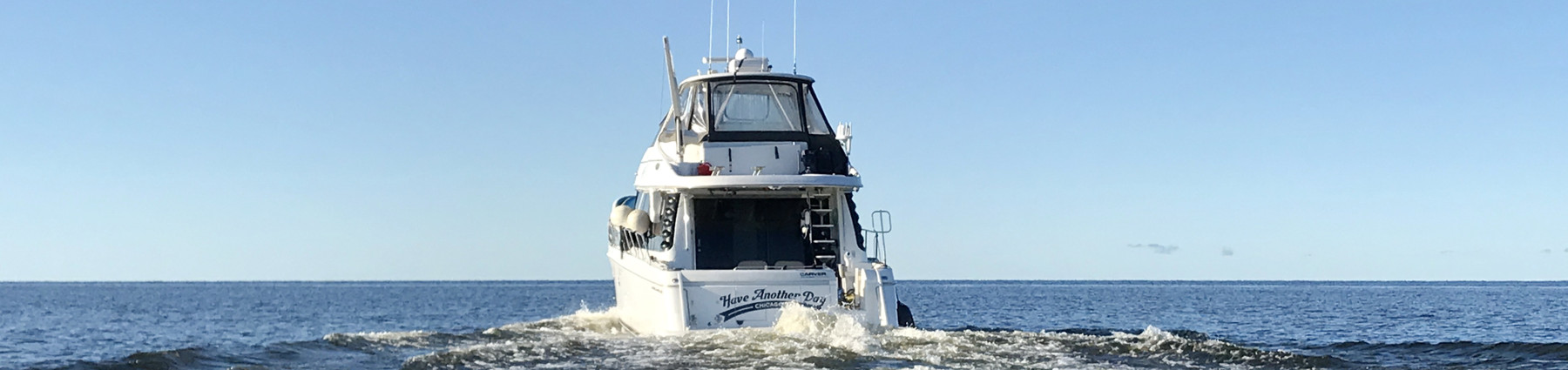
Here's a Gizmo plumbing detail that turned me on from day one: A hot/cold shower head plus salt- and freshwater outlets (with quick disconnects, yet) all clustered neatly under the fly bridge ladder, with hose storage. They're even labeled well! But, when I first fired up the freshwater hose to rinse off the cleaning work I'd started with salt -- the resources are limited where I'm tied up -- I got a funny feeling and took a taste...
Thanks to Sandy Daugherty over on the Forums, I now know that JRC has introduced a VHF radio series that can easily make direct DSC calls to AIS targets. They are most definitely big ship radios (see diagram below), and they do AIS calling in a way I hadn't anticipated, but still...