Things are changing around here, and in my magazine life too. News of the latter will come tomorrow, but do please note how much easier it has gotten to post comments on Panbo (updated software!). If you click the comment "Sign In" link now, you’ll see three kinds of user authentication—TypePad, formerly called TypeKey and once the only such service available; OpenID, which is new to me and seems a bit cranky, but is open source; and finally Panbo’s Movable Type OS itself. All three will purportedly keep your true identity safely hidden, if desired, and using any will get your comment posted here immediately. While the first two will work at many blogs, the latter is especially cool as it will eventually facilitate forum entries—even user blog entries—and will include Panbo-specific profile information, like what boats and gear Panbots use, if you’re willing to share. There’s also good news for Panbo advertisers…
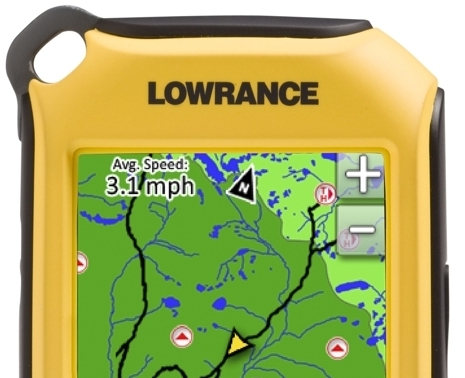
Lowrance just announced a new line of Endura touch-screen handheld GPS plotters that look like they’ll give Garmin some competition in this niche. Of particular interest, I think, is this line in the description of the Outlook model shown (it’s the base model, expected to retail at $229 when it ships in May): “Add shared web community content including routes/trails, POI’s, elevation data, etc. in GPX format through drag-and-drop to the device”…
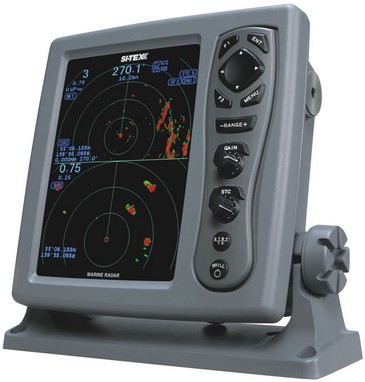
Some boaters don’t like multifunction displays—the theory being that several dedicated devices will never leave a skipper functionless—and thus I’m sometimes asked to recommend a standalone radar. Which is tough, as the recreational models from Furuno, JRC, and Raymarine that I used to be familiar with all seem to be history. Well, check out Si-Tex’s new T-900…
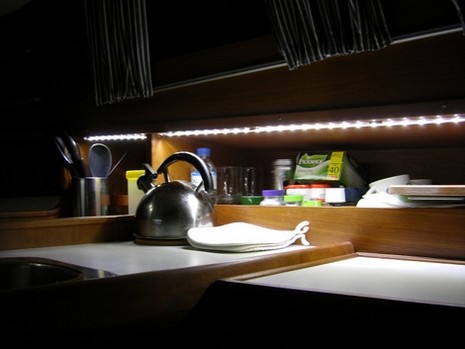
Dutch Panbo reader Eric Criens (thanks Eric!) reports that this good looking LED strip lighting on his 25–year-old Midget 26 (still in production) was easily fashioned from a relatively inexpensive Ikea “Dioder” kit (see below and this alternative). Apparently you can just cut off the transformer and feed 12 volts to the two wires on the white-only strips to get the above. But if you want to go snazzy, Eric says the four wires on the multicolor versions can be fritzed with to produce a choice of white or red illumination. (Report back if you figure out exactly how.)
Above is the MS-IP500 head unit of the full Fusion Marine Stereo system I’ve been testing in the lab. The sound is impressive, even with tracks as wildly dynamic as Wetnurse’s Life at Stake. (Check’em out; my boy Curran is the drummer!) Overall, I think the MS-IP500 is so innovative that it almost earned one of Sail magazine’s 2009 Freeman K. Pittman Awards…
Funny, I joke referenced mom in my first Panbo entry nearly four years ago. I’ve become a blogging fool since, but still don’t know how personal is too personal. Many of you have become friends, which is wonderful, while others are passing through in search of marine electronics nuggets, which is fine too. But if you’re in that latter category, you might just want to come back tomorrow, when Panbo will be fully back in action, and on topic.
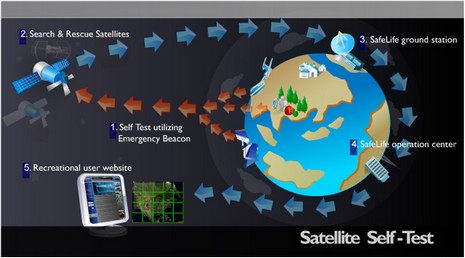
Last May I wrote about the benefits of live end-to-end EPIRB/PLB testing and a company—BeaconSure—that I thought could do it for us. I also e-mailed BeaconSure at that time and never heard back, and really don’t know if that link is anything more than an abandoned business plan. So I’m pleased to learn of SafeLife, a company that seems serious about a similar testing service, and more…
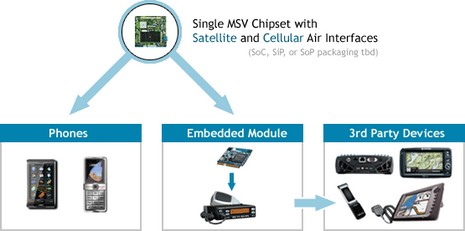
How’s about a module that can seamlessly communicate voice and data all around North America via either cellular or satellite radios, includes WiFi and GPS too, and can fit in a small handset or into a multifunction marine display? That’s what SkyTerra has in development, and apparently the company (formerly known as MSV) also has the first FCC license for such a sat/cell hybrid service, and hopes to soon launch two of the most powerful comms satellites ever…
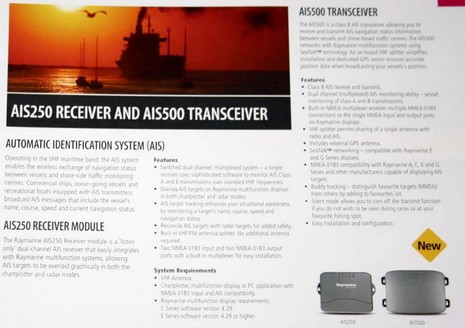
Given the new C Series Widescreens and ST70+ displays, and my mid-week absence (moms happen!), let’s just call this Raymarine New Stuff Week. Behold the AIS500, which just may be the easiest-to-integrate-into-your-system Class B transponder yet. That’s because, like Ray’s AIS250 receiver, it has an NMEA 0183 multiplexer and a VHF antenna splitter built right in. Note that splitting 25w VHF and 2w AIS transceivers is more complex than just sharing a VHF with a receiver, and to date only the Digital Yacht SPL250 claims the ability (and seems to work well in my testing). And that’s not all…
Photographing a brochure leads to distortions (thanks regardless to Richard “Widescreen” Brain), but use your imagination to square up and sharpen the new Raymarine ST70+ image above. Then understand that this 6.5” 640 x 400 pixel screen is capable of showing all the SeaTalkNG/NMEA 2000 navigation, engine, and systems data promised in the original ST70, and I think you’ll agree that this is a welcome product indeed. But where are the control buttons?
All hail Richard Brain. While the Consumer Electronics Show, year-end “best new…” lists and patent searches may all offer 2009 marine electronics possibilities, the real deal—mainly a passel of very interesting Raymarine preview products—is being shown at the London Boat Show. And Richard was kind enough to collect brochures, photograph them, and email them to me for your Panbo pleasure. So let’s thank Richard and say hello to Ray’s new “Widescreen” C Series, which is truly different from the original…
Hot damn. The nine and ten inch screens on these new ASUS Eee PC T91 and T101 “netbooks” swivel to tablet mode and are not just touch but multi touch. The small one weighs just over two pounds, and can have a GPS built in. Now I’m quite aware that my interest in the big HP TouchSmart series isn’t shared by many boaters, but, geez, couldn’t one of these little puppies make a nifty nav/comms accessory? Engadget and particularly LaptopMag have good T91/T101 coverage. Pricing isn’t noted but the existing ASUS Eee series bodes well. Also at CES, Spot announced a roadside assist add-on service that might be great for trailer boaters. I’m sure there’s more of interest at the show, and will keep looking.
One enterprising, if anonymous, Panbot has apparently been searching out filings at the U.S. Patent Office, and discovered some interesting recent activity regarding Furuno Electric Co. and Forward Looking Sonar (FLS). You may recall that Furuno previewed the “FL-7000” at the NMEA Conference in 2005, but then scrapped the product, purportedly due to inconsistent performance. That entry and its comments demonstrate well my personal enthusiasm for improved FLS and the current state of the technology (valuable but limited, with ongoing incremental improvements). Well, patents are hard to read, and don’t necessarily mean much, but…
My coverage of the NMEA Conference last October was dominated by Class B AIS (and largely—doh!—a vessel naming issue that turned out to be immaterial). But in fact I also learned how AIS is getting into all sorts of marine systems, and was reminded of that by the recently published minutes of the Oct. 3 GMDSS Task Force meeting I attended. One item of note is the prototype AIS SART seen above, overlaid on a slide of the impressive test results such SARTs are generating. Most recreational boaters aren’t familiar with Search and Rescue Transponders, but they are standard gear on ship lifeboats, and heretofore used radar amplification—like a RACON—to help rescuers home in the last few miles. I’ve seen a live demo and wasn’t very impressed, and I’ve even heard buttoned-up GMDSS regulator types complain that it was not a very effective technology. Well, guess what? AIS SARTs work much, much better. The specifications aren’t yet wrapped up, but interestingly AIS SARTs will apparently broadcast just once a minute, but with eight message bursts to compensate for wave interference. Is there lots more AIS may do? You betcha…
Aside from Panbo’s able crew of regular commenters—some of whom I’ve gotten to know personally, and all of whom I appreciate—the sixty thousand plus unique monthly visitors here are a somewhat mysterious mishmash of marine electronics enthusiasts, product info searchers, and trades people. (Feel free to speak up your own self, and apologies in advance for the somewhat cranky comment system, which will be improved in 2009.) Actually I also personally know a lot of folks in the trade who read Panbo regularly, and have been told that several companies have a designated monitor tasked with passing along relevant entries and comments to management. How 2009/Web 2.0 cool is that? And it means that if you’d like to express your wishes for the marine electronics future, you will be heard. Russ Irwin, proprietor of the data mishmash above, gets the first word (and credit as instigator):