Even if it was pretty predictable (I got it half right), Garmin will indeed add (“2nd Quarter, 2009”) fixed VHF radios to its ever-expanding marine line. Here’s the press release, and here’s a bigger image of the VHF 200 model above, including the GHS 10 full-function remote mic that can optionally wire to it. The second mic possibility is why you see “INTRCM” as one of the soft key choices on that 3.2” display, and it—along with the 20 watt hailer and a NMEA 2000 data interface—are about all that differentiate the $400 VHF 200 from the $250 VHF 100 seen below.
Above is the new home page at Maptech.com, and while it represents the end of the old Maptech, it sure doesn’t mark the end of the Maptech name. In fact, the blue “Marine Software” tab takes you to a new company called Maptech Navigation. It’s the creation of Peter Martin, who’s worked for Maptech, Chartkit, and as a professional mariner. Martin bought the rights to develop and market Maptech’s digital charts and software packages (except for The Capn, which found its own good home). Martin says his plan is basically “business as usual”…
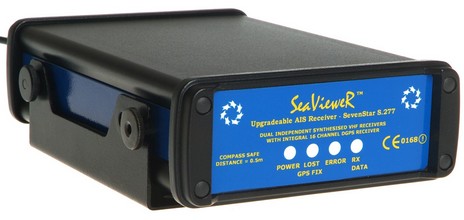
Shine Micro is not the only company offering a Class B workaround, i.e. a high-end AIS receiver that can later be turned easily into a full Class B transponder. The same is true of the SeaVieweR above, and bigger here, which is built in the U.K. by SevenStar and distributed to technical dealers in the U.S. by Whiffletree. The SeaViewR costs $995 in receive-only mode, which includes a purportedly high precision GPS, and another $400 plus tech time to make it into a transponder. Why would you want a workaround when the FCC has finally approved Class B? Well, it’s still going to take some time to get complete transponders to market. And besides you may need a technical dealer to install a Class B, whether it’s from SevenStar or another manufacturer:
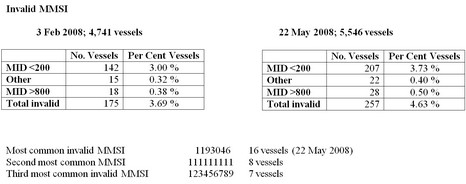
The above (bigger here) is clipped from an interesting report on MMSI “anomalies” that dropped into my e-mail box. It makes a good case for why the FCC decided that Class B AIS devices should have their MMSI numbers input in a controlled way, and why, as noted in the new Report and Order (page 20), it may extent those controls to Class A. As I understand it, invalid MMSIs don’t affect AIS’s primary collision avoidance function—unless there are duplicates in the same target area—but they can mess up advanced functions like DSC calling (and security monitoring). Here’s more detail on the report:
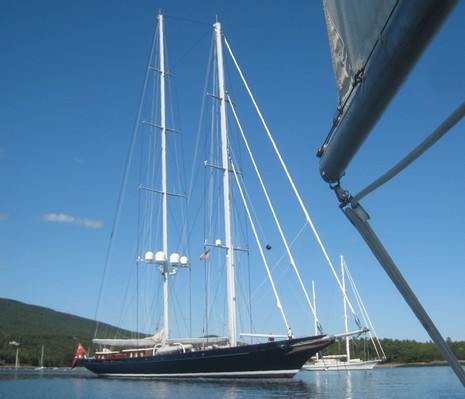
The 18' Annie G. must have looked comical, not to mention bedraggled, circling the 169' schooner Meteor as she varoomed her 100 kW bow thruster to set twin 600 lb CQRs in the Outer Harbor yesterday. But my mate Max (once owner of his own noteworthy schooner) and I had never seen this superyacht before and had to gawk. In fact if it weren’t for a later Google search—hello Meteor!—I wouldn’t know a thing about her, and still can’t figure out what all those domes on the carbon spreaders do.
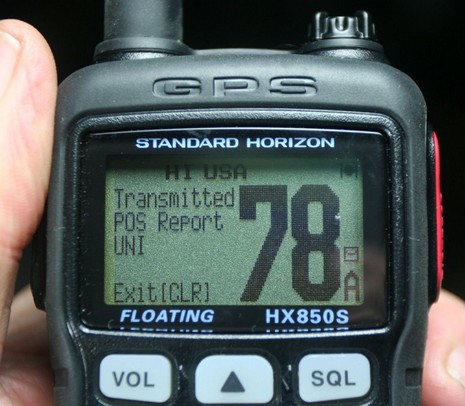
I finally got my hands on a Standard Horizon HX850S GPS/VHF, and I’m almost in love! Even if the 1.75” screen seen above, and bigger here, is not quite as bold as the first marketing images promised, I find it quite readable in any sort of light. The screens are well designed, too, offering channel labels if you want, or COG/SOG/position, and fairly intuitive access to the radio’s complete setup and DSC menus. A little time with the manual is necessary to understand some of the radio’s more obtuse capabilities and button combinations, but that’s to be expected with so much functionality built into such a small package.
My Class B AIS sources were right! Though it’s not yet in the FCC Daily Digest (Monday, probably), the new AIS Order was released yesterday and is posted as a PDF. And it looks good. If you recall, the FCC could have just granted waivers for the Class B devices already approved by the Coast Guard, but instead the Commissioners have fully approved Class B and dealt with side issues like frequency allocation. The major bit of news I see in the Order is that users will not be permitted to input their own MMSI numbers. However, the new Rule is nicely flexible about who can:
Two days in the deadline mill and I’m tuckered. But I thought you might enjoy this rather gorgeous helm, bigger image here. It’s the custom Wesmac 50 I mentioned back in June, i.e. the boat on which I got a taste of my writing subject, Garmin’s new autopilot. So let’s forget about that for the time being and take a look at the ergonomics of this dazzling command and control center. My notes:
Today two reliable sources told me that all five FCC commissioners have now signed off on Class B AIS for US waters, though neither knows when the Order will become effective. The final step should be an announcement in the FCC Daily Digest. Having been wrong about the timing so many times in the past, I certainly won’t venture a guess. But it does seem like a good time to discuss an e-mail I recently received from a marine electronics industry veteran and Class B AIS skeptic who would like to remain anonymous. Based on his own “on-the-water analysis” he thinks it’s “completely worthless”! His points, in italics, along with my comments:
So how about a product whose details are mysterious and which may not exist, and even if it does, probably doesn’t work very well? The thing is that I’ve gotten a little Bluetooth happy, and the Deckband 4i concept looks like a particulary interesting way to use it on a boat. From what I can gather at the unfinished site above, this hub not only permits four crew to communicate via Bluetooth cell phone type headsets, but can also somehow mix in VHF, and (I think) serves as a proactive man overboard alarm system.
I know a lot of salts, some of them geeks too, who've been using The CAPN for years, and don’t want to switch. I’ll bet they’ll be pleased to learn that this venerable charting software package will now be managed and developed by new owner Star Technologies, as announced here. I had a long chat with principals Bob Strunce and Witt Wittmaack today, and was impressed with what a good home this looks to be. For one thing, Star Technologies really is about rocket science, better yet the software side of it, and has been for some 30 years. For another, Strunce is a serious boater who’s been using The CAPN since 1993, and Wittmaack is Naval Academy graduate with time on submarines. Here’s what they have in mind for The CAPN:
Here’s some follow up on Russ Cooper, the Panbot who recently commented that he’s “spent >$10,000 to get an N2K coolant water pressure gauge that works...and still doesn't have one!” Ouch. He has a legitimate gripe, I think, though I doubt the problem is unique to Garmin. You see Russ bought a Bennington 2275RLi with a Yamaha 150 that he’s using on a particularly weedy lake in Ontario. Whereas the Yamaha is sort of NMEA 2000 compliant, he put together the nifty system you can see above (bigger here) and diagramed below. But—cue the Rolling Stones here—you can’t always get what you want, as Russ explains:
It’s a good day here when the sun is shining invitingly and a noteworthy, yet easy to write about, new product is introduced. So a Panbo thanks to Garmin for the new GWS 10 wind and weather sensor, bigger image here. What with NMEA 2000 proliferating widely, it seems a little strange that this might be the first standard whirligig (i.e. electro-mechanical) wind sensor with a standard N2K plug on it, but I’m pretty sure it is. Yet, as you’ll find in the press release, it also has air temp and barometric pressure sensors like Maretron’s WSO100 ultrasonic wind sensor and Airmar’s do-it-all PB200 (that I wrote about in August, but apparently still not quite shipping).
So I’ve been testing two marine WiFi systems. First up is newcomer 5MileWiFi, pictured above. Its heart is in that little machined aluminum case which delivers Internet to your PC via that main USB cable, also used to get some of the power needed to run what’s claimed to be a 1,000 mW WiFi transceiver. The side mounted USB cable is just for added power and can go to your PC or any other USB power source. The $399 package also includes 25’ of LMR240 coax and a 38” high 9 dbi omni-directional marine WiFi antenna.
I used Actisense’s QNB-1 Quick Network Block, above and bigger here, to create Gizmo’s little NMEA 2000 network, and it pretty much lived up to expectations. While using regular tees and fixed cable lengths would have been messy in the small confines of my console, this junction box let me cut cables to length and still end up with a fairly waterproof system. The built-in fuses and LED status lights made the install easier, and those cable glands provide good strain relief on a variety of cable sizes (add Tommy Tape when they don’t). But I must say that fixing wires to the terminal strips can be tedious, and downright hard in tight quarters (I did most of the wiring on a bench).
(Psssst!…back at work but need a little distraction, preferably for a good cause?) The screen shot above is worth seeing full size, but even then doesn’t do justice to the highly dynamic GeoCoastPilot beta program I’ve been entranced with for the last hour or so. The concept is an interactive 3D map that integrates official NOAA Coast Pilot textual information with vector and raster charts, bathy data, and panoramic photographs of key features. In this particular scene I clicked on the Portsmouth Harbor Channel Lighted Range link and the program lined up and highlighted a picture that might make it much easier to actually see the marks. When I then use the screen gizmo above the photo to tilt or turn the scene the photo changes if there are multiple shots available. There’s much more to it, as suggested by the choices at lower right, and for beta software, it seems to work pretty well. If you have a PC running XP or 2000, you go the GeoCoastPilot site and try it yourself, and you should!
I can tell you with some certainty that an RSSI value of -106 usually shows as one tiny bar on my Verizon Centro phone and usually means that it can ring when called but is darn flaky in terms of actual verbal communication. It’s pretty much the standard Verizon cell status around my house and even most places right outside. What I can’t tell you is whether the Cell Ranger Stix amplifier I’m testing was on or off when I took this photo…because it seemed to have no effect on the signal whatsoever!
Well, I’m impressed, and you may be too when you check out the bigger image. Repeating the image on that Garmin 5212 (via VGA cable) is a Planar LX1201PTI, one of the marine touchscreen family recently discussed. Both are turned up to max brightness and I did my best to balance the three photo lights arrayed around them. I think the Garmin 5000 Series has become the bench mark of bright touchscreen displays, and to my eye the LX is just a dite less bright, but has slightly more saturated and contrasty colors. The waterproof and reasonably priced LX also seems well made and is designed with multiple mounting options besides the surface mount I rigged (by snapping off the plastic bezel). Nice.
Big yacht IT is challenging, and thus I nearly had to tickle local marine networking ace Nik DeMaria (Blue Maple Systems) to capture his naturally grinning good nature, above and bigger here. I’ve known Nik “since he was knee high to a grasshopper,” as we say around here, but now he can make my head spin with talk of stuff like static IP addresses and Dynamic Host Configuration Protocol (DHCP)—his worries last week. You see, he and John Gass were just wrapping up the installation of a KVH V7 mini-VSAT aboard the 115’ sailing yacht Tenacious, and while they termed that chore “easy”—even pulled it off in less than a day—Nik was looking for an elegant way to manage the vessel’s multiple Internet users and sources. I think he’s still looking, and maybe some of you Panbo-reading IT types can help…
Now that, friends, is an antenna mast (bigger image here). By way of scale, the tubular frame radar array showing over the large horn is 24 feet wide. I also learned that while the crew of the USS Whidbey Island does get “slow” Internet access underway, it doesn’t work on some headings, which suggests that whichever dome delivers recreational Internet may sometimes be in the shadow of that huge mast. This 609’ LSD (dock landing ship) was here to celebrate Windjammer Weekend, and I lucked into a tour led by a cheerful Ensign in the “Electro” department. Details of interest: