Panbo

July 2008 Archives

Golden Shellback, waterproof your gadgets?

Jul 31, 2008

Golden Shellback blackberry

That’s a Blackberry getting dunked in pan of water, which it apparently survives just fine, thanks to a new “vacuum deposited” polymer coating process called Golden Shellback. You can see the CNET video “Waterproof your gadgets” below, Gizmodo filmed a cell taking a call while in a glass of ice water, and Tekzilla had some fun with an iPhone. But I’m a little confused; all these tech sites talk about “waterproof” but Golden Shellback itself clearly calls its technology “splash proof.” Many of us know from handheld VHF history that there can be a big difference.

Continue Reading

Fuel management 5, Northstar & Smartcraft

Jul 29, 2008

 Navman_5500_fuel_management_cPanbo

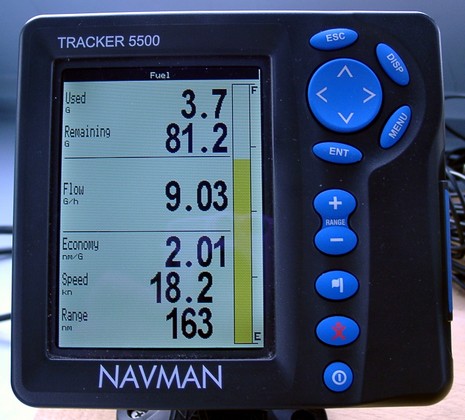
Mad Mariner just polled 400 U.S. boat owners about how they’re handling goosed up fuel prices, and the results are depressing. Though not terribly surprising, which is why I’ve gotten so keen on fuel management (part four is here, and you can work back). Actually it was years ago that I first saw the benefits of combining a simple gasoline flow meter with a GPS and software able to do calculations like miles per gallon, using Navman gear with the 250hp Volvo I/O on Ralph (still for sale, make an offer!). I could see the most economical spots in the boat’s power curve, and I could see them change with weight, sea state and other factors. I’m not sure I ever got it perfectly calibrated, so the numbers shown above may be inaccurate, but in terms of relative nm/g—and sweet spots—that’s not critical. And of course the subtleties are at least twice as important wallet-wise as they were in 2002, when I took the picture above.

Continue Reading

AutoTether, an update

Jul 28, 2008

AutoTether_air_horn

I was pleased to meet the founder of AutoTether, Anthony Viggiano, at MAATS, and learn more about his wireless MOB safety product, though I’ve already tried it, liked it, and written it up in PMY. Anthony, who struck me as a classic entrepreneur, says he didn’t realize how hard (and expensive) it would be to develop this system. The first part, settling on a design and getting it to work, was relatively easy, he said, but achieving a high level of reliability, without false activation, took some serious efforts.
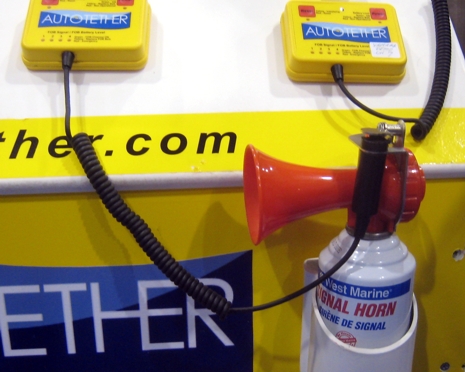
   There are a lot of extraneous wireless signals out there and after a year of added development AutoTether passes highly secure codes between base station and FOBs. Like I say, it seems to work fine, and I’ve yet to see a false activation. Now Viggiano has come up with neat variation, seen above, which will be of interest to sailors and bigger power boat folks; the AutoTether activator can be used to set off an air horn instead of an engine kill switch. Viggiano is also in serious talks with at least one big nav systems manufacturer about integrating his MOB device with a whole helm system. Maybe this business idea will work out.

Love thy coax, love thy connectors!

Jul 25, 2008

Cable_connectors_courtesy_Edward_F._Kuester 

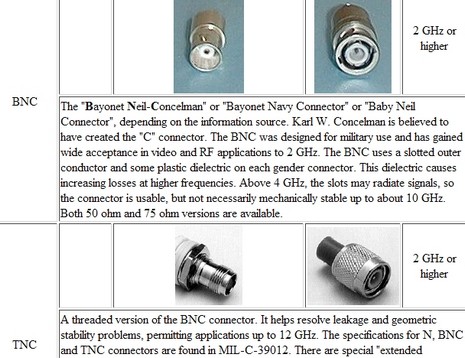
Let me say right off that the delightful title above—antenna cables and connectors really are important to performance—is stolen whole from a first class essay on antenna cabling written by Jason Reilly. And the illustration is cut from another useful coax connector page by Edward Kuester. I don't want to be an expert on such matters, but anyone who fools much with VHF, GPS, AIS, TV/FM, WiFi, and cellular antennas runs into all sorts of semi-standard connectors, and often the need to transition from one to another. The links above are great for the nomenclature, intent, and limitations of the various types, but I don’t think I’ve yet found the best sources for all the bits and pieces I could use in the lab, and you might need on your boat.

Continue Reading

RNC disruption, not as bad as it sounds?

Jul 24, 2008

RNC_Interruption_Notice

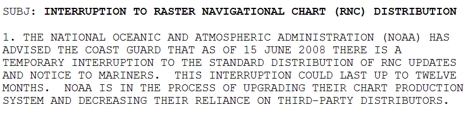
The U.S. Government has stopped distributing electronic updates to the official raster charts for up to 12 months? That doesn’t sound good. NOAA’s download site doesn’t mention a time frame for the “Interruption” but the U.S.C.G. internal bulletin shown in part above is more dire. (It’s published in full on Kurt Schwehr’s site, where you can also check out the Chart of the Future.) This is bad news for all of us who like using RNCs (Raster Navigation Charts) in the many charting programs that support them, not to mention Furuno, which decided to go with U.S. RNCs (and ENCs) in NavNet 3D and is already taking some heat for it. When NOAA decided to serve up RNCs free back in 2005, one of the big pluses was that they would be kept very current, and there were even little patch updates available. Besides, isn’t it depressing to any American that our government can’t even keep a relatively simple and inexpensive program like this going?

Continue Reading

Raymarine A-Series, reloaded

Jul 23, 2008

Raymarine_A_Series_reloaded

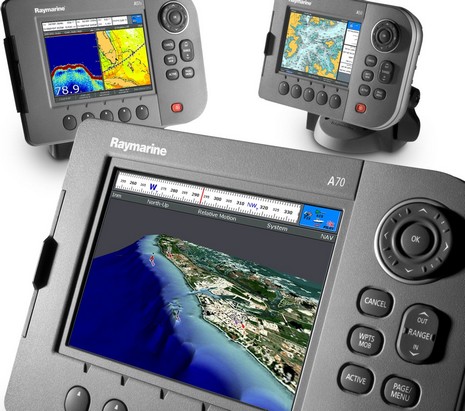
Amongst ICAST’s abundant rods and lures—even a big, lively bowl of live worms—I came across this interesting development: Raymarine previewing an impressively redesigned A-Series, previously unannounced and currently invisible on line. There will be five new models, whose names correspond to screen sizes, sort of. When the series truly debuts in October, we’ll see a 5" A50d, a 5.7" A57d, and a 6.4" A70d (hey, the C70 is actually 6.4" too), all with HD fishfinders built in (unlike the superseded models), plus A50 and A70 plotter-only versions. 

Continue Reading

Fuel management 4, Maretron N2KView

Jul 22, 2008

Maretron_N2KView_fuel_management_cPanbo

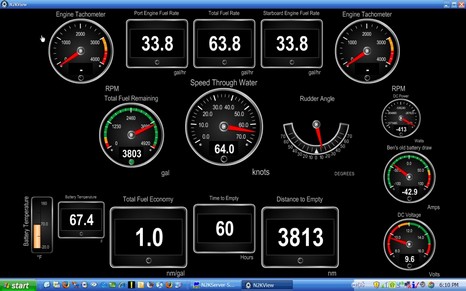
Remember Maretron’s N2KView? I tried the initial version last fall, and later wrote a column about the whole concept of packetizing NMEA 2000 data. Recently I’ve been testing Version 2.0 and can tell you that it’s faster, prettier, and more configurable—better in every way. Perhaps more important, though, is Maretron’s recent decision to position the original $2,995 product—which can or will eventually control switches, take action on alarms, handle cameras, etc.—as the Platinum version, and offer a Standard view-the-data-anywhere version for $995 (as explained in this PDF).

Continue Reading

Furuno SC-30 satellite compass, so sensitive!

Jul 21, 2008

NN3D_MFD8_SC-30_heave_compensation_cPanob

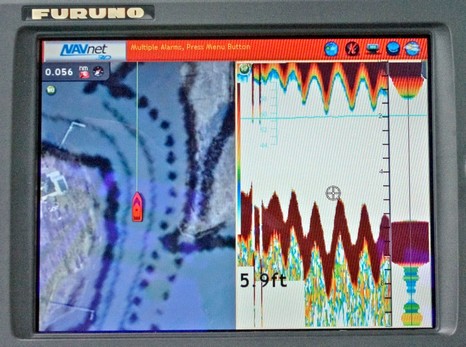
That’s a strange, but very impressive fishfinder scroll on the NavNet 3D MFD8 above, and bigger here. You see, Furuno claims that its new SC-30 satellite compass is so sensitive to a vessel’s altitude, which really only changes as it heaves up and down in seas, that NN3D can use that input to remove heave error from its fishfinder screen. I was pretty skeptical about that claim until the end of my NN3D cruise off Cape Cod, when Iker Pryzo uninstalled the SC-30 and showed us how simply pumping it up and down a couple of feet—shown below—registered immediately on the screen above. If it can respond to small, quick movements like that, it can surely detect swells and likely also compensate for pitch and roll, and thus stabilize side scanning sonar. Amazing!

Continue Reading

MAATS Innovations, the winners are...

Jul 18, 2008

Lowrance_LVR-880_lr_cPanbo

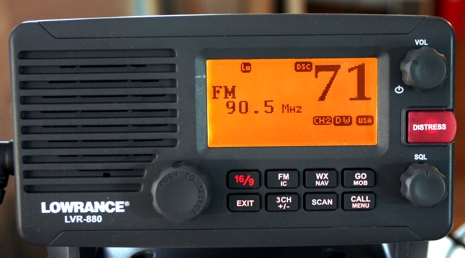
There were 15 entries in the “Aftermarket Electronics, Electrical Equipment, Instrumentation, Navigation Equipment including Software” category of this year’s MAATS Innovation Awards, and not a dud in the bunch! Which is why it’s particularly noteworthy that we seven judges gave the award to Lowrance’s Broadband Sounder and an Honorable Mention to Lowrance’s LVR-880 VHF/FM radio. I’ll be writing more about both these products as I should have samples installed on Gizmo in a week or so. The photo above is from a pre-production 880 that I tried in the lab for a month or so; the NMEA 2000 DSC features weren’t yet ready for prime time, but I was quite impressed with how well it could bring in FM radio while also scanning one, two, or all VHF frequencies, muting the FM whenever squelch was broken. Congratulations, Lowrance!

Continue Reading

ACR iPro, a GPS EPIRB with a screen

Jul 17, 2008

ACR_iPro_cPanbo

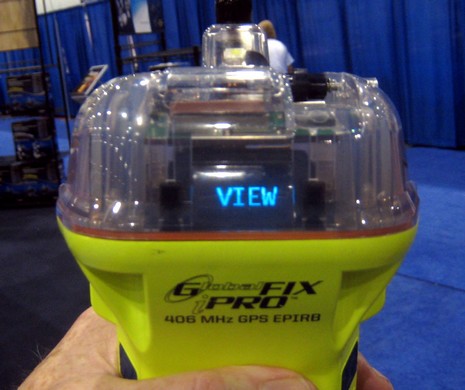
The GlobalFix iPro GPS EPIRB that ACR introduced at MAATS has at least two valuable innovations, the most obvious one being that one-inch digital display. While the EPIRB doesn’t need the screen to operate, it can provide reassuring and useful info. When you self test the unit, the screen will show the results and even suggest servicing if needed. If you actually activate the unit, as was being simulated here, the screen will give your GPS coordinates—handy if, say, you’re also calling in the distress situation via sat phone—and advise you on correct deployment. That’s what was happening in this shot. The iPro supposedly has an improved GPS receiver, but it wasn’t happy inside the Las Vegas Convention Center. So the scroll across its screen read something like: “GPS…WEAK…IMPROVE…SKY…VIEW.” Nice! 

Continue Reading

Vegas, baby, w/ da judge

Jul 14, 2008

Vegas 

I’m off to Las Vegas so early tomorrow morning I want to weep. But I’m looking forward to being one of the BWI writer/judges for the Marine Aftermarket Accessories Trade Show (MAATS) Innovation Awards. There were sixty products entered,  and while I can’t reveal names, I can tell you that lots of them are electronical, and even some of those I’d never heard of before I got the judging packets. Here’s the exhibitor list; and here’s some info on the big ICAST fishing show going on in an adjoining hall. If you see something I should be checking out at either venue, speak up! I’ll try to post from Vegas, but no guarantees. The last, and only other time, I visited was in 1969, and I saw very little besides the holding cell of the city jail (long story). I’d rather be a judge.

Garmin Radar & Maretron Compass, puzzles!

Jul 13, 2008

Garmin_Marpa_targets_cPanbo

Last week I got another brief look at Slancha’s Garmin 18” HD radar in action, only this time I got this screen shot showing its MARPA abilities in action, bigger here . But I’m still a bit puzzled about the implementation, and, as noted in the earlier entry on this unit, can’t find a thing about it in the manual. My guess is that the projected point and time represent the calculated CPA relative to your boat, not relative to the chart. Let’s consider the top right target first, and note that the arc represents where Slancha could be in 3 minutes at this speed. CPA, of course, is figured on the current speed and heading of your boat and the target. So I think that the Garmin is telling us that in 1 minute and 13 seconds the target will be a close as it’s going to and it will be broad on the starboard bow (but when this takes place we’ll be nearing that next bathy line and the target will be near that 11’ bump).

Continue Reading

Fuel management 3, Yanmar & Raymarine

Jul 11, 2008

Yanmar_Smart_Check_crop

Demonstrated at the Miami Boat Show, and scheduled to ship this Fall, Yanmar’s Smart Check looks like a gem of an engine monitoring system. You will need to have one or more Yanmar diesels with electronic interfaces and a NMEA 2000 connection to a Raymarine E-120, plus about $800 for the software (loaded into the E from a CF card), but, wow, you even get detailed alarms with trouble-shooting suggestions, and a maintenance log with reminders. And of course the gauges are complete and handsome, as you can see in this press release. But I want to focus on Smart Check’s fuel management features, which are the most sophisticated I’ve seen so far.

Continue Reading

From Colorado to Oregon, Garmin never sleeps

Jul 10, 2008

Garmin400c Camden cPanbo

I’ve been meaning to post this photo, bigger here, for a while, as indicated by the snow in the background! It shows how the Garmin Colorado 400c screen—despite the somewhat anemic back-lighting I once bitched about—looks Garmin rock_n_rollerquite good in direct sunlight. I was also going to write a bit more about the big “Rock 'N' Roller thumb wheel/cursor thingy” that’s both quite an interesting technology (the control signals are transmitted magnetically through a waterproof shield), and the doorway to an interface I’ve come to like quite a lot. But, dang, Garmin has just announced yet another marine handheld, the similarly powerful Oregon 400c.

Continue Reading

Memory-Map, new tricks and free starter edition

Jul 9, 2008

Memory_Map_gulf-stream

It’s wicked hot and sticky here, especially at this big computer, so what a fine time to receive a Panbot e-mail suitable as a guest entry! Richard Stephens—developer behind, and sometimes soggy user of, Memory-Map charting software—recently sailed aboard the Tripp 33 TRPXPRS in the Bermuda Ocean Race and reports:

Continue Reading

NN3D chart issues II, & some news

Jul 7, 2008

NN3D_BBox_Cape_Cod_cPanbo

If you'll take a moment to read Ben's comments on Panbo, you'll understand the problem. There is data on the NOAA charts that is not on the NN3D raster chart view. There is a problem with the conversion from the Maptech format to TimeZero format.

Geez Louise! I may not have expressed myself well, but that’s not what I wrote about Furuno NavNet 3D chart issues last week. And the post above is just one of many that I think are way wide of the mark. According to some on Hull Truth the NN3D raster and vector charts for the U.S. are both useless, it was actually Navionics vectors that was shown at the boat show demos, the MFDs show less chart data than the Black Box because of video chip differences, etc. It’s mostly baloney, but Furuno USA has been paying attention to early user dissatisfaction with the vector charts. In fact, I got a call today from Camas with the news that Furuno will be selling U.S. NN3D vector charts based on Navionics data by early 2009. But let’s break that down:

Continue Reading

Ode to Panbots, far flung & obsessed

Jul 6, 2008

Helmkluge-715631_courtesy_Steven_Roberts

If a man must be obsessed by something, I suppose a boat is as good as anything, perhaps a bit better than most.  — E. B. White

Some days I could be content just checking out the activities and links sent in by various Panbo readers. Who I like to call Panbots, somewhat in the spirit of Steve Roberts, the inimitable gizmologist with a knack for names. Yesterday Steve emailed notes on installing a Simrad AP20 (SimNet/N2K) autopilot he’s already dubbed “Tina” (as in Turner!). It went aboard his 44’ steel motor-sailor, the S/V Nomadness, which will have quite the systems when done. Steve’s blog has all the gory details, including a run down on the temporary electronics set up above (and the fuller White quote). You see he’s one of those frustrated folks waiting for a Furuno NavNet 3D delivery. {Meanwhile, a few of the Hull Truth posters who aren’t liking NN3D charts have gone around the bend into crazy conspiracy territory, even misinterpreting my entry on the subject; oy!, and more tomorrow.}

Continue Reading

Fuel management 2, FloScan

Jul 3, 2008

FlowScan_FlowNet_with_N2K_instruments_lr_cPanbo

Consider this test a work in progress! (Bigger photo here.) Those are two FloNet N2K interface boxes that FloScan loaned me with built-in simulation of something like a big sportfishing boat blasting along on a plane. I can modify the simulated flow value somewhat using the calibration controls built into the box, which also has an “instance” switch so that the left one (instance 0) is set up as as the port engine and the right one (instance 1) represents the starboard engine. As noted on first sight, FloScan has designed this adaptor so that a special display is not needed to manage all its calibration and flow meter diagnostics; all you need is a display that understands what to do with a fuel flow message(s). Well, easier said than done, particularly when you throw twin flow values at those displays first, and read the manuals later!

Continue Reading

Fuel management part one, Garmin

Jul 1, 2008

Garmin_18HD_and_fuel_sensor

My first screen shots of Slancha’s Garmin 18” HD radar drew a lot of interest and I look forward to more experimenting with it later this week, but the real subject of the shot above, and this entry, is the fuel management information shown on the bottom bar. The boat’s owner, Peter Smith, installed a GFS 10 fuel sensor on the system’s NMEA 2000 network, and he’s tickled with the results, particularly the miles-per-gallon info, which has shown him where the sweet spots are on his power curve. That “Economy” number—a calculation based on flow versus Speed over Ground (from GPS) or Speed through Water (your choice)—may change with the boat’s load, bottom growth, sea conditions, or engine tune, but he’ll be able to see it happening.

Continue Reading