
NN3D shipping facts, & the Time Zero connection
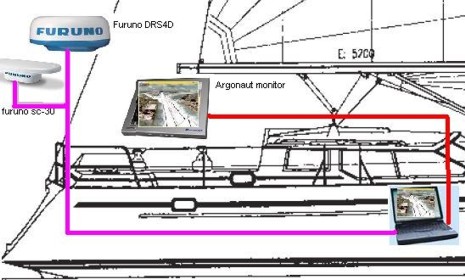
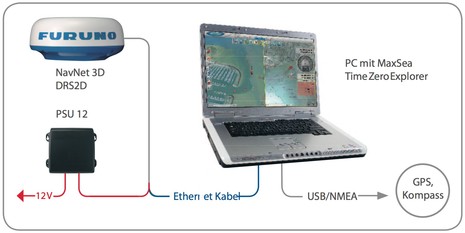
Can Panbo reader Rolf network the NavNet 3D version of MaxSea Time Zero straight to NN3D radar and GPS compass aboard his Regina 43 (as he graphically dreamed of above)? The idea seems conceivable given that NN3D radar scanners are independent Ethernet entities, and can even bridge in NMEA 2000 sensors, but I’ve confirmed from Furuno that you must have at least one of its NN3D processors in the system. That’s because only a Furuno MFD or Black Box can be the Master of a network, able to “act as a DHCP server and distribute IP address to any other Ethernet device (Radar Antenna, Sounder, Computer, …).” MaxSea Time Zero is going to work nicely in an NN3D network, sharing charts and all sensor data, but it can only be a “slave” in terms of network architecture (and it also won’t be able to do some configuration tasks like aligning a scanner).
I don’t really think this is a significant limitation as it makes so much sense to have at least an MFD8 in the system for its ruggedness. But I suspect Rolf and others may be disappointed to learn that Time Zero will not actually be available until some time this Fall. On the other hand, if you want to start with MaxSea 12.5 now, Time Zero will in fact be version 13, with only the normal full step upgrade fees.
Furuno is also having some trouble delivering all the NN3D processors boaters want. The orders placed in early March are now shipping as promised, but if you order an MFD8 or 12 today, it will not be delivered for an indeterminate length of time, possibly as long as several months. The “indeterminate” factor is because Furuno is working to ramp up production, but doesn’t yet know how well that will work. And of course there is an alternate explanation coming from a skeptic or two; i.e., that there are MFD performance issues and Furuno wants to limit the units installed just in case they have to replace them. It’s probably untrue, but persistent skeptics are sometimes right. Meanwhile, NN3D manuals are up and I’ve also learned the FI-50 instruments will ship in a month or two, with an MSRP of $595 apiece. And I’m pleased to add that in two weeks I’ll be spending a day off Cape Cod with NavNet 3D and a couple of its creators.



I’ll copy a email I received from MaxSea where they said the new Max Sea will available April. Now I know it’s May, but did this release it in Europe before here??
From: [email protected]
Subject: RE: MaxSea Software
Date: March 25, 2008 4:58:57 AM EDT
To: John Ford
in April
Marie Nanteuil
Assistante Commerciale / Sales Assistant
MaxSea International
[email protected]
Tel: +33 559 43 81 00
Fax: +33 559 43 81 01
http://www.maxsea.com
—–Mensaje original—–
De: John Ford [mailto:]
Enviado el: martes, 25 de marzo de 2008 2:20
Para: info
Asunto: MaxSea Software
When does the new MaxSea software get released??
Since MSTZ doesn’t have radar overlays until sometime this summer, it’s moot at the moment.
It may not be possible as Furuno says, but that particular reason seems very weak and/or problematic. There are any number of possible sources for DHCP servers, including the PC on which MSTZ is running.
If Furuno expects to be the Master of the Ethernet, they are going to run into conflicts with WiFi bridges, DSL routers, BGAN and all manner of other network gateways that must necessarily provide DHCP/NAT services.
Is Furuno expecting a dedicated “Furuno only” Ethernet, with non-Furuno traffic on a physically separate network? Shades of proprietary FurunoNet. Is Furuno expecting everyone to shut down all their Furuno devices and re-boot their PC before they access the net? That would be kind of odd since customers are supposed to accessing MyNavNet (www.navnet.com) for access to “premium benefits”.
This is also contrary to what I was told at the Ft. Lauderdale show when I asked this question. I was told that using MSTZ would be functionally equivalent to an MFDxx and nobody mentioned that it would be necessary to have an MFD active on the network.
With regard to the upgrade from 12.5 to TZ, one dealer with whom I spoke recently contacted Furuno in response to my inquiry. They responded that based on the answer they got from Furuno, they could not sell me MaxSea 12.5 with any confidence that it would be a “normal” update. They advised waiting until they got a less ambiguous answer from Furuno.
This is a shame. I will shortly be spec’ing a system for an offshore racing yacht for launch next May and was hoping to go down this route to save weight. Does this mean that the only straight to PC option is still Nobeltec?
On another note, I just completed a 1000 mile offshore trip up the East Coast in a new Riviera 45 with a Raymarine G-series network, including 2 G-series processors, 4kW Super HD radar, Raymarine AIS receiver, an ST70, and an Airmar weather station, among other equipment, and had flawless high performance all the way. The G-series is available now and awesome. Just my Raymarine-centric $0.02…
MaxSea appear to have a moving set of goal posts a lot over the last 2 months
We were told MaxSea will send us a new dealer dongle
Now its a software license each software will get 2 licenses that you can revoke every x days etc
Now my reliable contact at Furuno UK has said there will be NO upgrade from MaxSea 12.5 to TimeZero.
Well, I just got back from spending three hours at my dealer this morning comparing a Navnet 3D MFD12 against the Garmin 4000/5000 and the Raymarine E/G Series in a True Side-by-Side Shootout!!!
All I can say is that there is a New Sheriff In Town!!!
In overall performance, the Navnet 3D MFD12 was as good as the Raymarine G Series which was totally shocking. In terms of features, the MFD12 is much better than the G Series, E Series, Garmin 4000 and Garmin 5000. This doesn’t even consider the Navnet 3D Black Box unit which I decided was more than I needed.
If speed is the overall performance factor, the MFD12 and the Raymarine G Series are close and the others are not in the same league! Zooming the Garmin took 25 seconds to redraw one screen with the Sat Photos turned on while the MFD12 never lost the image of the same area with photos and better detail!! Don’t take my word for this fact, compare them for yourself.
In terms of features, concepts, and ideas packed into a chart plotter, Navnet is so far above the others, it is difficult to compare. It has Smart Raster charts which I love and had with my Northstar 962 but, the overall modes with 3D and the User Interface are simply amazing.
If the Furuno radar lives up to its name and the other revolutionary features I’ve read about, it is the product to beat as well.
You can argue technical babble about Networking but, Navnet 3D represents a true paradigm shift in the industry.
My dealer told me his biggest challenge will be getting enough of them and I think he is absolutely right.
I personally think having DHCP is a bad idea in any navigation suite. Options for statically assigned IP addresses seems important, in that if the DHCP server is down, the network is down, and therefore no navigation data what so ever. And since statically assigning IP addresses only gets confusing after the 256th address, I think there would be very few vessels that would run into this problem. Sometimes plug and play doesn’t seem so wonderful.
As for those who asked about IP addresses/DHCP server interfering with other forms of standard ethernet internet communications, a secondary network isn’t that unreasonable when looking at the cost of a usb to ethernet adapter (and usb hub if necessary).
Matt, IP’s given out by DHCP typically have a lease term of x days, so you wouldn’t automatically be down without the DHCP server. Also, static addressing can be implemented using any number of addresses (not just 254 – remember 0 and 255 are reserved), depending on the subnet mask being used.
Since sailors tend not to be network engineers and therefore not familiar with subnetting topics, I would suggest that using DHCP is the logical choice.
normal maxsea tz will read data from the navnet network (no radar overlay or chart shares) but makes for an easy install if you dont want the full blown NN3D MXTZ
What about Jeppesen and nobeltec HD radars ?
Can they beat Furuno’s radar quality ?
Considering they are Koden radars with very basic software processing i would hardly call them HD radars.
If anyone can define what HD—or Super HD, or Ultra HD—radar means, I’d love to hear it. I’ve definitely seen some excellent radar that’s named HD, but don’t know that it adheres to any specification. I’ve also been out on the water with a Nobeltec open array, and it produced very sharp and detailed radar imagery, though it’s not called HD.
HD, Ultra HD, Super HD, XL Turbo HD – marketing tricks – that what it is! What actually counts is array size and power.
I disagree, Berinjo. There may not be any standards to it but something often dubbed HD—software, DSP chips, something—is getting better radar images from the same antenna size and power. I’ve seen it.
Ben,
You are right, something make picture better – software and hardware power where software is running at. But signal from antenna is still from old same radar technology.
What about the placement of the radar. Can a HD radar be placed higher up in the mast ( or lower ), because of the fantastic software delivered from for example Furuno ?
This is conjecture, but I’d careful about putting an “HD” radar too high. One the best things about “HD” signal processing is that some versions can distinguish very close targets that used to be lost in noise. You don’t want to create a blank area by putting the antenna too high. Besides, I think GPS and AIS have made targeting ships and land at distance less important.
call me old fashoned but i prefer my radar to work well at short and long ranges as the ammount of ais problems i see is quite high.
AIS is good but not flawless
I second that. As much as I am looking forward to adding AIS, I am hoping for some more HD radar announcements on the low end, like an 18″ radome from Raymarine suitable for a sailboat and my E-series.
Has this issue of needing an MFD (or not!) been resolved? I really wanted to build out a Furuno system with MSTZ controlling everything. After spending all that money on MSTZ an Furuno devices, it seems totally silly to have to buy an MFD just to get it all to work.
The DHCP issue is completely bogus. As noted above, IPs can be assigned by the PC.
-tbg
TBG,
MXTZ is designed to run as a PC based MFD but you have the issues below.
No DHCP server issuing Furuno specific IP address yes in theory everything could get its IP from one DHCP server but the software in the MFD’s doesnt just randomly dish out ip’s.
Next MXTZ needs a system ID different from your MXTZ SN as the system is designed to read charts off the NavNet System ID generated from the SN of the MFD.
No echosounder as yet in MXTZ.
No NMEA-2000 / ethernet support since this conversion is done in the MFD sw.
If I buy a Furuno MFD8 and connect it to a Raymarine G190 19″ monitor via SVGA up in my cockpit, will the screen act like an 8″ monitor ?
@regina43:
Yes.
The Furuno “NN3D MFD8/12/BB Installation Guide” states:
A DVI monitor can be connected to the MFD8/12 to repeat the screen at a remote
location. The plug is DVI-D format and only a DVI monitor can be connected.
The MFD8 has a 640×480 (VGA) DVI-D output. The MFD12 has an 800×600 (SVGA)
DVI-D output.
I’d also like to point out that the G190 is USD12000 (list price), contains a fan, and consumes 90W. You’d be better off to put in a MFD12 extra Furuno chart plotter instead: cheaper, higher resolution and quieter.
Regina43, VGA 640×480 is going to look pretty poor on a 19″ monitor, regardless of how well Raymarine’s video scaling works (which is probably well).
Note that the NN3D Black Box supports 3 resolutions and recommended screen sizes:
12.1″ SVGA (800 x 600)
15″ XGA (1024 x 768)
17″ SXGA (1280 x 1024)
I think there is some control of font sizes and other display elements in NN3D, but basically Furuno/MaxSea designed the various resolutions to show best on certain size screens.
Hallo Ben,
I finally got my Furuno SC30 Satelite antenna installed:
http://www.fagerliferiehus.no/news/sc30_montert.jpg
On my first test drive, the “Radar overlay” menu is still gray ?
I could manually acquire a target, and the boat popped up on my chart as a ARPA symbol:
http://farm3.static.flickr.com/2149/4510803764_a2a7b52a31_b.jpg
But can this function be set to automatic acquire targets ?
I’m not very happy with my trails…
As you see on my pictures, there are trails on “everything”, and not only the boat’s we met..?
Regards The Regina af Vind� 43 captain
Time to read the manual, Rolf! (Or maybe check out NN3D videos.)
I recall that you have to enable radar overlay somewhere in the menu system. (And if you find yourself unable to pan far enough away from your boat’s location, that’s probably because the screen is locked to a radar overlay, even if the radar is turned off, which is kind of annoying.)
But wait until you see how much control you have over radar trails. You can even get true trails, i.e. target motion only, even while the screen is in relative motion. And, yes, your MFD (a 12?) and DRS can do real ARPA, i.e. automatic target acquisition. I think you set along with zone controls.
You need to do a little studying but the possibilities with your set up are pretty amazing.
Hi Rolf,
You cant enable radar overlay until your radar is transmitting that is the usual reason its grey.
Your trails are set to relative hence why everything moves.
On the radar page in the menu select true trails (this setting doesnt seem to save on the system i have here, slightly annoying….)
Andy
Thanks,
I upgraded the software from 1.12 to 2.04 in my MFD12 and waaooo !
Perfect !!
http://farm5.static.flickr.com/4038/4521145354_eede7742fc_b.jpg
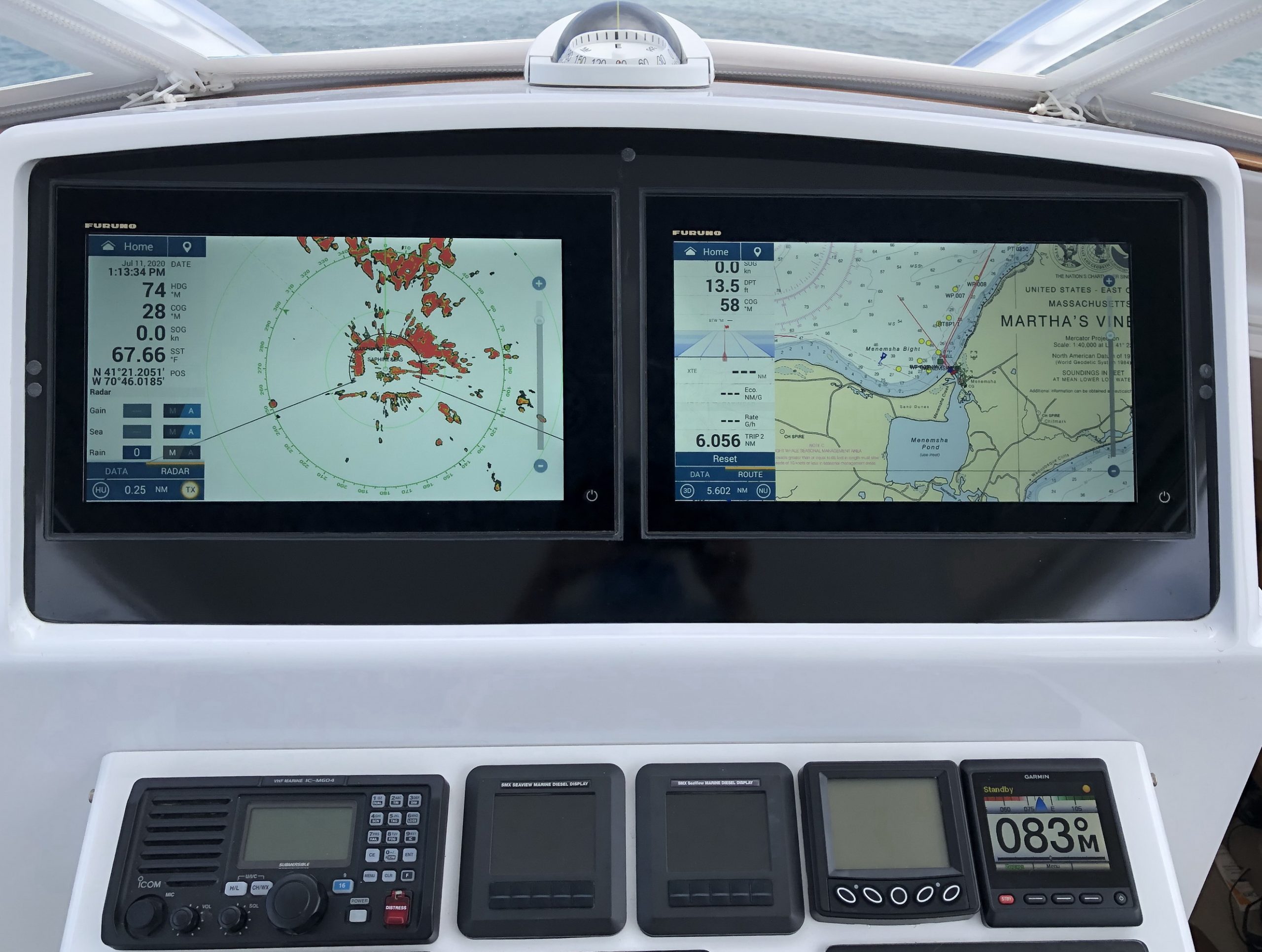
This Furuno equipment installed: MFD12, DRS4D and SC30