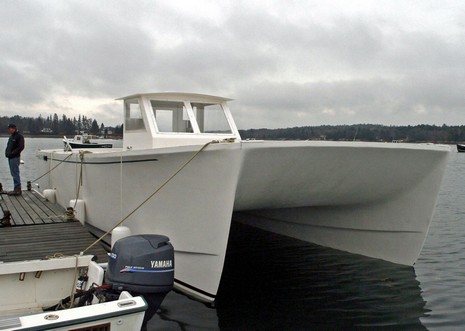
Big Gizmo? Gizmo the Large? Maybe just plain Gizmo, and add a “Li’l”—you know, in small letters on a diagonal—to the original (especially easy as I haven’t yet repainted the li’l darlin’ since the thief bastards scrapped the decals off). So, yeah, I’m sitting here fussing about boat names when, in fact, I may have completely lost my mind. That strange, yet oh-so-slippery hull above is a prototype for the Maine Cat P45 about to go into production down the road in Bremen, and P45 #4 now has my name, and deposit check, on it. (Hence my encouragement toward any boat nut who treats himself well.)
A subscription-based online boating magazine? Yeah, right! At first I thought the Mad Mariner concept darn right mad. But not anymore, and that’s not because it became a (highly appreciated) Panbo Sponsor. MM has been rapidly building a body of work that’s worth paying for. A particularly good example is their Navigation Software series. Primary authors Diana and Mark Doyle, who also create Managing the Waterway guides, set out to test and review every PC and Mac charting program available, including the free ones, and they’ve done an outstanding job. You’ll never see reviews this lengthy and thorough in a magazine. Actually there’s already a book’s worth of nav software information at Mad Mariner, with just about every program I know of covered, and apparently more resource material and gosh-knows-what to come. In fact, to my knowledge, there is no equivalent book in the print world, and if there is it certainly wouldn’t be this up to date. Plus MM has a lot of other electronics coverage spread amongst its articles and blogs, not to mention something new of general boat-nut interest posted every day. Some Mad Mariner content is available to anyone, and there’s a free 30 day trial of the whole site, but, what the heck, why not treat to youself to a year’s subscription? That’s my mood. As I’ll explain on Monday, I’ve gone and treated my boating passion very well indeed.
Here’s a post-Christmas guest entry from Dan Corcoran (b393capt), who wishes all a great holiday, as do I.
At the end of my last rant here on Panbo, I was resigned to spending my Christmas opening tie's (see above) and eating fruitcake. The picture above is in fact me opening my first present of the evening, which as fate would have it, was a blue tie. (Thanks Mom! It really is an exquisite tie, with impressive but subtle inlaid sailboat images that will compliment my best business suit.) But there was nothing to be sad about. Breeze Pleeze did pretty well tonight.
To heck with all the 2007 “best of…” lists, let’s reminisce. It’s 1984, the 47’ sloop Civais has just joined the list of new builds at the Paul Luke yard in Boothbay, Maine, and she’s sporting about as spiffy an electronics package as I recall from the era. Check the bigger picture here. That’s an International Offshore digital depth sounder and alarm at upper left, a back up perhaps to the Raytheon combination flasher and recording fathometer at the upper right. There’s also a Furuno CRT radar, with hood, just above the Trimble Navigation Loran C unit. Stacked just to their right, starting at the top, is a Stephens Engineering AM/SS radio telephone, a Magnovox satellite navigator (Transit, not GPS), and some sort of VHF radio (can’t make out the brand). Finally there’s weather fax (Alden?) and some sort of box that might be an antenna switch or tuner. And I dare say there are some spiffy old instruments in the cockpit. I doubt that any one piece of gear talks to any other, via NMEA 0183, 2000, Ethernet, or any other protocol. The good old days? Nah, but easier to get your installer head around. This photo is another from the great Red Boutilier Collection, courtesy of the Penobscot Marine Museum. More can enjoyed at MaineBoats.com. Reminisce!
PS On the book shelf is one of the better—and certainly the most humorous—star finding books I know, The Stars: A New Way to See Them by H. A. Rey (yes, the same man who created Curious George). And it’s still available.
I don’t have a good marine Christmas image like last year’s, but I do know where to steal a goofy marine electronics holiday card on the Internet. That would be at Echopilot, whose proprietors Mike and Susan Phillips have a tradition of creating such nonsense, and sending it to their friends in the industry. This year’s card is titled “The Echopilot products that never made it to market” and you can learn all about them here. I don’t know the Phillips well, but enough to know they are the good humored and proud owners a 25’ gaff rig sloop that was built in 1894! They haul the wonderfully named Tom Titaround on a custom trailor with an antique truck. On this year’s card they note a summer trip to the Crinan Classic Boat Festival in Scotland, where they “found rain and whiskey, both in industrial quantities.” But their dream is to bring Tom Tit to the coast of Maine, and that’s where you come in, dear readers. Who can come up with economical transport for Tom Tit, trailor, and truck from somewhere in Great Britain to somewhere near Maine? And who wouldn’t if they could?
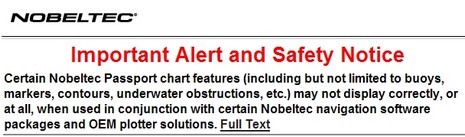
Yike. It seems that Nobeltec has guaranteed its support staff a busy holiday season by issuing the ominous sounding alert above along with update 9.3.2240 to its VNS and Admiral charting software. The exact chart regions/software combinations that have the problem are listed in the bulletin, and include the Northstar 972 but not the Simrad GB60. The good news for anyone who has trouble with the update is that Nobeltec recently extended its support lines to 13 hours a day during the week and 10 hours a day on weekends. The bad news for some is that with this update Nobeltec removes the ability to import S57 vector charts—for most people that means the free ENCs offered by NOAA—and even disables those already imported.
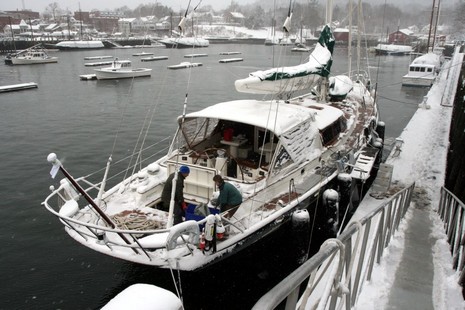
Yup, check out the bigger image, it’s been snowing here again and this poor crew was getting ready to take the lovely Aeolian south for the charter season tomorrow. Yipe! Apparently this was not exactly the plan in early July when the boat was hauled (which, amazingly, is documented on You Tube). Schedules can slip when the project list includes major items like a deck overhaul, a new engine and an exotic electronics network. I might have gotten a peek but there was a little stress aboard as yesterday that network had a “melt down” when a PC was swapped out.
I thank Dan for yesterday’s NMEA 2000 homily (more guest blog entries welcome!), but I do want to play devil’s advocate. I’ve had my head in the Simrad Yachting 2008 catalog today (unfortunately not online yet), and I’m ever more impressed with how thoroughly the company has adopted its SimNet version of N2K. All those yellow lines in the diagram above, bigger here, represent SimNet data bearing cables (power too in many cases). I hadn’t fully realized that Simrad has N2K GPS, depth, and wind sensors as well as the rudder angle and compass that were mentioned with the new autopilots. Of course the AI50 Class B AIS would also plug and play nicely with this typical sail system, and give it a backup GPS, as long as it was powered up. And the SimNet cabling has a lot going for it, like a tiny plug that’s the same on both ends, and the ability to daisy chain, even the backbone in some cases like that RS86 VHF.
I like to think that one function of Panbo is to be a place where marine electronics enthusiasts can share their thoughts—rants included—with each other, and with the many industry folks who read the site. That usually happens via comments but guest blog entries are also welcome. Hence we have the following bitter sweet Christmas tale from Dan Corcoran (aka commenter “b393capt”). Thanks, Dan!
Sorry Breeze Pleeze, no marine electronics in your stocking this year …
My wife wants me to get something on the Christmas list for Breeze Pleeze. Cool, I would really like that. I already had a solid plan to spend the winter storage period wiring a new N2K backbone into my 39’ foot sailboat Breeze Pleeze and her two N2K capable chart-plotters. So for Christmas I would, err .. I mean, Breeze Pleeze would potentially get her first N2K component.
The photo, bigger here , shows what a real winter we’re having on the coast of Maine, and it was taken before yesterday’s blizzard-rain-freeze event! The dashboard GPS tableau was because a motorcycle rider reported that sending a message from his SPOT may have caused his Garmin 276c to freeze up. But I drove around like this without problems (aside from getting laughed at); SPOT transmitted “OK” and “Help” messages fairly consistently, as seen earlier, and none of the plotters blinked.
Given some controversy about how big ships actually use AIS and what that may mean in terms of Class B, I asked Captain John Konrad to help out. Boy, did he, first querying his gCaptain readers, then bringing in Captain Richard Rodriguez for a professional small boat point of view, and finally e-mailing me with all the interesting comments below. This is the longest Panbo entry ever (and some of the best stuff is at the end). So how about a big round of applause for John, who somehow pulls all this off while still shipping out (he’s Chief Mate aboard a 835’ ship in the Gulf of Mxico right now, editing gCaptain by satellite!)
My recent mention of Class B negativity elicited a lot of interesting comments, including a long post by Mr. Fred Pot himself. Fred, who I once profiled as “AIS man”, has now established himself as the Class B curmudgeon, not just the inspiration of Navagear’s “AIS Class B Naysayers, Unite!” but also a rather negative Class B sidebar to an otherwise enthusiastic AIS article by Steve Dashew in the current issue of PassageMaker. I count Fred as an industry friend, but I think he’s gone way overboard on this subject, as shown by a couple of points made in yesterday’s comment:
Sort of like repairing or upgrading old instruments, you could also spend some winter off water time getting your waypoints and routes in order. C-Map has put together a nice tip sheet on how you might do that using their chart cards along with the nifty PC Planner product that lets you bring home plotter data and work with it and your C-Map charts on your computer. (To get the PDF, click on the orange card reader here.) You may not be up for making “chart art”, like above, but doesn’t it make sense to sort through the waypoints, tracks, and routes you accumulated last season?
We’re collecting some valuable information and opinions in the first “old instrument” entry (thank you, commenters!). For instance, who knew that Moor/EMS was still around making and servicing their economy grade sailing and fishing gauges (see this eBay store for pricing), some of which will fit holes left by other older brand round models. Plus local installer John Gass wrote me with some tips, like the fact that Signet Marine is still going strong. Actually that company Web site is really comprehensive, even including advanced testing info like the image above, used to troubleshoot a masthead wind sensor. Gass also recommended DMI Marine as “the place to go for Datamarine repairs” and Wheelhouse Marketing as “excellent for older B&G, Leica, and other obscure brands.” In fact, he says that Autohelm ST50’s are about the only instruments he can’t get repaired anymore, which is why he’s hoarding those removed during upgrades. In that dept. he says he usually uses Raymarine or Simrad to replace Autohelms, as the new DMIs are problematical size wise. I’m a bit naive about all this, probably becauses almost none of these companies are the sort to send out press releases or even attend the big boat shows. It would seem that DMI, Moor, Signet, etc. have found a comfy niche in what we might call the instrument underground. Who have we missed?
This week I’m hoping to find out more about private versus public Search and Rescue call centers (thanks for the interesting comments so far). But I’m also on another mission, and am hoping for your help. I have a Sail assignment on upgrading instruments. Say your old boat (10 years plus) has broken or tired speed, depth, and/or wind gear, possibly manufactured by a company you don’t hear much about these days, like Signet, Kenyon, Nautico, Datamarine, or International Marine (are there more)? Can you get the old stuff fixed? Is it worth doing? Are there relatively easy upgrades, perhaps using the same instrument and transducer holes, or the same mast wiring? If replacing instruments, how far would you go…some networked variety…color…NMEA 2000? What instruments do you find nearly essential to sailing?
I may be annoyed at the FCC, but the U.S. Coast Guard never ceases to impress me. In this CG video, also viewable below, a chopper team—rescue swimmer included—is picking up a sailor some 80 miles off the northern coast of California in late October. The wind is reportedly 50 – 60 MPH, and you can hear the pilot calling some swells at 30’. I think the most compelling thing about the video is the tight team work you can hear amongst the crew. Two guys were rescued off the vessel, which was unfortunately named Passing Wind II, and may have been a Nauticat 35. According to the ACR press release, the boat got rolled onto its cabin top, dismasted, and 2/3rds filled. “The life raft and dinghy on back were sheared off. We had no radio, the Satellite phone was drenched and dead, and all electrical pumps were useless.” But their GlobalFix EPIRB worked fine, the CG knew where they were within 30 minutes, and were there in 3 hours. Close call!
Honestly, what the hell is wrong with the FCC? Today some one who knows how these things work pointed out to me that the Commission only listed Docket
04-344–the
“
Amendment of the Commission's Rules Regarding Maritime Automatic Identification Systems”—on its Items on Circulation list as of November 19. I’m further told that, though the U.S.C.G. has asked the FCC to expedite this ruling, there’s really no telling when the Commissioners will sign off on it. And you’ll notice that many items on the list date from early 2007 and there are few from 2006! As for Ghassan Khalek’s mid-October “a matter of weeks, not months” and Jose Arroyo’s December prediction, I know not. Depressing.
The neat thing about putting satellite TV on your boat is that if you already have the service at home, most companies will let you put it on the boat for just the monthly cost of another receiver. The problem, though, is that the stabilized antennas start around $3,000 and even the small 14” ones can spoil a handsome boat’s profile. Enter the VuQube, which King Controls was showing at the Fort Lauderdale and NMEA shows.
Though my first SPOT test entry garnered no comments, I remain convinced that some boaters will go for this gadget/service once they fully understand what it can do for them. Actually, out on the water is where it may perform the most reliably. I’ve been trying SPOT in some tough situations and am learning that it needs a good sky view to work well. I had it out in the streets of New York City for several hours last week, and I don’t think it ever got a GPS position, and it only twice got a message off. By contrast, a little Lowrance XOG I’m testing could regularly get a fix on these same streets (which is where I last tried the AnyTrack, not midtown Manhattan but with many tall buildings). Of course SPOT does not claim to work in urban canyons, but I wonder about wilderness canyons or places with heavy, wet leaf cover. And I don’t understand why it isn’t able to indicate if it has a GPS fix, despite having four bi-color LEDs. {Correction: when you activate a SPOT function, it will indicate after a while if it does not have GPS fix, as—ahem!—explained in the manual.)
At least theoretically, Amazon’s super hyped Kindle “wireless reading device” could be a wonderful cruising gadget. Imagine waking up in one of the many U.S. coastal anchorages covered by the EVDO cellular service included in the thing’s $399 price. Any of the several major newspapers, magazines, and blogs that you can subscribe to would have already been downloaded into your Kindle, ready to read, along with 100 plus books you might already have stored in it (but which wouldn’t be weighing your boat down). Plus colleagues and family can send documents to your Kindle email, where they’re put into Kindle format and downloaded to you for a dime a piece. And the Kindle help files suggest that there’s even a basic Web browser among the “experimental” aspects of this gizmo. For more info here’s Newsweek’s thorough cover story (hey, that Ellison byline you may see around Newsweek is my kido!), and here’s Engadget’s more skeptical approach. But please don’t buy a Kindle without coming back here first. Even though currently sold out, Amazon is so anxious to get Kindles out in the field that they are offering Associates like Panbo an extraordinary 10% commission. So if you do decide to buy a Kindle, please start your purchase with this Amazon link, or the one below. Also tell us how you like it. Thanks.