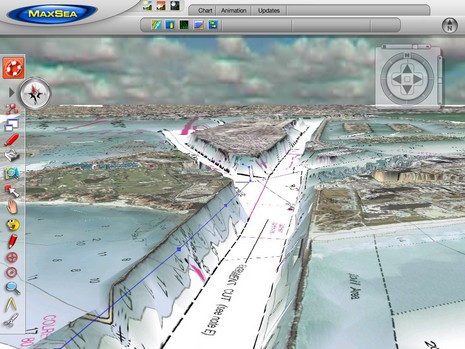
If you’ve been studying up on NavNet 3D, or watched yesterday’s video, you’d know that Furuno describes the product’s remarkably fast and smooth charting engine as based on “Time Zero” technology. And it’s so distinctive—especially, say, when you go into 3D mode and freely fly around placing a route, eye-balling radar overlay, etc.—that it deserves a name. However, Iker Pryszo, whose father Bryce founded MaxSea way back in 1985, explained to me that “Time Zero” has an entirely other meaning. In the life of a software program there comes a TIME to dump all the old code and start again at line ZERO. That’s just what MaxSea did some four years ago, even starting with a new programming language (though Iker didn’t say which). So apparently while some developers continued to work on the old code—evolving MaxSea up to its present 12.5 version, plus building the module that can integrate 12.5 with Furuno NavNet vx2 system—others worked on MaxSea Time Zero, the entirely fresh product that launches tomorrow at the Paris Boat Show. Judging from the screen shot above, bigger here , Time Zero is much more like what we’ve been seeing demoed on the NavNet 3D machines than it is any earlier version of MaxSea, despite those familiar icons running down the left side. And I’m told that the two, NN3D and MSTZ, are going to work together very nicely. Plus, simultaneous with Time Zero, MaxSea’s cartography company MapMedia is announcing a wide expansion of its coverage including new vector charts “Powered by Navionics”, with 3D data and photo maps, and new raster areas. Hopefully, there will be much more detail on all this at www.MaxSea.com very, very soon.
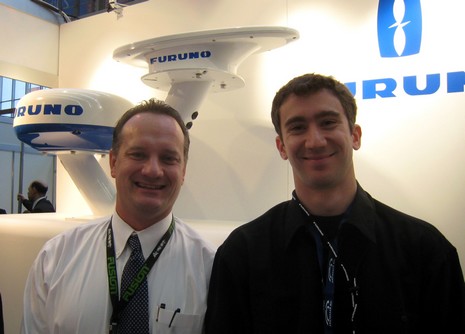
Above are Furuno Product Manager Eric Kunz and MaxSea developer Iker Pryszo at METS, where they had good reason to grin; Furuno’s booth was as jumping in Holland as it was in Florida. I can’t recall a marine electronics product that’s ever generated such a buzz. This comment from Milt Baker—“I thought NavNet 3D was the big hit of the Lauderdale show and I believe it will have a huge influence on the course taken by the marine electronics industry in the years ahead.”—is representative of many I’ve heard. And NN3D admirers include the best informed and most critical group I know…the product managers at Furuno’s competitors.
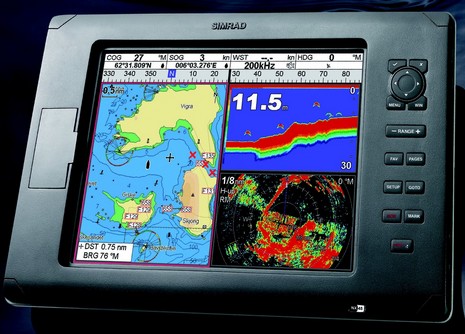
In addition to the networked GB40 series, Simrad also debuted the single station NX series at METS. Again there’s no information online yet, but a student of marine electronics will take one look at the image above and already know a lot about NX. Yes indeedy, I first tested, and liked, that 12.1” screen as the Navman 8120. Then at METS 2006 , when Brunswick New Technologies decided to drop the Navman brand in the U.S., the 8120 became the Northstar M120 and got a 8.4” sibling, the M84. But again, while you can learn a lot about the Simrad NX series by checking these Northstar pages, the units are not exactly the same. You guessed it, the NX40 and NX45 will both support SimNet/NMEA 2000. (Have I mentioned that 2008 is turning out to be the year of N2K!)
There’s nothing online yet, but Simrad did debut its Glass Bridge 40 series at METS. It’s somewhat familiar because it’s obviously based on the existing Northstar 8000i system, but it is not just a rebranded product. For starters the GB40 doesn’t utilize touch screens, instead offering more conventional monitors in 10–, 15–, and 19–inch sizes, and the OP30 controller—which is shown below, and can sit in an inset cradle—is nothing like the 8000i keyboard. Plus the GB40 only comes in a black box version, and that box, unlike the 8000i’s, has a SimNet/NMEA 2000 connector on it. (Have I mentioned that 2008 is turning out to be the year of N2K!)
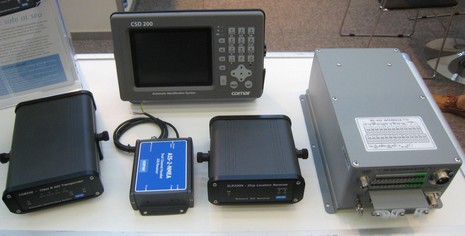
Comar Systems introduced no less than five new AIS products at METS, most of them seen in the photo above, bigger here. Together with Comar’s existing receiver and Class B transponder, they represent about every AIS possibility there is…except for one-channel-at-a-time receivers which Comar doesn’t believe in. Neither does SeaCas. I agree, and think they’ll go away fairly fast once navigators see how slow one-channel-at-a-time Class B plotting is, and also as Class B hardware becomes less expensive. At any rate, here’s a page of new Comar gear, including a lower cost ($440 retail) true dual channel receiver, an Etherneted IP-talking receiver (the more shore stations the better!), and a $3,000 Class A transponder that might possibly be fit on non mandatory vessels without the need for the separate $1,150 display. Meanwhile, Panbo reader Kurt Schwer, blogging from the eNavigation 2007 conference in Seattle, reported that the USCG’s Jorge Arroyo predicted that U.S. Class B sales will start in December. A thank you to Kurt, and let’s hope.
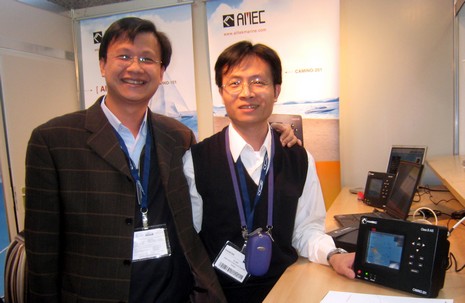
That’s Charlie Hsu, sales & marketing guy for Alltek Marine Electronics Corp. (AMEC), along with the company’s chief engineer. They were at METS looking for companies interested in distributing their Class B AIS, mentioned here last April. When showing me the unit, Hsu pointed out some yellow colored targets and explained that they were “buddy” boats. “Oh, you mean like the Simrad AI50’s buddy feature?” said I. “Exactly like that!,” replied Hsu, laughing. Then he showed me a new MOB product Alltek is working on, seen below (with the AIS display used to plot MOBs). Of course I said “Oh, you mean like Raymarine’s LifeTag system?” “Exactly like!” answered a proud Mr. Hsu.
So one of many things I’m feeling thankful for on this Thanksgiving day (here in the states) is the computer and Internet technology I’m still fascinated by, and which is crucial to the way I enjoyably make my living. So I decided to participate in the One Laptop Per Child GoGo program. GoGo stands for “Give one, Get one” and means my $400 will get a nifty seeming XO laptop (Pogue take here) given to a child in the third world, plus one sent here to Panbo World Headquarters. Who knows, maybe some of the component technology—like the small but high res and inexpensive sunlight viewable display—will be useful on boats. Plus I’ve got a geekish little nephew who may soon be ready for his first computer. Maybe you too should GoGo?
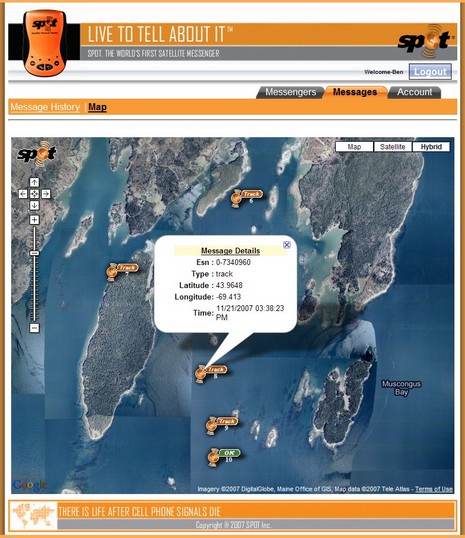
Since Sunday I’ve been testing a SPOT—the Globalstar-based “satellite messenger” first mentioned here in August—and I’m impressed. Check out the full size screen shot above, which shows me out in Muscongus Bay this morning (being shown a very cool cruising power cat, more info to come). The mapping is a little confusing because events are numbered backwards chronologically, and time is given in GMT (both quite fixable on the Web site, I think). So at #10 I activated SPOT’s “OK” function which sent a canned email/SMS, along with a Google Map link, to a list of people I’d set up on my SPOT Web page, where I can also customize the OK and Help messages. Then a few minutes later, at #9, I activated the tracking function which, as promised, sent an automatic position every ten minutes thereafter. Only position #7 is an anomaly; we weren’t over on that side of the island. At any rate, the unit is fairly easy to use, and seems to offer a lot of safety value and tracking/check-in function for the money. I do wish I’d had a chance to try it in Europe, which is supposedly under Globalstar’s not-quite-global footprint, but at least we do know that this technology works fine from Norfolk to the U.S.V.I., as discussed recently. Remember, Globalstar short messaging does not have the problems voice/email does…and, fellow yanks, here’s wishing you a fine Thanksgiving.
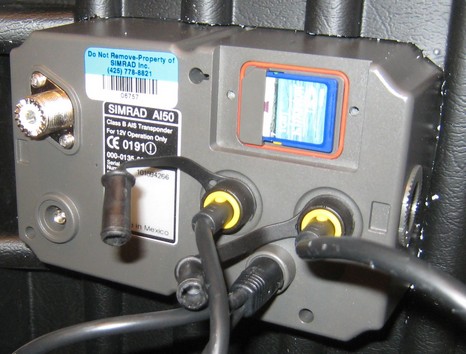
I took to the Simrad AI50 at first sight, but the more I learn the more I like. Above is the back of a unit I played with in demo mode at the NMEA Conference, and I’ve also been checking out the manual (available here). Here’s what I’ve learned so far. First of all, as indicated by those dual (daisy chained) SimNet cables above, the AI50 is a NMEA 2000 AIS transponder, the only one I know of. In fact it also puts out AIS plot data on 0183, but I think the included GPS is N2K, and so are some of the network features. Like easily initiating a DSC VHF call to an AIS target, without having to type in its MMSI number. (At the back of the manual, Simrad has nicely listed all the standard and proprietary PGNs the AI50 uses, but I still can’t tell if this feature will work with other manufacturers N2K radios, though right now Simrad has the only ones.)
It’s official. Today Inmarsat flipped the switch on the marine version of BGAN, dubbed Fleet Broadband. It’s been a while coming, as noted here last March, but the good news is that the smallest dome turns out to be less than a foot tall. Thus the new KVH TracPhone FB250 is almost the same size as the company’s existing TP 252 dome (Inmarsat Mini-M), as shown above in a photo I took at the NMEA Conference back in mid-October when KVH officially introduced the products. The big difference is that the Mini-M offers “dial-up” style data service “up to 9.6 Kbps” while the FB250 offers a “standard IP” always-on connection “up to 284 Kbps”. The bad news is that this wee dome still costs about $13,000 and pay-as-you-go data is about $13.50 per MB. Now that data cost is less than the earlier Fleet series (which charged in megabits not megabytes), but it’s still wicked costly if you want to surf the Web the way most of us do at home or work.
It’s interesting that Johnson Outdoors, makers of Humminbird electronics, announced the acquisition of GeoNav a few days ago. I’ve long thought that GeoNav gear was noteworthy, as noted recently, but never wrote much about it because it was never marketed in the U.S. The reason? GeoNav was owned by Navionics, which had made the decision some time back not to compete with their many OEM customers—Raymarine, Lowrance, Northstar, etc.—in the States. Now it looks like that restriction is finished and, though I have no idea of Johnson Outdoor’s plan, I wouldn’t be surprised to see some rejiggered GeoNav products come to America. One particularly interesting unit to look for is this GeoNav 3, an amazingly powerful but tiny handheld.
Raymarine SPX autopilots, a big refresh, N2K included
Nov 15, 2007
So they’d run out of press kits, and there’s nothing on the Web about them (yet), but there they are—a half dozen or so new Raymarine autopilot models that will be known as the SPX range, and look like replacements for the current range. New features? “Every SPX system comes with rate gyro” included; “Quicker install—no rudder reference required”; “over 10 dedicated fishing patterns” (note some at bottom of photo); and “Access to SeaTalkNG (aka, NMEA 2000) information via the ST70 color autopilot head.” So, given this week’s Garmin announcements and the new Simrad systems, I think we just went from zero to three brands of N2K-talking autopilots!
It’s still in prototype, “but close to done”, and close enough that I’m sure this entirely new Fusion marine stereo design is going to make some boaters very happy. Particularly those of the iPod orientation. This stereo doesn’t just work with the iPod’s stereo jack; as you can see below it has a complete iPod dock tucked away behind the faceplate, where your precious player will be safe from spray and bumps. Should you want a model with a CD player in this spot, then a separate weatherproof iPod dock will be an option.
I’m exhausted maties, but thought you might enjoy this pic of the new Garmin GMI 10, reported on a bit this morning. Garmin now has more detail here, and press releases on all the other new kit here. I’ll try to add more about my imressions in the am.
Good day. My fourth METS show in six years (starts tomorrow), but the first with my (fairly) patient wife along, and the first day that I’ve gotten out on the Amsterdam canals or even seen much blue sky here (in November). We got a ticket for a Blue Boat tour with our B&B, and that turned out lucky too. They seemed the most handsome and woody of all the tour boats, and our particular skipper hardly used the computerized “guide” (the mini PC screen upper right) in favor of his own patter and custom mix tape, both slightly cracked. His nav equipment? A Furuno GPS mainly displaying SOG, and a VHF that he used to keep in touch with the home office or, above, query an arrogant tug who cut him off cold. And mind you he’s driving a single screw vessel about 60’ long—no thruster, no deck hand—negotiating lots of traffic, and numerous bridges with barely a foot or two of leeway either side. His main safety tool seemed to be that rear view mirror over his left soldier and the mirrors strategically placed at many of the blind canal intersections. Not that a collision would cause any real harm. Great skipper; good day. And tomorrow, like Tuesday a year ago, should begin with a passel of Garmin press releases. What do you think…15” displays?…instruments?…Garmin branded auto pilot?
So Simrad has introduced two new auto pilot control heads, the AP 24 above, and the larger AP 28. As best I can tell they both enable the same rich suite of AP features, which include steering patterns and steering to a contour (both appreciated by trolling fishermen), ROT control (which I think means turn rates adjusted for G force), virtual rudder feedback (i.e. rudder sensor not needed for outdrive installs), and “No Drift Course” (even if you just set a course, the pilot creates a virtual waypoint and corrects for current and leeway). But the really big change from previous Simrad models is that these heads use SimNet, a cable modification of NMEA 2000, to communicate with new AC12 and AC42 pilot computers as well as with SimNet rudder and compass sensors included in Simrad’s new IS20 instrument series (which also looks interesting).
After Tim Hasson (of TechYacht) sent a head’s up about how neatly this year’s Carib 1500 rally is being tracked, I had a look—the whole fleet seen above this morning, a couple of days out of Norfolk, VA—and agree. You can see for yourself here, either in Google Maps or Earth. The company responsible for collecting and presenting the data is Magnalox.net, while the fully automated GPS communicators on the boats are made by Axonn. The whole set up is quite a change from past rallies, as Tim notes: “In the past, I collected everybody's position via Single Sideband, then passed the info on to the web site guy for posting on the web (a rather tedious chore, you can imagine). I’ve been replaced by robots, and couldn't be more pleased.” But the funniest line, I think, goes to Rally organizer Steve Black, who was quoted thusly in a good Cruising World article about the Axonn tracker:
And apparently, it's even been "sailor-tested." Nothing is required of these self-contained transmitters, so no one needs to touch them. "That type of reliability becomes extremely important," says Black, "when you're dealing with a group of people who like to fiddle with things."
Axonn, incidently, seems to be quite involved in the SPOT Satellite Personal Tracker, discussed here in August and now actually available. Doug Ritter has done some great research on SPOT, and I think it may become quite popular with boaters. In fact, I’d be testing one right now if it weren’t for a certain PR company that seems to be having a hard time locating its elbow, if you know what I mean.
I’ve been trying ClearPoint High Definition Weather for a couple of weeks now, plus I talked to some of the team at FLIBS. This is a very ambitious operation. The ClearPoint goal is to provide the richness and simplicity of dedicated XM and Sirius satellite weather anywhere on the globe, delivered by Internet. Plus they’re aiming to provide more exotic data—like 1 kilometer wind forecasting of certain sail racing hot spots and game fish revealing altimetry/chlorophyll imagery—for certain niche marine markets. And they seem to be working with numerous nav software/hardware developers to provide integrated packages, even automated weather routing. At any rate, check out the full size screen shot of ClearPoint’s PC client software above. The icons at the top—wind, fronts, lightning, hurricanes, and text forecasts—show what I’ve chosen to display on screen. With the window lower right I can page through those various elements, clicking for specific places on screen. And the icons below show other data types I could add to my mix. I like the interface quite a lot and some of the data, like far offshore lightning, I’ve never seen in any weather product before. But buying the ClearPoint service is not trivial, and that does not include the cost of offshore downloads, which could be in the .5 meg per hour range (there is a low bandwidth mode, and ClearPoint is working on total download size controls). Interested? There is a free trial; please report back!
I always make some time to get to the furthest reaches of the Fort Lauderdale and Miami Boat Shows. These are back rooms so far from the real action of these big shows that the new exhibitors you find there often think of themselves as exiled in “Siberia”. But I have sometimes found a really good product there, and have then helped make the product known…which is a thrill for me. But I’ve also seen some pretty weird scenes in Siberia, like when I turned a corner in the FLIBS convention center last month and found the four people above laying back in chaise lounges with goggles on and their mouths glowing blue! And apparently, bigger picture here, they’d paid $149 a piece for the privilege. I think it was the lab coats that cinched the deal. And that’s as serious as I’m going get, as my day of the year has rolled around again. At least I can look back at the last year and take pleasure in my coming out as a true propeller head.
So you know I think the new Raymarine G Series and Furuno NavNet 3D are pretty big deals on the high end of marine electronics. But they are computers, aren’t they? Interesting question. I don’t see Raymarine using that term on the G Processor pages, nor Furuno on the NN3D MFDBB pages. But they both have hard drives, they both handle lots of data and graphics very fast, and NN3D even supports conventional USB mice and keyboards. In fact, if you ask the guys who designed these machines, they’re not shy about what’s going on. The G Series run on Linux and NavNet 3D runs on Windows XP Embedded. So, yes, I think these are computers, even if built for the purpose (does the G above look rugged, or what?), and thoroughly locked up against normal PC software/hardware compatibility issues. But does even a heavy-duty locked-up computer make you nervous on a boat? I’ve heard some worry about the drives but mind you these are heavy duty shock mounted units, and, besides, it’s easy (if costly) to build redundancy into either system. Both are essentially headless, with all major sensors like radar connecting via Ethernet hub. And both, I think, automatically copy created routes, etc. to all processors on a network. Sounds pretty reliable to me, plus I like some of the Windows related interface features seen on NN3D screens like the fishfinder setup one below. What do you think?
Short of a boat show, maybe the best way to see how smartly the new Furuno NavNet 3D interface works is to check out the Tutorials at NavNet.com. Then you can see how those soft keys above fan as you turn the RotoKey knob, which thus gives you instant feedback about where you are even if the knob is separated from the display. Plus, being a knob and not actual keys, “RotoKey” means you don’t need to move either your eyes or your fingers to access NN3D’s soft controls. Moreover you can choose from several preset levels of RotoKey controls, also customizable, and you can jump right from your favorite set to all commands available for a particular screen with just a long push on the knob. The little icon at the end of the RotoKey label indicates either more choices under it (the arrow head), accessed with a button push, or its on/off status, changeable with a button push. The latter may seem obvious but truth be told the new Garmin interface often makes you do 3 button pushes just to change an on/off condition (steal this idea, Garmin!). Actually I’m told that Furuno itself “borrowed” the idea of separating the scroll and cursor controls from the Northstar 8000i (very much alive, by the way), and what a good idea it is. How many man button pushing hours (MBPHs) have you spent just getting a cursor to the edge of screen so it could start scrolling the chart! Jeff McLaren even compares the NN3D interface to high end video games, in a good way, and I suspect he’s right. I don’t know video games but I see well chosen bits of several good PC (and Mac) interfaces in NN3D. And not only is it frankly PC based (dig those left and right mouse button icons on the keyboard), but you can plug in any standard USB PC HID (human interface device), and use it right along with standard controls. Want a wireless RotoKey (and more)? All you need is a wireless mouse with a clickable wheel. Well done, Furuno.
Testing that Standard Horizon CPV550 wasn’t the only reason I was on the water yesterday. I was exploring some unfamiliar waters around Cundys Harbor, and it was damn inconvenient to have the big plotter and the Raymarine sounder both suddenly fog up. I’ve had this issue with the DS500X before; Raymarine’s solution was to have me stuff some desiccant bags into the back of the unit, which seemed a little half baked but did in fact work for over a year. Yesterday may have been particularly tough, what with big temperature and humidity swings. I’ll ask Standard about the fogging, but I’ll also write more about the CPV, which I have been quite impressed with.