Panbo

August 2007 Archives

AnyTrack? Not around here!
Aug 31, 2007

AnyTrack GPS100 cc

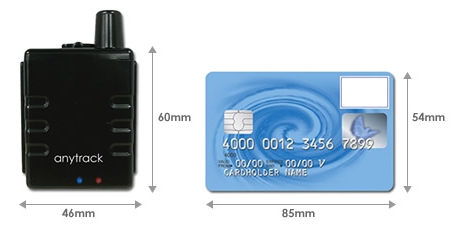
So the AnyTrack pitch is that the little GPS-100 above is “perfect” for locating stolen boats or vehicles, or tracking something or someone precious. The interesting technology involved is a built-in CDMA cellular modem and “Assisted GPS” which can supposedly enable online locating even inside buildings (and is so far only available on the Sprint system, according to an AnyTrack tech). The unit appears to be very solidly built, but I’m sorry to report that the overall service, not inexpensive, seems to be pretty much useless, at least on the coast of Maine.

Continue Reading

Magellan Crossover, a so-so AIO PND so far

Aug 30, 2007

Magellan Crossover marine screen cPanbo

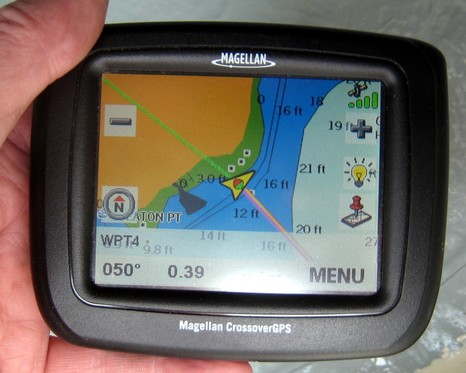
I’ve been intermittently testing this Magellan Crossover for months now, and the fact I haven’t mentioned it here is a sign of my ambiguous feelings about it.

Continue Reading

Tacktick Micronet, part 2

Aug 29, 2007

AnnieG_test_rig_cPanbo_lr

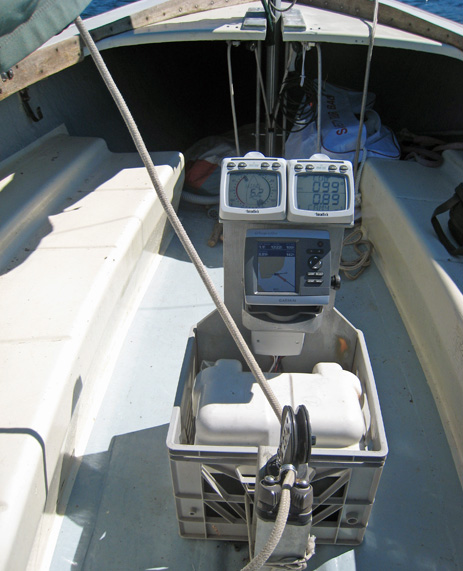
I don’t think I’ll be offered a job in any department at Lyman-Morse, but check out how I turned a milk crate and some wood scraps into Annie G’s new electronics test station. On top are the Tacktick displays already discussed, then there’s the wee Garmin 430, and the secret sauce — hard to see — is a Tacktick T122 NMEA Interface.

Continue Reading

Raymarine ST70, looks hot!

Aug 28, 2007

Raymarine_ST70_Standard_and_PilotHead

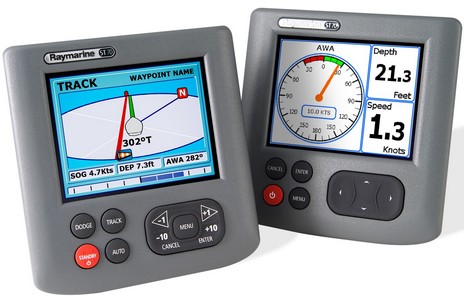
Do these new ST70 instrument and autopilot displays (bigger here) look beautiful or what? The problem is that the screens are probably faked, which is typical of this sort of product photography. But Raymarine assures me that they are gorgeous in reality, and may let me see for myself in a few weeks. The official U.S. unveiling isn’t until mid September but again, darn it, AskJackRabbit got the scoop, first finding some dope in England, then yesterday posting most of what went out to dealers…images, manuals, pricing, etc. Perhaps as noteworthy as rich color screens is the fact that ST70s can not only display NMEA 2000 info, engines included, but can also connect to existing SeaTalk instruments and sensors. Plus they mark the birth of SeaTalkNG (new generation), a N2K-like backbone and T cabling system. More on all after I study up.

Furuno NavNet 3D, a teaser

Aug 28, 2007

Furuno NavNet 3D teaser

AskJackRabbit got the NavNet 3D scoop, and it sounds interesting. Apparently the hardware is all new, including “digital” radar and several NMEA 2000 sensors (like GPS and weather), but is still backward compatible to some existing NavNet gear. The “3D” angle remains mysterious but Furuno is claiming “You won’t believe your eyes” in a weekly series of video teasers at www.navnet.com, and the ‘lectronic laddies are speculating over at BoaterEd and The Hull Truth.

Tacktick Micronet, part 1

Aug 27, 2007

Tacktick AnnieG cPanbo

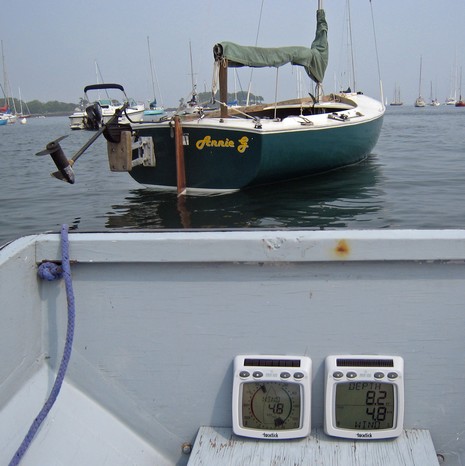
I finally launched Annie G., my Rhodes 18 (named after me mum), and am getting pretty excited about the various Tacktick instruments I’ve installed. I had to drill a substantial hole in the hull just forward of the mast for a T910 triducer that’s wired to a T121 Hull Transmitter mounted just under the mast partners. And I had to modify the old Windex mast-head plate to attach the T120 Wind Transmitter . But I did not have to run a wire down the mast, which would have been a major pain. And of course the T112 Analogue and T111 Dual Digital displays—also wireless and solar powered—don’t need wires either, as I’m demonstrating from my skiff above.

Continue Reading

"Lost Claws", a homie

Aug 26, 2007

Lost_Claws_cPanbo_th

Maybe my favorite-named lobster boat ever, caught here in pristine just-relaunched condition, before she went to work in Penobscot Bay.

Continue Reading

Distributed power, no bus, no code

Aug 24, 2007

Electra_DC_breakers_cPanbo_lr

This (bigger here) is one of the DC panels on Electra. What’s unusual is that its modern electronic breaker/switches do not connect to a bus and then to various microprocessor-loaded control panels, like, say, Moritz’s Octoplex (my PMY column in PDF here) and other systems Nigel Calder has covered so well in Professional Boatbuilder.

Continue Reading

Freestyle MP3 player, really waterproof

Aug 23, 2007

FreestyleWhole

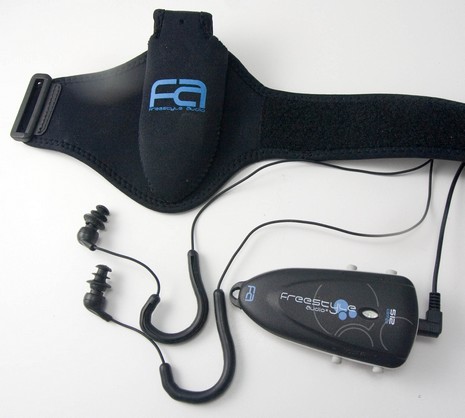
Man, there are a lot of waterproof iPod cases, but if you’re really active in/on the water you might want to consider a dedicated, if limited, solution. The Freestyle Audio MP3 player has no screen and just a gig of flash memory, but it’s waterproof to 10 feet, shockproof, and it floats. The interface is simply a multi-color LED and four stiff buttons for on/off, volume, and track advance/back. For charging and downloads, it has a special USB cord that inserts into the earphone plug, and it comes with a little program for arranging a play list. And it is tough. I tried it windsurfing in the B.V.I. and whereas I had to wear a life jacket, hadn’t been windsurfing in about a decade, and it was gusty, I beat the hell out of this test unit. Multiple high-speed dunkings, earphones ripped out, etc. Freestyle kept the tunes coming. 

Seetrac Solo, more tender tracking

Aug 22, 2007

Seetrac_Nobeltec_plot_2

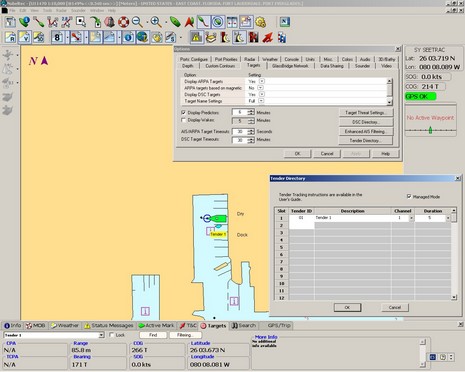
Well, my entry on how Rendez-vous tender tracking uses AIS message conventions seems to have confused even some AIS savvy folks (sorry, Del). To be clear, Rendez-vous will not show up on anyone’s screen unless that screen is connected to a specific network of Rendez-vous radios. Rendez-vous just uses the AIS data structure so that plotting software does not have be modified to see the tenders in a network. Get it? I think it clever, but the folks who developed the Seetrac Tender Tracking systems aren’t so sure:

Continue Reading

Lowrance N2K FM/VHF, and more

Aug 21, 2007

Lowrance_LVR-880

If you check the bigger image, you’ll see the FM band button, a welcome first for a fixed VHF radio. But maybe better yet, I think, is the Lowrance style NMEA 2000 plug on the back.

Continue Reading

Hurricane tracking, XM & more

Aug 20, 2007

Garmin_XM_Hurricane_Dean_lr

Panbot Allan Seymour (thanks!) sent in this image of Hurricane Dean showing on his XM-enabled Garmin. It also happens to show the southern limit of XM’s cloud coverage coverage. Which shouldn’t be confused with the southern limit of the area covered by XM’s satellite, though it’s close. Meanwhile, gCaptain put up a good list of online hurricane tracking maps, plus a link to great info on Google Earth storm tracking. Tis the season.

Rendez-vous, clever use of AIS standards

Aug 20, 2007

Rendez-vous_Admiral

Tender tracking systems, like the Nobeltec/Seetrac combo discussed here last year, are a bit exotic (even a bit mockable). But I’ve seen the captain of a big charter yacht worry over a ditzy guest out on a PWC, plus I see how over-the-top some mega yacht tenders are getting (like the Vikal Limo). In fact, when I was in the British Virgin Islands last spring, it seemed like every big, really fine center console I saw turned out to be the “little” boat often towed by one much bigger. In other words, tender tracking can be serious business, and I think the new SeaCas Rendez-vous system looks to be a powerful solution.

Continue Reading

TDI inverters & converters, modular & hot swappable

Aug 17, 2007

Electra TDI inverters cPanbo

This week I spent some more time aboard the fabulous Electra, back at Lyman Morse after a month long trial/pleasure cruise to New York. I’ve come to realize that her owner, George Wallner, has a deep understanding of electricity that’s similar to the way some fine chefs I’ve met know the science and mechanics of their basic materials like, say, butter. Wallner is not only a talented electrical engineer but also a guy who’s run a company that manufactured mission critical electronics—credit card swiping systems—and a yachtsman who’s been seriously cruising a boat similar to Electra for ten years. Don't you want to see how he’s equipped his new ride?

Continue Reading

HF weather broadcasts, & DMS, revisited

Aug 16, 2007

CamslantWhen I first mentioned the USCG’s need to replace its HF weather radios, I had a hard time getting into the Document Management System (DMS) where any us can make a comment or see other people’s comments. Well, apparently some 900 folks did figure out DMS, and the vast majority of them are asking the government to spent the four million dollars it will take to replace 20 transmitters. I learned this from Joe Hersey’s rec.boats.electronics post and there’s also a new NavCen page on the subject. There are 10 more days to make comments, and the USCG would like more, but neither of those references tell you how to find your way around http://dms.dot.gov/. The magic Docket ID/Number is 27656. Entering that in “Simple Search” or “Comment/Submissions” will get you to the HF Weather issue. Yes, it seems a little nuts that the government is going to all this trouble about a piddly 4 million (especially considering Iraq), but wouldn’t it be a shame to lose HF weather broadcasts?

Pilot's bag, part 2 (belated)

Aug 15, 2007

Pilot Skip Strong Wheelhouse screen

Above is a laptop screen from the Wheelhouse II program which is part of the Raven pilot package I discussed back in June when I got a ride on Penobscot Pilot. Skip Strong grabbed the screen from a recording of the Nor’easter outbound trip he piloted that day, and it’s well worth seeing at full resolution. As I wrote in my Sept. PMY column:

Continue Reading

Reporter Wireless, catch a thief

Aug 13, 2007

Reporter Wireless receiver back

Responding to a Hull Truth discussion about the value of DSC, a cruiser anchored in Panama reported how it just helped him deal with an intruder. Reporter Wireless sensorThe full story (see 8/4/07 “update” on his site) reveals that he was alarmed about the intruder by a simple wireless motion detector designed for home use and for sale at $70.  Reporter Wireless looks to be a pretty powerful system, and whereas the battery operated sensor is weather proof—and it looks like the receiver can be run off a 12v supply—pretty boat worthy. The receiver, by the way, can support four sensors, and has a relay to fire a louder alarm or talk to another monitoring system. The manual is available here.

Lighted Charts, for the man who...

Aug 13, 2007

Harbor_Lights_cPanbo_lr

I saw a lot of interest at the MBHH Show, but nothing as novel as these decorative charts with LEDs correctly displaying the characteristics of all lit aids to navigation. Carl Welshman designed a circuit board that he can program with up to 52 light sequences and which he wires to each LED. You can see the detail a little better in this larger shot, but you really have to see one in the flesh to appreciate the excellent craftsmanship. There’s info about upcoming shows, available charts, etc., at Harbour Lights’ site, but not prices, which are understandly significant.

Handheld DSC VHF/GPS, I wish!

Aug 10, 2007

DSC_Alert_HX470S_cPanbo_lr

Rusty commented that the FCC may make GPS mandatory in a DSC-equipped handheld VHF, adding that he’d “rather spend $300 on a 5 watt marine portable with GPS location rather than buy one of these FRS 'locators' {TracMe}.” I agree completely, and even see considerable safety value in a DSC handheld without GPS. If, say, my little Gizmo caught fire, I wouldn’t hesitate to hit the red button on my Standard Horizon HX470S. (Actually you have to flip off the cover, press the deep button hard, and wait three seconds, counted off on screen as shown above.) 

Continue Reading

Spot, another tracker/beacon

Aug 9, 2007

Globalstar Spot

Interesting! The just announced Spot is a waterproof Globalstar messenger and GPS combo that will purportedly let you alert the authorities (at least the U.S. ones) with your position, or ask for help from your friends or just notify them of where you are, or build an online track of your travels. It will be available in November for $149 with an annual service contract ranging from $99 upwards depending on what features you want to use. There’s not much detail on the Spot site yet, except for some pretty extreme fear marketing, but I’d guess that this product will get some real attention, even from some boaters. And I’m glad that, unlike TracMe, Spot is not confusing the market place by using the term Personal Locator Beacon (PLB). Safety-seeking boaters will be confused enough, what with this, possibly MOB Guardian, and who knows what else competing for our confidence.

PS 8/13  I spoke with the gentleman from Spot who was good enough to straighten me out about its technology in the comments section below. Indeed, Spot uses Globalstar’s reliable one-way messaging system, which has nothing to do with the failing amplifiers that are causing trouble for the voice/data service. I also learned about GEOS Alliance, which will be providing Spot’s 911 capability. Sounds interesting, and I look forward to possibly trying Spot this fall.

MOB Guardian, & a cruise ship alarm?

Aug 8, 2007

Mobguardian

While on the subject of PLBs, MOB Guardian is an interesting combination of proactive personal MOB transmitters, like Raymarine’s LifeTag, with a satellite-based (Iridium apparently) communications station. So it can alarm both a boat and the authorities of a man overboard, or some other critical situation.

Continue Reading

TracMe, not a real PLB

Aug 7, 2007

TracMe_Package_600w

To be charitable, the new-to-the-U.S. TracMe looks to be a low cost, short range homing beacon that may have some safety value in certain circumstances. But it’s hard to be charitable about the company’s decision to market it as a Personal Locator Beacon, when it has nothing to do with the technology—and the international search & rescue system—that most of us associate with that term.

Continue Reading

WAAS weirdness, part III

Aug 6, 2007

WAAS_RayA60_G545_Aug6_cPanbo_crop

I didn’t get on the water today (my current PMY column alluding to house projects undone is true, worse than implied actually), but I did find a spot down the street that has a decent sky view to the Southwest where the new, and possibly troublesome, WAAS satellite #51 lives. Which is why—if any neighbors are reading—my truck was parked there with three chart plotters running on the cab roof for a few hours. It can take a while for a GPS to find and download WAAS corrections, which probably explains why I failed to see WAAS differential corrections on the Garmin 4212 last Thursday. Garmin assures me that, “As for the new WAAS satellites, all of our newer receivers include firmware that will recognize these new satellites. It might take a few minutes to discover the new PRNs, but they will be picked up eventually.” And the picture above, bigger here, proves it. There’s #51 and all satellites in use are being Differentially corrected.

Continue Reading

Digital chart art? Come to Rockland!

Aug 5, 2007

EricHopkins03 44degreesAs a young island boy, I spent a lot of time looking at maps and charts, plotting courses to find buried treasure, and later as a way to find my way in the world. In recent years, I’ve been drawn to the strong graphic images on my GPS screen as I navigate the local waters. This piece is painted on a rudder from a North Haven dinghy, the oldest one-class design in America, donated by J. O. Brown on North Haven. The image is a loose interpretation of Rockland Harbor around The Atlantic Challenge dock area taken from my GPS map. I like the idea of combining a rudder, the part of a boat that provides direction, with the GPS map imagery that tells you where you are, so you can choose where to go.

Continue Reading

14' of boat, 24" of screen, & more WAAS

Aug 3, 2007

24_inches_of_Garmin_cPanbo

Had some fun this morning, showing my friend Jack the Garmin 5212 and 4212 in action while cruising around a very busy Camden Harbor (classic boat races again). Jack’s no geek but has a lot of plotter time, especially on Garmins, and he really liked these new machines, even the Mariner’s Eye 3D view. Now you will see on the bigger image that there are lots of fingerprints on both screens but mostly it’s the photo/sun angle; they weren’t nearly so noticeable in use. Mainly, I think, because both screens are so very bright even in direct sun. The finger prints are particularly bad because some doubter said he bet the screen wouldn’t work if I had saltwater on my fingers. Easy enough to test, and it worked fine!

Continue Reading

WASS wacky, watch out!

Aug 2, 2007

Flash

I just learned that on July 31 (or July 16, according to this Trimble PDF), the FAA decommissioned WAAS satellites 122 (#35) and 134 (#47), and that at least some marine GPS receivers are not able to recognize the remaining two correction-sending birds, 135 (#45 48) and the new 138 (#51). In other words, your plotter may not be showing your position quite as accurately as you’re used to. Take care, and please report in about your WAAS status. There’s a bit of info about this here, and a good explanation of WAAS here. And maybe you can figure out what the FAA is up to here.

PS 8/4: I’ve added the WAAS satellite service numbers—the # you should see on your GPS’s status screen—to the “PRN” numbers cited above and in the technical notices. Learning those numbers (thanks to Wikipedia) means that the Garmin GPS17 I tested yesterday was seeing the latest #51 satellite, which is the Telesat in geosynchronous orbit at 107W, and may be the only bird visible way up here in the Northeast. #48 is the PanAmSat at 133W and together they are supposed to give most of the U.S. redundant coverage. I still don’t know if the Garmin was actually receiving WAAS corrections. Nor am I convinced that a possible lack of WAAS makes much difference to marine navigation, given how good the uncorrected signals are.

FAA_WAAS_coverage_next_generation

Northstar 8000i & VEI & Furuno, @ 40k+

Aug 2, 2007

Hatterascal_Hatteras_60GT_VEI lr

PMY’s Patrick Sciacca had quite a time testing this 3,600 hp Hatteras 60GT, at one point doing 48 mph in a serious seaway.  He was also impressed with the 15” touch screen Northstar 8000i on center in the helm’s pop-up electronics console. I got quite excited about the 8000i when it was previewed to me back in late 2005, but then it didn’t actually get to market for some time, and now things are a bit up-in-the-air as Navico absorbs Northstar.

Continue Reading

TH Class B, & come on FCC!

Aug 1, 2007

True_Heading_ClassB_cPanbo

Back in June the FCC asked for comments regarding Class B AIS units, and several of you—along with the USCG and other safety minded organizations—all encouraged the FCC to approve, or at least waiver, transponders already approved and in use outside the U.S., as soon as possible. There were NO objections. I was not the only one who thought that units like this True Heading would be available shortly after the comment period ended, like now. But they’re not, and recently I heard that there will be yet another comment period and even waivers may not happen until October. How the FCC justifies it glacial pace I have no idea!

Continue Reading