

Shakespeare CruiseNet, supercellularistic?

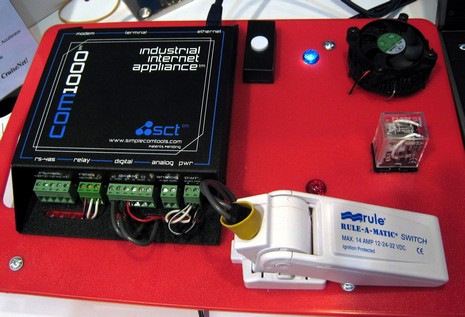
That’s a Shakespeare CruiseNet Cellular Router set up at the Miami Boat Show, where it was cruising the Internet at a zingy 3Mb, and serving it up via the WiFi router at left, which is plugged into one of its four Ethernet ports. When installed on a boat those dual stubbies would be replaced by a pair of marine cell antennas, because CruiseNet’s high performance design incorporates antenna diversity technology. Another reason for its somewhat jaw dropping cost—models start around $1,600, street, without the antennas!—is the industrial-strength, full-power cell transceiver built into the box. Most of the other cellular routers that boaters are fooling with—like the Junxion Box or the Kyocera KR1, or even KVH’s TracNet 100–use a wimpier PC-card-style consumer-grade radio that you supply. CruiseNet also includes a one year subscription to the “Full-Throttle” proxy server compression service Shakespeare has set up (renewable at $50/year), and it somehow establishes a static IP address, which apparently is not easy on a cell network.
The IP address means that CruiseNet and everything attached to it can be queried from other computers, which leads to all sorts of possibilities, as was illustrated by the control and monitoring test board Shakespeare had set up in its booth. This product could the heart of a very connected boat, at least until you get 20–50 miles off the U.S. coast, where Sprint and Verizon broadband always-on data service ends. I’m working on an article about connected cruising, and would love to hear how people are using WiFi, cell, sats, SSB, and/or pigeons to stay in touch, or whatever.



The Cruise Net system sounds ideal for US waters, but my wife and I are about to set sail around the world. What’s the best system to give us maximum internet connectivity in foreign waters?
CruiseNet looks pretty cool. It only seems to do CDMA EVDO though. That means Sprint and Verizon only. Possibly limiting world travel areas. Antenna diversity is interesting, I wonder if it really makes and difference though with external marine antennas.
I’d also like to see what the power output is of the unit alone with no amplifier. Does it really have Super Power Output? It doesn’t look very Heat Sinked. 3 watts would be high power. Would they be diversifying that to two different outputs? I might be impressed if those details were published. Also why would you need to Proxy / Compression the web with High Speed Internet? Compression typically used on Slower Speed Internet Services… compresses images and thus lower quality images.
I’m always a little wary of what I call “dB Marketing” which I’ve used to discuss antennas. You have dBi, dBd, and dB Marketing. I’d like more real specifications and test results before I’d be a believer. Shakespeare has always been a popular name in antennas, and I otherwise have not reason to doubt their quality.
A shout out Hello to Ted Halstead. I see you’re a Panbo fan as well.
—
Alan Spicer
http://www.marinetelecom.net
Did I mention you might be locking yourself into a specific cellular carrier (ala iPhone stuck with AT&T)? Tell me if I’m wrong, but there are two versions, one for Sprint, and one for Verizon?
—
Alan Spicer
http://www.marinetelecom.net
Bump on a really old blog entry, but there doesn’t seem to be much buzz about the CruiseNet anymore, or additional info such as user and installation manuals on Shakespeare’s website.
Has anyone in the listening audience been able to do any long-term tests on the device (on any cellular network), or for that matter, has anyone even installed/used one onboard?
How does it compare to a $60 aircard from a cell provider – is it really worth the $1,000?
I have tested the CN1100 on Verizon and Sprint from rural southern N.J. Both appear to operate without an amplifier and with only one external antenna out to about 12 miles off Atlantic City. They have considerable latency but thats not the modem it is the animal called EVDO. If I run the CN1100 to a small WiFi router I can use my Skpe phone only about 80% of the time. I prefer my Ericsson W-25 to the other modems because it has voice and AT&T has the NJ shore blanketed with HSPDA so I get a hard wired voice line into my Panasonic 5.8Ghz phone system and better speeds than I generally do over EVDO rev.A. I generally turn off WiFi on all my routers or WiFi enabled devices because I also use a GeoSatSolutions HP unit and most of the time I even turn off it’s backhaul card (200mw) to let the 1 watt unit’s receiver do it’s thing. I prefer the KVH TracNet100 over the CN1100 on VZW because some visitors like playing with MSN TV otherwise I have multi-outlet 4 port CAT5E wall plates wired to each service providers switch the TracNet has a Kyrocera router again I have the WiFi disabled and it’s ports hard wired. There is only limited support from both KVH and MSN on these devices now. You will see many being dumped on E-Bay without the proper Kyrocera card that must come from KVH to have the MSN integration firmware. If you can get a card from KVH (I did they sent one no charge) you will have to jump through hoops with MSN to get that working properly. KVH told me there are only 2 techs at MSN left that are familiar with the TracNet100 unit and that was 7 months ago when I decided to install the KVH TracNet100 and get rid of the CN1100 on Verizon. I still use a CN1100 on Sprint. I have found with all the cellular land based systems that running the hardwired 3 watt 800Mhz and 2watt PCS “REPEATERS” that my data speeds were slower. I believe this is because the repeaters are not well filtered and they also create a delay be it microseconds but in some situations you could have one service driving the repeater into compression and the other buried in the noise. I keep one on the boat turned off but with a selection of cables to hook to any of the cell providers cards or modems if I were in an emergency and felt the repeater would help. High external antennas are a must and I prefer using LMR-400 from the base of the antenna to the modems or card adapters. Same with the IDEN system I have which uses a Dock-N-Talk to integrate IDEN/Nextel through my phone system. I have one of the few dual band 800/900mhz repeaters made but again the IDEN radio an I-355 uses a jumper to a TNC wall plate that converts the cable to LMR-400 to a Hyper Link 800/900Mhz gain omni. I have received dispatch calls up to 15 miles out. Again everyone’s milage may vary depending on where the tower is in relation to your boat. Then I have a TracPhone 252 until the FB-150 from KVH comes out. That should be interesting to test latency and thru-put.
Bill Lentz
Bill,
Quick question. I am considering either the CruiseNet unit or the Ericsson W-25 (now the Ericsson W-35) for my sailboat. All things being equal (i.e., I will be using the same carrier with either one so the cell tower spacing will be identical), which unit pulls in a stronger signal or are they about the same?
Msny Thanks!
Steve