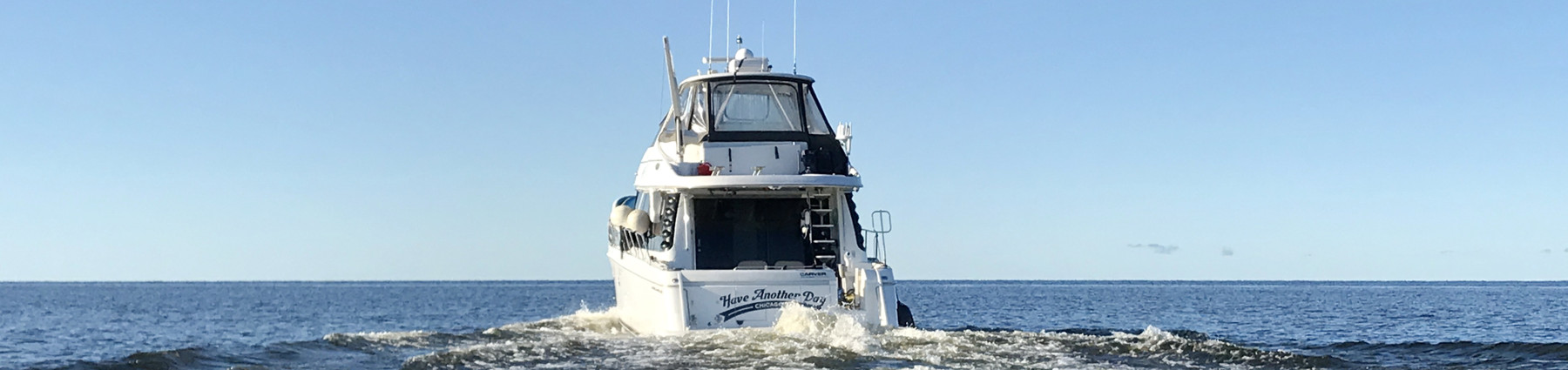
NVTi’s new 5000 and 6000 series multi-camera night vision gear got a nice mention from an interesting blog called Core77, which noted how the industrial designers behind the striking look above did a study of the yacht aesthetic which led them “to embody notions of speed, precision, durability and sex appeal as the camera's key characteristics. The camera head, consisting of a brilliant white aluminum body and tungsten rings, and its motor base are separated, allowing the unit to appear sleek, agile and vigilant on the deck.” (Which happens to be my personal on-deck goal as well.) It’s funny to see this baby and the company’s now rather plain-looking earlier designs all lined on NVTi’s product page. From there you can also find out about the various improvements the company has made on a technology that had already impressed me quite a bit. You can get wider field of vision on the thermal cams, yet more zoom on the low lights, plus 2-axis gyro stabilization on the whole shebang, and—very cool—the ability to lock onto a target selected off your radar screen. “…be it a floating container or another vessel, the cameras will automatically track to that location. Locking onto the object, the cameras will follow it until the craft passes by safely.” I’m guessing that this feature uses MARPA, but I’m not sure; there’s a picture, none too great, below, and good tracking videos here. All nice, but do note that this new design starts at $73,000.
I’m very glad that BoatU.S. keeps a boater’s eyeball trained on the government, but, man, it must be hard to understand what’s going on sometimes. The organization’s latest concern is a Congressional budget proposal that cuts “the President’s request for Mapping & Charting and virtually zeroed out any funding for converting existing paper charts into electronic files.” Say what? The piece goes on to lay out all the reasons why that is a bad idea, including the idea that conversion to ENCs will save money eventually. Anyone guess why congress thinks this program a waste?
Funny that just yesterday I referenced my own submarine experience, which involved a Garmin, and today two Panbotes tip me to an AP article about the brand new 377’ nuclear sub Texas, with a cool picture of the conning tower that just happens to have a Garmin 278, 376 or 478 stuck on its windshield (even Garmin doesn’t know which). I think I see a large screen mounted down lower—which goes with AP’s description of the sub’s high tech systems, even a fiber optic periscope—but the screen doesn’t seem to be on. Maybe the software is ‘delayed’, as they say (as if software could get a flat tire on the way to work), so someone went to West Marine and bought the Garmin? At any rate, bad guys on foreign shores should note that the USS Texas, among other lethal abilities, “can travel with a small special forces submarine, nine commandos and their gear”.
We’re on our second day of gray and wet here in Maine, and I’m missing that summer passage on Shanghai Baby. This shot shows us at sunset, Andrea and Rich, the-ex-sub-captain-brother-in-law on the bridge, about a quarter of the way across the Gulf of Maine on a straight shot from Monhegan Island to the Cape Cod Canal. We did the whole leg—Camden to Cuttyhunk nonstop in 25 hours—at about 1300 RPMs, or 7.5 knots, which got us about 2 miles to the gallon, a quiet ride, and a gorgeous night offshore. The electronics angle? Light pollution! That damn steaming light leaked annoyingly into both helms, a shame because otherwise both had good visibility and good control over the electronics glow levels. I’m not sure it would be legal to move the nav light to the antenna mast, which is offset because it also serves as the tender crane, but I’d sure look into it. When running at night, getting the lighting right around the helm is important.
This photo shows the AIS receiver test I mentioned a while back. There’s organizer Jeff Hummel of Rose Point Navigation, Doug Miller of Milltech Marine and Cory Sytsma of SeaCAS, plus eight different receivers all set up on the shore of Puget Sound. It would be great to see how they performed head-to-head, but the picture also reveals what turned out to be a significant flaw in the testing. The close proximity of receivers and antennas apparently created an interference cloud so strong that performance dropped 50–75%! For instance, the first unit that was turned on, a single channel SR161, showed a range of 17-20 miles until the others went on and its range dropped to around 7 miles. The crew did go on and collect some results (which didn’t look good for single channel models), but almost none of the manufacturers involved think they should be published. Hopefully the test will be restaged with much greater separation between the units. In the meantime, hats off to Jeff and the gang for the effort. Their work does suggest that we need to learn more about receiver interference and proper installation, and they also did a separate antenna test that we’ll publish soon.
The good folks at Shine Micro sent over an update on their own Class B AIS product, RadarPlus, and the general state of the category:
* RadarPlus really exists, units licensed for experimental use are in the field (right), and test results are “very pleasing.” (Though, no surprise, receiver sensitivity does really matter with these 2 watt units; more on that in September).
* However, “dealer programming of the MMSI is definitely coming for North American users”, and “The FCC can be expected to take a minimum of 4 months to digest all the comments they are receiving on the latest ‘Further Notice of Proposed Rule Making and Fourth Memorandum Opinion and Order’” (in .pdf here).
* Which is why Shine isn’t currently predicting “any date for FCC approval of AIS Class B”, but does “like Comar and True Heading, plan on shipping units internationally in late October.”
I searched through that .pdf above, plus the FCC site, for more on this MMSI/Class B business, but without success. Anyone? It might also be interesting to see who has applied for Class B licenses.
I just got the new Captn. Jack’s catalog, which seems pretty quick given that Maptech just took over the operation a few months ago. The online Captn. Jack’s is also back in business, which means I can link you right through to some of the more interesting offerings:
* The fictional Jack is indeed bundling Maptech Chartbooks with Garmin plotters, as above, including putting all the on-paper waypoints into the plotter. Just the product combinations themselves look like decent deals, the waypoints a very useful bit of frosting. (I’m hoping to try the feature out).
* The Capn software (no previous relation to Captn. Jack, and different spellings retained) has now become CAPN Integra AIS, and there’s some more detail on how Maptech plans to market it. Jack is also selling the U.S. Boating Charts DVD, which I have tried (it’s excellent), both alone and nicely bundled with Memory Map.
Note that Captn. Jack’s is offering free ground shipping and a money back guarantee (though a tight one). Altogether it’s a pretty neat catalog, and probably the one most focused on marine computer navigation, though it still doesn’t thoroughly cover the products available. Isn’t it strange that Captn. Jack’s once offered almost every major ECS except the Maptech ones, and now it features Maptech’s even larger roster but is missing major products like Nobeltec, MaxSea, and RayTech?
I’m still thinking, and writing a PMY column, about my TracVision M3 experience. I called Chris Watson, KVH’s Communications Manager, yesterday and wasn’t surprised to learn that the company has two full time technical writers on staff. They’re good too! I just can not imagine a better written or illustrated installation guide (full install image here), not to mention the hole drilling template, list of items shipped (w/photos), receiver user guide, etc. A nearly foolproof installation. In fact, KVH even supplies several extra of the various small fasteners that a fool like me is apt to flick overboard! Now I’m not sure how many owners will actually install a $5,000 system like this, though it is an almost-guaranteed satisfying experience. But KVH’s attention to detail could also make it quicker, and hence less expensive, for a pro to install, plus it speaks so well of the company’s style. More evidence is an M3 white paper (available from the M3 product page) that details all the technical innovations required to get a 14.5” dish antenna to perform as well as an 18” one, as shown in the test result graph below. It also lists all the testing this thing went through, which Watson says has resulted in near zero repair issues. So what’s wrong with the M3? Well, it only does DirectTV and it will not do High Definition (HD), plus of course you can find stabilized 18” dishes that cost less, especially if you go to a really unknown brand like the SeaSharp SeaVision that was aboard Shanghai Baby. Which I was looking forward to trying…except it was DOI (dead on install). Even if it had worked fine, as the first eight purportedly have, I’d still question the savings. Especially as I’ve seen other small sat TV companies show up at a boat show or two and then vanish. Of course there are several much less expensive, much lower performance, boat TV options (which I’ll discuss later), or the very simple NO-TV choice Andrea and I are tending toward. While I can easily picture cruising without TV (as always), I would like a fast Internet connection. For ‘work’ you know, though I might sometimes enjoy watching, say, Crooks & Liars clips, or YouTube nonsense. Which makes me wonder if a product like KVH’s own TracNet 100, previewed here last winter, and now fully detailed and shipping, will end up competing with TracVision?
I like putting chart screens in Course or Track Up mode, except that sometimes they jump around too much. Illustrated above is a nicety I hadn’t seen before, control over how much your track can vary before the screen turns. In a similar vein, the 8120 also has a neat “Static Navigation” control that let’s you set a SOG number under which the speed always reads 0 and COG doesn’t change. {The picture—by the way, and bigger here—is in a style I’m working to perfect: sharply focused gizmo in foreground, soft marine scene as background. That’s a Fleming 55 and a Midnight Lace back there, both lovelies.} More 8120 notes:
* A negative 8120 surprise was learning that a NMEA 0183 data-in cable is not included in the box (though it is available, and I’m getting one to see how well this MFD will handle wind and other data out of the Airmar WeatherStation). In fact, 0183 seems to be slighted in favor of Navman’s own NavBus. Thus the 8120 will only plot DSC targets coming from a Navman VHF, which is odd as that’s usually a standard 0183 function. * Build quality of the these early-off-the-line machines is a tad dicey. The first one I got wouldn’t do video and I had to use a blade to open the map cartridge door. * While I’m normally a soft key sort of guy (which may be a tester’s bias: I use so many different machines that I like to get led through the command structure), I find the 8120 key set and nested menu structure, with its nice big fonts, quite easy to navigate. * Shown below is a unique (I think) and very desirable display feature; you can vary what Navman calls the Split Ratios so that windows can be sized individually. * So far, then, a few pluses and minuses; but there’s no doubt that the 8120 is a lot MFD for the money. I won’t be able to try the SmartCraft interfacing, but it sure looks good. I will eventually test the built-in sonar (the window below is simulated) and fuel flow support. By the way, there’s a nifty promotion going on, but not much longer: if you buy an 8120, or a TrackFish 6600, before 9/1, you can get a free C-Map Mega card.
“Navionics welcomes Boeing’s escalated commitment to the marine electronic charting market. No doubt, this will help both the technological and the regulatory part of the business mature and provide a better service to the mariner, ultimately increasing safety of navigation as well as expanding the market.”
Mind you that for over 20 years Navionics and C-Map have each been run by their respective Italian founders, Giuseppe Carnevali and Fosco Bianchetti, two gentlemen who were once partners and seemed to compete both enthusiastically and graciously. This is a big change in the little industry the two dominated. It could mean new opportunities for Navionics, or it could be challenging, but I think we can safely translate the statement above into a simpler term — “Game on!”
Continuing on the subject of testing KVH’s M3 TV system, pictured above (and bigger here) is the nifty little 12v Direct TV receiver and RF remote that are included. The 3 LEDs along the top left of the receiver tell you most everything you need to know about voltage status, antenna activity, and overall system happiness. In the background you can make out the single coax cable that both powers the antenna and brings back the signal. And then there’s that Navman 8120 multifunction display (MFD) I’ve been testing recently. Pretty cool that you can watch TV on a 12” plotter/sounder/(radar soon) that seems to be selling for around $2,200 on the street.
But the video quality did seem to vary noticeably and in price order, with the Garmin 3210 below (and bigger here) in the middle, and the E-120 pictured last week—which has a video coprocessor—at the top. Hence my cute You Get What You Pay For title. Incidently, none of these MFDs seem able to use their full screens for any sort of video display. But, of course, if you did have a KVH M3 aboard, watching it at the helm would be very much secondary to using it with a nice flat screen TV or two (which I just don’t happen to have on Ralph).
Intermittent WiFi in Cuttyhunk, fog in Fisher’s Island Sound, a greasy scallop and bacon pizza, one engine overheating…it was a hell of a cruise, really! I’ll share more later, but I’m tickled to arrive home and find that two Panbotes e-mailed me about the late Friday news that Boeing has bought C-Map. Wow.
I didn’t see this coming, and am not sure how it will work. The strategy stated in the press release is that C-Map will help Boeing’s Jeppesen subsidiary, already huge in aviation mapping, grow its marine division. I find it a little odd that the release never mentions Nobeltec, which seems to be the only real meat currently at Jeppesen Marine, even if it’s only listed under “Recreational Solutions”. It’s obvious that C-Map’s commercial vector charts will fit nicely into Jeppesen’s commercial goals but what happens to Nobeltec’s Passport charts? And what about the various recreational electronics products, like Standard Horizon plotters, that are actually built by C-Map? And does this affect BNT ME, i.e. Navman/Northstar, for sale and fairly committed to C-Map cartography? Your comments welcome (and a big thanks to Aaron and Milt for the head’s up).
PS, 8/21: I’ve called the various companies involved and no one can really say much during the “quiet period”, i.e. the 90–120 days it may take to have the deal OK’d by various regulatory bodies. But I did learn a little: * C-Map’s hardware manufacturing, as well as aviation/land navigation products, are actually separate companies, and are not part of this deal. * Jeppesen says it has every intention of continuing and improving C-Map’s existing OEM operations, i.e. no worries if you have a plotter using C-Map cartography. * The folks at C-Map and Nobeltec (and, of course, Jeppesen) all sound excited about future product strategies (that they can’t really talk about yet).
Wonder how I got that high shot of Ralph yesterday? It was from the fly bridge of this baby, Shanghai Baby, an Island Pilot 395 that I’ve finagled use of for a week. Designer Reuben Trane turned the helm over to us on Sunday, and we got acquainted by dubbing around the fabulous Spirit of Bermuda launching in Rockport. Yesterday was photo day, with Jamie sometimes on Ralph’s roof while Andrea and I made like tourists around Camden Harbor and hot rodders out on the bay. Fun, particularly as the boat handles quite nicely at all speeds. Today the weather here is crappy and I’m trying to get packed and tie up loose ends. Tomorrow morning we’re off to Essex, Connecticut, probably crossing the Gulf of Maine overnight at displacement speed, for fuel economy and sheer joy of getting offshore on a flat night. Are you getting the picture? Postings will be slim to none until next week!
It doesn’t even look as silly as I thought it would (bigger here
) on my 25’ Ralph (still for sale, people!). The KVH M3 Satellite TV dome is some svelte at less than 18” high and 16” in diameter, supposedly the world’s smallest fully stabilized antenna system. But, think about it, it takes more than small size to succeed on a smaller boat; staying locked onto, say, a DirectTV satellite (the only service so far supported) is harder when a boat’s motion is quicker. Yet I did donuts in Ralph, even got sideways in a wake that snap rolled me so badly I almost fell down… and the M3 retained lock. It was also incredibly easy to install. I’ll have more on this impressive (if somewhat pricey) unit soon, but for now will close with an image of how the M3 output looks on the E-120. It’s bigger here, but do note that a still picture of video never does it complete justice. This was very sharp, saturated, and smooth moving TV.
Imagine a thick New York accent, “So sue me, already.” Maybe the whole thought is, “Hey, pissed off cause I can afford to keep this cherry Bunker & Ellis as shiny as a violin? So sue me!” Sorry, no electronics today, folks, but another in a continuing series on catchy boat names. Have a great weekend (and if possible do drop by the fabulous Maine, Boats, Homes and Harbors Show.)
I have a great deal of respect for professional seaman, but, like the rest of us, they do screw up. Unlike the rest of us, they are driving very massive vessels. In April 2005, for instance, the container ship Lykes Voyager, en route to Vancouver at 19.5 knots had a fender bender in a foggy Taiwan Strait with another container ship, the Washington Senator, which was Hong Kong bound at 17 knots. “No one was hurt but both ships were damaged and a number of containers were lost overboard.” Imagine the sound! As usual the MAIB (the UK’s Marine Accident Investigation Branch) has produced an amazingly detailed report on just what happened, available in several PDfs. Noteworthy items as drawn from the report by Digital Ship:
* “Using the VHF radio, the master of the Washington Senator had agreed to a starboard to starboard passing arrangement with another vessel that he mistakenly thought to be the Lykes Voyager - he was, in fact, conversing with another unidentified vessel.”
* “The use of the radio as the primary method of communication for a distress call after the collision was also ineffective according to the investigation, as there was no response from any other vessels or from the search and rescue (SAR) authorities.” (They used 16, not DSC!)
* “Even though both ships in this case were fitted with AIS equipment it was not utilised for identification - if it had been the Washington Senator could have easily identified which ship it was speaking with, and the incident could have been avoided.” (Both had only MKDs to track AIS targets, which—in other words—were not integrated onto their radar or chart displays.)
We need to think about realities like these even as we get excited about Class B transponders. And thank our lucky stars that we weren’t in a small boat trying to avoid these behemoths that foggy morning off Taiwan.
Did you cruise some mega systems with Intelisea on Monday? Well, now you might want to visit another relatively new monitoring company, Krill Systems, and download its SoftDisplay demo (it’s a single zipped .exe file and needs only XP or 2000 to run, no installation). You may miss that “carefor more champagne, sir?” feeling, but I think you’ll find well thought out software for monitoring important stuff on, say, a 45’ trawler. Krill is aiming for less than mega with a starter kit at $4,500. That gets you an Electrical System Sensor Pod (below), a Tank & Switch Sensor Pod, all cables and sensors, an Ethernet Switch, and the SoftDisplay to run on your yacht’s computer. Krill also makes a waterproof 8.4” display (a dedicated CE PC actually) with built-in WiFi lest the Ethernet run is too difficult. Of course more sensor pods can be added and, because Krill’s front end is a small PC application, off ship monitoring should be fairly easy to setup. Here’s the full image of the SoftDisplay screen above but you really should try the demo, drilling down to see how tanks are calibrated, bilge alarms set, etc. Also note developer Casey Cox’s unique bonus display of incoming NMEA navigation data.
On Sunday I had an enjoyable on board visit with another avid marine electronics geek (and Panbo reader), and one of several things he said that stuck with me was, “If I could get a Class B AIS for $1,500, I’d write a check today!” Well, he doesn’t have long to wait, and he’s going to have choices. I understand that the Comar CSB200 will ship in mid-September and today the German AIS shop Y-tronic announced that it is taking pre-orders for this Trueheading AIS-CTRX Class B transponder, which will also be available in mid-September. Some notes about it:
* The BSH type approval is German, but it does supposedly apply to the U.S. and Holger Emmel of Y-tronic writes, “We will of course sell to the US!”
* These units will be “pre-programmed by the dealer with the yacht’s static data (MMSI, type, name, call sign) and can be operated in a stand-alone fashion”. I’m learning that this may be true of all Class B AIS transponders, thus minimizing erroneously programmed units (think DSC issues). And you’ll still be able to get AIS target and GPS position feeds from the unit if you want.
* The AIS-CTRX has “an additional distress button” that sounds interesting, but neither Holger nor I understand exactly how it works (even after reading Trueheading’s own PDF brochure).
Finally, note that these are not the only Class B transponders that will become shipping products in the next few months, nor is the distress button the only unusual feature. Sorry, but I can say no more.
Stuck in an office far from your boat? Or maybe your mega ride is in the yard for repairs? Well, then, scooch on over to Intelisea, a relative new comer to the world of high end monitoring and control, and enjoy some mouse time touring its online demo. The software design is elegant (and admired in the programming community), and it’s fun to think of yourself minding a 100+’ yacht packed with sensors and PCs. Intelisea systems are being installed on three large new yachts right now, but the builder is so far unwilling to publicize them (frustrating for the sales guys!). The systems are “complete sensor-to-user solutions” and, of course, very customizable, but Intelisea does quote a “standard” price of 60k for a 30m yacht.
I don’t know much about Erica’s electronics, but ain’t she ‘purty’ (bigger photo here). Yesterday I went out on the Bay to watch some of the annual Castine to Camden classic yacht race (also covered here last year). The poor boats were struggling to maintain headway in almost whiffless conditions, but it was great to see this just launched classic, especially with builder Todd French (French & Webb) driving and designer Chuck Paine as ‘afterguard’. From the closeup I’m guessing B&G instruments and a Northstar 6000i multifunction display. And, yes, that’s a URL on the transom of the spiff cold-molded tender, but so far there’s not much to see at www.artisanboatworks.com.
I’m still looking for more detail on this story—like how many buoys, and when?—but I understand that the U.S. Coast Guard and NOAA are working together to put AIS transponders on many of the offshore weather collecting buoys. Of course that means that the buoys will show up as targets. But also broadcast will be the sensor data—current, wind, visibility, etc—which will supposedly then get ashore (and into the satellite and other services) more frequently, plus be available direct to anyone with an AIS receiver and the right software. But that’s not the only purpose, by any means. The transponders are apparently set up to forward received target info via Iridium to the USCG Maritime Domain Awareness Program. Hence, “the buoys would form a ‘picket line’ around the continental and southern Alaska coast that would detect AIS-enabled ships as they pass in near real-time to enhance maritime security, as well as support safe marine transportation for commerce.” (Images graciously passed along by Fred Pot)
PS 8/8: I stand corrected: while the transponders described above are being “discussed”, what the USCG is actually working on right now is simply placing “AIS receive-only equipment on certain weather buoys in order to receive AIS signals from ships further offshore than can be done with shore-based receivers.”
Above, and bigger here, is how NavSim’s new NavCruiser Pro indicates dangerous CPA situations. (And, please folks, if you want to show off how well your AIS application presents CPA info, don’t hesitate to send me screen shots.) But today my real subject is the Coast Guard’s desire to add some 17,000 more vessels to those already required to carry AIS in U.S. waters. Here’s some of the language from a notice about the proposed rulemaking, which may take effect in 2007. The vessel groups affected are all commercial self-propelled vessels 65 feet or greater (including fishing and passenger vessels), towing vessels 26 feet or greater and over 600 horsepower, vessels carrying 50 or more passengers or certain dangerous cargoes; dredges and certain high speed passenger craft; operating on U.S. navigable waters. We estimate that the number of vessels affected by the AIS portion of this rulemaking is approximately 17,400 foreign and domestic vessels
It is my understanding that this new AIS fleet—which includes, yipee, the Maine state ferries that criss cross my Bays in all conditions plus many of the fishing boats that meander around unpredictably on the offshore Banks—will have the choice of Class A or Class B transponders, and the latter will be on the market this fall. So in the next year, seeing AIS targets will become even more valuable, and the ability to transpond yourself much less expensive. But remember that Class B units only broadcast dynamic data once every 30 seconds, at best. Won’t that make single channel receivers seem noticeably slow on the update? There are other issues with Class B, but they’ll have to wait.
Here, and bigger here, is some gear installed at the communications desk just behind Spirit of Zopilote’s helm. Mind you that the 64’ SoZ is not required to carry AIS; skipper Bruce Kessler—a guy with approximately 25,000 hours at sea—voluntarily equipped himself with that full-on Class A Furuno FA-100 transponder. “I figure it's important to us. We travel outside, we travel in the shipping lanes.” Kessler says (I’ve been listening to the interview tapes today). Of course he values the AIS target information showing on Nobeltec Admiral above and at his helm, but he also knows that at least some ships are seeing him in similar detail. Several times during his East Coast transit he had ship officers or pilots radio him—”call me by name, instead of ‘boat at …, course of…etc.’ and say something like‘we have a little problem here, that other vessel over there is…and would you mind moving a bit more to starboard…’. It’s just how we were hoping this would work!” Not that the Furuno unit has been flawless. Apparently it’s been back for servicing once already and still won’t interface nicely with SoZ’s electronic compass. That’s why her AIS target at rest wasn’t quite right when I first spotted it a month ago. Nor is it easy to input data like the vessel’s dimensions, but that gave me an opportunity to fiddle with the thing. (Unlike a month ago, SoZ’s AIS target now shows correct dimensions, which are actually input relative to its GPS antenna, which means there’s some math involved, which may be why it gets messed up so often, as in yesterday’s entry). At any rate, Kessler is a good example of a serious cruiser who has chosen to transpond, and is glad of it. But I’m sure he’s too damn salty to count on it. Which is good because—you might find this surprising—many ships out there don’t actually have a decent way to monitor the AIS data being received by their own transponder. In fact, take a look at the picture above again. That teensy plotting screen on the FA-100 (now superceeded by Furuno’s newer FA-150) actually exceeds the minimum specs for the Minimum Keyboard and Display (MKD), which is all that a ship is so far mandated to have in the wheelhouse. Transpond away, but you may not be noticed.