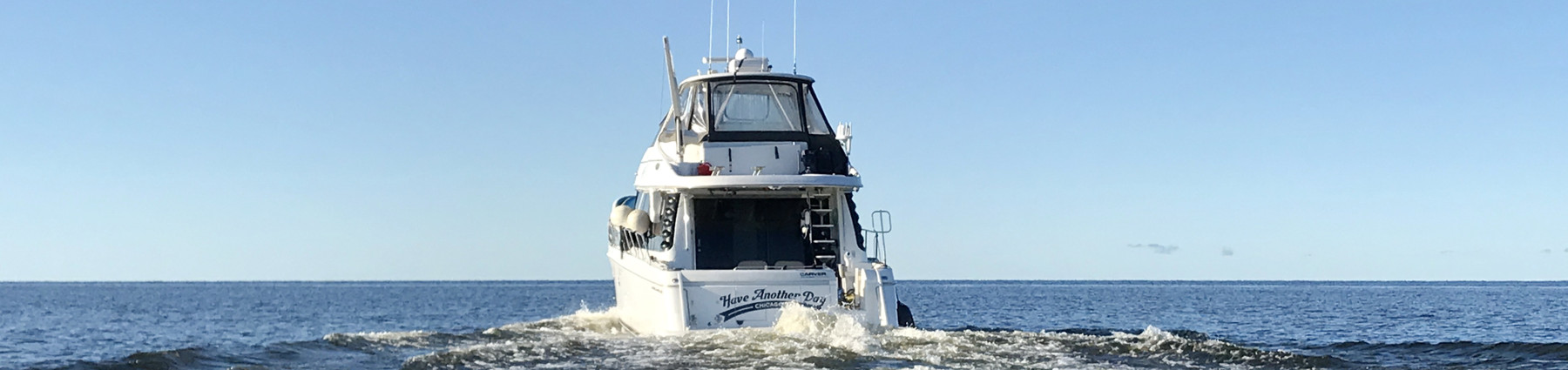
To transpond or not to transpond, that is the question.
Jul 31, 2006
Apologies to Shakespeare. Please do open the full screen of the above, as it nicely illustrates a point I mentioned this morning…how neatly Capn Voyager plots where a Closest Point of Approach is going to happen. I like it and I don’t recall seeing it done before, either with AIS or ARPA (but I certainly could have missed something). The screen shot also illustrates another situation I’d rather simulate than actually experience in limited visibility…an 85’ motor yacht and xx’ tug coming together with me as the possible sandwich meat, worse if I slow down! Now, here’s a question. Class B AIS is just about to hit the market, likely in the $1,200–$1,500 range. But some knowledgeable people think that it doesn’t matter much for smaller boats to be sending out their position, that 90% of AIS’s value is in being able to see what the big guys are doing so you can stay the hell out of of their way. What do you think?
PS. I like software like Nobeltec and Coastal Explorer which can draw AIS targets to scale when you zoom in to an appropriate level, but notice how screwed up the dimensions of the tug Seguin are. I see user input mistakes like this all the time.
Call me a scaredy cat, but I vividly remember a morning watch motoring in thick fog toward Yarmouth, Nova Scotia, knowing that a sister ship to this ferry would soon overtake us at high speed, fog be damned. I was aboard a 42’ sloop with a dinky 12” radar scanner and a questionable radar reflector (they all are), and I was picturing one of those bows piercing something other than waves! That was maybe six years ago, and I don’t think I’d even heard of AIS yet. If I’d been out there this morning—instead of simulating a voyage using The Capn and live AIS targets (note the CPA graphic)—look at all the information I could have had! Panbo already has a prodigious collection of AIS entries, but there’s lots happening, so brace yourselves for a few more.
Ralph may be very much for sale, but until that happens I going to keep piling on the temporary electronics. Check out the bigger picture of this rig…dual MFDs, dual satellite weather, and dual ultrasonic weather stations…and some other stuff. By the way, if you don’t get the name, does it help to know that the dinghy is “Norton”? Wishing you a cool and boaty weekend.
A chap named Wayne B. is very happy with his new boat WiFi set up over at rec.boats.electronics. He says he’s “hitting low power, indoor access points at least 300 yards away,” and expects to get commercial outdoor APs at over a mile. Wayne’s using an external USB-powered NUB-362(EXT) radio connected with 30’ of Hawking CoAX to a 9dB Hawking omni-directional antenna that’s 30’ off the water. Those links go to online sources and the whole kit adds up to around $185, plus, per Wayne, “an adapter to go from an SMA connector to type N coax, also available at CompUSA”. Cool, and less expensive than purpose built marine gear we’ve seen here and here. But I couldn’t get the NUB362’s specs to open and am not sure this will work with my son’s Mac. Anyone know a sure fire way to improve a Mac’s WiFi range?
PS 7/31: There’s another interesting discussion of Wayne’s WiFi rig going on at rec.boats.cruising. Also the whole bundle of hardware is available cheaper at Netgate (though it turns out the radio is only 200mW, not good enough for Jeff). And thanks, everyone, for Mac WiFi booster ideas!
I promise I’ll stop writing about this ledge soon! But it does turn out that Garmin’s optional BlueChart G2 cards, first discussed in May, look good in terms of the great Burnt Coat Harbor bent prop incident. That is the guilty ledge just showing in this photo, taken at approximately mid tide; you can even make out the Can right (east) of it, especially nearer full resolution. Note too the trees on the little islands, a helpful detail that the Cruising Guide chose to emphasize in its sketch chart. Below you can see how the photo icon shows this shot’s view angle. Notice the multitude of photo icons! There’s also a straight down of this same ledge, a view from the north, several pulled back views of the whole channel, something like 12 pictures all together. By contrast, neither Maptech nor C-Map Max has any panoramic photos of this harbor, and Navionics Platinum has 3, but much more pulled back. Could I have missed a photo? You bet; no one seems to have the perfect photo interface yet, and with such a large inventory, Garmin has further to go than most. They’re working on it; the improved icon just arrived in a recent release. Mind you that Garmin’s cards are fairly pricey (especially considering that users already have the G2 charts themselves build in), but I do believe them when they say they’ve spent heavily on helicopter photography.
Looking at the animated version of this graphic too long may make you ill, but it does nicely illustrate the very different schemes that Sirius and XM chose in their efforts to blanket North America in audio and data, including, of course, our recent obsession…live marine weather. Both schemes seem to work fine around the U.S., especially on boats with their naturally wide open sky views, but how far offshore, north, and south can you receive Sirius or XM? A lot of cruisers would like to know, but the company Web sites seem vague on the subject. For one thing, I don’t think they themselves are positive about their footprint edges, and don’t want to over promise. Another issue is that XM and Sirius may broadcast into countries where they are not licensed to, and where someone thinks they should be. You may recall a long period when Canadians could only subscribe to satellite radio using U.S. addresses, even though most could get it fine. XM and Sirius were not bragging about their Canadian coverage then! Both Audio services are now licensed in Canada but, head’s up, Sirius Weather isn’t yet. Which brings us to some legalese in the Raymarine Sirius literature suggesting that your expensive weather receiver might not work if you go outside U.S. territorial waters. Not true; I checked! And judging from the unofficial footprint map kicking around the Internet (right, and slightly bigger here), Sirius will deliver fine service in Canada, out past Bermuda, down to around Antigua, across to maybe the Canal, and actually further into Alaska than shown (so I’ve heard). I understand that XM is similar except that it doesn’t reach as far south, which seems confirmed by the unofficial XM footprint map below, created by WxWorx, the company that’s developed a PC hardware/software system for XM Weather. They’d like to hear more reports from XM users on the edge, and I’d like to hear from anyone who knows more about how far either service reaches. Thanks.
PS, 7/28: We’ve been kindly sent links to a good collection of footprint maps and to a related forum discussion in which one poster describes getting XM in the Azores using a dinky home antenna (though it was before some changes in XM’s satellites).
Why haven’t more people who use Navionics charts experienced a C “5” ledge misfortune? Certainly one reason is the Taft/Rindlaub Cruising Guide to the Maine Coast, which contains the sketch chart excerpted above and is consulted in biblical fashion by many cruisers. Notice how useful those dashed arrows are, especially as the overall bouyage—if you happen to be passing right through Burnt Coat, as many do—changes from red right to red left (or vice-versa, because both passages are returning from the sea to a harbor). Heck, my 1979 Duncan and Ware Cruising Guide to the New England Coast talks about how an “able vessel can beat through” this passage “leaving the two cans to starboard”. And that was before chart plotters even existed (and sailors were gnarly navigators, especially Roger Duncan!) Going to the other end of the spectrum, look below how Navionics’ own Platinum grade chart shows the ledge, if you have the top-down photos turned on, including the “land & sea” option (full screen here). There are many ways to get by that Can without damage. But before anyone starts judging yesterday’s ledge leaper a fool, they should take another look at the plain Navionics chart image, excerpted at right. It’s a clean-looking, easily-read chart, just what we’ve been asking for. But not only did Navionics leave out the ledge, the very vector gods (who actually ‘draw’ these charts) conspired to worsen the error. Look how the extra big Can symbol (which I like) hides the fact that there’s any water at all between it and the little island (though, mysteriously, not below). My point? Vector charts are “smart”, they really are, but sometimes not as smart as a cartographer placing a Can just so on a paper chart, or someone who’s been there simply sketching some guidance.
Panbo readers who’ve been with me for a while may remember how I’d regularly link to my Power & Motoryacht columns as they simultaneously came out in print and online. It worked nicely, I thought, as the columns often brought together the blog noodlings into a more coherent whole. But that came to a screeching halt last fall when, due to personnel changes, PMY cut back on what went onto www.powerandmotoryacht.com. Well, the situation seems to be changing. My 2006 columns aren’t up yet, but PMY did recently post the features from our June Electronics issue, including my opus on PC charting programs (and also Pete Dubler’s hands on experience with M-Tec marine cellular gear and highliner Karl Anderson’s take on creating 3D bathymetry). I dare say the same gentleman is also responsible for putting much of the Voyaging Spring issue online, including my Helm Shot column, profiling Steve Smith and his Raymarine H6, and Hudson River Melting Pot, a totally non electronic feature that I had a lot of fun researching. Plus Sail has put up a page linking to PDFs of its three May communications articles including my take on significant 2006 products. When it rains, it pours. My understanding is that both PMY and Sail are working on vastly more informative Web sites, and it’s my hope that Panbo might be involved in that effort. (In the meantime, thanks to all who dropped something in my PayPal tin cup yesterday.)
This is what the gentleman saw on his Raymarine plotter, bigger here, which is why he says he cut between Harbor Island and Can “5”, and that’s why he’s now hauled out having his bent props, and maybe more, repaired. Ouch! Navionics missed a ledge, a pretty important one. In fact, the thing is vaugely drawn on the official NOAA raster chart, heavily zoomed below (and also showing my fortunately uneventful track through the same beautiful area last summer), but still every other brand of vector chart I looked at did manage to get it right. (The images futher below—C-Map, Garmin, and then Nobeltec—all show the ledge and are interesting to see side-by-side, but note that how they display varies a lot from one device to another and also according to how variables are set). Now, I believe that electronic charts are pretty reliable (the Lowrance NauticPath and ENC display issues aside, probably all fixed by now anyway). But I also suspect that every vendor—even NOAA (by the way, the 1:40,000 ENC for this area hasn’t been issued yet)—makes mistakes. Just like the splash screens and navigation manuals say, reliance on a single data source is not a good idea (especially when the bouyage appears confusing, which in this case will get another entry). In the meantime, I’ve learned from Navionics that this error has been reported and will be corrected in the next regular annual update if not before.
It was a miserably rainy weekend here in Maine and much of the East Coast…lousy for boating, but good for testing weather systems and fooling around with blogs. It took Yme and I longer than anticipated to actually transfer all of Panbo’s accounts, but now it’s done, and I’m feeling a little frisky. Hence the slightly modified blog name, header graphic, and sidebars. Yes, that is the threatened contribute link over there. I do spend more time on Panbo than is economically justifiable, so here is a way appreciative readers can help…until the big sponsorship revenues kick in (smile).
At any rate, please join me in a big thank you to Yme Bosma who founded Panbo—including coming up with the mysterious, but memorable, name—and is now toiling away at the amazing Eccky and no doubt many other high tech endeavors. Here’s wishing him some dry air and fine boating.
How about that! The Memory Map Nexrad function for Smart Phones that I tried and raved about now does animation, at right, plus it’s been debundled from the charting software. $10 and it’s yours, no subscription needed, and data use is efficient and user managable. (By the way, developer Richard Stephens may be seriously field testing this product over the weekend, as he again sails the Mackinac aboard Flight Simulator. He says the course is a thunderstorm alley. Good luck, Richard!)
Meanwhile, Panbo reader Bob Mueller wrote in to say that he’s figured out how to get simple Nexrad images onto his not-so-Smart Motorola v710: I host my own website on the residential DSL line in my home, and I created a page with a custom PHP script that I wrote. The PHP script goes to the ADDS (Aviation Digital Data Service) website, pulls a NEXRAD radar image for the area where I boat. The image displays a very large area, that would not be easy to interpret on my cell phone screen. My script then crops the image to the exact resolution of the phone screen. The script saves this cropped image to the hard drive on the web server for display on my cell phone's screen via the phone's web browser. (I would be more than happy to share the code, it is only a few lines!) {Send me a note if you want that code — Ben}.
PS Thanks to Gizmodo for picking up on my Sirius & XM weather testing (even if they somewhat misinterpreted my ramblings); we’re getting major hits, which I find very auspicious as today I officially became sole proprieter of www.Panbo.com. Wishing all a great weekend.
I do feel a little guilty. My buddy Jamie was out there in those islands with friends and family on a Maine Cat 41, and I knew it, but didn’t think to call his cell and advise him about just where those monster thunderstorms were tracking Tuesday evening. Yeah, they’d heard the warnings beeping all over the radio, but still didn’t know if a cell would actually hit them, or when, until one rolled over the horizon (which surely happened, as shown so vividly above). Sorry, Jamie!
It was too bad because I could really see what was going on, having fired up both the Sirius and XM live weather services I’m testing. My goal was to see how detailed and accurate the satellite information is, and more specifically if it could have helped me get around the worst of the weather in a reasonably fast boat. Conclusion: Yes, if the cells aren’t coming at you in a solid line, and the boat is fast enough. Of course there are numerous subtle differences between the services, and a few anomalies. In the latter department, observe the two photos below, Garmin XM on top (bigger here), Raymarine Sirius below (bigger here), taken at almost exactly the same time.
For some reason Sirius was not tracking any storm cells in New England that evening, i.e. was not generating the arrows that indicate speed and direction, and can be clicked on to reveal more information like chance of hail. XM’s tracking, which nicely indicates the dimensions and speed of the cell, was working fine, but its analysis of precipitation seemed to be markedly off. I was there, and the rain was tapering off just as indicated by Sirius, not about to pour buckets as suggested by XM. Yes, XM shows a 4 minute delay, but I don’t think Sirius was much fresher (it should be time stamped). Hell, that data has to go from the radar station out to a network, through the processing facility, up to the satellites, and back down to these machines. A four minute delay is damn good, especially given this level of detail for the whole U.S.A. And that’s the real story here; I would really like one or the other of these services at my helm. More tomorrow.
7/21 Update: Sirius and data provider WSI are trying to figure out why those storm cells weren’t being tracked (I see a similar problem today off Long Island), and I have a call into XM about why their Nexrad might be a little off. In the meantime, a couple more notes to go with these illustrations:
* I like how Raymarine overlays the weather on a simple outline map, instead of charts, but it would be good to add some landmarks for orientation, like maybe port names. I found myself turning all sorts of stuff off on the Garmin charts, stuff I’d like to see otherwise, so I could see the weather better. On the other hand, the streets and names on the Garmin were useful when overlaying cloud cover, as seen above. Sirius does offer cloud cover, but does have Canadian weather radar.
* Garmin’s new “Presets” weather interface is excellent. See the “Storms” lower left on the screen; push the Next Preset soft key and you get the “General” preset, then the “Sea State” preset. The names don’t really matter as you can go into the weather setup area and customize just what mix of data you want for each preset. Moreover—and Garmin has had this for a while—you can specify presentation of individual data types by zoom level. That’s a little harder to get a grip on, but also helps you mix all the data available in sensible ways. I encourage Raymarine to steal the preset concept, and maybe the zoom level too, ASAP!
I guess it’s a little pathetic—me spending so much time on the Web, instead of on the water—but I have enjoyed using SeaLinks AIS Live, above, to keep track of some bigger yachts visiting Maine this summer. As of yesterday, Shine Micro, aka SeaLinks, is making users register but it’s easy and free. I don’t know where their receivers are positioned but they surely work well, as seen in the screen shot bigger here. That chart is about 150 miles wide, and Spirit of Zopilote is tucked into Southwest Harbor surrounded by hills. It’s hard to make out even on SeaLink’s small area chart of Portland, but that’s where the 228’ Floridian is now. I first saw her off Camden via AIS last Friday, then in the mega flesh shown below, but AIS couldn’t alert me to the fact that ex President Bush would lunch aboard on Monday. It gets wild around here this time of year! (Here’s the photo bigger, easier to make out the owner’s team—the Miami Dolphins—logo on the copter tail and the Intrepid “tender”, which has triple 285’s on its stern).
PS. It’s amazing how many different ways there are to display AIS on the Web, and new ones seem to crop up every week. Here’s San Francisco Harbor with the ships animated, and here’s shipping along the coast of Germany overlaid on Google Maps or Google Earth (if you register, and have GE installed, but very, very cool). And don’t forget classics like the Irish Sea and the grand daddy of them all, AISLive.com (which also requires registration, but covers many coasts). Enjoy.
PPS. Rosepoint Navigation is testing eight different AIS receivers from Milltech Marine, SeaLinks/Shine Micro, and SeaCas, and we plan to publish the results here on Panbo. Stay tuned (so to speak).
PPPS. The world of AIS, and Panbo, is large. Jan Egholm, part of a team running a commercial AIS service in the Faroe Islands, just sent along this image demonstrating how well a Shine Micro receiver can work on a 750 meter hill. Those AIS targets stretch from Iceland to Norway! Jan’s company Web site is a little tough to read because it’s in Faroese, but here’s a PDF explaining Vikmar’s service in English (there’s much more to Web AIS than megayacht ogling).
One factor inspiring me to get a bigger boat is an old friend who spend a few days with us recently. Bruce is older than me—which is old—but last year he sold his house and took off in his 34’ sloop down the East Coast and into the Bahamas. He had a wonderful time, and now has the boat back in the Chesapeake for some work, and plans a more leisurely trip South this fall. He kept things quite simple, no computer, but he did invest in that $100 PocketMail Composer above. In the photo he’s dialed an 800 number that came with his $15/month subscription, and then squeezed the gadget’s adjustable earphone and speaker against my handset and pushed the button that activates the acoustic modem. After a period of squeaks and squeals, he had sent and received his e-mail, as shown below. No color screen and no attachments, but the PocketMail system works economically in many parts of the world (In the Bahamas, for instance, there’s a Nassau access number, meaning Bruce could use a cheap in-country calling card at pay phones). Here’s the PocketMail Web site.
Like many blogs, we’ve had a lot of trouble with spam comments. For a while now, we haven’t even let comments go up without first inspecting them, which is a bit of a pain for commenter and inspector (me) alike. I’m pleased to announce that you can now use the TypeKey Authentication Service—which is free and reputable—to post comments immediately. Signing up only requires a name and e-mail address, and your deciphering one of those graphic code thingies that frustrate software spiders. Once acquired, your TypeKey name and password will work on many blogs created with Movable Type. Please register.
We are still allowing comments from unregistered, even anonymous posters, but we have to deal with hundreds of spams a day to make that freedom available. It is tempting to simply limit all comments to folks who are TypeKey registered.
Ralph is in the water and running sweet, but I’m trying to remember that I want to sell it (just can’t call this boat a ‘she’) so that I can seriously look for a larger boat that Andrea and I might cruise for weeks at time, maybe all the way down the East Coast. Ralph is an odd boat, a 1976 Wellcraft that I completely made over in the late 90’s. I’ve just put a pretty complete listing, with lots of photos, at UsedBoats.com. Please be in touch if you’re interested, or just have advice on how to sell it. Thanks.
Yup, a digital radar double header. Garmin announced this stylish 4kW/4’ open array along with a 4kW/6’ model. Note again the DSP claim, “Digital processing allows for more precise recognition, enhancement, and filtering of radar echoes – making the finished display easier to read and interpret.” I only have one screen shot, taken with the $3,600 4–footer, but it does look pretty sharp (below, and bigger here). I also notice in the specs that these arrays can run at either 24 or 48 rpm, which may mean that the display software will eventually be able to show you two ranges at once, a very nice feature on some Simrad and Si-Tex radars. That’s all I’ve got for now; you all have a great weekend.
It’s digital radar Friday. It must mean something when two new scanner series are made official on the same day…a trend perhaps? Northstar’s, hinted at last winter, is called High Definition (HD) Digital Radar. and it comes in 2kW/18-inch and 4kW/24-inch radomes, as well as 6kW/48-inch, 10kW/72-inch and 25kW/84 inch open arrays. They will work with the 8000i series, mentioned yesterday, and the new 6100i update to the 6000i series (and come October, the Navman 8120 will become compatible with the smaller scanners). The press release, not online yet, boasts of “enhanced Digital Signal Processing (DSP) techniques, combined with 10-bit target discrimination, provide unparalleled radar images.” I’ve seen quite a few of those images, and they are impressive. Notice how in the one below, bigger here
, the radar is discriminating amongst all those boats moored behind a breakwater in Hobson Bay, New Zealand. Nice!
Brunswick still hasn’t sold its BNT electronics division, but a big reason it might want to raise cash is becoming more apparent. Ever since the stock price popped a bit on the late April announcement, it’s been downhill sledding. And yesterday was awful as BC announced “significant” retail sales declines and plans to reduce production. (Overall this is not a good sign for the economy, or my business, though, wow, BC’s big boats are still selling.)
Meanwhile the rumors about who would buy BNT have pretty much died down…but Northstar/Navman seems to be chugging along just fine. In fact, I’ve got two folders of really interesting screen shots to share in the near future, and BNT ME recently announced a big sale of 8000i gear to Viking Yachts. (Whose sales may be just fine, because…oh, I don’t know…we’re living in the Roaring 00’s?)
I looked forward to the battle of XM and Sirius marine weather services, and now it’s here. Right now, down in the shop, I’ve got Sirius Marine Weather running on the E-120 and XM Marine Weather running on the Garmin 3210 (and both are ready to go aboard Ralph, which I launched yesterday, yeee-ha). That screen shot above is Sirius on the E, bigger here. You’ll notice Nexrad precip radar, storm cell vectors, water temp, wind arrows, outlines for NOAA text forecasts, and of course the red Tornado Warning area. There’s a lot to these services, and to the interfaces needed to get the most from them. I’m wondering if any of you have experience with either service, or would like to see particular data screens, or just have opinions about subscription weather? Here’s a good page to see what XM beams down, and here’s a similar list for Sirius (click on the FAQ). Don’t be shy!
PS 7/13: An unusual aspect to the Sirius screenshot is that we almost never get Tornados in this part of the world, and it was nice to have a plotter beep me about the possibility. On the other hand, no tornados actually materialized (no fault of Sirius). Below, bigger here, is a Garmin XM image from last evening. That rain definitely did come my way.
While I’m back on the subject of charts, Curtis Island in particular, I want to correct an error I made last Winter. That’s when I made note of how my borrowed C-Map Max card seemed to have lost track of Camden’s largest aid to navigation, the Curtis I. light. It was confusing, as I noted, but it turns out that I wasn’t completely wrong; the early versions of Max had an overly aggressive decluttering algorythm that could sometimes declutter something as important as that light. However, what I did not understand was that C-Map had discovered and fixed the problem quite rapidly. The reason I didn’t know about the fix was that I had a card that didn’t come through normal channels, plus I didn’t call C-Map to ask. And there, friends, is one weakness of Panbo. I kind of shoot from the hip on this blog. When I write a magazine article I have the time to make calls and check facts, but here I’m hoping that readers will notify me of mistakes and I’ll correct them online. Please feel free to note those mistakes, and hopefully I’ll correct them faster than this one! At any rate, C-Map’s Max card not only shows the Curtis Island Light at every appropriate zoom level, it also has a picture of it.
I first heard about Navionics Silver all-in-one card last October, and the whole Silver/Gold+/Platinum (plus Fish’n’Chip) strategy was revealed in February. You can now buy a Silver card—at $116 (discounted) for coverage of the entire continental U.S. coastline, Great Lakes, and Bahamas—but are the charts as detailed as the ones on the more expensive cards? Above, on top, is what a Platinum or Gold card looks like at 1/2 mile range on a Raymarine E or C-Series plotter. It’s a pretty faithful copy of the 1:20,000 harbor chart of the Camden Rockland area (which, by the way, is not included in the paper ChartKit). Underneath it is a 1/2 mile range using a Silver card; the dots indicate that you’re over-zoomed and, in fact, the spot soundings are based on the 1:40,000 coastal chart of the area, seen below. However, the critical rocks and coastline detail come from the 1:20,000 chart, as you can see off Dillingham Point and the west end of Curtis Island. It also seems that some deep water contours have been removed from Silver and the extra data like marina information is minimal. But, still, Silver is “almost as good as Gold” (as Navionics told me). (The Bahamas are excepted as Silver uses the old, crude HO stuff rather than the private data that Navionics is now using on its better cards.)
What with a holiday trip and the stolen boat drama, Panbo suffered recently. I will definitely get back to business next week, but in the meantime how about a peek at the all-business helm I got to see aboard Spirit of Zopilote last Friday. You really must open the larger shot (link fixed!) to appreciate how well the electronics are laid out—all within reach of the comfy double helm seat—and what good sight lines are retained (here looking out along the west side of Camden’s inner harbor).
SoZ, as it’s sometimes called, is the very first Northern Marine 64’, in fact the first Northern Marine anything, built in 1997. Trust me, she feels at least as hunky as she looks. The helm is in the “best of breed” style popular then, and still popular with many salts like captain Bruce Kessler. Note Furuno CRT fishfinder and radar, Northstar GPS, and PC running Nobeltec Admiral, all separate. Note too the lack of a steering wheel! In fact there is one—down at knee level, for emergencies only—plus the power steering jog stick can run either of the two entirely independent Simrad Robertson autopilots. It feels like everything’s been thoroughly thought through on SoZ, as you will gather in this Trawler World feature on bringing her around from San Diego. I also found this nice speech apparently penned by Georgs Kolesnikovs when Kessler (seen below in SoZ’s very squared away engine room) was awarded Passagemaker of the Year.
I was hiking to Schoodic Head this afternoon when I got a very garbled cell call. Going by the few words I heard (“Mr. Ellison, we’ve…”) and the phone number, I guessed that either Gizmo had been found or my house had burned down. Well—hot diggity dog, and blow me down for being such a pessimist—it turned out to be option one, and sounds like Gizmo is in good shape. More detail tomorrow.
PS, 7/7: Yesterday I found the fellow who recognized Gizmo from the Village Soup article; he doesn't want his name in print, but he's a good guy, and a boat owner, and praise be to him. Thanks also to the Waldoboro officer, who made me feel somewhat less dumb by saying that his boat also sits in his yard completely unlocked, ready to go. Thanks too to my local officer who encouraged Village Soup to publish an article, and of course to Village Soup itself.
As for the thieves, it seems like they weren't too smart. They took the big cooler, the anchor, and docklines but left a tank full of gas and a color fishfinder. They also scraped the name decals off—and some paint, darn it—as if they were going to keep the boat, but then they abandoned it. I suspect they changed their small mind(s) when a friend said, "Hey, I saw that boat on the Internet", or maybe they just couldn't sleep due to the bad vibes sent their way by my friends on the Soup message board and here on Panbo! Thanks to all!
Today’s the 4th of July here in the States, and I’m off to watch lobster boat races and fireworks. Loud and louder! Panbo posting will be very light around this holiday, but it does seem like the right time to honor the guys who build large (+/- five foot) radio control models of WWII naval ships and then stage battles in which they sink each other! Yes, those are CO2 powered “Big Guns” shooting large shot through balsa “plating”. You can imagine that the electonics to control all this (see below) are pretty complex. A good place to explore the technology is in the “Naval War College” section of the The Big Gun Web Portal, but do not miss the photo section of The Australian Battle Group. You may not be surprised to see that this is a nearly 100% male activity. Here’s wishing everyone an explosively happy holiday.
I can hardly believe it. I’ve lived on the same property since 1978, and no one’s stolen even a paper off the front step. Late this afternoon I went up to the area behind my house I like to call my “boat yard”, intending to hook Gizmo onto the new trailer hitch I’d just installed this morning. The plan was an early morning fishing trip (and engine check) on Lake Megunticook tomorrow, and an island exploration near Jonesport on the 4th of July. But Gizmo was gone. Some time in the last few days, some bastard had the brass to haul it away, even though several of my neighbors can see the area fairly well. I’ve talked to the police and prepared a .pdf to send around and post (download here). If you live in New England, please be on the lookout for Gizmo, and wherever you are please think very, very bad thoughts about whoever stole my boat. Thank you.