The Sea-Me active radar reflector has been around for a few years, though it’s not well known in the States. I was just reminded of it by an article in the British publication Yachting Monthly, which recently tested just about every radar reflector available, both in a lab and on the water. The Sea-Me blew the others away. By amplifying and sending back the X-band radar signals that hit it, this gizmo can make a small yacht look like a big ship. Which is exactly how I’d like to look in the Dover Straits or right outside Camden on a foggy day like this. I once wrote a column discussing this concept, along with how radar reflectors are tested and the Sea-Me. The scary truth is that most radar reflectors on the market are not very effective. The fairly large and expensive passive ones that did well in Yachting Monthly’s testing were the Echomax EM230 and standard size Tri-Lens.
At right is a aft-looking view of the Eastbay helm I visited last week. You can see some serious wood work that puts the steering compass right where you’d want it. The problem is that this compass performs poorly; apparently its deviation error varies with the status of various electronics and is therefore not correctable. I hear this story all the time. And the second part of the story is like most: the owner doesn’t much care, as he’s content with the COG and heading readings he gets from his GPS and the electronic compass in his autopilot. In fact, of the 4 new J-100s launched in my harbor this summer (there’s a sailboat model on fire!), only one has a magnetic compass (but all have 12” multifunction displays!). That really surprised me as sailors tend to be the most compass obsessed of boaters. What’s going on? Is the traditional compass going the way of the paper chart? Is there one on your boat? Is it adjusted properly? Do you use it? I’d appreciate your thoughts.
It happened that a very experienced compass adjuster I know stopped by yesterday. He told me that the compass above is a poor quality Danforth, and that a similarly sized Ritchie SS-2000 would likely do a better job. I’m hoping to tag along with Jeff on an adjustment job, and learn more about how to make a magnetic compass work well around a modern helm full of electro-magnetic forces.
By the way, the odd little frame next to the compass above is a serial port so that routes and waypoints can be uploaded into the Northstar 6000i’s via NMEA 0183.
I tried plugging a regular household DVD player into two video capable plotters last week, and the results were quite viewable, confirming the value of helm stereos that can also play video discs. That’s a Standard Horizon CP1000 10” above and a Raymarine E120 12” below. Both have some control over picture brightness, contrast, and color saturation, though the E’s is easier to find and use. The E also has a choice of aspect ratios, but I still couldn’t get the picture to fill the full width of the screen. And yes, that is the actor from Friends who now mocks his acting career on the TV show Joey. This particular job, Lost in Space, must have been inspirational. I have no idea why the DVD is lying around my house.
Hurricane Katrina whacked south Florida fairly hard yesterday and now it looks likely that she’ll power up and smack the northwest section of the state early next week. Per usual, there’s an extraordinary amount of data and valuable prediction information at the National Hurricane Center’s web site. Hurricanes are truly meteorological loose cannon, but it is amazing how far our ability to forecast them has advanced. I got to tour the NHC facility in Miami in early 2004 and was bowled over by the high levels of technology, data i/o, and brain power. That was the year that NHC’s back testing program indicated that their forecasting was good enough to begin issuing 5 day track predictions, which have no doubt saved lives and property since. By contrast, observe above how hurricane warnings were delivered to sponge boats off St. Pete, Florida, in 1938 (from NOAA’s online photo library).
Now, no idiot U.S. Senator (carrying water for a few private weather companies) is going to stop NOAA from distributing hurricane information, but, as you likely know, Senator Santorum of Pennsylvania does have a bill in process that might severely limit its ability to share less critical information. BoatU.S. has just posted a good editorial on the issue. Following one of its links, I found and used an easy e-mail form to register opposition to the bill with my senators. Why don’t you?
Update, 8/28: Naturally I’m curious if Katrina could reach Maine with any force, and I now see that the NHC has a new series of ‘experimental’ wind graphics that are quite valuable. This one shows me that the models now predict a 5–10% probability of over 50 knot winds on Thursday. Hmmmmm. Note that it can be animated if you click on ‘loop’.
I’ve been trying this Navman M300, the marine model in a new line of small GPS “Sport Tools” designed to strap to your arm while you windsurf, skate, ski, run, or walk. It delivers speed, heading, distance covered, lap times, etc., but not position or “go to” guidance. And it will not interface to a PC for data collection or waypoint passing. Both interface and tightly defined purpose are KISS (keep it simple, stupid) ideas, largely I’m guessing to differentiate the Tools from the various Garmin Foretrex and Forerunner models that dominate this niche. There are only two buttons and about six choices for the text screen (which is small but readable in all daylight conditions). The firmware for some models seems to have especially valuable features—like the way the ski model leaves the lift segments out of your speed averages and distances—but personally this marine model doesn’t excite me (learning how Richard Stephens uses his Foretrex did, but that’s me). I’m also dubious that “reliably water resistant” is good enough for wind surfers; I know that when I used to do it I’d spend a good deal of the time thrashing about while submerged up to my chin! Then again I would like to know how blindingly fast I was going when I had it together. By the way, the 19 knots max speed above was on my bike, going down a steep hill. I need to exercise more.
Update, 9/2: My doubts abut the windsurfing model may be off base. I’ve now learned that they were used successfully for the Maui Speed Challenge (yes, Navman was a sponsor, but these are the top guys and wouldn’t tolerate a product that didn’t work well).
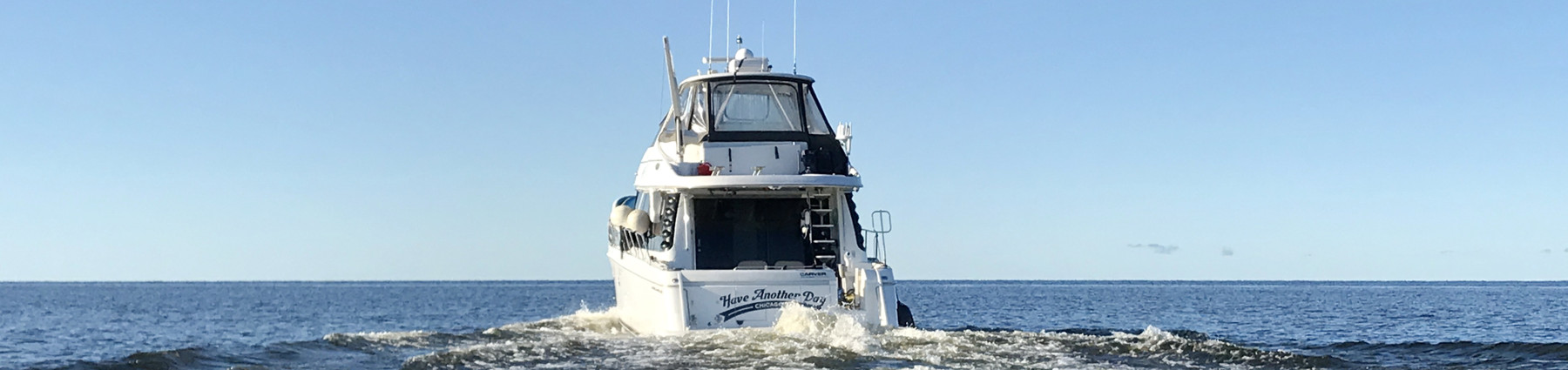
Sorry if there’ve been too many “what’s on board” entries recently, but these are the high days of summer here, they don’t last long, and I’m enjoying them! Yesterday I took a little spin on this spiffy Eastbay 54SX; the ‘research’ will go into my next Helm Shot column in Voyaging. I’m particularly pleased with this picture (bigger here); I had to do a lot of fiddling to make it look like reality! (By the way, those are the Camden Hills out there; I live in the westward lee of the middle one).
Yes, there are FOUR Northstar 6000i’s on this single helm boat, but the very experienced owner—this may be his 13th sizable boat, he’s lost count—has his reasons. The two 10” displays on the Himalaya (that’s what they call that little mountain of an electronics cabinet you see on these tall windowed boats) are the main navigation tools, usually run chart left, radar right. (North up and head up, respectively…the man has been doing this a long time, and says he’s sticking with the modes he knows). They’re networked together with Northstar’s N2 (Ethernet), sharing a 4’ 12kw (special order) radar scanner, a GPS, and a black box fishfinder. The two smaller overhead displays share their own N2 network, another GPS, and a 4kw dome scanner. Redundancy! The system is also designed so that guests, or a co-pilot, can use that 6” display at far left without getting in the skipper’s way. Meanwhile the right 8” is ready to serve as backup if the main system packs up. (It’s also set to use radar overlay, which the owner admits to ‘peeking’ at on occasion ;-). There’s more of interest on this boat, but for later…
Over at rec.boats.electronics there’s a great thread underway about the ‘perfect’ built-in onboard computer. I’m particularly interested as I’ll likely go that route if and when I ever manage to finagle a larger cruising boat. In the meantime, last week I put some miles on the rather funky rig above (bigger here), and it actually performed pretty darn well, even gunkholing around the hairy unmarked ledges in Penobscot Bay’s outer waters (it was calm and clear). I used the old soft case (and sometimes a towel) to keep the laptop from sliding around. Valuable accessories are the Hoodman screen hood (really cuts glare, though I notice they don't seem to sell this model anymore), a tiny Atek optical USB mouse, and an old Deluo USB GPS (no WAAS and weak signals in my cabin, but still consistently accurate). Here I’m using Coastal Explorer 1.1 (now shipping), which is giving me that “the more I use it, the more I like it” feeling. It happens that the designer of CE has an interesting description of his own onboard PC system here.
If you see the distinctive twelve pulse signature above on your radar screen, it means that someone in trouble has activated a Search and Rescue Radar Transponder (SART). You’ll find them at the pulse closest to you. SARTs are a lesser known component of the Global Maritime Distress and Safety System (GMDSS), and thus are required on many commercial vessels, as well as some offshore races like the Fastnet. They're designed to be used in addition to DSC or EPIRB distress calls, helping already alerted rescuers zero in from about 10 miles to within about 500 feet. Simrad’s new SA50 model is especially compact at about 10" tall and 3" wide. It can be set up to turn on when a life raft is deployed, or manually activated. It retails at $975, and uses a battery pack that does not require ‘hazardous’ handling and has a 5 year shelf life. (Why Simrad distributes highly angled and/or shadowy pictures baffles me, but I do appreciate seeing what a SART actually looks like in use).
My PMY column about testing NMEA 2000 is in print and online now, but something odd happened during the production process. It opens with a picture of the NMEA test setup aboard my little outboard boat, Gizmo. The screen on the laptop is naturally quite blown out in the open sunlight, so the PMY page designer asked the “color house” to goose it up a bit. Actually, this is often necessary to make photographs of LCD screens look more realistic, since a camera is nowhere near as agile as the human eye. But someone in the color house took a shortcut and simply copied the Raymarine E screen onto to the laptop, creating a very unrealistic image. Nobody noticed until it was printed.
At any rate, above is another image of the two NMEA 2000 plotters, plus a Standard Horizon CP1000, aboard my other test boat. It’s unretouched, meaning all the screens actually seemed brighter in reality, but it does show (bigger here) how comparatively bright the Raymarine E is (though note that the screens are not in direct sunlight, so transflective properties are not evident). If there was a laptop in the scene, it would look darn dim. (A March article I wrote about the E series is also now online, though without pictures.)
Test boat #2, by the way, is the long neglected Ralph, which deserves an entry one day. But today the missus and I are headed off for a long weekend of cruising aboard, so there will be no entry tomorrow unless I come across an odd WiFi connection in the outer islands.
I’ve already noodled on my theory that the proliferation of video capable plotters will stimulate more and more boaters toward helm stereos that can also play DVDs. Well, here’s a new one from Jensen that would fit the bill even installed in a place that sometimes takes spray. The MDV6115 has a dual gasketed CD door and conformal coated circuit boards, and its LCD is supposedly sunlight readable. Besides AM & FM, the 200 watt stereo plays VHF weather stations. Besides regular CDs, the deck will play MP3 CDs, and of course DVDs. You can even select the PAL region, meaning it should work with DVDs rented in any country you travel to. It comes with both wired and wireless remotes, all for a suggested retail of $500. The Jensen site doesn’t have info on this model yet, but an interesting online store called Rock the Boat Audio does, though not in their marine video section (we’re all just getting used to this video thing).
How do they do that? The new JRC JLN-550 Speed Log at right is displaying not just 18k of forward speed over the ground (SOG), but is also showing that the bow is going to starboard at 1.8k and the stern to port at the same speed. The trick starts with a 4 beam 240 khz sonar transducer in the bow. The doppler shifting of the sonar pings off the bottom is used to get two axis SOG. The third axis (the stern motion) is calculated by adding rate-of-turn input from a gyro or ROT capable electronic compass. When bottom depths exceed 250 meters, the unit can switch to speed through the water (STW) using ultrasonics (2 mhz) to measure passing particles. Now this is big ship gear for sure—it starts at about $26,000, and the 265 pound transducer is termed “compact”—but accurate STW underway and multi axis SOG around docks would be very useful on medium size boats too. I’m hopeful. Airmar already has an ultrasonic speed transducer scaled for yachts (pdf brochure here). Now we just need a small, reasonably priced 4 beam sonar transducer.
Once again the Maine Boats and Harbors show was a great chance to rejoice over how healthy boatbuilding is in my state, and to see some interesting electronics setups. This is a high end Sequin 52 built by Lyman Morse. I really like how the helmsman gets fingertip control over most everything, but the crew can also see what’s going on and easily help with the navigation. Left to right on the pedestal (bigger picture here) are a Maxwell windlass control, a remote for the Raymarine ST290 graphic instrument displays over the companionway (which can show most anything), plotter/radar on center, and finally thruster and autopilot controls. The big HSB networked display (now superceded by the E series) under the dodger means someone can, say, mind the radar in fog, selecting MARPA targets and otherwise assisting the driver. And there’s another 10” down at the nav station, so someone else could be, say, working on a route. All three could be using the electronics independently, except for sharing a single radar range, and everyone on board can know where they are on the chart, boat and wind speed, etc. Fairweather (good pictures there) even has an ST290 display mounted in the overhead above the owner’s berth, the modern version of a telltale compass. Looks like A+ ergonomics to me.
If you have a fast Internet connection, you also have a zillion good weather resources at hand. I wouldn’t dare to say which are best. But one I’ve gravitated to over the years—even paid a tiny subscription fee to—is the Weather Underground. I think it started as a university science project, which may account for the name referencing a really desperate and counter productive 60’s political movement. Whatever, it’s great. The screen shot at right (bigger here) shows how you can zoom in on a NEXRAD radar animation which you can also customize to your taste. Wunderground now even identifies storm cells, which I’d only seen before on the high end satellite products from XM and The Weather Channel Marine. But it was interesting yesterday when that cell shown over Penobscot Bay sprung up right over my house. 12 minutes earlier it didn’t show on NEXRAD at all. In other words even the fanciest tools couldn’t have kept you out of the way. The front did clear the air though, making for a great first day of the Maine Boats & Harbors show in Rockland, which is where I’m headed. Have a wonderful weekend!
It was just last week that Rich Ray sent me this screenshot of MacENC, a new version of his GPSNavX charting program that supports NOAA’s free ENC vector charts. But after Tuesday’s news about free raster charts, it no longer seems like a big deal. Now we know that by about next spring Rich and other developers will probably be able to sell their charting software on a DVD that includes the digital equivalent of every single NOAA U.S. paper chart, without any encryption hassels and at little added cost. And users will be able to update those charts weekly if they want (making that easy will be another chance for developers to add value). But ENCs aren’t going away. They’re better than RNCs in many ways, and they’re definitely the future. Eventually—when ENCs are perfected and coverage complete—NOAA will drop raster chart production altogether, even printing paper charts from the vector database (if they print charts at all). Right now it’s quite useful to have both RNCs and ENCs for the same area; each has data or display features that the other lacks. In fact, if I was a Mac person, I wouldn’t think twice about paying the extra $35 for MacENC. I’m looking forward to inexpensive DVDs loaded with both types of free U.S. charts.
By the way, breaking the raster story generated a record number of readers here at Panbo, and for a moment made me feel like Matt Drudge (in a good way). A big thanks to whoever it was out there e-mailing Panbo links all over the planet!
I’m a long time fan of the PDA charting program Memory Map, which is also sold as Maptech Pocket Navigator, and think that its developer, Richard Stephens, is one hell of a programmer. It’s no great surprise then that Richard has mastered mini PC navigation, even while overnight racing aboard a wickedly wet Corsair 28R trimaran (In fact, it was so wet, at one point we had a 2’ long fish flapping around in the cockpit!). But it’s good to know that a coder is out there getting his butt soggy (getting to be one of my favorite blogs), and it surely is interesting to hear about his set up:
I used a PDA for navigation (of course). Itwas connected by Bluetooth to a GPS and to a cell phone in the cabin, which was in turn connected to a Digital Antenna signal booster and 4' antenna. The PDA was an iPaq 4700, in a Otterbox 1900 hard case. I wear the PDA most of the time, strapped to my body with bungee cord (under my PFD belt so it does not flap around). It is turned off when I am not actively navigating, to save power. I also wear a Garmin Foretrex on my wrist, programmed with the route and strategic waypoints [using Memory Map either on the PDA or a PC].
The PDA runs Memory-Map for navigation, using the full detail of NOAA raster charts, with all weekly NTM corrections applied. I used the cellular internet connection to access weather information from NOAA. The real-time buoy/weather station reports, weather radar images, and the ETA wind model. were all extremely useful at different stages of the race. All of these were accessed just using the web browser on the PDA.
Richard and the rest of the Flight Simulator team won first in class in their latest race, the Mackinac. How geek cool is that?
Wow! The CRADA (Cooperative Research and Development Agreement) that made Maptech the only official source of NOAA Raster Navigation Charts (RNCs, like the snip above, which are like paper charts) is over, and the new plan sounds terrific. Maptech will continue to use its expertise to produce/update the RNCs, but will deliver them weekly, in unencrypted .bsb format, to the Office of Coast Survey (OCS), who will distribute them over the Web. Anyone will be able to download them for free, including commercial vendors who can encrypt, add value, and repackage them (within certain guidelines). While this development has been rumored about for some time, this is now the official word from OCS, though “No date has been set by which this distribution of free raster charts will begin.” A free portfolio of U.S. RNCs—which, unlike the ENCs, is complete—will really stimulate PC and Mac charting programs and I think has already motivated some of the price slashing and big value adds in the vector chart segment (just check out the “charts” section of Panbo). Above all, I suspect it means that eventually just about every salt water boat in America will have some sort of plotting device aboard. Hats off to NOAA, and let’s hope that some the world’s other hydrographic offices follow its lead (don’t hold your breath).
Update, 8/10: I’m getting questions about how “official” this news really is. My source is a fairly formal e-mail sent by OCS to a developer. It seems quite genuine and clearly states what I wrote above. But please note the one sentence I directly quoted; we do not yet know when this will happen.
Update 2, 8/10: Another developer I know called OCS and spoke with the gentleman who heads up the RNC division. He verified the above and also said that their goal is to have all RNCs online by the end of this year, if not sooner.
Update, 8/11: Alright already! I finally did what a better (and less busy) reporter might have done in the first place; I spoke directly with the Public Affairs Officer at OCS. He verified this story completely, but said that NOAA didn’t plan an announcement until free downloading is immanent. So, no, you won’t find this on an official Web site, but, yes, it is official.
I was a little stunned this morning to discover two very interesting and ambitious marine weather services that seem to have sprung up fully formed, but without my knowledge! SailFlow and FishWeather are sister services, each offering tailored weather products either graphically via the Web or a WAP enabled cell phone (there are lots), or via a regular voice call. The services boast their own weather sensors covering a lot of the U.S. coastline, plus their own meteorologists and even computer modeling programs (in addition to public resources, of course). It turns out that both are the spawn of WeatherFlow, a company which has spent 15 years building a “national coastal mesonet with a presence in over 20 states…The WeatherFlow staff of engineers, meteorologists, and IT professionals are dedicated to increasing the understanding of the complex nature of climate within the coastal zone.” I intend to try out at least each service’s free month trial Web subscription. By the way, Eli of EliBoat—whom I had the pleasure of meeting last week—has been using WSI live satellite weather, which is a whole other animal than SailFlow. He posted some comments yesterday.
I was pleased to get an automated e-mail from Boat U.S. last week reminding me to update the registration info associated with the MMSI number I got through its Web site a couple of years back. It’s really important to keep this data current as the rescue authorities will use it if you ever make a DSC distress call with your VHF (or SSB) radio. Bad info can lead to wasted rescue resources, or worse. I haven’t moved or changed phone numbers, but adding more alternate numbers was easy, as was getting the free number in the first place. If you are one of the many who have a DSC radio but still haven’t gotten an MMSI number, for goodness sake do it! While it’s true that the U.S.C.G. hasn’t fully enabled its DSC listening system yet, it’s very likely that someone will hear you if you hold down that red button. Note that if you plan to take your boat outside the U.S. you should get your MMSI from the FCC, along with the needed VHF and other radio licenses. Otherwise, your MMSI will not be added to the international database. Tim Hasson of Marine Computer Systems has some good information about that whole FCC process here.
Another contender in the safety category of the MAATS innovation awards—the one that I think should have won—was Mustang Survival’s vest PFD with LIFT. I say this because last summer I tested the vest, then in developement, along with 7 other top quality inflatable suspender and belt style PFDs, and thought it was the best by far. That’s me above, and I’m not standing on the bottom; the Mustang vest is holding my head and shoulders out of the water without any effort on my part. Plus it was more comfortable than the suspender types out of the water, uninflated, and significantly more comfortable than all the other models in the water. The latter is a big deal if you’re trying to keep your mouth out of the waves and operate “help me” gear like flares, strobes, laser lights, a PLB, and/or a handheld VHF. LIFT (Life-saving Inflatable Flotation Technology) costs more than other inflatable PFDs, but it’s a truly innovative design and could make a difference. I wrote the testing up for the Nov. 2004 Sail, unfortunately not online. By the way, some August vacationers at a local swimming hole were amused as I donned full foul weather gear, then repeatedly jumped off a rock and “blew up” as Jamie took notes and snapped pictures. Some fun.
That’s Elizabeth Meyer driving her ‘new’ 1916 Lawley yawl to a finish line off Camden yesterday afternoon. I saw this boat at Brooklin Boat Yard 4 years ago, when it looked like it might disintegrate if someone sneezed too hard. The complete (every stick of wood) restoration, just finished, included adding some modern electronics, as subtly as possible. Notice how the antennas—radar, VHF, GPS, and Iridium (I think)—have all been painted to blend with the mizzen mast. Actually, painting out logos is an affectation I see on lots of high end and/or classic yachts. Quite understandably I think. I wear logo shirts all the time, either for work or because they were free, but if I ever own a really good looking boat, I’ll be damned if it’s going to be an electronics billboard. Maybe some manufacturers will consider making the logos optional? By the way, Eli of Eli Boat, was racing too; I missed him at the finish but hope to learn more about the snazzy electronics he was using.
I tested a Garmin 276C last year, and it’s an excellent little chart plotter, and also quite adept at street navigation (screen selection, distance and speed units, and routing style all switch over with a single button push). The screen is very bright and very fast. In fact, it was one of my five “editor’s picks” for 2004 in Sail magazine. Now the 376C adds XM weather and audio, making this unit far and away the most unique portable on the market. You can even plug in a blackbox fishfinder. I also tried an early version of Garmin’s Network system, which included XM weather and radio. The interface to all this info was a little clunky, but I understand that it’s been vastly improved. Which I imagine we’ll see in the 376C. And the network's fairly large receiver and separate antenna have been reduced to the petite GXM 30 smart antenna shown above. The 376C retails for a grand, but you really could carry it, along with your subscriptions to XM weather and radio, from boat to car to home. Neato! (But do note that it does not include all U.S. charts, like the new 192C). Here's a higher res version of the image at top, showing some of XM weather’s rich data. Note the storm cell predictions and lightning tracking (which is 5 minutes fresh and extends 300 miles off the U.S. coast). And here’s a column I wrote about the Garmin phenomenon last year.
Coastal Explorer 1.1, the current thing (and a Maine story)
Aug 2, 2005
Rosepoint Navigation’s Coastal Explorer is now in “open Beta”, meaning it’s essentially done and available for download by all registered 1.0 users. The retail version should be coming along soon. The “1.1” tag is dry humor; there are so many major additions to the program that they could justify a jump to 5.0 or beyond if they felt like it. At any rate, above (bigger here) is an example of the new tides and current prediction functions. They are extremely well done; you can easily animate multiple onscreen tide and current stations and/or get graphic, tabular, or text info for any one station. Bravo!
I chose the particular area above so I could tell you something about coastal Maine, and the characters who live here. That light blue area (you really need to look at the full screen) is the Bagaduce River, which isn’t a river at all, but rather a long, complicated tidal bay (that extends well beyond the chart window). 10 feet of tide is trying to fill or drain that whole area every 6+ hours, hence the 2.3 kn current at the Jones Point station I’ve selected. The coast is so complex, and the prediction stations so spread out, that Maine boaters become amateur hydrographers, able to guesstimate current strength by looking at the chart and a tide table.
Mainers can also be crusty. The story goes that there was quite a contentious town meeting when that little bridge (lower right) was built. One gentlemen got up and said, “Why the hell should it cost so much; I could piss half away across there.” To which the moderator replied, “Sir, you’re out of order.” And got back: “You’re damn right I’m out of order; if I wasn’t I could piss all the way across!”
Bennett NMEA 2000 Trim Tab indicator, cheaper & better!
Aug 1, 2005
Here’s a NMEA 2000 application I hadn’t thought of, but one that makes terrific sense: the Bennett NMEA 2000 Trim Tab Interface will install easily back near the tab motors, tee into a 2000 trunk line, and send the status of the tabs to all displays on the network. Plus it will work with any of the company’s currently available tab systems (80% of US market), and it will only cost $120. I’ve been on many boats, including my own 25’ Ralph (recently back in the water), where indicators would make the tabs much easier to use, but when I’ve asked builders why they don’t install the currently available ones, they say they’re too unreliable and/or too expensive. This looks like a far better solution, and another reason why boaters and builders might move to 2000. There are two caveats, however. One is that specific displays will have to be programmed to show the tab information they are receiving. The example above is a 2000 plotter/sounder by Lowrance, which has already agreed to support Bennett’s interface. (The tab window could be more efficient—i.e., show the info well in less space—but I suspect that this is just a prototype). The second is that this product, introduced at MAATS, won’t be available until 2006. But that gives companies like Raymarine, Simrad, and Maretron time to program their displays to work with it, plus it will encourage other electronics companies, boat builders, and boaters to climb on the NMEA 2000 bus. Bennett doesn’t have information about the interface on its site yet, but there is a neat, if slightly geeky, simulator. It’s perfectly possible, by the way, to also control tabs via NMEA 2000, which would simplify installation, particularly on multi station boats, and would also enable integration of the controls with, say, Maretron’s pitch and roll sensor.