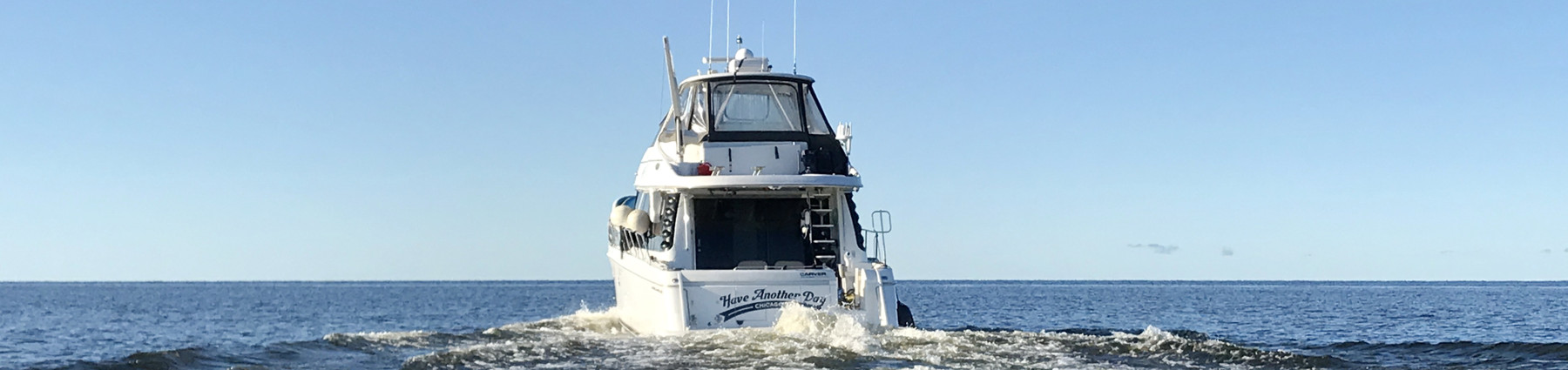
The horrid run of foul weather has finally broken here, and I’m happily on Cape Cod for a few days of “researching” a cruising story…so posting may be irregular this week. I did have a couple of very illuminating conversations about AIS listeners last Friday that I want to start sharing. It seems that the technology is moving even faster than we realized; two reliable sources predict that most every brand of plotter will read AIS target messages by next February’s Miami Boat Show! I also heard an interesting report on receiver quality. One of my sources says he tested a SeaLinks RadarPlus dual channel listener against a low cost Chinese-built model, and—given the same antenna and circumstances—the RadarPlus “saw” twice as many targets at almost twice the range. I look forward to my own testing, and yours, but right now I have to go boating.
One of the things I enjoy about the marine industry is how an inventive boater—there are lots, particularly sailors for some reason—can still get a product to market. You’re looking at the world premier of Navlight Indicators…Larry Schaffer sitting in a rented booth at Strictly Sail Miami, ready to explain his very clever navigation light accessories. He has since put up an informative Web site, so I’ll just note that he’s created little LED’s that will show you just how your running/anchor lights are switched, plus a current sensor system that will make them blink if a light fails. You can get a dedicated panel that showcases the idea, or parts so you can upgrade an existing panel. Good job, Larry!
Rugged waterproof build, 3 levels of LED light going all the way from “holy cow” bright to 28 hours on 3 AAAs dim, this Friday’s gadget is the best boat headlamp I’ve had my mitts on. Plus the accessory red gizmo adds backup or can protect your night vision. The $39 EOS and $10 Pilot are also good examples of the amazingly detailed product reviews some outdoor folks are putting on the Web, like here, here, and here. So I shall say no more. Have a great weekend.
Comar has a new SLR100 single frequency AIS listener for £299 suggested UK retail (the SLR200 is £575). Since they now make both single and dual frequency, I asked them about the differences. It turns out that their receiver, unlike Nasa’s, automatically switches channels every minute. “The main reason behind this was that just occasionally we have seen ships with faulty transponders that are only transmitting on one channel, so we wanted to ensure we at least caught those some of the time.” The downside of this approach is that infrequent data—like an anchored ship’s name, sent on one frequency every 6 minutes—might slip by the auto switching for a long time.
I’m also learning that the AIS system allows “competent authorities” to manage frequency use in busy coastal areas (apparently the transponders can be remotely controlled by such authorities). Comar confirmed that “Authorized authorities can command individual or all vessels to shift to another frequency. Both the SLR100 and 200 use synthesized frequency controlled radios so that they can also shift frequency. Although the high seas frequencies for AIS will always be the default, it may be that as more congestion occurs in busy areas channel switching will become more prevalent, Tokyo Bay for instance use 2 local frequencies.” Thank you, Comar, for the information. Seems like the frequency issues are a little more complicated than they first appeared, and I intend to keep on digging.
I wish I knew. ReggataNews.com has been posting some great photos of the yachts, but they almost never show electronics (generally the case for megayachts, unfortunately, as owners and charterers don’t often drive them). Above is a tight crop from a hi res image (more here, credit: Carlo Borlenghi/Rolex) of the 174’ (53m) Drumbeat. You can make out massively complex helm stations port and starboard (there’s redundancy!) and at least one large hooded ECDIS or radar unit. The guy in the middle may be “handling” 26,000 sq. ft. of sail with a little forest of joysticks. I must say that wearing PFD’s on this flying bridge seems a bit over the top. On the other hand, some of the boats that went too far north have been getting pounded. The skipper of Sojana reported dryly, "We're hammering along at 12 knots right on course, right down the great circle at 075 degrees true. Some of the electronics aren't working as well as they used to, but we are reasonably happy.”
Nobeltec just announced an InSight Sounder option for its VNS and Admiral charting+++ programs. The company can now supply the soft– and hardware for plotting, radar, AIS, and fishfinding, including a heading sensor and even a wireless display. Nobeltec has also established a relationship with SkyMate, the easy-to-use satellite messaging and monitoring system that I’ve followed with much interest. Their respective programs can now share a PC and sensors nicely, and maybe more (not much on either company’s sites yet). Finally, Nobeltec has slashed the price of its AIS listener (was it the first to offer AIS to yachts?), and is running some new rebate programs. And we can imagine that the lads in the lab are working on more ways to expand the total package.
Panbo—all AIS, all the time! I’m surprised to be writing so much on this subject, but there’s a lot going on, and you all seem so interested. Yesterday’s discovery was that ACR is giving away a PC simulation of its GlobalWatch Class A AIS set, an interesting all-in-one design that includes a qwerty keyboard. The software emulates all the machine’s functions, and thus is quite informative about the operational nuts and bolts of AIS, particularly its little discussed messaging and polling capabilities. There’s even a control panel that lets you manage the signals other vessels are sending. In this screen shot (bigger here), Dora has sent out a “Sinking!” alert and M/V Panbo responds (hey, it’s raining and ugly here). The software is in a zip file here, and seems quite safe and unobtrusive—I don’t think it writes even one line to your registry file.
The June issue of PMY includes my take on the Furuno/MaxSea alliance. I titled it “Keys to the Kingdom” because it’s truly a big deal for Furuno to give PC software access to its whole NavNet system. It really shows what Ethernet can do, besides string multifunction displays together, and I’m guessing it will “encourage” Garmin, Northstar, and Raymarine to develop or find PC programs to run with their Ethernet systems. Dedicated electronics and PC-based systems used to be parallel universes (with a few significant exceptions); now they’re coming together. Good!
I used to refer people to AISlive as a great way to learn what the technology is doing for marine safety, but unfortunately the revised public service has turned out to be rather limited. Yesterday I tried out a Xanatos Holding’s viewer and it accesses nearly as much data as AISlive used to (though it only covers the Vancouver, Canada, area). A bonus was spotting Le Grand Bleu, a remarkable 354’ megayacht that carries a 74'’ sloop as a tender! Xanatos is the developer of Titan AIS software, seems to be working on a Class B transponder, and has a good guide to AIS on its site. By the way, LGB’s AIS “static information” indicates that it’s a “Cargo” ship with a “77m” beam, which I imagine is a case of GIGO, the old database term for operator error, “garbage in, garbage out”.
Yike! Above is the OPC’s prediction for 8 pm tomorrow night, my time. Today, 20 of the mightiest sailing yachts on the planet will set off from New York in a Transatlantic Challenge meant to celebrate, and smash, the 12 day, 4 hour race record set by Charlie Barr 100 years ago (also well explained by Josh Adams here). Somewhere the famously hard-driving skipper may be chuckling. If I’d been invited to join the fascinating mix of swells, enthusiasts, and pros (some apparently obnoxious) making the crossing, I’d be feeling a bit like a squirrel in front of a truck. That low looks like a lot more weather than is normal this time of year. I’ll bet the onboard weather guys and routers like Commander’s are quite focused right now. It seems like communications and forecasting technology will play a big role in whether these boats get a sleigh ride or a pounding. I’ll be following the race with interest this week (and hoping to learn more about the electronics used).
Monday, 11 am update: the Grand Prix boats have headed way south and are now making 18 knots. Meanwhile the big low may stall right over Cape Cod, which is where I was supposed to go boating later this week. Drat!
Tuesday, 12 am update: the gale warnings here in Maine and on the Cape have been upgraded to storm warnings, NE gusts up to 50k tonight, but it’s still not clear how the racers will fare, though the ones who went way south are looking pretty smart right now.
Navagear found a solid state bilge pump switch that can discriminate between fuel/oil and water, so presumably you will not pump the bad stuff overboard. I’m just a wee bit skeptical about how well this works in the real world. What if there is just a little oil swirling around your bilge; might the switch shut down when you didn’t really want it to? A while back I tested SensaSwitch (above), another solid state “float” switch that I liked a lot. It does not claim to “discriminate” against hydrocarbons but one reader wrote in claiming that oil films made it stick on or off, which of course is what no-moving-part switches are supposed to avoid (my test didn’t include oil!). The company tried to investigate the claim but the guy said he’d thrown the switch away, and his email went dead, so this report is very much hearsay. Does anyone out there have either SensaSwitch or Water Smart Switch installed in their boat?
Yesterday I was tickled to learn that Nasa’s AIS Radar and Engine will be marketed in U.S. under the well known Si-Tex brand (thanks, Pascal). That means U.S. sales and support. It also turns out that the Engine will put up AIS targets on a variety of Si-Tex plotters, like the Color Max below (just a mocked up screen). This AIS listener business is moving fast!
U.S. Navy Submarine Captain Kevin Mooney takes full responsibility for crashing the San Francisco into a practically uncharted undersea mount in the Pacific last January. Yesterday the New York Times published a detailed story about the accident, particularly the drama of trying to treat and evacuate mortally injured Petty Officer Joey Ashley. Then CBS 60 Minutes did a “Who’s to blame” piece, which I happened to see. The interviewer drew out how Mooney was using a classified, best-available Navy chart and steering a route sent from headquarters, but still the Captain—who seemed like an very decent man—insisted that he should have been going slower, should have checked other charts (where there were just hints of the mountain). Most of all, he said, “I should have been more skeptical about the chart data.”
Those are words to remember, especially as there’s a growing disconnect between our super precise electronic navigation and the precision of the underlying chart data. It’s a phenomenon I wrote about here.
The super fine sailing newsletter Scuttlebutt is having a subscription drive, with benefits for all. If you aren't getting it, or know people who might enjoy it, for cripes sake do the clicks. The ‘Butt’ may be mostly about racing, with rarely an electronics reference, but it’s wonderfully written, covers many sailing subjects, and sometimes features stunning photos by the likes of Carlo Borlenghi (how does he do this, by the way…in a wet suit?).
Correspondant Dan is psyched about the growing possibilites of Mac navigation for his 40’ sailboat. The starting point is GPSNavX, which offers a hell of a lot for $50, was extravagantly reviewed by Chuck Husick here, and will soon—according to Dan—support free NOAA ENC vector charts. Possible hardware includes a “Mac Mini, a normal 12-15" monitor for below decks, a sunlight monitor (like certain Big Bay screens sold by Tom MacNeil Electronics) for the helm w/mouse and buttons to control the software on the mini, BSB charts form Maptech, and a Nasa AIS Engine.” He also mentions a Mac compatible USB GPS whose links seem dead, but there are other choices; I like the looks of the USGlobalSat MR-350 cabin top model that can be bought with GPSNavX. Dan closes his description with that favorite Mac brag, “And, best of all: no viruses...” Us PC people are a little jealous about that, and about the Mini, which almost seems designed for a boat.
Seems-to-be-a-trend department: another correspondant, a true Uber Geek, wrote last night describing the elaborate system he’s putting together for a custom 50’+ power cruiser. “The helm support computers will be Mac Minis and the planning software will be GPSNavX, an insane value at $50!!”
Eli, proprietor of the often stimulating EliBoat, knows Maine waters and yesterday wondered “if the new charting programs will ever find a way to plot 6 trillion lobster pots.” His number is only a slight exaggeration; the pot buoys and their warps really are a navigation problem. Eli jests but I do hear talk of AIS transponders replacing RACON buoys at harbor entrances and maybe someday the tiny RFID radios supposedly coming to everything in Walmart will warn a boater of a dead on buoy about to tangle his prop. But in the meantime a sharp blade can do what electronics can’t. I tried this Hook Knife from Sailors Solutions last summer and it is wickedly effective.
Yeeeeeha! The basic V-24 is a 26’, 360 Hp, 70 knot racer designed a few years ago by Ocke Mannerfelt, and said to be relatively ‘safe’ and easy to drive. Panbo reader Tom W. has a custom version sporting 650 Hp and capable of over 100k—nicely displayed at www.batboats.com. You can imagine that it gets noisy in there! He and his passenger currently use a full duplex “helmet intercom system made by PCI Race Radios that’s tied into my VHF radio with push to talk buttons in the dash for both driver and passenger.” He’d like to do away with the wires. Can anyone suggest a solution?
It was another damp weekend in Maine, but the leaves are popping and I finally got out on the water. The NMEA 2000 test rig performed fabulously. Check out the bigger image here to see how the Raymarine E120 and Simrad CX34 are both getting GPS, heading, speed through the water, etc. from the Maretron sensors. A PC charting program could have been easily sharing it too, had I dared bring a laptop along. At this moment I was drifting (speed 0, SOG 2.2; heading 85, COG 64) down the St. George River with…errrr…a rather high level of situational awareness. Both plotters were able to calculate current set and drift pretty accurately, and the Maretron display kept track of the little boat’s pitch, roll, and rate of turn. And I had even more redundancy than expected…it turns out that if I unplug the Maretron GPS, the E120 will switch over to the Simrad GPS that’s plugged into the CX34. The one glitch was the depth delivered by the Maretron transducer, much shallower than shown, but I’m sure there’s an explanation. Plus I had another sounder, not shown, and in fact the shoal area ahead is deeper than charted. And it’s a lovely river to gunkhole (click here for an experiment with Maptech’s chart server).
It’s hard to reconcile the somewhat goofy bridge scene above with the wicked looking warship below, but they represent the same yet unbuilt U.S. Navy design called a Littoral Combat Ship (LCS). Picture an aluminum and steel 127m (417’) trimaran capable of sustained “sprints” at 47 knots and tight manuevering—even in shoal water—with waterjets and steerable thrusters. While flying last week I met an enthusiastic General Dynamics engineer who gave me the Web address of this fascinating project. Of particular note to electronics geeks is the design’s “flexible information technology backbone that allows ‘plug and play’ integration.” Apparently the Navy has imposed “open architecture” requirements and GD’s solution “leverages industry standards and non-proprietary interfaces.” I guess that explains all the Dell monitors on the mockup bridge, and I wonder if they are using NMEA 2000? And wouldn’t the LCS design make a hell of a megayacht, though Larry Ellison—no relation—would have to settle for something shorter than his current ride. (More pictures here).
Yesterday Roger (a true DYI guy I’ve noted before) commented enthusiastically on Nasa Marine’s “AIS Radar.” It certainly does seem to provide a complete AIS listener for a very reasonable price, about $365, but I have some concerns. The main one is that Nasa “chose to simulate the plan position indicator (PPI) of a conventional radar display” (hence the name). In other words the target vessels are plotted relative to your own boat’s course and speed, not their true course and speed (though that’s shown in the data window). The goal is simplicity; a target on a collision course will generate a trail headed right at you. The problem is the plotting confusion possible when you change course or speed. Plus AIS Radar, like Nasa’s AIS Engine, only uses one frequency at a time—though that may not be an issue. And, finally, it does not support output to a PC. For more information, allGadgets has the manual posted here. Of course, my concerns may be unwarranted; I’d like to hear from users and/or try one myself.
Hey, I actually can build something more substantial than sentences! Below is a plywood creation (bigger here) that will let me test the borrowed Maretron products (everything shown) and other NMEA 2000 gear either in my shop or clamped to my test boat, Gizmo. Note that all six devices shown not only share data through the rugged “Micro” size 2000 cable, but get power from it. That yellow wire is the 12v tap, supplying up to 4 amps to each side of the trunk line, which in this case is very short. Compass, 2000–PC USB gateway, GPS, and display are all on the upper or left side of the trunk. Depth/speed/water temp transducer, network test meter, and tees for the two plotters (separately powered) are on the other side. If I’d used heavier “Mini” size cable, there could be 8 amps available on either side of the tap. Putting together this little network was way easier than chopping up the plywood but there are details, like the Terminating Resisters at the trunk ends, you have to know about. Maretron has put together a useful “NMEA 2000 network designer’s guide” (and cable catalog) which is in PDF form here (if you just view individual pages, the guide portion starts on 17).
Last year Doug Ritter (right) and his Equipped to Survive Foundation (ETS) did the boating (and outdoors) community a tremendous service by uncovering performance problems in the optional GPS portion of PLBs and EPIRBs made by McMurdo. McMurdo subsequently offered a free upgrade to existing units. ETS now plans to test the upgraded beacons, as well as the latest models from McMurdo and ACR. If you’re in the U.S. and have an unused, but upgraded, McMurdo beacon, ETS wants to swap it for a brand new one and will even send you pre-paid shipping material. The deal sounds pie simple, and you’ll be helping to confirm for all boaters that the upgrade truly did the job. For an idea of how amazingly thorough this testing program is, check out these ETS Web pages. Update 5/17: Apparently Doug now has enough upgraded beacons.
Yesterday I plugged both a Simrad CX34 and a Raymarine E120 into a little network of Maretron NMEA 2000 gear…and, hot damn, both multifunction units immediately recognized and started displaying the available heading, GPS, depth, etc. info. No setup, no multiplexer, no fussing with 0183 wires—it just worked. The Simrad also had its own GPS attached, recognized that multiple GPS sources were available, and let me choose, via a thorough set of interface menus, which one to use (see below, and bigger image here). Easy redundancy, not to mention easy data sharing across a multi manufacturer network…this is good stuff. I witnessed, and wrote about, these capabilities last winter, but actually having my hands on 2000 gear is still exciting. More to come.
Me matey Charlie Doane just returned from skippering a New England to Caribbean delivery that included its rightful share of electronics drama. One night, sailing to windward and heeled down hard, he heard the “instruments down!” call from the cockpit. His first reaction — after yelling back “cope!” — was to nose around the power supply system, a whiff of sizzling circuitry leading the way. Low and behold, down in a low locker was a 24v-12v step-down transformer immersed in a puddle of saltwater that had apparently been collecting from a slight deck/hull joint leak that was getting a prolonged dunking. Electronics breakdowns, and other problems, tend to make deliveries challenging, and it’s telling that this was a seasoned 48’ Swan, the Mercedes of production boats. She’s been in service eight years, but apparently the little leak and the low gizmo had never interacted before. Another interesting aspect to this tale is that Charlie's crew were clients of Offshore Passage Opportunities, delivering the boat to learn offshore seamanship by doing. Not only did they sail on to Bermuda without instruments, but there helped Charlie locate a functional stepper installed elsewhere on the boat and swap it out. There were more invaluable lessons, including some fuel management theater, and I'm hoping Charlie will write up the whole trip for Sail.
One problem with putting together a high power marine WiFi system is the need to use finger-thick low-loss LMR 400 coax—the shorter the better—between the high-gain antenna and the radio. The stuff is hard to run and particularly ungainly when plugged into the dinky connector on a laptop’s PCMCIA card. One solution is a WiFi “Ethernet bridge” which can be installed near the antenna and then connected to the boat’s computer or network router via a slim, no-loss Ethernet cable. GeoSat Solutions has gone the next step by designing a 12v, 250 mW bridge into a waterproof box and packaging it with a 10 dB omni-directional antenna. This is a serious ($1,395) big boat system.
It’s a little confusing but note that one of these bridges—there are inexpensive non-marine versions—can connect to a conventional WiFi router. Thus a boater can use a normal WiFi laptop on board, connecting to shore via two WiFi hops. Here’s an interesting example of such a system installed on a Greenpeace vessel.
Friday gizmo: Davis just announced WindScribe, a $129 ultrasonic wind speed sensor that apparently uses some of the technology seen in Airmar's WeatherStation. WindScribe also measures temperature and computes wind chill, and can be mounted using an included bracket. There’s nothing up on the Davis Web site yet but it will probably go in this section of wind indicators. One thing I don’t understand in the press release is the gadget’s ability to “monitor maximum headwind, maximum tailwind, 5-second average and running average.” How can you measure head and tail winds without knowing your own speed?
In addition to Kees’ report yesterday, Dan sent in a link describing another successful test of the Nasa AIS engine, this time in conjunction with GPSNavX charting software for Mac computers. (Thanks, Dan, and I’ll follow up on your other Mac navigation suggestions soon). PC Maritime's interesting Navmaster Superyacht AIS package (look in the Leisure section) includes the same Nasa engine, which passed the company’s own testing and is reportedly pleasing early users. Superyacht’s AIS display looks like the best I’ve seen to date. Click here for the full screen shot and notice how the vessel is drawn to correct scale and its predicted track, i.e. rate of turn, is shown along with its heading. The user gets to control what data gets shown with the AIS target, plus the sidebar neatly categorizes all possible AIS info. I still want to know if there's a downside to only receiving one AIS channel at a time (I've asked Nasa), but it sure is exciting to see AIS hardware, and software, rapidly becoming affordable for even medium size yachts.
Update: “The same data is sent alternately on both channels so listening on one channel only is not much of a limitation. (It means the unit would 'hear' data every 6 seconds rather than 3 seconds from a vessel travelling at speed.)” — Nasa Marine
I’d never heard of this Nasa AIS “Engine” before, but oddly got two e-mails yesterday that referenced it. It seems almost too good to be true: a simple AIS listener that can feed ship information to a PC’s serial port for a mere $200 (plus cost of VHF antenna). It’s sold by a U.K. firm here, but does not seem to be listed at its manufacturer’s site here. One spec I see that might be a deal breaker is that a user must “Select 161.975 or 162.025 MHZ operation”. I thought AIS devices automatically use both. Please, someone, educate me on these mysteries!
Update: Be sure to read the comment from reader Kees who owns one of these listeners, reports good performance, and terms it an “outstanding no unbelievable value...” Thanks, Kees!
When Navionics Platinum chart cards come out this summer, 3D photo mapping will come to boat plotters. Platinum (still not much on the Web yet) is really going to turn some heads, as it did during the Miami Boat Show. If you want to see what the eventual possibilities are, take a look at NASA’s free program World Wind. It’s not quite as user friendly as Keyhole, but has higher resolution photography for much of the U.S. The screen shot above (bigger here) shows a Hilton in Clearwater Beach, Florida, where I’m attending a magazine meeting this week. In World Wind I was able to check out the beach and marinas, etc. before I got here. You’ll understand why posting may be irregular this week!
OK, I’m obsessed with charts, but I’m not the only navigator thus afflicted. Last week I used a snippet of a wonderful 1685 chart that’s available on the Net, and promised to tell more. The source is the U.S. Library of Congress Map Collection. The LOC has scanned scads of cartography at very high resolution for your viewing and downloading pleasure. You’ll see several categories, none of them “nautical charts” per se, but you’ll find all sorts once you dive into the search engine. Shown here, and larger here, is a bit of a 1921 chart of Miami. It’s interesting as an early example of color use, and also because it shows a Miami Harbor that’s damn shallow and missing some major features like Fisher Island and the whole cruise ship dock area.
You can zoom into the detail of these charts nicely on the LOC site, especially if you have a fast Web connection, but there’s a problem if you want to download one for further perusal or printing. Many are in an unusual format called MrSID that no standard graphic program I know of can read. The solution is IrfanView, an excellent freeware (or “beggar ware”) program created by a young Bosnian named Irfan Skiljan. IrganView can turn this 6.6 meg .sid file of Miami into a 90 meg .jpg file that would print nicely full size. The LOC offers some maps and charts for areas outside the U.S., but if there are richer sources I'd sure like to hear about them.